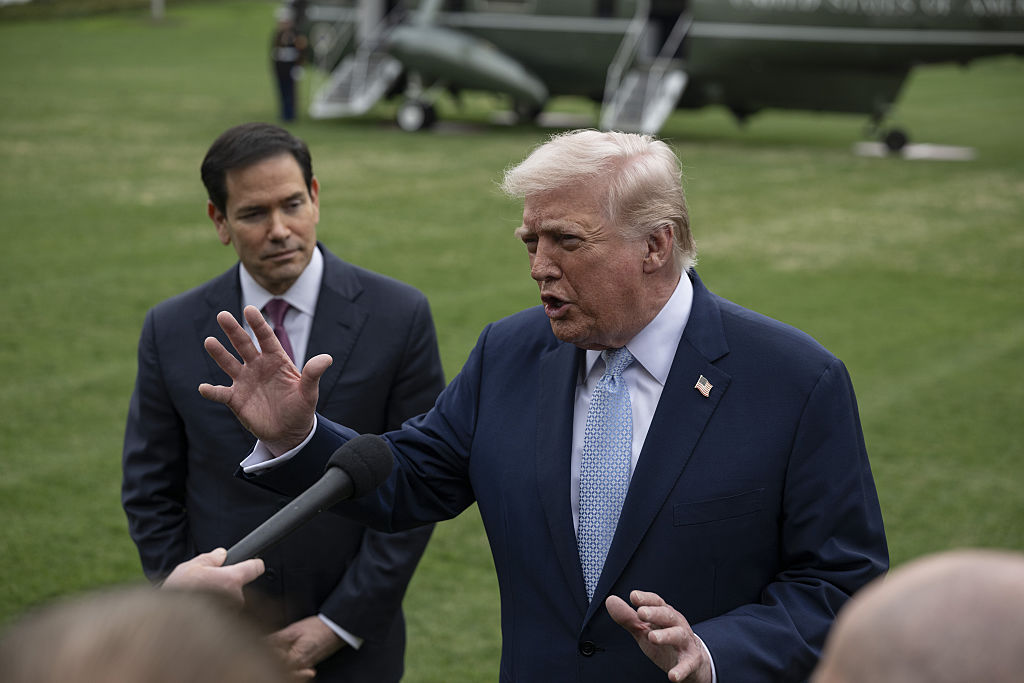
As Trump contemplates a ground operation in Iran, he will be reckoning with the ghosts of previous western “excursions” in the region, as he recently labeled this war.
History suggests three endgames for his intervention in Iran are plausible. First, a hasty deal on terms that aggrandize and empower Iran, creating an American equivalent to Britain’s Suez Crisis. Second, a protracted struggle which becomes structurally reminiscent of the Iraq War. Third, a dramatic escalation which achieves Iranian surrender quickly and cleanly. The bad news for Trump is that the outcome he seeks, number three, is the one without real precedent.
In the first scenario, Trump makes a deal on terms that flatter Iran. Rather than compel Tehran to restrict its nuclear, proxy and missile programs – his initial war aims – the President would be forced to acknowledge Iranian authority in the Persian Gulf. This would either be explicit, via a new legal regime for the waterway, or implicit, via failure to break the blockade. But the upshot would be clear: in the Gulf, Tehran rules the waves.
Escalation without a coherent theory of victory risks another quagmire
For all the operational successes of the joint US-Israeli aerial campaign, this would be tantamount to strategic defeat. America’s brand of “security diplomacy” – the regional influence lent by acting as defender of last resort for Washington’s partners – would be badly discredited. Iran, meanwhile, would emerge with proof of concept of its capacity to bully both its neighborhood and the world by simply threatening to close the Strait of Hormuz.
In other words, this would be America’s “Suez moment.” Like Britain in 1956, a superpower will have lost out to a weaker adversary in the battle to control a strategic waterway. Like Anthony Eden, who was threatened with economic oblivion by Dwight Eisenhower unless he withdrew, Trump’s military gains would be vitiated by a harsh market response. Suez improved Gamal Abdel Nasser’s domestic position and enabled him to project greater influence across the region by forming the anti-western United Arab Republic and inspiring a military coup in Iraq and political crisis in Lebanon, both instigated by Nasserist forces. Today, an emboldened Iran will possess considerable leverage over its Gulf neighbors. This would confer the ability to exact levies in the Strait permanently, rebuild its proxy network and isolate Israel.

The second scenario sees the US escalate against a regime that refuses to fold. The sequence of events might look something like this. US Marines seize Iranian islands in the Persian Gulf involved in exporting oil and policing tankers. Simultaneously, US Special Forces deploy along Iran’s southern coast in a mission to degrade the Islamic Revolutionary Guard Corps’s (IRGC) mine depots, anti-ship cruise missiles and speedboat fleets.
Faced with the prospect of the US busting open the Strait while holding Iranian oil exports hostage – thus flipping the current strategic equation on its head – the Iranian regime could choose to double down rather than sue for peace. Iran could deploy elite IRGC forces – perhaps the Saberin Unit and Nohed airborne Brigade – to impose maximum political costs on Trump by killing American troops. American forces must fend off the assault, possibly supported by reinforcements, until either the regime’s will or economy breaks. Either could take months.
This “quagmire” would be Trump’s Iraq. While plainly incomparable in terms of the duration or scale or military deployment, the similarity is structural: unyielding strategic aims exert a ratchet effect on political and military commitment, resulting in an irreversible escalation ladder until one side cracks.
The opening gambits of both the George W. Bush and Trump administrations possess a similar logic. Both believed that overwhelming initial force would blow the adversary away. Thus, on February 28, the US and Israel launched massive strikes on Iran’s leadership, command-and-control centers and offensive capabilities (drone and ballistic missile launchers facilities). Between March 20 and May 1, 2003, the US-led coalition attempted to assassinate Saddam Hussein at Dora Farms, seized Iraqi oil fields, bombed the Ministry of Defense and Republican Guard headquarters and demolished key military production sites.
When unexpected consequences arise – Iran’s ferocious horizontal escalation, the scale and tenacity of the Iraqi insurgency in 2003 – maximalist yet ill-defined strategic objectives assume an inertia of their own. As the White House supposedly considers a “final blow” against Iran, likely a military ground component with accompanying surge of air power, it is impossible to ignore the traces of the “big push” advocated by Bush’s national security advisor, Stephen J. Hadley, that later materialized as “the surge.”
The final scenario is the one the President is surely hoping for. Here, a successful US operation against Iran’s naval capabilities, combined with the seizure of Kharg Island, which accounts for 90 percent of Iranian outflows, forces the regime to capitulate before it implodes.
There are grounds to think it might. The Iranian economy cannot limp on without crude oil exports. Although oil revenue only constitutes 30 to 40 percent of the state budget, the yuan earned from these sales prop up the rial given the sanctions on Iran’s foreign reserves. Without this hard currency, inflation would swiftly become hyperinflation. Goods that Iran cannot import via barter trade with surrounding states would fast become unaffordable. The most credible estimates suggest that, under such a siege, the economy could hold out for two months.
More importantly, the salaries and pensions that sustain the undying loyalty of the military rank and file will become worthless. The favorable exchange rates enjoyed by regime acolytes would disappear. No longer able to enjoy superior living standards to their fellow citizens, one might expect the security forces to be less willing to mow down unarmed protesters again.
One might doubt the existence of a political system that would reject a negotiated settlement in favor of such pain, or to be precise, deflecting such pain on to its people. But the Islamic Republic is capable. It has chosen to be bombed not once, but twice, in nine months rather than relinquish uranium enrichment.
The regime did capitulate to survive on one occasion – the anomaly that proves the rule. In July 1988, Supreme Leader Ruhollah Khomeini accepted a ceasefire after an eight-year war with Iraq he had couched as existential. Yet the immediate conditions that led to this decision are not apparent today. After eight years of exhausting war, Saddam Hussein’s army escalated dramatically between April and July that year as it conducted five lightning offensives. Simultaneously, Iraq signaled an appetite to widen the war further through its sponsorship of an incursion into Iran by the Mojahedin-e Khalq.
Also in the spring of 1988, the US destroyed Iran’s naval capacity to disrupt the Strait in Operation Praying Mantis. At that time, key figures in the regime such as Akbar Hashemi Rafsanjani began to argue that peace alone could ensure regime survival. Even the fanatical commander of the IRGC, Mohsen Rezai – currently the supreme leader’s military adviser – confessed to Khomeini that summer that victory was likely unattainable.
The regime is neither so beleaguered nor receptive to compromise today. A hardline faction spanning the IRGC, clergy, and shadowy security elite has coopted the instruments of power, many of whom hail from the same few provinces and fought together during the Iran-Iraq war. Each views this war as a golden opportunity to re-establish much needed deterrence after a string of losses since 2023. One can safely wager that nobody of any stature is playing today’s Rafsanjani.
History, then, is against Trump. This is not to say that failure is inevitable, but that the mistakes of the past must be avoided. Blinking now turns Trump into Eden and Iran into Nasser on steroids. Escalation without a coherent theory of victory risks another quagmire. The challenge is that Tehran will only contemplate backing down if America projects unwavering resolve. Put differently, the President’s only path to victory is through escalation, even if the stakes are immense.




Comments