Iran

Paul Wood, Katy Balls, Olivia Potts, Benedict Allen, Cosmo Landesman and Aidan Hartley

From our UK edition

40 min listen

On this week’s Spectator Out Loud: Would Trump really bomb Iran, asks Paul Wood (1:38); Katy Balls interviews Health Secretary Wes Streeting on NHS reform, Blairism and Game of Thrones (8:38); Olivia Potts examines the history – and decline – of the Easter staple, roast lamb (18:25); the explorer Benedict Allen says Erling Kagge and Neil Shubin were both dicing with death, as he reviews both their books on exploration to earth’s poles (22:13); Cosmo Landesman reflects on what turning 70 has meant for his sex life (28:46); and, Aidan Hartley takes us on an anthropomorphic journey across Africa (33:55).  Produced and presented by Patrick Gibbons.

What’s going on in the Pentagon?

In the past two days, three senior Defense Department officials have been suspended and one has resigned. Their departures are apparently connected to an internal investigation into "recent unauthorized disclosures of national security information." On Tuesday, Dan Caldwell, who has been working closely with Defense Secretary Pete Hegseth, and Darin Selnick, the Defense Department’s deputy chief of staff, were escorted from their office by guards. Then, yesterday, Colin Carroll, chief of staff to Deputy Defense Secretary Stephen Feinberg, was ousted, too. John Ullyot, a top Pentagon spokesman, also announced he was resigning.All four men are military veterans.

pentagon

Would Trump really bomb Iran?

From our UK edition

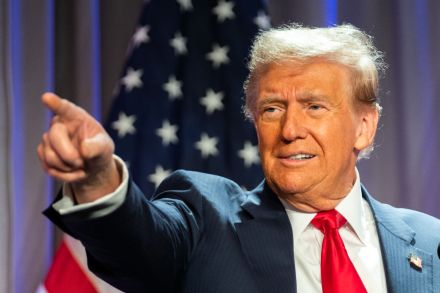
A satellite picture shows six American B-2 Stealth bombers parked on the runway at Diego Garcia. The planes – each with a distinctive flying-wing shape, like a bat – are sinister, otherworldly, and seem like a portent. Surely that’s the idea. Donald Trump has warned the Iranian leadership there ‘will be bombing the likes of which they have never seen before’ if they don’t agree to limit their nuclear programme. The US is also sending a second aircraft carrier to the Middle East and anti-ballistic missile batteries to Israel. This is Trump’s ‘coercive diplomacy’, and so far, it’s working.

Ukraine is just one part of Trump’s Great Game

From our UK edition

Washington D.C. For Donald Trump and Vladimir Putin, it’s a case of today Ukraine, tomorrow the world. In their much-hyped telephone call this week, the Russian leader didn’t appear to give much away: a step towards a sort-of ceasefire, a prisoner swap and a few other bits and bobs. But Putin knows that Trump wants a lot more than just an agreement on the Donbas. Settling the most significant conflict in Europe since the second world war is merely a prelude to a much bigger deal in the Holy Land, a truly historic arrangement that could satisfy the Donald’s desire to be thought of as a peace legend. That’s why Trump sent Steve Witkoff, his special envoy to the Middle East, to Moscow to pre-negotiate with Putin last week.

Donald Trump, Putin and the Concert of Arabia

For Donald Trump and Vladimir Putin, it’s a case of “Today Ukraine, tomorrow the world.” In their much-hyped phone call this week, the Russian leader didn’t seem to give much away: a step toward a sort-of ceasefire, a prisoner swap, and a few other odds and ends. But Putin knows that Trump wants much more than just an agreement on the Donbas. Settling the most significant conflict in Europe since World War Two is merely a prelude to a much bigger deal in the Holy Land — a truly historic arrangement that could fulfill Trump’s desire to be seen as a legendary peacemaker. That’s why Trump sent Steve Witkoff, his special envoy to the Middle East, to Moscow last week to pre-negotiate with Putin.

putin

Trump has elevated the Houthis as an opponent

So much for President Donald J. Trump’s serial vows to extricate America from the Middle East’s seemingly endless wars and feuds. His bombing on Saturday of numerous targets in Yemen has further enmeshed it in them. Several weeks of bombing loom as Trump vows to crush the Iranian-backed Houthi militia and warns Tehran that it might be in for similar treatment.  His statement was unequivocal: “To Iran: Support for the Houthi terrorists must end IMMEDIATELY! Do NOT threaten the American People, their President, who has received one of the largest mandates in Presidential History, or Worldwide shipping lanes. If you do, BEWARE, because America will hold you fully accountable.”  Whether the Iranian mullahs will be impressed by Trump’s fulgurations is an open question.

houthis

Extraordinary: The Seed of the Sacred Fig reviewed

From our UK edition

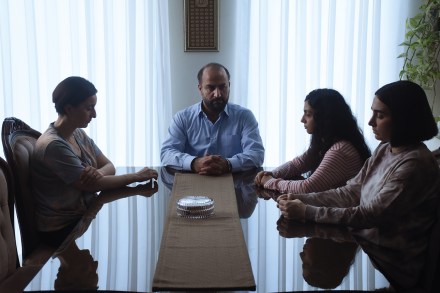
The Seed of the Sacred Fig is by the Iranian filmmaker Mohammad Rasoulof and all you need to know is that it is extraordinary. What you don’t need to know, but may like to know, is that Rasoulof, who has already been imprisoned multiple times by the authorities, filmed it clandestinely while directing remotely from an undisclosed location and then had to flee Iran on foot. The journey was extremely complicated and dangerous and took 28 days. You could never accuse Rasoulof of taking filmmaking lightly. But that’s not the bottom line. The bottom line is: it’s enthralling cinema. The film follows a family in Tehran. Iman (Misagh Zare) is the patriarch who has just been appointed an investigating judge in Iran’s revolutionary court.

Will the Syrian Civil War create another ISIS?

From our UK edition

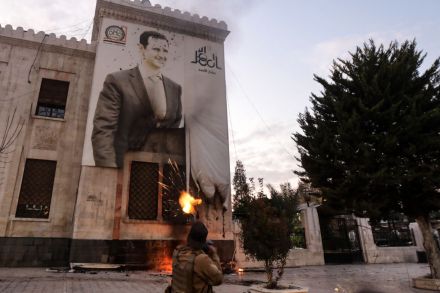
There are unintended consequences, and then there are unintended consequences. What we are seeing in Syria, as Aleppo and Hama fall (and Homs braces itself) to a coalition of anti-regime forces whose DNA is to be found in al-Qaeda et al, is an unintended consequence of Israel’s bombardment in Syria of Iran-funded pro-Assad groups, and the pulverising of Hezbollah in Lebanon. An unintended consequence of the weakening of Iran and its Axis of Resistance. For the three pillars on which Bashar al-Assad props up (for the time being) his murderous kleptocratic narco-state – Iran, Hezbollah and Russia – are, respectively, on their ‘best’ behaviour in the hope of talks with the US, broken, or extremely distracted.

Trump is already the diplomat-in-chief

The United States only has one president at a time. Until January 20, that’s Joe Biden. But President-elect Donald Trump and his skeleton foreign policy team are waiting in the wings, plotting policy behind the scenes on issues — Ukraine, Gaza, Iran, Middle East peace — that have stymied the Biden administration for the last year. In fact, Trump is already influencing the respective calculations of allies, partners and adversaries before he even steps foot in the Oval Office. And Biden’s advisors seem perfectly fine with it. Trump fancies himself as a master negotiator, somebody who’s inherently skilled at poking, pressuring and sweet-talking the opposite side of the table until he gets what he wants.

diplomat

A pause between wars

From our UK edition

‘What is to stop it happening again?’ was the pertinent question put to me by a Lebanese friend this week as we discussed over a mezze the announcement of a ceasefire between Israel and Hezbollah. Given what we know of the terms agreed between the combatants, the answer seems to be, ‘Not a lot.’ Generally, I am not one to pour cold water or see the glass half empty. But beyond welcoming a cessation in the brutal meeting out of death by bombardment on the civilians in both Lebanon and northern Israel, it is hard to see the ceasefire agreement as sustainable in the long term.

The Exchange will delight anyone seeking an impossible story made possible

“I have been instructed to tell you that what you are proposing is entirely impossible. Nevertheless, in Iran, even the totally impossible becomes possible at times.” Such was the mysterious riddle that confronted the English art dealer Oliver Hoare as he sat across from an Iranian contact in Paris in 1992. He had just presented a madcap plan: to reunite the state of Iran with one of its most prized but long-lost manuscripts.   The Shahnameh of Shah Tahmasp is an illustrated epic poem comprising 50,000 rhyming couplets. Completed in the mid-sixteenth century, this “book of Kings” is one of the most exquisite examples of Islamic art and poetry ever to have been produced.

Trump’s very catholic cabinet

Donald Trump’s second term administration is taking shape, and thus far it’s turned out to be impressively Catholic in its approach — representing Trump’s dominance of the Republican coalition and his capacity to ignore the worst instincts of some of his more vocal supporters on the New Right who see governance through a naive lens. One of the questions heading into this term was who Trump would disappoint by being insufficiently one thing or the other — by being too radical in some areas or too modest in others. But at this point, there are very few people disappointed in the names he’s chosen, outside of a handful of very online voices who had fantasies of their favorite pundits and follows on X getting a shot at cabinet positions.

cabinet

What comes after Trump’s decisive victory?

The candidate who said Americans should be “unburdened by what has been” is now a has-been. The irony will be lost on her.  Also lost was the traditional graciousness — and normative necessity — of conceding defeat clearly and publicly as soon as the loss is certain. When Donald Trump failed to take that step in 2020, after exhausting his court challenges, he violated that norm and deepened our national divisions. He deepened that chasm on January 6 and later by continuing to challenge the rightful winner. Those challenges threaten the peaceful transfer of power and undermine the public consensus that the winner holds office legitimately.  Kamala Harris learned from Trump’s mistake and repeated it.

donald trump victory

Iran is playing a dangerous game

From our UK edition

A drone exploded in a sleepy Israeli seaside town yesterday. The target of the attack was Benjamin Netanyahu. By luck, the drone missed its target – Netanyahu’s home – and no one was hurt in the explosion. Hezbollah launched three drones from Lebanon toward Caesarea. Two were shot down by the Israel Defense Forces but, worryingly, the third arrived undetected. Sirens, which are supposed to warn civilians of an impending attack, did not sound, meaning no one knew they should seek refuge in a bomb shelter. The Israeli Prime Minister claimed he was not at home when the drone hit. An Iranian – or Iranian-backed – assassination of the Israeli Prime Minister (or other senior figure) would change the game completely.

The Iranian diplomat trying to stop Armageddon

From our UK edition

‘The embassy is being invaded. The ambassador has had to lock himself in his office upstairs, and there are people on our balcony. Your government is responsible for the safety of our diplomats and embassy. We will hold you accountable...’ The voice at the other end of the line was calm, though there was no mistaking the underlying aggression. ‘The Vienna Convention is very clear about the responsibility of host countries for diplomatic missions.’ I received that call in the autumn of 2017, when I was coming to the end of my second year as Britain’s ambassador to Iran.

What follows Sinwar’s death in Israel’s war in Gaza and beyond 

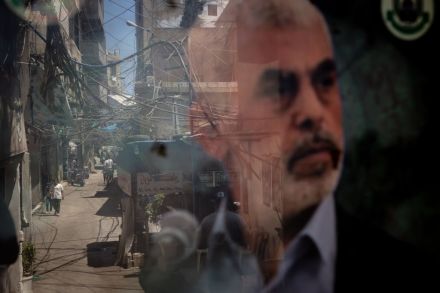
Yahya Sinwar, the Hamas leader and strategist responsible for the largest massacre of Jews since the Holocaust, is dead, killed by the Israeli Defense Forces in a tunnel beneath his hometown of Rafah in Gaza.   Although the Biden administration (rightfully) congratulated Israel, both President Biden and Vice President Harris had previously demanded Israel not stage a major military operation in Rafah, where Sinwar and other Hamas leaders were killed. That advice matched the administration’s strategic wisdom throughout the conflict.   With Sinwar gone, the key questions now are: what is the endgame in Gaza? And how does Israel’s success in Gaza affect the current battle against Hezbollah in Lebanon and the future battle against the Islamic Republic of Iran?

yahya sinwar

Kamala creaks in hard-hitting Fox News interview

Vice President Kamala Harris sat down with Fox News’s Bret Baier for a half-hour interview in which Baier politely took no prisoners, pressing Harris on the issues most voters cite as their top concerns. Harris took almost zero accountability for the Biden-Harris administration’s failures and offered few answers on her specific policy positions, pivoting instead to besmirching rival Donald Trump and provide offerings from her platitude grab-bag. Baier hit the ground running by asking Harris how many illegal immigrants she thought her administration has released to date — “One, 2 million?

bret baier fox news

Where conflict in the Middle East goes from here

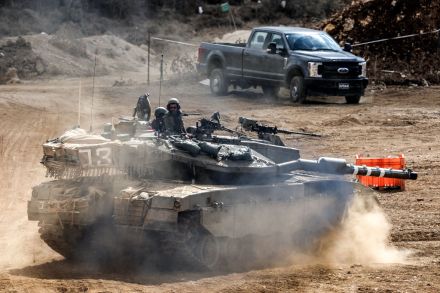
Anything written on the Middle East at this moment in history is almost instantly out of date. As Lenin said: “There are decades where nothing happens; and there are weeks where decades happen.” The Arab-Israeli war in 1967, the Iranian revolution in 1979, the invasion of Iraq in 2003...the region may once again be at one of those forks in the road that dictate the fate of nations for years to come. Journalists’ predictions age like milk out of the fridge. Nevertheless, here are some: Israel attacks Iran. This isn’t a hard one. The question is what form that attack will take. The prime minister, Benjamin Netanyahu, has wanted to bomb Iran’s nuclear facilities before, only to be stopped by the US.

Israel’s revenge, farewell Fraser & the demise of invitations

From our UK edition

37 min listen

This week: Israel’s revenge and Iran’s humiliation. As the anniversary of the October 7th attacks by Hamas approaches, the crisis in the Middle East has only widened. Israel has sent troops into southern Lebanon and there have been attempted missile strikes from the Houthi rebels in Yemen and from Iran. Is there any way the situation can de-escalate? And how could Israel respond to Iran? Former BBC foreign correspondent Paul Wood and defence and security research Dr Limor Simhony join the podcast (1:03). Next: it’s the end of an era for The Spectator. This issue is Fraser Nelson’s last as he hands over the reins to Michael Gove. Having spent 15 years as editor, with 784  issues to his name, what are his reflections on his time here at 22 Old Queen Street?

Biden-Harris should help destroy Iran’s nuclear and missile infrastructure

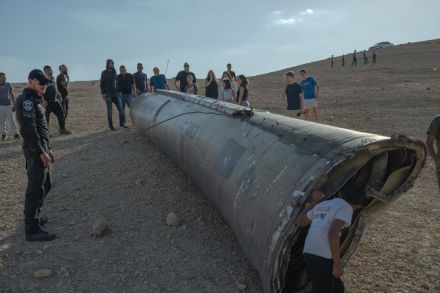
Iran on Tuesday launched 180 ballistic missiles against Israel, a democracy the size of New Jersey. It was the largest escalation to date in a year-long, seven-front war waged by the world’s leading state sponsor of terrorism against Israel, the United States, and global maritime shipping. President Joe Biden and Vice President Kamala Harris must come to terms with the fact that this attack resulted from their own foreign policy — subsidized by billions of dollars in US sanctions relief, legitimized by strategic accommodations to Tehran, encouraged by pressure on Israel and invited by the non-stop signaling of American fear of escalation.