Housing

I’ll dare to say what Andy Haldane doesn’t 

From our UK edition

A sandwich with Andy Haldane, the former Bank of England economist, now president of British Chambers of Commerce, is the intellectual equivalent of a lunchtime workout with an ultra-fit personal trainer – or so I imagine, having never submitted to the latter experience. When his BCC role was announced in February, Haldane spoke of ‘a fighting chance’ that UK growth would beat expectations for the coming year. But that was before the closure of the Strait and the resurgence of global demons. The purpose of the sandwich was to find out if he had tempered his upbeat tone. The Iran conflict is ‘the last thing anyone needed, least of all the UK’, he began.

Letters: what vegetarians get wrong

From our UK edition

Flat broke Sir: John Power’s article on the property squeeze (‘Flatlined’, 18 April) identifies a symptom of a deeper problem, the overregulation of property. Buyers are deterred by spiralling service charges, which are themselves driven by layers of legislation, insurance premium hikes and rocketing labour costs. Those still willing to take the plunge are then hit by a tax system that actively discourages transactions. In the absence of buy-to-let demand, it is no surprise values are dropping. The solution is obvious. Stamp duty, with its crude cliff edges, freezes activity and distorts prices. A landlord or renovator can face £20,000 or more in tax on an entirely ordinary flat, a deterrent by design. This is not a plea for higher prices.

Flat out: the property squeeze crushing the young

From our UK edition

Last month, a new account called London Price Drop appeared on X. It has already gained more than 14,000 followers simply by posting screenshots from Rightmove, which illustrate how properties in the capital are falling sharply in value. One of these is a leasehold flat in Shepherd’s Bush purchased for £425,000 in 2017, before being re-listed for £395,000 in May 2024, and eventually sold for £325,000 last August. Adjusted for inflation, that represents a real terms loss of close to £250,000. The London Price Drop account is so popular because it contradicts an assumption that many in Britain hold dear. Young or old, owner or renter, almost all of us believe that buying property is the route to wealth, and that house prices, in the long run, always go up.

Why does Trump love Zohran so much?

Mayor Zohran Mamdani met Trump in the Oval Office yesterday to pitch a huge New York City housing initiative – and secure the release of a Columbia University student from ICE custody. Mamdani’s communications director said that Trump was “very enthusiastic” about the plan to build 12,000 new affordable homes in Sunnyside, Queens, by using over $21 billion in federal grants. What’s more, the student, who happens to be a photogenic young woman, was freed. Results all around. Zohran and his team gave Trump a prop newspaper with the headline “TRUMP TO CITY: LET’S BUILD,” a play on the 1975 New York Daily News cover – “FORD TO CITY: DROP DEAD.” The headlines made a clear case for how much the people would love Trump if he went ahead with Mamdani’s plans.

zohran trump

Is the Florida boom over?

During the pandemic, Florida became a haven for those looking to escape lockdowns. Miami was a “Zoom town,” a place where rich mobile professionals moved to enjoy the beaches and freedom, while continuing their remote jobs. Some $36 billion in extra income tax registered with the IRS in 2022. That great influx of people has now come to an abrupt end.  ‘Florida is paradise, but you live in paradise to enjoy it, not to bust your ass’ New US Census Bureau figures show that net migration to the Sunshine State has fallen 92 percent since 2022, its lowest level for more than 15 years. The number of people moving to Florida has collapsed, while existing Floridians are picking up stakes and going elsewhere.

florida

Don’t listen to those who tell you America is over

From our UK edition

What has gone wrong for Americans? To listen to an increasing number of politicians and pundits on both sides, from Tucker Carlson to Alexandria Ocasio-Cortez, from Nick Fuentes to Zohran Mamdani, the answer seems to be: everything. Americans are unable to get a job; to afford the necessities of life; to get married or have children; to find religious meaning or form friendships. And all of this can be laid at the feet of corrupt institutions and a corrupt system. This conspiracy-tinged vitriolic take on the American system is a lie. Yet it contains a grain of truth. Our institutions have been led self-servingly by a coterie who disdain American values.

The ‘affordability’ delusion

During last week’s excruciating Oval Office make-nice between an insultingly buddy-buddy American President and a fraudulently obsequious New York City mayor-elect, the contest was over which pol was the more patronizing. At one point Trump graciously granted his petitioner permission to call him a "fascist" while clearly implying the guy’s OTT campaign rhetoric had been embarrassing. Donald Trump sat regally on his throne, patting Zohran Mamdani’s arm while commending "Attaboy!" as if petting a golden retriever that had fetched a ball. For his part, Mamdani stood mutely by the Resolute desk with cartoonish humility, hands over crotch. This cowed performance of beta-male submission was meant to disguise who’d got a leg over whom.

Affordability

Why Britain needs more Yimbys

From our UK edition

21 min listen

Chris Curtis and Maxwell Marlow may have different political ideologies, but they agree on one key diagnosis: Britain is broken. Their solution can be found on baseball caps and bucket hats across social media and SW1: ‘Build Baby Build’. Less than a week before the Budget, Chris – MP for Milton Keynes and chair of the Labour Growth Group – and Maxwell – policy fellow of the Yimby Initiative, alongside his day job at the Adam Smith Institute – join our economics editor Michael Simmons to talk about the pro-growth measures they champion to radically change Britain. Produced by Patrick Gibbons.

Labour’s war on heritage

From our UK edition

Britain’s heritage is slowly going up in smoke. Medlock Mill was Manchester’s oldest standing textile mill until it burnt down in June. It joins Grade I-listed Woolton Hall – destroyed by a catastrophic fire in August. But it’s not just the buildings that are under threat, but the entire system designed to protect them. Prior to the disaster, the architect Stephen Hodder had proposed gutting the mill and converting it into a 37-storey block of student flats. A coalition of concerned citizens and conservation charities fought for a stay of execution by applying for the mill to be listed. After reviewing new archaeological evidence, Historic England concurred and recommended it for Grade II.

Where can I get some meth?

I was born in Santa Monica, California. So were four of my children. When I was little, Santa Monica was still a sleepy backwater with mom-and-pop stores, a quiet local beach that was never crowded and virtually zero crime. A place where murder or mayhem or even robbery were unthinkable. Then, sometime in the 1990s, Santa Monica was discovered by the rest of the city as a “really nice place to live” and was targeted for destruction. In Los Angeles you are not allowed to have nice things. Every Christmas, Ocean Avenue along the coast was lined with 13 historic, life-size scenes depicting the complete life of Jesus. These famous and beloved displays started in 1953, but in 2015 the city banned them after atheist groups complained.

meth

Newsom won’t create abundance

With great fanfare, California Governor Gavin Newsom recently signed “historic” legislative package designed to “advance an abundance agenda.” It’s a nod to the recent (and fashionable) book Abundance by the liberal bloggers Ezra Klein and Derek Thompson, and it’s supposed to reform a state best known for a punitive cost of living and chronic shortages of everything essential – including housing, water, and energy.  Key to Newsom’s new legislation are Assembly Bill 130 and Senate Bill 131, both of which make fundamental changes to how the California Environmental Quality Act (CEQA) is enforced.

Newsom abundance

The problem with scrapping leasehold

From our UK edition

Like most non-renting flat-dwellers, I call myself a home-owner or owner-occupier, but that isn’t quite true. I don’t own my flat; I am a leaseholder. What I bought was the right to occupy it for however many years are left on the lease – and as the lease runs down, the flat is worth less and less. Conversely, this is why, if you were so minded, you could find a prime London flat for a (relative) pittance if the lease has only a few years to run, and why long leases generally come with a premium.

Should you leave the country? Other questions for 2025

From our UK edition

I was intending to write one of those ‘Ten tips to change your life’ lists that fill so many column inches at this drab time of year. But I got no further than ‘Buy bigger trousers’. Instead, I’ll tackle some of the obvious questions you might be asking as you watch snow turn to slush and wait for the boiler repair bloke to answer his phone. Can I cheer you up? Let’s see. First, will 2025 be a good year to buy a new home (a decision that should always be taken on at least a five-year time horizon)? Pundits see house prices going up (and mortgage rates eventually coming down) in 2025, but not by much. More usefully, Savills predicts 23.

The West faces a new type of housing crisis

Throughout the West, particularly the Anglosphere, housing costs are ravaging the middle class. Homeownership, long the key to social mobility, is on the decline, particularly among younger generations and minorities. According to the Organization for Economic Cooperation and Development, house prices in high-income countries have been rising “three times faster than household median income over the last two decades,” causing the standard of living “to stagnate or decline.” Unlike previous housing crises, this one is not primarily caused by mass displacements due to wars or natural disasters or population growth.

housing

How can Ireland survive the seismic changes of the past three decades?

From our UK edition

Historians in Ireland occupy a public role – unlike in Britain, where those with an inclination towards the commentariat usually migrate to America. This is perhaps not surprising in a country where public intellectuals are exemplified by Stephen Fry and philosophers by Alain de Botton. Ireland presents a more demanding prospect, where, ever since the days of Conor Cruise O’Brien, historians have colonised the public sphere with influential newspaper columns and regular debates on television. Indeed, when the national TV station began broadcasting in the early 1960s, it featured a discussion programme called The Professors, all of them historians (and one or two usually a bit the worse for wear).

How hot is too hot to work?

From our UK edition

Gold standard The Paralympics were instigated in 1948 and first held alongside the Olympics in Rome in 1960. But disabled athletes were competing in the Olympics long before that – notably George Eyser, a German who settled in St Louis, USA. That he had lost a leg after being run over by a train and wore a wooden prosthetic did not stop him taking up athletics and gymnastics. When the Olympics came to his city in 1904 he won three golds: in the parallel bars, long horse vault and 25ft rope climb. He won three other medals, on the pommel horse, horizontal bars and in a team event. He also competed in the triathlon, which in those days consisted of a 100m run, the long jump and shot put – but came last. Ship shape How dangerous is it at sea?

How do Britons get their news?

From our UK edition

SS-GB The car company Jaguar said it won’t make any new cars for a year as it re-invents itself as an electric-only car company. For a long time the automatic choice of stockbrokers in the ‘gin and Jag belt’, the company had beginnings that were less luxurious. It was founded in 1922 as the Swallow Sidecar Company to make sidecars for motorbikes. It produced its first car, a two-seat open tourer, in 1935, by which time the company was known as SS Cars. Remarkably, it retained this name almost entirely throughout the second world war until, to escape associations with the Nazis, it was renamed Jaguar – a brand name it had previously used on sidecars. Info wars Education Secretary Bridget Phillipson wants children to be taught how to spot misinformation online.

Letters: you can have a ‘good’ divorce

From our UK edition

Splitting the difference Sir: Hannah Moore’s article ‘Split personalities’ (27 July) is brutal. ‘There’s no such thing as a kind divorce,’ she writes. Ms Moore cites Amicable, the company I co-founded after my own long, painful divorce, as promoting the impossible idea of a ‘successful divorce’. Unless you have been divorced, it is hard to understand the pain and soul-searching that ending a marriage entails. Emotionally, psychologically and financially, it tears you apart. Divorce can reduce unhappiness and remove unbearable pressure from families. In broken relationships, the only thing worse than breaking up can be staying together, especially for the children. Do you really want to role-model ‘put up or shut up’ to your kids?

Beware the bat police

From our UK edition

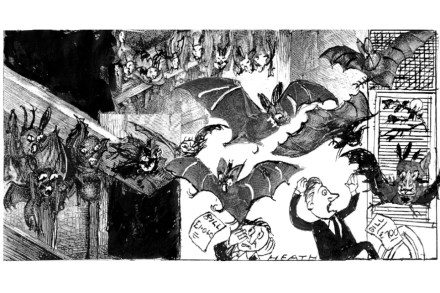
My friend Andrew is angry. He has just had the bat people round to look at his building project in Swanage. There was no evidence of bats that they could find, but that didn’t mean there weren’t any. A full survey would be required. In total the non-existent bats in our village hall cost the parish more than £2,500 I advised him to pay up and not dwell on the madness, but his ire reminded me of my own recent experience with the bat fuzz. From 2018 until this June, I chaired the committee responsible for refurbishing a village hall deep in rural Somerset. As law-abiding and nature-loving people, we followed our surveyor’s stern instruction and did all the bat-friendly things we needed to do before starting the work.