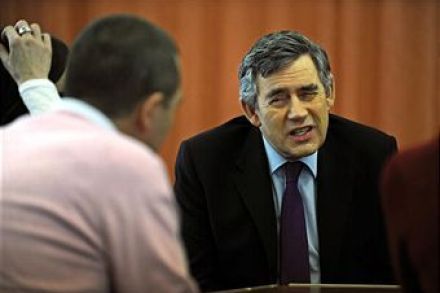
Gordon brown

In response to CoffeeHousers

CoffeeHousers have left some characteristically forthright and thoughtful comments on the blog about my Keith Joseph lecture, and I thought I’d answer them in a post.   Tiberius says that I don’t mention voters very much – I talk only about ideas. The voters have been taught Labour ideas: isn’t this something the Tories have to deal with? First, I firmly believe that the public are open to persuasion, open to new ideas having seen the collapse of Labour’s ideas. But, in my lecture (full text here), I do mention voters quite a lot. As Keith Joseph put it, it is folly to seek the ‘middle ground’ between political parties, and Conservatives should seek the ‘common ground’ which they share with the punters.

Why winning isn’t enough – and a response to The Fink

I delivered the Keith Joseph lecture last night, entitled Winning Is Not Enough. My point: that the Tories have adopted so many Labour policies out of tactical considerations that they are in danger of getting to office only to find they have signed up to continuing Gordon Brown’s agenda. The problem is not so much Gordon Brown himself, but his misunderstanding of government and politics: it’s his ideas that are so dangerous. If those ideas survive with a blue rosette, they are no less dangerous. And if a Tory government adopts these ideas then that’s not change. It’s more of the same.

Legg latest

The Legg report is about 240 pages, if you can manage it.  But the message you can take from it is short enough: there's going to be plenty more public anger with our political class.  Guido's post here should tell you why.  But, suffice to say, there are MPs paying back up to £42,458.  There are dodgy claims for flagpole accoutrements, luxury furniture and expensive gardeners.  And even the report itself cost more than the money than it's going to recoup. Although I don't think the parties should be trying to make political capital out of each other's misdemeanours – beyond, of course, proposing ways to fix the mess – there's little doubting that this is especially bad news for Gordon Brown.

The chip on Brown’s shoulder

So the former roadblock is now a born-again reformer – and, like most born-again types, he wants everyone to know about it.  Writing in today's Guardian, Gordon Brown sells his proposal for a referendum on the alternative vote system as "a rallying call for a new progressive politics."  And, from there, he gallops through written constitutions, Lords reform and digital democracy.  Watch him go.   Amid it all, though, I couldn't help noticing that the PM repeats a key mistake from last year: "I am inviting the leaders of all parties to engage positively in these debates and back our constitutional reform and governance bill.

Was today a turning point?

I suspect that when we look back at this year, we might conclude that today's PMQs was a turning point. David Cameron has had a poor January but today he was back on form, winning - as Lloyd Evans says - PMQs for the first time this year. Perhaps more significantly, there was real noise from the Tory backbenches, which have been noticeably quiet in recent weeks. It was as if the party was pulling back together after a relatively trying period. It was also significant that Cameron stayed on the offensive throughout; he didn't get drawn into conducting the debate on Labour's terms despite Brown's best efforts. Gone was the defensiveness that got him into trouble over recognising marriage in the tax system and the extent of the cuts 2010-11.

Brown meets his Waterloo

Lord Guthrie had it right with his well-directed expletive: Gordon Brown just doesn’t get defence. His record, both as Chancellor and PM, leave him vulnerable to criticism on the subject; but today, Brown has been confronted by a khaki-clad nightmare. After suffering his first reverse at PMQs for months, beaten decisively by a beautifully executed Tory plan, former permanent secretary at the MoD, Sir Kevin Tebbit, informed the Chilcot Inquiry that Brown ‘guillotined’ the defence budget with annual reductions of £1bn. Geoff Hoon’s testimony disclosed the full effects of Brown’s single act of stringency. The timing could not be better for the Tories, who have been intent on self-destruction of late.

Cameron blitzkriegs back into the game

Dave bounced back today. After a couple of lost months he showed up at PMQs and gave a thoroughly convincing display. Shrewd tactics, sound principles, headline-friendly quotes and some decent gags. The Chilcot Inquiry is proving a handy prosecution witness in the case against Brown. Cameron quoted a fistful of top generals who believe the former chancellor was a serial under-funder of the military. Brown’s response was a classic example of bluster and confusion. Good arguments arrive singly. Bad arguments enter in rowdy swarms. He gave five different replies to the main charge: the 2002 defence review had been the best in 20 years; fourteen billion pounds has been spent on Iraq: the rising defence budget would rise even further; the Tory manifesto in 2005 promised a £1.

Brown’s empty PR promise

Gordon Brown's proposal to bring in a referendum on electoral reform has a beautiful symmetry with Tony Blair's pledge to do exactly the same thing in the 1997 manifesto. That pledge never came to pass, once Mr Blair discovered the usefulness of a majority of 178, compared to dealing with the Lib Dems all the time as coalition partners. And Mr Brown's conversion to electoral reform has the mirror-image motivation: making the system kinder to losing parties has a certain attraction, if you are heading into opposition. Debates about electoral reform are rather strange. A very small number of very passionate people can talk for hours about the minutiae of different electoral systems and how they can radically change politics.

Will Brown’s election chances be Chilcot’s premier victim?

Giving evidence to the Chilcot inquiry, Tony Blair said: “I never refused a request for money to pay for arms and equipment during my time as Prime Minister.” The panel did not take the bait, but they will have to following Lord Walker’s evidence today: "There was indeed a list of stuff that we were having to make decisions about and I think we drew a line somewhere halfway down the page and said, 'if you go any further than that you will probably have to look for a new set of chiefs'." The disclosure has the iron-cast hand of Brown upon it. The PM’s decision to give evidence may prove a ruinous act of hubris. Voters and commentators may not comprehend the subtleties of deficits, but all can see when a politician has neglected serving British troops.

Leaked MoD report says, well, nothing really

What is the difference between a sieve and the Ministry of Defence? If you think of good punch-line send it in; in the meantime, suffice it to say that department seems to be leaking any and every sensitive document in its possession. Ministry of Defence staff have apparently leaked secret information onto social-networking sites sixteen times in 18 months. Over the week-end, it happened again: Sky News obtained a paper, which will form the basis of the forthcoming Strategic Defence Review. I have not seen the paper, but judging from the Sky reports there is not much to get excited about. Everyone accepts that the nature of warfare is changing, that traditional battle-lines are being re-drawn and that a new form of warrior will be required for future conflicts.

Talking to the Taliban | 29 January 2010

After the London conference, it is clear that “talking to the Taliban” will become part of the strategy in Afghanistan. But the conference left a number of important questions about what this means in practice unanswered. Talking to the Taliban is not a new idea. Even though he expelled a British and Irish diplomat for holding secret talks with Taliban in December 2007, President Karzai has become an advocate for such negotiations over the last two years. In the Spring of 2009, Saudi Arabia hosted tentative negotiations between Karzai’s representatives and former Taliban, with links to the current movement. But the idea now has a head of steam behind it.

Gordon’s off the hook, for the moment

Oooh, there’s just been a wonderful exchange at the Chilcot Inquiry. Baroness Prashar was asking some kindergarten questions about military planning. She barely mentioned Geoff Hoon’s evidence that the MoD was chronically under-funded and short of equipment before, during and after the conflict, and merely concentrated on 'visible military planning', or the lack of it to be precise.   Blair is much more assured after lunch than he was immediately before, and gave one of those of those “Trust me, I’m Tony” spiels about the armed forces’ readiness.

Why does the Iraq war still fascinate the politics of the present?

This week has seen confirmation that social mobility has stagnated, that the economic recovery is dangerously anaemic and that peace in Northern Ireland is threatened. Yet a conflict that was declared won nearly 7 years ago has been ever present on the frontpages. Bagehot is not at all surprised that the Iraq war remains definitive: ‘There is one way in which, despite the inquiry, Iraq has come to seem a less definitive issue: in Mr Brown’s handling of the public finances, it has a rival for the status of Labour’s worst mistake. Yet Iraq remains the most important single decision the government has made. Even taking a generous view of its behaviour—that it was cavalier and naive, rather than actively mendacious—the war remains an enormous stain.

Terrific, Baroness Ashton has made a dreadful start

Gordon Brown is a master of connivance. I never understood that he is contriving the EU’s destruction until hearing of Baroness Ashton’s glorious exploits. Agnes Poirier reveals all in the Times. CND’s sole attraction was that its protesters went home every evening and never worked weekends. Alas, the EU is for twenty four hour party people, but the 9 to 5 spirit of Greenham Common lives on in the EU’s High Representative and one time CND Treasurer, Baroness Ashton. Conscious of her carbon footprint, the Baroness commutes between London and Brussels most days and never answers the telephone after 8pm.

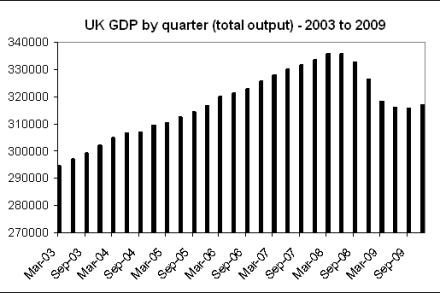
The economy has gone precisely nowhere in 5 years, but at considerable cost

The longest recession suffered by any major country in this cycle seems thankfully to be drawing to an end, even if only by the narrowest of margins.  Such has been the severity of the downturn though, that, as the above chart shows, GDP has fallen back to the levels of mid-2005. The economy is basically the same size as at the time of the last election. This means for probably the first time in modern British history, living standards have failed to rise for almost the entire duration of a Parliament.   Sadly, the cost of the economy going nowhere has not been as lacking as the growth or living standard increases. The national debt has virtually doubled since the last general election, rising from £440 billion to £870 billion now.

Growth but of the weakest possible sort

So Britain did grow in the fourth quarter of last year but only by 0.1 percent. Many on the Labour side had hoped that the moment that the country started growing again, Brown would be able to go on the offensive; arguing that his handling of the economy had steered Britain through the crisis. But the fact that the growth number is considerably lower than expected, most predictions were for growth of 0.3 to 0.4 percent, has rather stymied that plan. There are now only one more set of GDP figures before the election, presuming that it is held in May. So, it is now almost certain that Brown will not be able to go to the country boasting of a robust recovery. (The worst case scenario for Brown is that these figures are revised downwards meaning we are still in recession).

The demographics of power-sharing

The union of irreconcilables was unlikely to last: power-sharing in Northern Ireland is on the verge of collapse. Where once Blair and Ahern would descend on Stormont as a couple of charismatics, today Gordon Brown and Brian Cowan face an enormous and unenviable task. They deserve support: both governments have been courageous in their approach to Northern Ireland, and the Tories were right to offer unconditional support. In which case, why did the umbrella of unionists, including the Tories’ Northern Ireland spokesman Owen Paterson, convene at the Marquis of Salisbury’s house in secret? A mixture of the furtive and the preposterous, one expected reports of Richard Hannay emerging from behind a curtain and fixing his Colt on Peter Robinson.

What Tory split?

He never deviates and he never hesitates; if he stopped repeating himself Brown could be the star of Just a Minute. He was at it again today: “We must reduce our deficits steadily according to a plan, but we must do nothing this year that will put our recovery at risk.” The cuts-investment dividing line has been nuanced into a question of timing. Brown cited Ken Clarke among the “major world leaders” who lend his policies authority. Brown has overreached himself.

Nest-eggs for some pre-election goodies

Labour’s tax on banks that pay bonuses has failed to change behaviour and so will raise significantly more money, roughly two and a half billion more, than the Treasury budgeted that it would. How Labour uses this extra revenue will tell us a lot about how Labour intend to campaign and the balance of power within the government. At Brown’s press conference, Gary Gibbon pressed the Prime Minister on whether this money would all be earmarked for deficit reduction, the option that those close to Darling prefer. Noticeably, Brown failed to endorse that idea. He also would not commit to using any other extra revenue exclusively for deficit reduction. The significance of this is that there are rumours floating around that a bank might be sold before the election.

Out of recession and into debt

The deficit is in the Tories' crosshairs this morning. George Osborne pens an article in the Times, castigating Brown's obsession with continuity: ‘We need a new British economic model that learns from the mistakes of the past. First, that new economic model requires government to live within its means. We entered the recession, after years of growth, with one of the highest deficits in the developed world and we leave the recession with our credit rating under threat. That will have potentially disastrous consequences for international confidence. If Britain starts to pay the sort of risk premiums that Greece is paying, the interest bill on a £150,000 mortgage would go up by more than £200 a month.