Germany

The cultural hodgepodge that is Europe

From our UK edition

If Geert Hofstede’s name is familiar to you, it might be from pop-science articles explaining a spate of Korean airliner crashes in the 1990s. A widely held theory placed some of the blame on the hierarchical nature of Korean culture; this made the junior pilot reluctant to mention any mistakes made by his superior. If he noticed the captain heading for a hillside, he might summon up the courage to mutter, ‘Perhaps, honoured sir, you might like to pay particular attention to the interesting terrain.’ This contrasts with low ‘power distance’ cultures: New Zealand, say, or Ireland. On Aer Lingus, a stewardess could jab the pilot in the ribs and say, ‘Watch you don’t fecking crash, you gobshite!

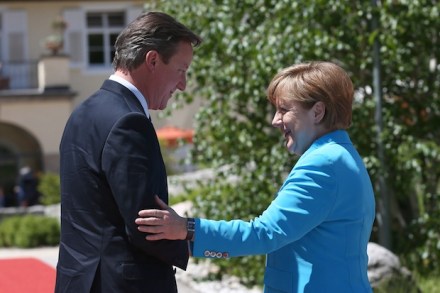
Angela Merkel and David Cameron fail to work out who’s in the driving seat

From our UK edition

At times in David Cameron's EU renegotiations, it's seemed as though the Prime Minister struggled to be in the driver's seat. Now evidence has come to light that confirms Cameron's power struggle with one of Europe's main leaders. Speaking at the Hay Festival, Neil MacGregor -- the former director of the British Museum -- let slip the difficulties he encountered when Angela Merkel and Cameron arranged a visit to see an exhibition he on German history from the past 600 years. Of all the objects in the exhibition, MacGregor thought the VW Beetle would make a great prop for a photo opp for the two leaders. Alas, it wasn't to be. While Merkel and Cameron's teams were both keen on the idea, they couldn't agree who would sit in the driving seat. As a result, the photo was never taken.

Happy ending

From our UK edition

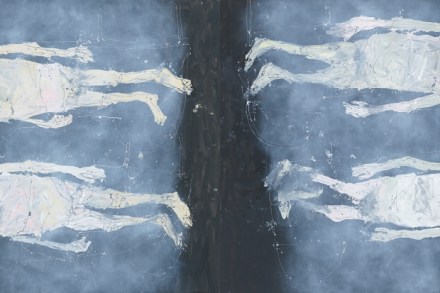
‘In many ways,’ Georg Baselitz muses, ‘I behaved against the grain of the times I grew up in.’ The era was 1960s Germany; in that context, Baselitz feels he was subversively respectable. ‘For example, I never took any drugs. I have been a very faithful husband, I just wanted to hold on to my wife, I wasn’t interested in straying. I never went on any political demonstrations.’ His major offence, however, was not what he didn’t do but what he actually did: paint figurative pictures. Eventually, fashions reversed, and this perverse behaviour made Baselitz a celebrated figure in the world of art. At 78, he remains vigorously productive.

Hit-and-miss Handel at the Göttingen Festival

From our UK edition

Ask anyone to name the greatest classical composers and certain names are bound to come up – Mozart, Wagner, Beethoven, Bach. But ask them which composer’s music they’d most like to live with for a week, exclusively, and answers will change. Greatness is one thing, but a great festival composer is quite another – someone whose works have not only sufficient quality and variety to stimulate, but also a certain comfort, a clubbable ease about them. Handel is one such, a composer whose music has spawned festivals from London to Halle, Dublin to Tokyo. It’s only appropriate, given the composer’s long association with England, that two of these festivals – London and Göttingen – are now directed by an Englishman.

The Spanish argument for abolishing government

From our UK edition

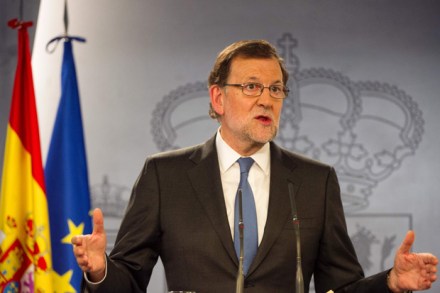
On 26 October last year, the Spanish government shut up shop in preparation for a general election. This duly took place in December but then a strange thing happened: after all the build-up, the arguments, the posters and the television coverage, the result was… nothing. The various parties were so balanced, so mutually distrustful and ill-assorted that no government could be formed. Since last October, therefore, there has been no government in Spain. One can imagine that the average political correspondent would think this a terrible problem, maybe even a crisis. The Financial Times has referred to Spain ‘enduring’ months of ‘political uncertainty’. This is assumed to be a matter requiring furrowed brows and grave tones.

Filming the Final Solution

From our UK edition

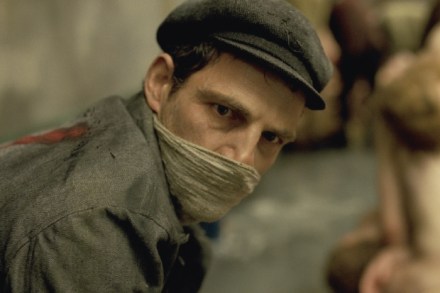
In July 1986, nine months before he died, I met the Italian author and Auschwitz survivor Primo Levi at his home in Turin. He was in shirtsleeves for the interview and the concentration camp tattoo 174517 was visible on his left forearm. (‘A typical German talent for classification,’ he tartly observed.) If This is a Man, Levi’s chronicle of survival, offers a warning to those who deliver facile judgments of condemnation: only those who have survived the Nazi camps have the right to forgive or condemn. Attempts to recreate the Final Solution on screen were mostly a ‘macabre indecency’, said Levi.

Who needs governments?

From our UK edition

On 26 October last year, the Spanish government shut up shop in preparation for a general election. This duly took place in December but then a strange thing happened: after all the build-up, the arguments, the posters and the television coverage, the result was… nothing. The various parties were so balanced, so mutually distrustful and ill-assorted that no government could be formed. Since last October, therefore, there has been no government in Spain. One can imagine that the average political correspondent would think this a terrible problem, maybe even a crisis. The Financial Times has referred to Spain ‘enduring’ months of ‘political uncertainty’. This is assumed to be a matter requiring furrowed brows and grave tones.

Obama warns of countries who ‘use trade as a weapon’. Like USA over Brexit?

From our UK edition

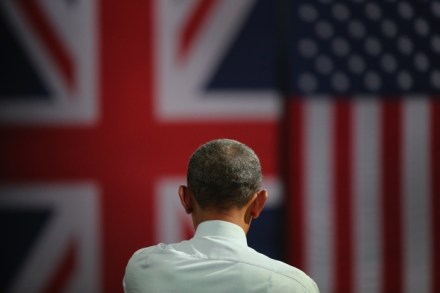
President Obama has taken his European tour to Germany, where he touted the 'indisputable' benefits of an EU-US free-trade pact. Speaking at the Hannover Messe Trade Fair, Obama noted the importance of an agreement as a bulwark against the likes of Russia 'at this time of uncertainty, including here in Europe, when others would use trade and energy as a weapon.' Trade as a weapon? You don’t say. Obama’s remarks in Germany came shortly after his visit to Britain, where he bludgeoned Brexit campaigners with the implied threat that Britain would 'go to the back of the queue' for a US trade pact if it left the EU.

A poem for Erdogan

From our UK edition

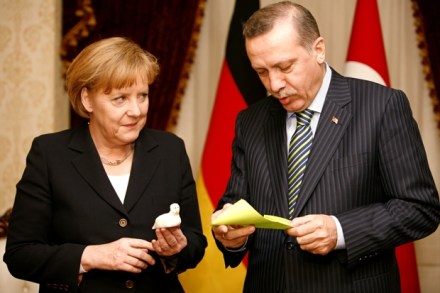
At the end of last month, a German comedian appeared on German television and read a poem mocking Recep Tayyip Erdogan, the president of Turkey. Jan Böhmermann’s satire was directed, among other things, at the laws President Erdogan has been using to lock up his critics. Turkey — which David Cameron is still fighting to bring into the EU — now has some of the world’s most repressive speech laws. Numerous journalists have been arrested for ‘insulting’ President Erdogan and he has even been known to ban Twitter in the country when corruption allegations against him and his family have surfaced online. Yet until Mr Böhmermann came on the scene, one might have expected these lèse-majesté laws to remain in Turkey. Not so.

Introducing ‘The President Erdogan Offensive Poetry Competition’

From our UK edition

Nobody should be surprised that Turkey’s President Recep Tayyip Erdogan has instituted effective blasphemy laws to defend himself from criticism in Turkey.  But many of us had assumed that these lèse-majesté laws would not yet be put in place inside Europe.  At least not until David Cameron succeeds in his long-held ambition to bring Turkey fully into the EU. Yet here we are.  Erdogan’s rule now already extends to Europe. At the end of last month, during a late-night comedy programme, a young German comedian called Jan Böhmermann included a poem that was rude about Erdogan.  Incidentally the point of Mr Böhmermann’s skit was to highlight the obscenity of Turkey already trying to censor satire in Germany.

Just join Germany

From our UK edition

An argument you sometimes hear from those sitting on the Brence (the Brexit fence) is that it’s a pity the EU couldn’t have stayed the same as it was when we first joined it in 1973. Back then, say the Brence-sitters, it was a trading bloc with only nine members, which made sense. Greece wasn’t a member, nor were Spain and Portugal, never mind Lithuania, Latvia and all those other countries ending in vowels. But if we could go back to that better arrangement — play fantasy politics, as it were — would we, with hindsight, want it to include France and Italy, two of the original nine? Their economies are both now looking pretty rackety. In fact, isn’t there only one country in Europe with which we would want to be BFF (Best Friends Forever)?

Portrait of the week | 17 March 2016

From our UK edition

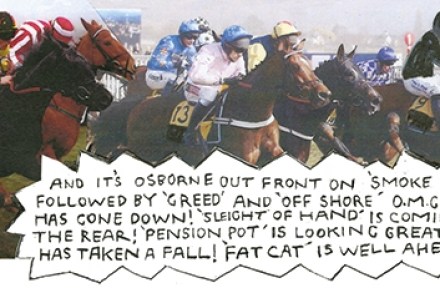
Home In the Budget, George Osborne, the Chancellor of the Exchequer, kept talking of the ‘next generation’. He outlined cuts of £3.5 billion in public spending by 2020, to be ‘on course’ to balance the books. Personal allowances edged up for lower taxpayers, with the higher-rate threshold rising to £45,000. A ‘lifetime Isa’ for under-40s would be introduced. Corporation tax would go down to 17 per cent by 2020. Small-business rate relief was raised: a ‘hairdresser in Leeds’ would pay none. Fuel, beer, cider and whisky duty would be frozen. To turn all state schools into academies (removing local authorities from education), he earmarked £1.5 billion.

Is more multiculturalism really the cure for the EU’s problems?

From our UK edition

Germany is on its feet again; the country’s answer to Ukip, Alternative Für Deutschland, made huge gains at the polls, winning a presence in three state assemblies. The shadow of Auschwitz looms over all European politics on the subject of immigration and race, but obviously more so in Germany, and many people are worried. Their growth in popularity may have something to do with the chancellor’s decision to invite one million and counting people from the wider Middle East, in an gesture historians will probably see as the grandest act of folly of early 21st century history. Some people are worried that, along with FN, Ukip and Trump, AfD are extremists who represent a threat to the established order.

Even the Germans are starting to despair of their country’s migrant policy

From our UK edition

A rather impressive performance by Alternative für Deutschland (AfD) in Germany’s regional elections. Second in Saxony-Anhalt and double digit percentages in Baden-Württemberg and the Rhineland-Palatinate. Today’s papers have tended to conclude that despite AfD’s shock success, the elections were nonetheless a triumph, of sorts, for Angela Merkel’s policy towards migrants, if not for her party, the CDU. I can’t say that I see it like that. For a party which did not exist four years ago to take a quarter of the votes in one lander is a remarkable expression of dissatisfaction with the status quo. Add into that the fact AfD is held in some suspicion as being exclusively middle-class, if not Junker, in its make-up.

Right-wing populists surge in Germany’s state elections

From our UK edition

Angela Merkel continues to reap the whirlwind. In this weekend's elections Alternative für Deutschland (AfD) has emerged as the fastest-growing political insurgent party since 1945. It has managed to enter all three state parliaments - with over 10pc of the vote in Baden-Württemberg, Rhineland-Palatinate and almost a quarter of the vote in Saxony-Anhalt, more than double the centre-left SPD. It focused its campaign as a protest against Merkel’s migrant policy, a policy that paid off. Its success is more than just another example of Europeans letting off steam.

The Spectator’s notes | 10 March 2016

From our UK edition

Surely there is a difference between Mark Carney’s intervention in the Scottish referendum last year and in the EU one now. In the first, everyone wanted to know whether an independent Scotland could, as Alex Salmond asserted, keep the pound and even gain partial control over it. The best person to answer this question was the Governor of the Bank of England. So he answered it, and the answer — though somewhat more obliquely expressed — was no. For the vote on 23 June, there is nothing that Mr Carney can tell us which we definitely need to know and which only he can say. So when he spoke to the Treasury Committee of the House of Commons on Tuesday, his opinion was no better than that of any intelligent and well-connected person who deals with money.

A civilisation under siege

From our UK edition

[audioplayer src="http://rss.acast.com/viewfrom22/thedeportationgame/media.mp3" title="Douglas Murray and Don Flynn from the Migrants' Rights Network discuss deportation"] Listen [/audioplayer]There are two great deportation games. One is the carousel which Rod Liddle describes — but even this, for all its madness, pales alongside the border-security catastrophe unfolding on the continent. Thanks to geography and a few sensible decisions by our government, Britain has so far been spared the worst of the migrant crisis. But we should pity most of the other European countries, because they are losing control not just of their borders but of their civilisation and culture — the whole caboodle.

Driven to extremes

From our UK edition

Imagine if Nigel Farage declared that police should be ready to shoot migrants trying to make it from Calais to Britain; saying: ‘I don’t want to do this, but the use of armed force is there as a last resort.’ And imagine that in spite of this — or perhaps because of it — Ukip were to overtake the Labour party in a national poll to become the most popular opposition party. This, in effect, is what is happening in Germany. The words above were spoken by Frauke Petry, leader of Alternative für Deutschland (AfD), the insurgent party which is threatening to make large gains in state elections in three key German regions next month.

Why are Amnesty keeping the details of their plan to bring in more migrants secret?

From our UK edition

The head of Amnesty, Kate Allen, was busily talking the most terrible balls on the radio this morning. In an interview on the Today programme she reminded everyone of how bad the situation in Syria is and indulged in the usual Conservative-bashing by arguing that Britain wasn’t doing enough to alleviate the refugee situation. Despite spending more than almost any other country on regional solutions to the humanitarian catastrophe and a commitment to take in 20,000 refugees over 5 years, Ms Allen particularly lamented that we were ‘not joining with the rest of Europe.’ Seemingly unaware that most of the ‘refugees’ flooding into Europe are not Syrians and not refugees, she insisted that Britain should nevertheless bring in far more of them.

Low life | 11 February 2016

From our UK edition

The hotel reception was lit by three gloomy low-wattage light bulbs. It should have been six but the management was economising. The hotel’s nod to the city carnival was a single balloon strung from one of the empty bulb holders. I let my backpack drop from my shoulders and checked in. WiFi, said the receptionist, cost extra. The WiFi registration process was as insanely convoluted as buying illegal drugs. Room number dreiunddreissig was on a shabby corridor with two other doors. The room was dismally cold and small. It was bare of every amenity one normally expects to find even in a cheap hotel room, except for a bed, a kit wardrobe and a tiny table whose surface area was taken up by a dirty old television. The thin carpet was soiled, the wallpaper peeling.