Germany

Is Germany becoming the new sick man of Europe?

From our UK edition

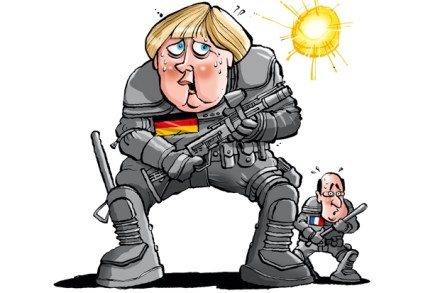
It’s not going well for Germany at the moment. Their largest bank is on the verge of collapse while their second largest bank is laying-off staff. And Frau Merkel is having to cope with the political fallout of her open-door immigration policy – not least a rise in populist nationalism and a dip in her own popularity. Germans have also been told in recent months to stockpile food, while a leaked document suggested a return to national service, which stopped in 2011, was being considered. But that's not all: the country's economy recently slipped in the World Economic Forum’s competitive ranking. All this makes for a grim picture.

Who comes after Merkel?

From our UK edition

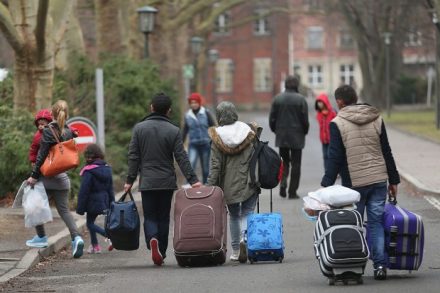
A year from now, 60 million Germans go to the polls in the most important general election in mainland Europe for a generation. The result will define German — and European — politics for the next four years. There are huge questions to be resolved, from the refugee crisis to the financial crisis, but right now the question in Germany is: will Mutti run again? Angela Merkel’s nickname, Mutti (Mummy) is a memento of happier times. A year ago, her position as matriarch of the Bundesrepublik seemed unassailable. And then, last September, she opened Germany’s borders to hundreds of thousands of fleeing Syrians. Over a million refugees arrived last year. The reaction of native Germans could be measured at the polling booths.

The Spectator took on Chancellor Merkel and President Erdogan – and won

From our UK edition

Hurray!  It is not often one gets good news, but here is some.  Jan Boehmermann, the German comedian who read out a rude poem about Sultan Erdogan on German TV, has had the prosecution against him dropped.  In the last couple of hours prosecutors in Mainz said that they did not have ‘sufficient evidence’ against him. Well I say ‘Ha’ to that, for it is purest face-saving.  The evidence was broadcast out on German television in March for any and all to see.  President Erdogan complained and with the approval of Chancellor Merkel an ancient and outdated German law (about not insulting foreign rulers) was dusted off and Jan Boehmermann faced years in prison.

Meet the German business giant who is excited about Brexit

From our UK edition

Mathias Döpfner, the extremely tall, extremely intelligent head of Axel Springer, is unusual in the generally conformist German business elite because he is not an unqualified believer in the German economic model. I have known him slightly for about 20 years and have always been interested by his questing, speculative mind. We have had conversations about the freer, Anglosphere model of economic life which he admires. Although he is not anti-EU — that is still almost against the law in Germany — he is sceptical of its direction. Now he has blasphemed in the EU’s main church in Britain — the Financial Times — by telling the paper that within three to five years he would expect Britain, as a result of Brexit, to be better off than its former EU partners.

Want a bank rescued? Don’t ask a German

From our UK edition

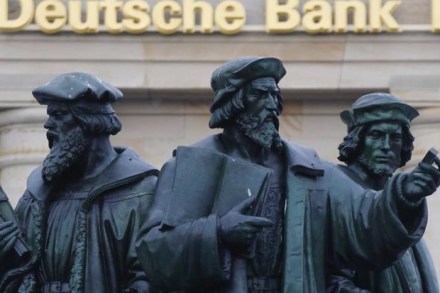
Make a car? Sure. Win a Word Cup? Yup. Write a symphony? Without doubt. There are lots of things that you rather have a German doing than anyone else in the world. But there are also a few things you’d rather they didn’t. Right now, rescuing a bank is right at the top of the list. All this week, the financial markets have been gripped by the slow-motion car-crash of Deutsche Bank. An institution that was once the mightiest in Europe, and a by-word for financial stability, is now teetering on the edge of collapse. Its share price has halved this year, and today is hitting a fresh 30-year low. The cost of insuring against a default has soared, and now the hedge funds are refusing to deal with it. It is not quite in bank run territory yet - but it is getting perilously close.

How Brexit Britain can save Greece

From our UK edition

The cheerful, nattily dressed Englishman checking out at my hotel in Mykonos as I was checking in with my daughter looked shocked as he scrutinised his bill: 'What's the VAT? Twenty-four percent? How can that be?' I instantly violated my pledge to my daughter not to embarrass her by talking politics on vacation. 'You can thank Wolfgang Schäuble and the Germans,' I told the man. 'Austerity politics and all that.' My new acquaintance pondered what I was saying -- 'Is that so?' he said, or something to that effect -- then quickly changed the subject to the charm of cobblestone and the local nightlife. I didn't ask him how he had voted on Brexit, but I wish I had, for an incendiary political idea was beginning to form in my mind.

Doctor’s orders

From our UK edition

Second acts in British politics are vanishingly rare these days and Liam Fox, restored to the cabinet by Theresa May, is determined to make the most of his. We meet at his central London flat at half-past four on Sunday afternoon and even then the International Trade Secretary is beavering away: preparing for his meetings at the World Trade Organisation in Geneva the following day and finishing off his conference speech. He offers us a drink — red wine? pink champagne? — but pours a cup of tea for himself. Fox, as ever, is full of fizz. He clearly loves being back at the centre of things, and immediately starts contrasting Theresa May’s premiership with that of David Cameron. ‘We think similarly,’ he says.

Frankly impenetrable

From our UK edition

One day in April 1969 Theodor Adorno began teaching a new course entitled ‘An Introduction to Dialectical Thinking’. Feel free, the sociologist-cum-philosopher told the packed hall at Frankfurt University, to ask questions as I go. Two of his charges did so immediately. When was Adorno going to apologise for having set the cops on those campus protesters three months earlier? Before Adorno could reply, another student scrawled ‘If Adorno is left in peace, capitalism will never cease’ on the blackboard. At which point the whole class shrieked ‘Down with the informer!’ Then a group of women surrounded Adorno, bared their breasts, and showered him with rose petals. Grabbing his hat and coat, the hapless prof ran.

How Alternative für Deutschland forced German politics to the right

From our UK edition

‘When the world ends, I’ll go to Mecklenburg,’ quipped Bismarck, ‘because there, everything happens a hundred years later.’ Mecklenburg-Vorpommern has always been seen as somewhere behind the times, but has this sleepy backwater now become a portent of momentous things to come? In last weekend’s regional elections, Germany’s fledgling anti-immigration party, Alternative für Deutschland, came second, pushing Angela Merkel’s CDU into third place – in her own constituency. So was AfD’s Leif-Erik Holm right to say that this could be the beginning of the end for Merkel? And does this shock result mark the end of the beginning for AfD?

Forget the ‘Norway model’. Germany suggests UK could get ‘special’ EU status

From our UK edition

Britain’s decision to leave the EU sent shockwaves crashing throughout the continent. As Europe struggled to interpret the outcome of the referendum, we heard calls for Brussels to drive a hard bargain with the UK in order to contain the 'Brexit contagion'. The European Council President Donald Tusk's warning that the UK must not be allowed to 'profit' from leaving the bloc summed up this mood. But now, it seems, our neighbours in Europe are coming to terms with Brexit. And with it, the desire to punish the UK appears to be dampening. Michael Roth, Germany's European Affairs minister, has this week suggested that a 'special status' could be achieved which would take into account Britain’s size and previous commitment to the European project.

Germany turns against EU-Turkey deal

From our UK edition

Is the tide in Germany turning against Turkey? It certainly seems to be. A poll today shows a majority of Germans favour ending the refugee deal agreed between the EU and Turkey back in March. The agreement has helped stem the flow of migrants flooding into Europe, making a repeat of the 1.1m people who arrived in Germany last year unlikely. But the deal came at a price: Turkey won a renewal of aid, the prospect of visa free travel for its people across Europe and the biggest prize of all - 're-energized' EU membership talks. Yet for all the bluster talked about the EU deal, it seems that many Germans are not happy with it and want it to end.

Munich notebook

From our UK edition

It has been a strange week in Munich; a week of deceptively cool mornings, afternoons hot enough to fry eggs and thunderstorms at twilight that have turned streets into streams. A week of reflection, too, capped last Sunday by a service of remembrance in the cathedral, attended by Chancellor Merkel, to honour the nine young lives taken in the shooting at the shopping centre which sent a tremor through Freistaat Bayern, and through the nation. One more tremor. It has been the summer of terror in Bavaria. Würzburg, Ansbach, Munich. But the Münchners have taken it well, in as much as one ever takes these things well. Along Maximilianstrasse, where the rich play; by the banks of the River Isar; in the lush acres of the Englischer Garten, life has gone on.

Portrait of the week | 28 July 2016

From our UK edition

Home The collapse of BHS after Sir Philip Green had extracted large sums and left the business on ‘life support’, with a £571 million pension deficit, was ‘the unacceptable face of capitalism,’ said a report by the Business and the Work and Pensions select committees of the House of Commons. The British economy grew by 0.6 per cent in the quarter ending in June. A man was shot dead at a commercial pool party in Headley, Surrey, organised by Summerlyn Farquharson, known as the Female Boss Krissy, and the Jamaican reggae artist Jason White, known as Braintear Spookie. HMS Ambush, a Royal Navy Astute-class nuclear-powered submarine, was in a ‘glancing collision’ with a merchant vessel while submerged off Gibraltar.

Terror is the new normal for Germany and France

From our UK edition

Update: This piece was written yesterday and so is already out of date. This morning two armed men entered a church near Rouen during Mass.  They took the priest, two nuns and a number of congregants hostage. It appears that they slit the priest's throat before themselves being killed by French security forces.  Nobody can think of any possible motive, though people claiming that attacking Christians at prayer is not a traditional Islamist practice have clearly not paid attention to Iraq, Syria, Nigeria, Pakistan, Egypt or any number of other countries around the world. Well this is all going very well isn’t it?

Germany comes under attack again

From our UK edition

For the third time in a week, Germany has come under attack. On this occasion, a Syrian asylum seeker blew himself up outside a festival in the Bavarian town of Ansbach. Twelve people were injured in the incident last night but thankfully no one else was killed. It's still too early to tell what the motive for the attack was but one thing does seem clear: nerves in Germany are fraying. Sadly, the latest incident was carried out by a man who was given shelter by a country which took in 1.1million asylum seekers last year. The man responsible for the attack had recently been told his claim for asylum had been rejected - but that means little in Germany, where half of those who had their claims rejected were allowed to stay put anyway.

Theresa May’s first day and Boris at the Foreign Office: How the foreign press reacted

From our UK edition

A new British Prime Minister is always big news on the continent and around the world. This time around, with Mrs May tasked with redefining Britain’s relationship with the EU, the foreign press has taken a special interest in recent events in Downing Street. One of the big stories aside from Britain's new Prime Minister taking up her role is Theresa May's decision to make Boris Johnson Foreign Secretary. Here's how the press around the world reacted to the news: France: With France bracing itself for a protracted period of arduous negotiations with the UK, Britain's new Prime Minister is big news across the Channel. Le Figaro goes as far as to brand Theresa May Britain’s new 'Iron Lady'.

The cultural hodgepodge that is Europe

From our UK edition

If Geert Hofstede’s name is familiar to you, it might be from pop-science articles explaining a spate of Korean airliner crashes in the 1990s. A widely held theory placed some of the blame on the hierarchical nature of Korean culture; this made the junior pilot reluctant to mention any mistakes made by his superior. If he noticed the captain heading for a hillside, he might summon up the courage to mutter, ‘Perhaps, honoured sir, you might like to pay particular attention to the interesting terrain.’ This contrasts with low ‘power distance’ cultures: New Zealand, say, or Ireland. On Aer Lingus, a stewardess could jab the pilot in the ribs and say, ‘Watch you don’t fecking crash, you gobshite!

Angela Merkel and David Cameron fail to work out who’s in the driving seat

From our UK edition

At times in David Cameron's EU renegotiations, it's seemed as though the Prime Minister struggled to be in the driver's seat. Now evidence has come to light that confirms Cameron's power struggle with one of Europe's main leaders. Speaking at the Hay Festival, Neil MacGregor -- the former director of the British Museum -- let slip the difficulties he encountered when Angela Merkel and Cameron arranged a visit to see an exhibition he on German history from the past 600 years. Of all the objects in the exhibition, MacGregor thought the VW Beetle would make a great prop for a photo opp for the two leaders. Alas, it wasn't to be. While Merkel and Cameron's teams were both keen on the idea, they couldn't agree who would sit in the driving seat. As a result, the photo was never taken.

Happy ending

From our UK edition

‘In many ways,’ Georg Baselitz muses, ‘I behaved against the grain of the times I grew up in.’ The era was 1960s Germany; in that context, Baselitz feels he was subversively respectable. ‘For example, I never took any drugs. I have been a very faithful husband, I just wanted to hold on to my wife, I wasn’t interested in straying. I never went on any political demonstrations.’ His major offence, however, was not what he didn’t do but what he actually did: paint figurative pictures. Eventually, fashions reversed, and this perverse behaviour made Baselitz a celebrated figure in the world of art. At 78, he remains vigorously productive.

Hit-and-miss Handel at the Göttingen Festival

From our UK edition

Ask anyone to name the greatest classical composers and certain names are bound to come up – Mozart, Wagner, Beethoven, Bach. But ask them which composer’s music they’d most like to live with for a week, exclusively, and answers will change. Greatness is one thing, but a great festival composer is quite another – someone whose works have not only sufficient quality and variety to stimulate, but also a certain comfort, a clubbable ease about them. Handel is one such, a composer whose music has spawned festivals from London to Halle, Dublin to Tokyo. It’s only appropriate, given the composer’s long association with England, that two of these festivals – London and Göttingen – are now directed by an Englishman.