France

Macron backs May over Russia

President Emmanuel Macron has offered his full support to Theresa May and said that France may take its own action against Russia after the poisoning of Sergei Skripal and his daughter in Salisbury. On a visit to Touraine on Thursday morning, the president was asked about the incident and he replied: "Everything leads us to believe that responsibility is in fact attributable to Russia. I will announce in the coming days the measures that we intend to take." Macron is hosting German Chancellor Angela Merkel in Paris on Friday and it's expected that the pair will make a joint announcement in which they reiterate their support for Britain.

Marine Le Pen’s relaunch falls flat

It wasn't the weekend that Marine Le Pen envisaged. When last Saturday dawned in the northern French city of Lille, the leader of the National Front probably rose from her bed with a spring in her step. Ten months on from her disastrous performance in the second round of the French presidential election here was Le Pen's chance to get her political career back on track. Furthermore, she had a little surprise in store for the party faithful, an illustrious guest who would enhance her own international credentials. Sure enough, Steve Bannon elicited a hearty roar from the audience when he strode onto the stage: "Let them call you racist, let them call you xenophobes, let them call you nativists," thundered Donald Trump's former Chief Strategist.

Could the golden girl of the French right emulate Macron?

The news that Marion Maréchal-Le Pen will share a stage this week with US conservatives, addressing the annual Conservative Political Action Conference event shortly after vice-president Mike Pence, has caused much excitement within the French right. The 28-year-old Maréchal-Le Pen, niece of Marine, the leader of the National Front, withdrew from political life in June after her party's disastrous result in the second round of the presidential election. Allegedly disillusioned with the direction the party had taken in the previous months, focusing more on the economy and the EU, than on social conservative issues that are close to her heart, the departure of the golden girl of the National Front dismayed the French right.

Gavin Williamson’s diplomatic incident

Since Gavin Williamson was appointed as Defence Secretary, the Conservative MP has been in a rush to prove his credentials. From battling the Treasury over proposed military cuts to posing with rescue dogs, Williamson certainly seems a man in a hurry. However, with speed comes mistakes. Today's Financial Times reports of a diplomatic gaffe committed by Williamson this week. Ahead of Theresa May's speech this weekend in Germany on a new security relationship with the EU, the Prime Minister has been doing her best to charm European leaders – recently hosting Emmanuel Macron. However, this week Williamson dismissed the importance of one of France in defence matters.

Macron’s naive plan to revive national service

Emmanuel Macron's vow to press ahead with plans to bring back national service for France's youth has taken many by surprise. The French president's insistence that the scheme would be mandatory is also something of a shock, contradicting remarks made last week by Florence Parly, the minister of the armed forces, who appeared to suggest the service would be voluntary. Not so, according to a government spokesman, who said 'it will be universal...and it will be obligatory'. So how has this announcement been greeted? In Britain, such news would inevitably be met with howls of outrage from certain quarters. In France, however, Macron's plans have, for the most part, been greeted warmly.

France’s Jewish population has good reason to feel afraid

In January 2016, Nicolas Sarkozy was honoured by British Jews at a ceremony in London. The former French president was thanked by Chief Rabbi Pinchas Goldsmith for his support during a decade that had seen an upsurge in anti-Semitism across France. 'France right now is the main battleground between hope and fear for the future of Europe, especially for the Jewish community', said Goldsmith. Two years on, and Britain has also become a battleground for Jews. Anti-Semitic attacks are now at record levels in the UK, according to a report released this week, with 2017 witnessing a 34 per cent rise in violent assaults against Jewish people. Holland and Belgium have also undergone similar dramatic surges in anti-Semitism in recent years.

Running for her life

Françoise Frenkel was a Polish Jew, who adored books and spent much of her early life studying and working in Paris. Her passion for French literature led her to open the first French bookshop in Berlin in 1921, a resounding success in spite of the predominantly Francophobe sentiment in Germany following the first world war. She happily reminisces over its ‘curiously mixed clientele’: ‘Famous artists, celebrities and well-heeled women pore over the fashion magazines, speaking in hushed tones so as not to disturb the philosopher buried in his Pascal.’ It soon became a place of readings, lectures, plays and parties and an essential stop for any French writer passing through Berlin.

Low life | 18 January 2018

In France, or in Provence at least, polite rule number one is to say hello. You must offer a distinct ‘good day’ or ‘good day, ladies and gentleman’, for example, when joining the queue in the baker’s or at the post office, or when getting on a bus or entering a bar. A nod or a wink just isn’t enough. Neither is a self-effacing silence. ‘Bonjour’ is the password. Since I have discovered it, I have been jovially saluting everyone right, left and centre. The inexplicable hostility I used sometimes to encounter in shops has stopped, and moreover the French have revealed themselves, incredibly, to have a fine sense of humour, which is roughly the opposite of my impression before I began to say hello indiscriminately.

France and Brexit: lessons from history

Almost 50 years before Brexit, there was a ‘Frexit’: France shocked her allies in March 1966 by giving notice of her withdrawal from an international community of largely European states (plus the USA and Canada), of which she had been a member for 17 years, on the grounds that she wished to regain her national sovereignty. French withdrawal from the integrated military command of NATO was complete within two years. Though France remained a member of the Atlantic Council and subsequently negotiated a continued role in certain NATO institutions, she left the all important collective military command which France’s president General de Gaulle claimed bridled her independence and her ability to play a world role.

Emmanuel Macron’s charm offensive is paying off

Summit? What summit? Coverage of today's Anglo-French tête-à-tête at Sandhurst can best be described as low-key on the French side of the Channel. And that's being kind. To say the French don't care may be a slight exaggeration, so let's settle for Gallic indifference. None of the newspapers cover the summit on their front pages and it was the seventh item on France's equivalent of Radio 4's Today programme this morning, sandwiched between a report on the Woody Allen allegations and the latest news from the Australian tennis Open. No analysis, little interest, just a brief mention that the president of the Republic will be in England for talks with the British Prime Minister. Whose name is Theresa May, just in case listeners didn't know, and many don't.

President Macron is winning the political talent show

A predictable epidemic of froggy bashing has erupted in Britain as Emmanuel Macron brings his global victory tour to Britain. He is rubbing-in his humiliation of Theresa May with the ‘gift’ of the Bayeux Tapestry, although in truth merely the loan of it, which you do not need Trumpian genius to know commemorates the last time anyone from France was able to claim any kind of creditable victory against Albion. Not since De Gaulle has Britain faced such a cunning adversary. Macron makes no secret of his ambition to punish the City for Brexit, and provoke an exodus of bankers to Paris. This is unlikely as Paris it must be said has many of the characteristics of a 'shithole', starting at the Gare du Nord.

Brexit Britain’s Macron paranoia

In 2015, millions of French people tuned in to watch French Bashing, a television documentary which sought to explain why those horrible Anglo-Saxons were so consistently mean about France. The whole gamut of historic insults and stereotypes were analysed in the 90-minute film, from popular portrayals of the country as an ungovernable nation of idle protesters to the ‘cheese-eating surrender monkeys’ moniker that dates back to 1995. It struck a chord at a time when the country was near rock-bottom, confused under the presidency of Francois Hollande, hit by terrorism, high unemployment and an unrelenting stream of negative international media coverage.

The Bayeux Tapestry is coming home at last

The Entente Cordiale is alive and well, it seems. It was announced today that, thanks to the benevolence of Emmanuel Macron, the Bayeux Tapestry will leave France for the first time in nine centuries, and be loaned to Britain. Strictly speaking, though, you could say the tapestry was coming home, since it was almost certainly made in Kent, by English women toiling under the Norman patriarchy. It tells the story of the most famous battle in English history, an event that helped to define not just Anglo-French relations but also England’s ingrained class differences.

The French women who stood up to the #MeToo movement

Why the big fuss about the 100 eminent Frenchwomen, including Catherine Deneuve, who have criticised the #Metoo movement as a puritan backlash? Their viewpoint, expressed in a letter to Le Monde, is little different to the one expressed by their president in November, when Emmanuel Macron spoke out against sexual violence and harassment but warned against a culture of 'denunciation' where 'each relationship between men and women is suspicious.' In reminding France that they are 'not a puritan society,' Mr. Macron was tacitly drawing comparisons with the Anglo-Saxon world, long seen by the French (and other Latin countries) as prudish in sexual relations.

Low life | 4 January 2018

As I stood there, I was reminded of the man of no fixed abode who, several years back, aged 68, made it into the local paper charged with shoplifting. He’d failed to steal a bottle of champagne and a hat to the value of £75. In court, the magistrate had inquired as to the brand of champagne. On being told that it was Pol Roger, he jocularly commended the tramp on his refined taste, and said that it inclined him towards leniency. That gay tramp came to mind now, two days before Christmas, as I stood in front of the champagne section in the French hypermarket, tempted by the special festive offer of 25 per cent off a magnum of Nicolas Feuillatte Grand Reserve, a mid-range champagne that I prefer over some of the dearer ones, a saving of €11 per item.

The ‘Queen of France’ is making life difficult for Macron

The new year in France has got off to its traditionally violent start, with hundreds of cars set ablaze across the country and an attempted lynching of two police officers in the suburbs of Paris. Yet in the increasingly surreal world of social media, what is causing uproar is Brigitte Macron's breach of protocol to stand beside her husband on state visits. The custom has been for president's wives to stand behind their husbands, but Madame Macron has said that from now she'll be side by side with her man. 'A woman does not have to be behind', she is quoted as saying by RTL radio.

Emmanuel Macron is becoming the darling of the Deplorables

The French have long loved a beauty contest and this year's Miss France was screened on Saturday night on prime time TV. While ITV dropped Miss World from its main schedule in 1988 in response to feminist protests, beauty pageants continue to pull in the punters in France, with a peak audience of 8.8 million watching Miss Pas-de-Calais win this year's crown. Feminist groups claim that Miss France is an offensive anachronism that should be consigned to the past. Raphaëlle Rémy-Leleu, spokesperson for the 'Dare to be Feminist' organisation, said 'it was a shame that the only night of the year dedicated to women on TV cultivates the idea of female objectification'. But there will be no beauty pageant ban on Macron's watch.

Laurent Wauquiez could bring Emmanuel Macron crashing back to earth

Laurent Wauquiez has done the easy part. It was never seriously in doubt that the 42-year-old was going to win last night's contest to elect the new leader of Les Républicains, a position vacated by François Fillon after his humiliating presidential campaign in May. But now for the real test: challenging the hegemony of Emmanuel Macron. In the six months since he became the youngest president of the 5th Republic, the 39-year-old Macron has invaded centre-right territory. Not only that but he's made off with several high-profile Républicains, including Prime Minister Édouard Philippe and Economy Minister Bruno Le Maire.

The French left is tearing itself apart over Islam

Six months into his presidency, Emmanuel Macron looks untouchable. He has conquered the unions, and his political opponents are a shambles – none more so than the Socialists. Just how divided they are was demonstrated earlier this month when a vicious war of words erupted within the French left. The cause was Islam, an issue that has been agitating Socialists for decades. When the first Socialist president of the Fifth Republic, François Mitterrand, was elected in 1981, his government was initially a friend of Islam. As the eighties wore on though, some on the left became alarmed at the demands being made of the Republic: prayer rooms in factories and the right to pray five times a day were particular sticking points.

When things fall apart

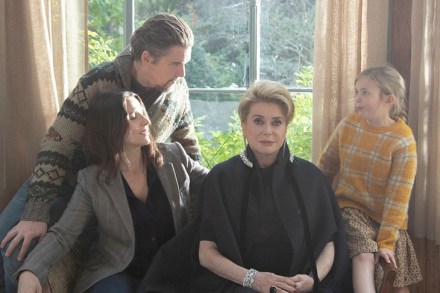
The films of Michael Haneke wear a long face. Psychological terror, domestic horror, sick sex, genital self-harm — these are the joyless tags of his considerable oeuvre. Such an auteur is not the obvious sort for sequels: The Piano Teacher 2 or Hidden — Again! aren’t destined for your nearest multiplex. And yet his new film is an intriguing knight’s move away from his last. Amour (2012) was a hot-button portrait of dementia in which an elderly husband watched his wife’s mind drift away as if on an ice floe. Eventually, he smothered her with a pillow. In Happy End, the widower is back, and this time he’s out to kill himself (although the strapline on the poster is not so jaunty). Haneke has widened the canvas to include the whole family.