France

Michel Houellebecq and the tyranny of Islamist sensitivity

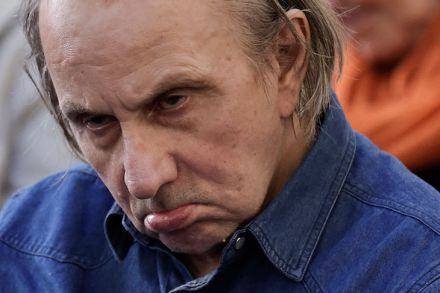
They’re coming for Michel Houellebecq again. The rumpled, chain-smoking laureate of misery is once more in the crosshairs of the French state for causing offense. I’ll give you one guess who he’s offended. That’s right: Muslims. Islam really has become the premier snowflake religion, a faith so exquisitely fragile that even a grumpy novelist puffing on a Gauloise in a Parisian cafe can give its clerics a fit of the vapors. If a faith cannot survive a mordant Frenchman calling it silly without going crying to the courts, then the problem is the faith, not those who mock it Houellebecq has been formally charged by a judge in Nanterre, near Paris, for comments he made in 2022.
I’m mourning the loss of BBC Sounds

Provence The other Friday, via the reader comments section, I was contacted by a chap, Simon, inviting me to attend a piano concert in the next village, the proceeds of which were going to those affected by the recent wildfires. I was thrilled, Radio 3 is on at home 16 hours a day sometimes. Especially since those heartless wankers at the BBC pulled the plug on the Sounds app last year for people outside the UK. Living abroad has its advantages. The cave here above the medieval village feels right to me: safe, quiet, unique – and the terrace has a terrific view. And being so tiny and south-facing, it’s relatively inexpensive to heat and maintain, but it can be isolating.

Beware left-wing fake news

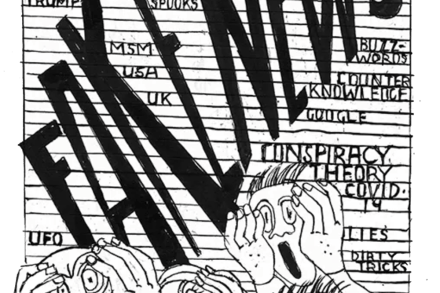
We hear a lot from the lanyard class about the harm that mis- and disinformation causes, from anti-migration protests to climate denialism. But they take it for granted that it is always right-wing grievances that are fuelled by fake news, never left-wing ones. Now that the unrest in France has spread to the rest of the Continent, fuelled by misleading claims about school cuts and Israeli genocide, I think we can confidently say that left-wing mis- and disinformation is more dangerous. Take the alleged cuts to the French education budget, the focal point of the student protests. In fact, the French government’s spending on schools is set to rise next year by €1.1 billion. That’s a 1.

Europe’s right turn is inevitable

The French Revolution remade not only France but Europe, some 230-odd years ago. Even Napoleon’s final defeat at Waterloo was not really the end of what the rebellious Estates General had set in motion in 1789. The Revolution proved that an ancien régime could be overthrown and, once that was demonstrated, no king anywhere could feel completely safe. The Revolution continued as an ideological struggle long after the shooting ceased. Indeed, the world wars of the 20th century were arguably a late phase of the processes begun by the Revolution. Now France faces a different kind of revolution: the prospect that Marine Le Pen will win next year’s presidential contest. Le Pen is considered absolutely haram by liberals everywhere, not only in her own country but throughout Europe.

europe

Will we always have Paris?

Two worlds met in Paris last week. Thanks to the presence of Art Basel, some of the world’s most valuable art that wasn’t already in the city was shipped there. It arrived just in time for Paris to go up in flames. Most of the art fair went ahead as planned at the Grand Palais, but the final weekend was canceled. Parisian friends and those who were visiting the city described scenes of Dada-esque absurdity. They navigated streets filled with burning bins and rioting “youths” in balaclavas, before slipping into champagne receptions. Some who attempted to get out of the city spoke of Mogadishu-like scenes at Gare du Nord, where the country’s newest net-contributors were busily assaulting any available police and stealing the luggage of any tourist they could find.

The specter of civil war haunts France

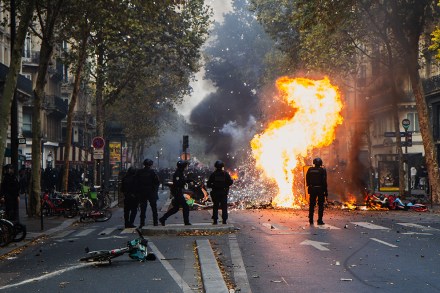
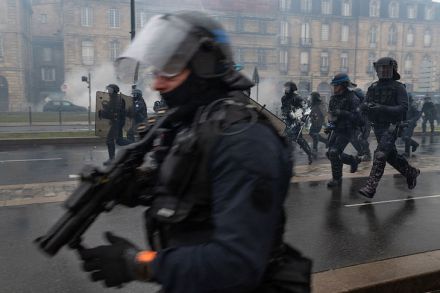
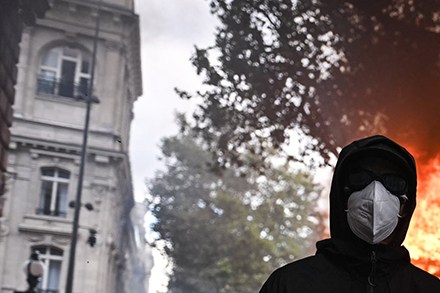
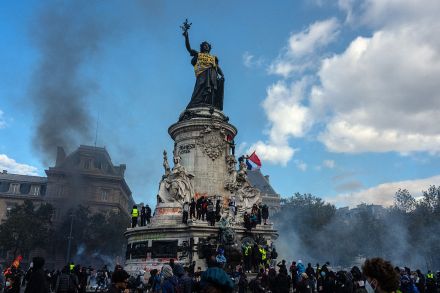
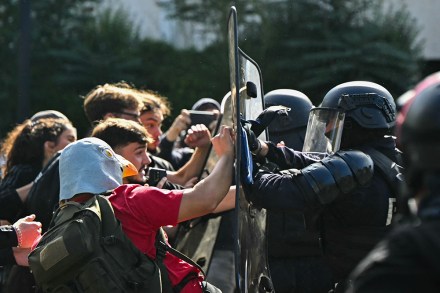
It was a peaceful weekend in France apparently. One broadcaster described the latest protests as “calm” and Le Monde said they unfolded “without serious incident.” Tell that to the 53 police officers who were injured in clashes with demonstrators, 1,513 of whom were arrested as trouble broke out across the country. Laurent Nunez, the Interior Minister, said that in several towns and cities the police had been subjected  to an “extremely high level of violence.” This Saturday is Halloween and social media is full of threats and taunts about bringing terror to the Parisian bourgeoisie In Grenoble, for example, hundreds of far-left extremists were beaten back by police who resorted to tear gas and baton charges.

Can we be surprised that France has descended into nihilism?

Given its corpulent government and inexplicably entitled populace, I’ve long been in awe of the fact that France functions at all. In the past four weeks, the verdict is belatedly in: it doesn’t. Early estimates of the riots: 1,500 shops damaged, destroyed and/or looted; 1,000 police officers injured; at least 1,800 arrests; innumerable cars burned; multiple architecturally irreplaceable public buildings set alight or vandalized. Two versions of the “unrest” have emerged. For the left-wing press, “mostly peaceful” minors protesting poor educational provision were joined by “mostly peaceful” adults protesting the cost of living – who were then infiltrated by masked outside “agitators” of totally unknown identity who looted and set stuff on fire.

nihilism
Could France’s crisis come to Britain? with Louis Sarkozy & Loyd Grossman

Could France’s crisis come to Britain? with Louis Sarkozy & Loyd Grossman

45 min listen

For this week’s Edition, Lara Prendergast is joined by the Spectator’s economics editor Michael Simmons, writer Louis Sarkozy and broadcaster Sir Loyd Grossman. This week: is France heading for revolution? As protests and unrest grip the country, Louis argues that France faces overlapping political, economic, demographic and security crises – and warns that the turmoil is likely to have consequences for next year’s presidential election. Is Macron losing control? Could Marine Le Pen finally take power? And to what extent are the violent riots uniquely French, or part of a wider European unrest? Also: why does Napoleon still loom so large over French politics and culture?

The riots are driving French politics to its extremes

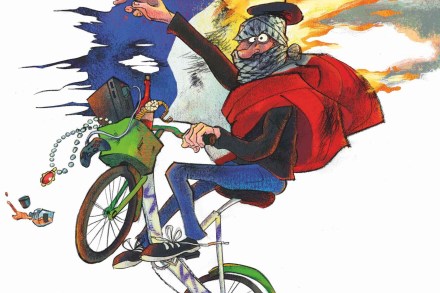
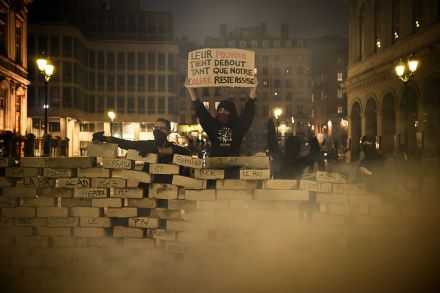
Paris The wonderful thing about electric bikes, if you are fighting with French riot police, is the way they burn. You skid your Lime or Vélib’ into the middle of the Boulevard de Magenta, which leads from the Gare du Nord down to the Place de la République, and set it alight along with a pile of ordinary bikes, and soon you have a conflagration of rubber and battery chemicals. During the weekend’s street protests, the fires provided cover for rioters breaking into mobile phone, vape and jewelry stores and the money-transfer shops which serve the many immigrants who work in eastern Paris. By Monday morning, a vicious guard dog stood outside an Intermarché supermarket, snarling at customers coming in one by one.

Vigilante on bike

What do Italy’s rioters want?

“Facciamo come in Francia!” shouted the masked and hooded rioters on Sunday in Milan and other major Italian cities, notably Turin and Bologna. “Let’s do like in France!” By far the worst violence was in Milan around the Duomo where about 3,000 rioters fought running battles with police and sacked and looted countless high-end shops. Most of the 200 rioters arrested in Milan on Sunday, plus the 70 odd on Saturday during similar though less destructive scenes, were Italian citizens who are the children of immigrants, according to media reports. They are known in Italian as “di seconda generazione.” Around 60 of those arrested were foreign nationals. Eighty percent were teenagers under the age of 18, some as young as 12. Far-left white activists were a small minority.

France is a warning – our civilization is not immortal

Could it happen here? I suppose that’s the underlying thought many of us have had as we watch France burn. And the immediate response is, why wouldn’t it? I am old enough to remember in the early 2000s when people used to say France was a model of integration. Then in 2005 the suburbs went up in flames, followed by parts of the center of Paris and other major cities. The Citroën flambé became a national dish and suddenly talk of “the French model of integration” disappeared. That same year, eight home-grown terrorists of foreign origin attempted to blow up the London transport network, four succeeded and a little bit of that blasé British attitude that we know better than the French disappeared too. In 2011 our own cities started burning, but we learned nothing from that.

I’ve ended my ‘situationship’

Provence Lying awake at 3.30 the other morning, I thought about a V.S. Pritchett quote: ‘Once one has got used to the big wrongs of life, little ones wake up, with their mean little teeth.’ These past few weeks ‘little ones… with their mean little teeth’ meant another chest infection, laryngitis, baffling spreadsheets, a painting I couldn’t get right which was holding up studio work, two new tyres, losing my glasses and almost daily migraines. But worse, with regret and a heavy heart, a few days before I’d ended for good an on/off long-distance and occasional, but fond, ‘situationship’. Horrible word but apt in this case. It was never going anywhere, neither of us wanted it to.

Our thirst for torching old buildings

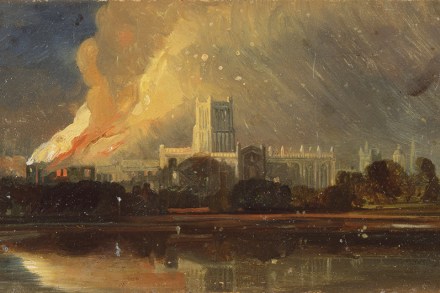
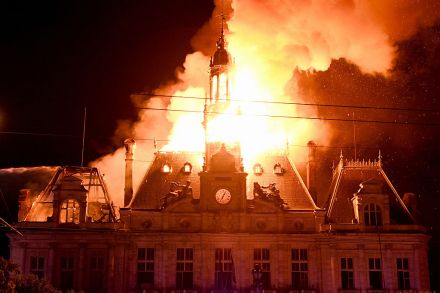
Regard the protestors. See how happy they are. Can you hear them whoop and whistle? The burning clock tower of the town hall has fallen inside the old building. Houp-là. How they whistle and whoop! The baying of such mobs in public places is as old as the history of towns and cities, the burning of buildings equally antique. Order and chaos, civilisation and barbarity, the call of the primeval. Limoges has long been famed for its ‘arts of fire’, of the elements and crafts involved in the making of enamelware that reached its artistic zenith between the 12th and 14th centuries with a host of exquisite crucifixes, crosiers and tomb effigies, a hosanna of book covers and reliquary caskets.

What I saw in the French riots

From our US edition

It’s the third week of the student-led protests in Lyon, and the second that my university has been blockaded “in solidarity.” When clouds of tear gas drift onto my street on Saturday, it’s an almost routine sight. My neighbor across the road is sitting by his window, eating potato chips, pointing out some of the more family-friendly placards to his toddler. Smartly dressed shoppers move through the crowds with scarves as improvised gas masks. I decide to make myself some porridge.   I am interrupted by a series of heavy thuds. Out of my window I see a group of balaclava-clad men taking turns to launch themselves at my neighbor’s front door. It eventually gives way, and they rush into his stairwell. The toddler begins to cry.   Time to leave.

lyon french riots

Could this be the end of the French Fifth Republic?

May 1958. After 12 years, France’s Fourth Republic was ungovernable, with cabinets lasting barely seven months on average. Four years of worsening war in Algeria culminated in the army’s Algiers putsch of May 13, demanding stronger political authority. General de Gaulle – Resistance hero, France’s savior in 1944 and now the army commanders’ choice – stepped forward. Exploiting the insurrection, he demanded the premiership, temporary rule by decree and six months to draft a constitution for approval by referendum rather than parliament. President René Coty agreed. On June 1, 1958, de Gaulle became the Fourth Republic’s last prime minister; six months later, he was the Fifth’s first president.

Barbarism cannot triumph in France

On Bastille Day, 1883, the people of Limoges inaugurated a beautiful new town hall, paid for from the legacy of a rich burgher with no children. On Saturday, rioters set fire to it. “Barbarism is not the prehistory of humanity but the faithful shadow that accompanies its every step.” That was Alain Finkielkraut, but I know it because Clive James quoted him when he wrote of how to keep our societies and values alive. He said we liked to think being cultured warded off barbarism, but that barbarism doesn’t care if we are cultured or not. He was only half right. Barbarism does care: it hates us for being cultured. Barbarism, whether imported or home bred, wants to see our culture burn.

The world’s greatest hotel has blocked the invasion of influencers

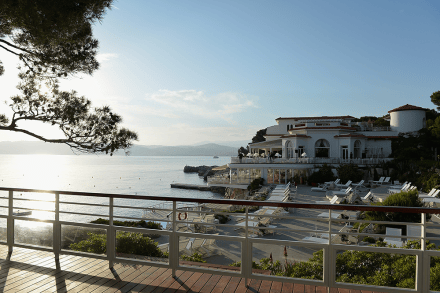
Antibes The poule de luxe stalked through the lobby on six-inch spike heels. In her wake shambled a small son and broken wallet of a husband. She held a selfie stick aloft to film every second of herself storming to her lunch reservation, single-minded in her search for prime social media content scraped from the best hotel in the world: the Hôtel du Cap-Eden-Roc, Boulevard John Fitzgerald Kennedy, Antibes. She had an expression that reminded me of Hitler’s smirk on the occasion of his pilgrimage to Napoleon’s tomb on his first and only trip to Paris in June 1940. It was one of glazed triumph that she had got there and wanted it all recorded for posterity.

We cannot trust our AI overlords

It is no longer an exaggeration to say that the digital apocalypse is at our door. The advance of artificial intelligence is outstripping our fears and expectations. The machinery of the state, slow and predictable by nature, is so thoroughly outpaced in its capacity to control and regulate that it does not even realise it. Our politicians, running on antiquated software, cling to problems that are pressing but dated (such as the retirement age and the number of civil servants) and barely speak of the cataclysm on the horizon. Édouard Philippe, who is currently the frontrunner of the traditional right-wing constellation in France, recently remarked that he used LLMs (large language models) to write his emails. Such is the abyss of our backwardness.

Do France’s student protesters have a point?

On September 21, students at the Lycée Saint-Exupéry in Créteil, south-east of Paris, staged a protest. They had a list of grievances. Classes were overcrowded and there was a shortage of teachers. They were also dismayed at the decaying state of some of the school buildings and the automated university admissions platform they feel deprives them of autonomy. Students filmed the protest and uploaded the footage onto social media. It went viral. Across France, children in other secondary schools joined the protest. They aired the same complaints as their peers in Créteil – and more. Some students described seeing rats in classrooms, others of enduring leaking ceilings and moldy walls. For many, memories of the summer heatwave were still painfully fresh.

Don’t take Britain’s cathedrals for granted

Everywhere I hear voices complaining about charges being imposed on those who wish to visit our great cathedrals. Everywhere, I reply to them: ‘Stop moaning and pay up!’ In fact, you should give more than you are asked. Who else is going to provide the money to save these astounding, irreplaceable buildings for a future in which they may one day be full of worshippers again? Wouldn’t you spend more on a good meal or a good bottle of wine, or a trip to the cinema? https://www.youtube.com/watch?v=2KJJ4FFVjGA Yes, of course, there should be concessions and exemptions if you are a child or disabled or have no job or are living on a tiny pension.