Food

Chicken forestière: a deeply autumnal dish

From our UK edition

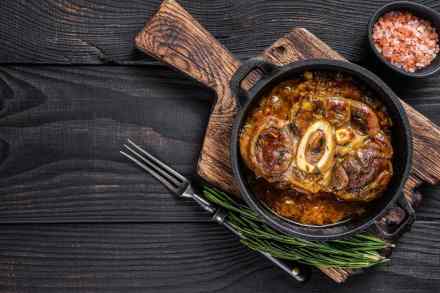
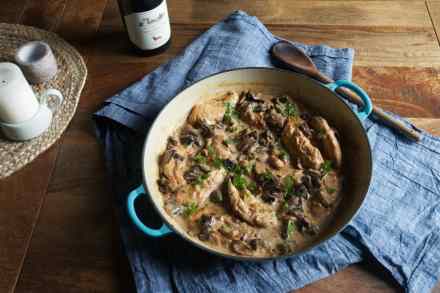
I have always been a bit of a stew-pusher; it tends to be my answer to any of life’s dilemmas, culinary or otherwise. Friends coming round? Stew. Cold and dark outside? Stew. Feeling sad? Stew. To be honest, it doesn’t matter whether or not the weather demands it, I am always in the mood for stew. I’d eat mince and dumplings in June, a slow-cooked sticky oxtail ragu in high Summer. But once Autumn arrives, and my obsession is legitimised by the cold and the dark evenings, there’s no stopping me. In our household, it’s casseroles from now until Spring. I struggle to think of something more comforting and cosy than a big, generous dish of braised meat, tender vegetables and a beautiful sauce arriving at the table.

Carbonnade à la Flamande: give your stew a Flemish makeover

From our UK edition

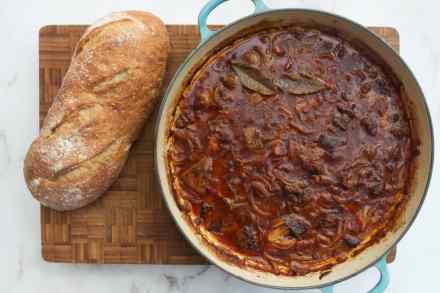
‘Casseroles,’ Julia Child wrote to her long-term penpal Avi DeVotos, ‘I even hate the name, as it always implies to me some god awful mess.’ On this, Julia and I are in full agreement: I have a real problem with the word ‘casserole’. And ‘stew’ for that matter. Both of them sound so unappetising, so school dinners. But Child and I are also aligned in our hypocrisy, because actually, deep down, I love a casserole, as long as you call it anything else. Like me, despite her vocal opposition to the casserole, Child loved bourguignons and carbonnades, coq au vin and poulet poele à l'estragon, and wrote about them with enthusiasm and appetite. Of course, all of these are casseroles, just with fancy (or specific) names.

The real Greek: Lemonia reviewed

From our UK edition

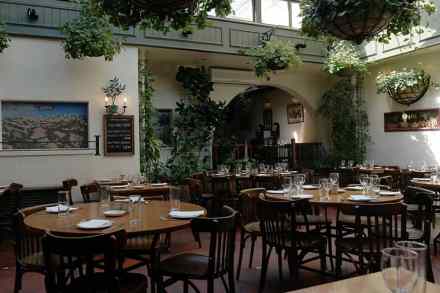
Lemonia lives in the old Chalk Farm Tavern in Primrose Hill, which is better known as the set of Paddington. It is not surrounded by fields filled with duellists under a hill of primroses these days, but it is still vast, pale and beautiful: a survivor in the sprawl. There has been a tavern on this site for so long — it was first recorded in 1678 when a corpse was carried to it — that it is possible John Keats drank here. I hope so. It is not a beaker of the warm south – it is slightly too near Camden and its stink of pigeon and bleach for that — but it is close enough. Some restaurants hold memories of pleasure: this is one such place.

Burrata inamorata

Wise men say only fools rush in. But in this particular instance, I really couldn’t help falling in love on the spot. Like a zillion others, the story starts on a night out. When my party, dripping with rain, arrived at the restaurant, our table wasn’t ready, and they ushered us to wait at the bar The bar was a happening kind of place. Instead of looking up at shelves of bottles and bartenders mixing drinks, it looked down onto the kitchen area, which was built around a giant wood fire over which five or six cooks labored frenetically. The flames blazed openly, fed from the picturesque log stack that lined the back wall of the dining area.

burrata

Curry can be guilt-free (if you know how to make it)

From our UK edition

Two of the misconceptions surrounding curry that it consistently struggles to shrug off are one, that it is unhealthy, and two, that it is difficult to make at home. I’ve always found both perplexing. Turks and Persians must be similarly bemused given the reputation of their archetypal food, the kebab. Yes the late night version, carved from a rotating trunk of greasy lamb with a mini chainsaw and then covered in garlic mayo, is a calorific car crash. But kebab as it was meant to be – meat simply grilled over charcoal and served with rice and salad – is perfectly healthy every day food. And yes a curry house korma is fattening, even before you add in the three poppadoms and pints.

What does Peter Quennell have to do with fish?

From our UK edition

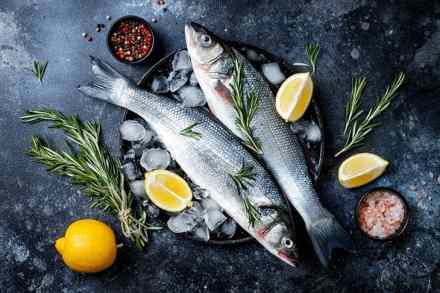
When Peter Quennell was sent down from Oxford for consorting with a woman called Cara (by Evelyn Waugh’s account), he joined Sacheverell Sitwell on honeymoon in Amalfi. I don’t know what Mrs Sitwell thought of it. I learnt this odd fact because I was seeing what connection his name had with quenelles, the fashionable dish like rissoles or gefilte fish traditionally made with pike in Nantua in France. Their quenelles are big — no fiddling around with spoons — and covered in crayfish sauce. They may be better eaten on location than tried at home. Anyway, there is no connection. The surname Quennell comes from the Old English cwen, meaning ‘woman’, and hild, ‘battle’.

Scarface’s lair with nibbles: Louie reviewed

From our UK edition

A French creole restaurant rises in the sullen ruins of London. It is called Louie, for French king or trumpeter, depending on your wish. It is next to the Ivy — now a private members’ club and franchise stretching to the London suburbs bearing small bowls of shepherd’s pie — and it is infinitely preferable. That is, I can get a table, and no pastiche medieval windows or tabloid photographers are involved. It’s a terrible thing being jostled into a gutter so someone can photograph the former cast of Crossroads. The Ivy is the Love Island of grand restaurants. It is for the spuriously famous, which is now everyone. The zeitgeist cries: we’re going to need a bigger Ivy. Or at least it used to. Louie is a small, golden rebuke.

Jamón Croquetas: an oozing Spanish entrée

From our UK edition

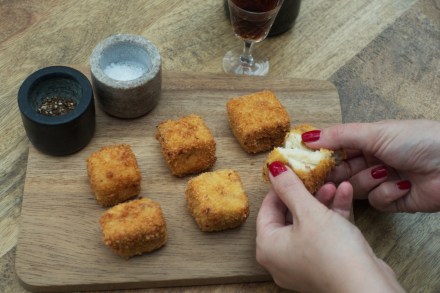
Being deeply unchic and uncosmopolitan, for a long time I assumed that croquetas were the same as the croquettes of my childhood: potato-based, probably a bit bland, and almost certainly coming from a bag that lives in the freezer. We’d often have them served with roast ham and cider sauce and green beans, as part of a main meal. To be fair to me and my culinary shortsightedness, the two bear strong similarities: both are breadcrumbed and fried or baked, soft within, and similarly shaped and sized. But, to my mind, croquetas are several levels above the French/English potato variant. Of course, Spanish croquetas don’t contain potato at all. The filling is made from a thick, thick bechamel sauce: a flour and butter roux cooked with milk to form a sauce.

In defence of cruel foods

From our UK edition

Fishmongers are an endangered species in London. Thankfully, 15 minutes walk across Westminster from The Spectator’s offices there is an excellent fish stall on Tachbrook Street market in Pimlico. Jonathan Norris’s stall — much frequented by 1990s Tory politicians — does a thriving trade in live lobsters. He will happily boil the crustaceans for you in his lobster kettle, but buying them alive is more fun, especially if you have children in tow. At this time of year the lobsters are Cornish; in the winter live lobster flown in from Canada will have to do. Buying — and then boiling — live lobsters is a sure way of getting children interested in their next meal, at least it is with my two boys.

Must all history programming be ‘relevant’?

From our UK edition

When it comes to history programming, television’s loss is increasingly audio’s gain. People moan to me most weeks over the lack of really good, rigorous, eye-opening documentaries on the screen, and I can only nod along in agreement. Oh for a Kenneth Clark-style lecture! More Michael Wood! There’s an especially strong appetite for the adventurous commissions of the 1990s and 2000s. It’s principally podcasts, now, that are pouring into this void. Stephen Fry’s Edwardian Secrets, a 12-episode sequel to his previous series on the Victorians, even sounds like an extended BBC4 documentary, replete with talking heads, choral background music and just a dash of Horrible Histories.

Bread is the staff of life

I cannot claim the gift of prophecy, but early in 2020 — before lockdown panic-buying and the warnings of a dire wheat harvest causing bread-price rises — I became a bread-maker. I dug around on the internet for a good recipe for sourdough, and found one padded out with the usual bloggery and waffle. Absent the philosophy and the pious musings, it gives a clear, sensible route to bread self-sufficiency. Sourdough doesn’t need bought-in yeast, only a ‘starter’ of flour and water. This is often called a ‘mother’, and attracts wild yeasts as it develops; after five days in the jar it is a gently bubbling ferment of living yeasts, and you keep it going by adding flour and water to it day by day.

bread
French

In search of lost French restaurants

Readers of a certain vintage will recall when any listing of fancy restaurants in a big city had a heavy French accent. Look at the ‘Let’s Eat Out’ section at the back of an old issue of Gourmet magazine from the 1970s for the evidence, at least for New York but, if memory serves, it was true for London as well. (The Italians probably ran second, then the Chinese, then a big falloff to other countries but still mostly European ones.) The way it worked at Gourmet — you got a listing if you bought an ad — only understated things. Lots of good places never advertised at all or simply did not aspire to the tony status that association with the likes of Gourmet conferred. Names like Le Chamberlin, La Caravelle, Le Chantilly, Mon Paris, announced their sole culinary allegiance.

The American dream has no time for offal

You can get goat in parts of New England. Consumers of Portuguese origin create a market unparalleled elsewhere in the US. In Boston, as I recall, Savenor’s used to sell camel and kangaroo. Few meats are too un-American for New York City. Ottomanelli, purveyors to whatever is left of the Four Hundred, still has venison of the quality they sold to the Upper East Side in the Gilded Age. Los Paisanos in Brooklyn stocks alligator, turtle and caribou. But the great days of the 1950s, when a club in New York served porcupine, caribou, muskrat and armadillo, are fled. With the closing of the American mind has come the narrowing of American appetites. Americans’ self-image is of enterprise, pioneering, innovation, adventure and the call of the wild.

offal

Tres leches cake: a soaked pudding straight from Latin America

From our UK edition

I confess, the idea of a tres leches cake did not initially appeal to me. A dry sponge soaked in a variety of tinned milks sounds, at best, like bland nursery food and, at worst, tooth-achingly saccharine. ‘Milky’ has never been one of the words that I hope to see in connection with anything other than ‘coffee’ or ‘Way’. But I saw it likened to trifle and curiosity got the better of me – and I’m so glad it did. Actually, a tres leches cake is not terribly like a trifle at all, although I can see where the comparison came from. Soaked puddings are nothing new, and that’s really what a tres leches cake is.

An intensely quiet and soulful performance from Nicolas Cage: Pig reviewed

From our UK edition

What use does a fallen and corrupted world have for a man of integrity? This was not the question I had anticipated walking away with after viewing the new Nicolas Cage indie Pig, but much of the film, from Cage’s intensely quiet and soulful performance to the new ideas it has to offer a very old narrative, was a satisfying surprise. The film is ultimately a story of revenge, but it plays out in unexpected ways. Cage is Robin Feld, a man living off the grid with only a truffle pig and a recording of his deceased wife for companions and a trade in the luxury food item as an income. But when his cabin is invaded and he is attacked and his pig is abducted, he’s forced to con-front his old life as a chef in Portland to get her back.

Watercress soup: the lunch that keeps on giving

From our UK edition

I’m normally averse to leftovers: it’s not a trait I like in myself. I’d far rather be able to eat the same thing for days on end, especially when it’s seasonal veg, or an enormous, hearty stew that I’ve spent ages making. It’s a sensible way of cooking: healthy, seasonal, cheap, time-saving. But I’m easily bored, and the best laid plans of mice and men the night before, clingfilmed or tupperwared up, no longer appeal the following lunchtime. I end up parcelling those thoughtful, carefully prepared dishes onto my husband and plumping instead for so-called novelty in the form of toast, or a sandwich. For some reason, soup is the one dish that doesn’t suffer this fate.

Who’d want to move to America now?

From our UK edition

There’s a biopic released this summer, Roadrunner, about the late great chef, writer, bon viveur and TV presenter Anthony Bourdain. It recounts the many invaluable lessons Bourdain taught, such as: never eat the lower colon of a warthog; never order fish in a restaurant on Monday (it will probably be three days old); and, most of all, the American Dream is over. This last fact may seem jarring. Bourdain was a proudly patriotic American. However, I firmly believe he reveals this truth in the 36th episode of his splendid food-and-travel TV show, No Reservations. In this particular episode Bourdain visits Cleveland, Ohio. In his boyish, enthusiastic way, Bourdain tries all manner of nosh.

Curry, colonialism and the problem with ‘cultural appropriation’

From our UK edition

The latest casualty in the culture wars is an innocent-sounding word: 'curry'. Apparently it's inappropriate to use it, and incorrect to use it to refer to all spicy Indian food. It's far too broad as to be misleading, doesn't even have pan-Indian usage, and it remains tainted by its colonial origins. This is the widely reported opinion of Chaheti Bansal, a Californian blogger who posts Indian recipes on Instagram.  'There's a saying the food in India changes every 100km and yet we're still using this umbrella term popularised by white people who couldn't be bothered to learn that actual names of our dishes', she writes, imploring people to 'unlearn' the term. The word was indeed made popular by colonialists: the Portuguese.

Have my suits shrunk in lockdown?

From our UK edition

I hadn’t noticed how much weight I’d put on during lockdown until I went out for a business lunch a couple of weeks ago. It was the first time I’d put on a suit and tie in 16 months. As I struggled to pull on the trousers, I thought: ‘Something’s wrong here. Did Caroline hang one of the children’s suits in my cupboard by mistake?’ But no. It was mine. To fasten the trousers I had to suck in my stomach like Mr Incredible trying to squeeze into his superhero costume. And my ‘slim fit’ white shirt wasn’t merely snug; it was more like a straitjacket. I looked like a bald Boris in his pre-Covid pomp.

High on the hog: The Pig at Bridge Place reviewed

From our UK edition

The Pig at Bridge Place is not a pig in possession of a country house, but I would be for it. You cannot have enough pigs, or any edible fauna. It is, rather, a hotel inside a Jacobean mansion — or, rather, part of a Jacobean mansion, the rest burnt down, and is all the better for it — in a pleasingly unkempt part of Kent, just beyond Canterbury. There are ten Pigs, dotted across the south coast as if in homage to Armada beacons. They are the successor to the Soho House brand, which is looking increasingly dusty, and in velvet. My main objection to Babington House is that it is for people with Peter Pan Syndrome: children who cannot grow up. They served fish-finger sandwiches and I think I saw a giant inflatable unicorn in the pool, but I have may have imagined it.