Europe

From the archives: Ridley was right

                                      In July 1990, Nicholas Ridley told Dominic Lawson that monetary union was “all a German racket designed to take over the whole of Europe”. He was immediately forced to resign from the Cabinet. In this week’s magazine, which hits newsstands today, Lawson says that Nicholas Ridley was right (subscribers click here). Here, in full, is the article that ended his career: Saying the unsayable about the Germans, Dominic Lawson, 14 July 1990 It is said, or it ought to have been said, that every Conservative Cabinet minister dreams of dictating a leader to

In this week's Spectator: The great euro swindle

Very rarely in political history has any faction or movement enjoyed such a complete and crushing victory as the Conservative Eurosceptics. The field is theirs. They were not merely right about the single currency, the greatest economic issue of our age — they were right for the right reasons. They foresaw with lucid, prophetic accuracy exactly how and why the euro would bring with it financial devastation and social collapse. Meanwhile the pro-Europeans find themselves in the same situation as appeasers in 1940, or communists after the fall of the Berlin Wall. They are utterly busted. Let’s examine the case of the Financial Times, which claims to be Britain’s premier

The Lib Dems warn the Tories over Europe

The Lib Dems have just had a brief Q&A on foreign affairs. Paddy Ashdown and defence minister Nick Harvey gave staunch their support to the Afghan Mission, but confessed to having misgivings. Ashdown described the Bush administration’s strategy as an “absolute model of how not to intervene, both militarily and politically”. This failure, Ashdown said, ensured that a “victor’s peace” is now beyond NATO’s grasp. Harvey admitted that NATO’s political progress in Afghanistan remained “very slow” despite ISAF’s recent military success; this is scarcely surprising given the litany of bombings and assassinations over the course of the summer. The debate touched on the need to forge new trade relationships and

WEB EXCLUSIVE: Spectator Europe Debate

It’s time for Britain to leave the European Union. That was the motion at last night’s Spectator debate. Rod Liddle officiated between the two sides, with Christopher Booker and Daniel Hannan supporting the motion and Denis MacShane and Phillip Sousta against. You can read Lloyd Evans’ exclusive report of the evening’s proceedings here. 

Time to leave the EU?

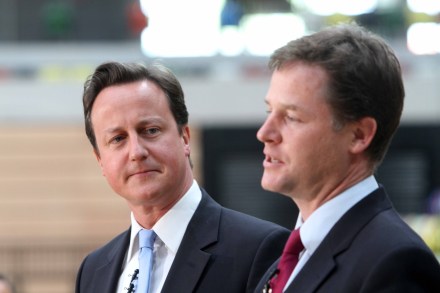
Today’s Lib Dem attack on their coalition partners comes from Chris Huhne, who rails against a “Tea Party tendency” in Conservatives sceptical of the European Union. His premise is that those who are hostile to the EU are a minority. It’s worth digging a little deeper here, because the opposite is true. If you believe that Britain has benefited from EU membership, you’re in a smallish minority – 35 per cent to be precise. Huhne seems genuinely unaware of the depth of feeling out there. CoffeeHousers may be familiar with opinion polls commissioned by eurosceptic groups. But – as we say in the leading article of this week’s Spectator – the

Italy in the firing line

Markets sank into negative territory this morning, following Standand&Poor’s downgrade of Italy’s credit rating. (Although they have since recovered.) The agency cut Italy’s rating from A+/A-1+ to A/A-1; it also kept its outlook as negative. The agency’s reasoning is hardly surprising: growth is negligible, debt is unsustainable and Silvio Berlusconi’s inert government appears incapable of arresting the crisis. Frail economics and supine politics, those twinned threats to prosperity, have struck again. The implications to the Eurozone, and the world economy, are obvious. An economist in Nomura’s Sydney office told Reuters, “It only adds to the contagion risk over Greece and has encouraged the flight to safety in markets here.” Over

The coming row over Europe

One of the most striking things about Lib Dem conference has been how up for a scrap over Europe the party’s ministers are. Every single Lib Dem Cabinet minister has, over the past few days, ruled out any attempt to repatriate powers from Brussels. Given that the Conservative party wouldn’t forgive David Cameron not attempting to use any new treaty negotiation to try and regain control of various issues (see David’s blog from earlier), this puts the Prime Minister in quite a dilemma. Personally, I expect Cameron will go for the repatriation of powers. The AV referendum showed that when he has to choose between really angering his party or

Europe looms its head to threaten the coalition and the Tories

The Telegraph’s splash on Europe indicates that the issue, which proved so toxic to the last Conservative government, has risen again. Writing a stern op-ed for the paper, serial rebel and anti-Cameroon Mark Pritchard calls for a referendum. This will have irritated Downing Street no end, which is understood to have hoped that the whip-sanctioned Eurosceptic grouping that has formed around George Eustice might have contained the party’s factious elements. But some disgruntled MPs on the right privately say that last week’s well attended meeting of Eustice’s group turned into something of a disappointment. The insistence that an exit from the EU was off-limits for the moment was apparently met

Osborne’s £12bn question

The FT makes for grim reading this morning (£). The paper claims to have replicated the Office for Budget Responsibility’s methodology and it has found that the structural deficit is £12 billion larger than was thought. If this is true, and coalition ministers are scrambling to deny it, then George Osborne is unlikely to have virtually eliminated the structural deficit by the end of this parliament, his avowed aim. The strategic implications are clear: the 2015 election would become a much tougher prospect for the Conservatives, as Osborne might to struggle to present them as the party that delivered the economy from disaster. There have been clear indications that all

The Lib Dems celebrate their achievements

Sandals are being rattled in Birmingham this morning. The Liberal Democrat conference opens to a chorus celebrating the party’s achievements in government. Nick Clegg tells the Independent that “Liberal Democrat fingerprints” are all over flagship coalition policies on schools, welfare, pensions, banking reform and the NHS reforms. He says of the latter that the Liberal Democrats have tempered the Conservatives. Clegg will reiterate this point at a rally later this afternoon. Despite news that the Liberals seek an electoral accommodation with the Conservatives, senior party figures are at pains to accentuate their differences with the Tories. Danny Alexander informs the Financial Times that he views the new backbench Tory Eurosceptic

From the archives: The doomed euro

It was doomed from the start; that’s the prognosis of those who think that the single currency’s crisis is near terminal, such are its structural and political weaknesses. People warned that it could be thus when the Euro was first launched. Bruce Anderson was among them:  Had Mr Blair been braver, he could have been in on this week’s euro euphoria, Bruce Anderson, The Spectator, 9 January 1999 The combined political will of 11 nations – or at least of their political elites – assured an easy birth for the euro. But the euphoria should not deceive us. Most thoughtful politicians and commentators throughout Euroland will acknowledge that the present

The deep Euro-crisis threatens political stability

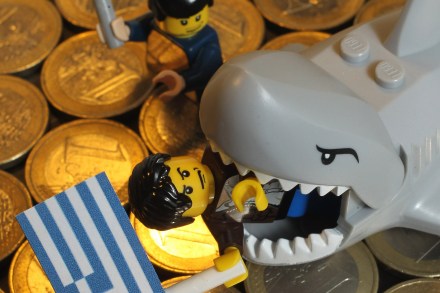
It is hard to overstate how serious the crisis in the eurozone is or what it might do to the politics of Europe. The European project is putting in danger the very political stability in Europe that its supporters have always claimed to be its strategic and moral justification. I understand that American banks are now so nervous about the situation on the continent that they have effectively stopped new lending to European banks. The view in Westminster today is that the Greeks will avoid default for a little longer. But few can see them making it to Christmas. Indeed, the expectation seems to be a default sometime in October.

Osborne: I know what it’s like to be in business

George Osborne spoke to Telegraph’s Festival of Business this morning and he gave a speech that was dominated by the issue of growth, or rather its absence. He reiterated the tax cuts and entrepreneurial relief measures first unveiled in March’s Budget. Osborne didn’t limit himself to his list of accomplishments. It was an empathetic speech. He related his memories of the “ups and downs” of his father’s business, the drapers Osborne&Little. He acknowledged the pressures of running your own enterprise in conjunction with a busy family life; a constant struggle that is exacerbated during hard times. “I know the kinds of pressure you are under,” he said. Osborne is frequently

"It started in Germany..."

Bugger the Bundesbank — that seems to be ECB President Jean-Claude Trichet’s current raison d’être. The ECB, together with other global central banks, yesterday agreed to provide dollar funding to ease the mounting liquidity crisis in European banks, largely caused by American banks curtailing interbank lending in anticipation of another crisis. This unorthodox action runs contrary to the wishes of the German Bundesbank, adding to the pre-existing strain between the ECB and the German establishment over bond purchasing, tension that was epitomised by the resignation of Jurgen Stark last weekend. Obviously, central banks do not take this action every day and it is yet another indication that crisis is now impending.

The last of England

Martin Vander Weyer’s column in the latest issue of the magazine is essential reading. It features five current stories from the business world. The Vickers report, Martin says, will merely offer the same poor service for consumers at a greater cost. Martin also notes, as he did two weeks ago, that American banks are winding down their lending to European counterparts in anticipation of a crash, and adds that American politicians are keen to paint Europe as the bogeyman for their financial ills, conveniently ignoring the failure of Obama’s hugely expensive stimulus. Martin also touches on unemployment and the Eurozone crisis. His final vignette is a parable for our troubled

Britain sues the ECB

As the EU debt drama continues unspooling like a perversely watchable soap opera (the FT’s Neil Hume describes it as ‘eurozone crisis porn’), an intriguing sub-plot has emerged: Britain is suing the European Central Bank. The Treasury is unhappy with an ECB move to limit the kind of euro-denominated products that can pass through UK clearing houses, suspecting it’s a bid to shift financial activity from London to Paris/Berlin. So it’s taking legal action, the first of its kind by an EU member state. This is not the first UK-EU disagreement that has surfaced in recent months, underlining the tensions between Britain and the Continent as financial centres across Europe

Merkel & Sarkozy have only words

It was something of a mystery. Emergency conference calls about the future of the Eurozone were being made yesterday, but there was no news of those discussions. As it turned out, this was for the best of all possible reasons: there was no news to report. Angela Merkel and Nicolas Sarkozy announced no new measures to alleviate the sovereign debt crisis; rather, they merely declared “solidarity” with Greece and assured the markets that Greece would not be forced from the single currency. Their words seem to have assuaged the markets for the moment, but only the most brazen optimist would bet on the rally being long lived. Tests of confidence

Clegg sounds a dire warning on the economy

Nick Clegg gave a speech on the economy earlier this morning. As Tim Montgomerie notes, Clegg came close to admitting that the economy is nearing crisis. He said, “The economic context is much worse than before. Yes, facts have changed” and added that the “government is not blind to deterioration in economic environment”. These warnings tighten a knot in already sick stomachs; but, with the Eurozone mired in a crisis that is fast becoming existential, banks under mounting strain, rising unemployment, widespread talk of further Quantitative Easing and the very public internal debate in the coalition about the need for tax cuts, Clegg’s comments don’t come as a great surprise.  He also introduced

The Euro-crisis heats up

Angela Merkel, Nicolas Sarkozy and George Papandreou are in crisis talks about Greek debt. There are rumours that they are preparing an “orderly default” for Greece. But, officially, Merkel is still pressing ahead with implementing the existing Greek debt deals. This meeting also has a domestic context for Merkel. According to the FT, she is determined to stamp on the growing disquiet within her governing coalition over the Eurozone crisis and is pleading for calm resolve. It remains to be seen if she succeeds.  The danger of contagion within the Eurozone remains and concerns about the exposure of French banks persist, which is doubly worrying for Nicolas Sarkozy given the proximity

Hague says he's been held back on Europe by the Lib Dems

William Hague’s comments in an interview with The Times that the Liberal Democrats are restraining the Tories on Europe will increase the grumbling among Tory backbenchers about the power of the junior coalition partner. Hague tells the paper that ‘A point of difference in our manifesto was the aim to repatriate some powers. Clearly that’s something I’m in favour of, but that’s the area we had to compromise on in return for other compromises.’ (In many ways this is a statement of the obvious. But in the current uncertain European environment, his remarks are news). In an attempt to reassure euro-sceptics, Foreign Secretary stresses that the Conservative party ‘would like