Economy

Brown kicks off 2010 with dividing lines aplenty

Clear your diary, invite the relatives over, and huddle around a computer: Gordon Brown will be delivering his New Year’s message – via podcast, on the Downing St website – this evening. Just in case you’ve got other things to be doing, this article in the Telegraph gives you a good taste of what to expect. In summary: dividing lines and optimism. There’s plenty on how the Tories are planning for “a decade of austerity and unfairness” – in contrast to our glorious PM, who predicts falling unemployment, more new businesses and prosperity for all. Indeed, the snippets that the Telegraph carries indicate just how eager Brown is to deploy a green shoots strategy.

Simple but effective?

It's the most straightforward dividing line the Tories could draw: "Tories good, Labour bad".  But it's still striking to see it deployed quite so bluntly as in George Osborne's Telegraph article this morning.  His point is that four more years of Labour will lead us to ruin, whereas a Conservative government would pull us out of the mire.  Here are some snippets: "Down the path of least resistance lie economic decline, higher interest rates, high unemployment, and more social breakdown. This is the path down which a cynical and exhausted Labour Government tempts us. But there is another path that leads to lasting recovery, rising prosperity, social responsibility and a new way of doing things. ... If Labour get in again, that won't happen.

Europe: ignoring the Lisbon Treaty when it suits them

Is Greece too big to fail? When the Eurozone project was up and running, its taxpayers were promised: this was not a system where they’d have to bail out a badly-run country like Greece or Italy (or Brown’s Britain, were we members). But this rule (a clause in the Lisbon Treaty) is being torn up with various assurances from Germany and the ECB that they Greece is too big to fail – and they’d rather put their taxpayers’ wonga on the table than risk their precious promise. I made this point in my News of the World column yesterday (that bit not online). Here’s the story: 1. The Eurozone did have a clear ‘no bailout’ promise.

It’s the economy, isn’t it?

The Tories' 17 point  lead in this morning's Observer Ipsos-Mori poll has got tongues wagging. The headline figure is that confidence in the economy, and by extension the government's management of it, has collapsed since the PBR. Just 32 percent of voters believe the economy will improve in 2010, compared to 46% last month. The politics of debt and the public finances appear to have swung decisively in favour of the Conservatives, and the leadership must press that advantage all the way to the ballot box. But the economy represents only part of the explanation. Anthony Wells' digest of the poll is a must read, and he notes that the 'lack of political weighting' has 'produced such extreme switches in support'.

Cameron plans to lighten up

David Cameron’s interview with Tim Shipman suggests that the Tory leader is about to undergo a course correction. The Tories have, rightly, begun to be frank with the public about the cuts that will need to be made and have, again rightly, refused to rule out a short-term rise in VAT. But the ‘we’re all in this together’ rhetoric has only been applied to the tough measures that are needed now not the prosperity that might follow in years to come. If Cameron is to start showing the public more of his vision of where he wants to take Britain then that is to be welcomed. But he also needs the rest of his top team to communicate to the public what the consequences of carrying on spending massively more than the country earns would be.

Cutting the deficit sooner won’t risk the recovery

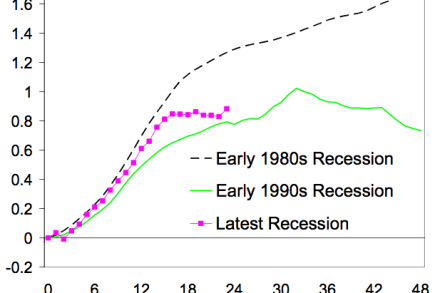
Would cutting spending “risk the recovery?” This claim is, literally, Gordon Brown’s re-election manifesto. He is hoping that the Tories haven’t learned to use numbers as weapons – so any economic message he has will not be effectively countered. In fact, his claim is very easily exposed as being bogus by a simple look at recent British economic history. Bloomberg’s Chart of the Day shows that economic growth in the past two recessions (white line) was not at all threatened by fiscal tightening (green graph). Even Goldman Sachs – which is acquiring a reputation as the Labour Party’s house broker – is conceding the central point.

Inflation nation<br />

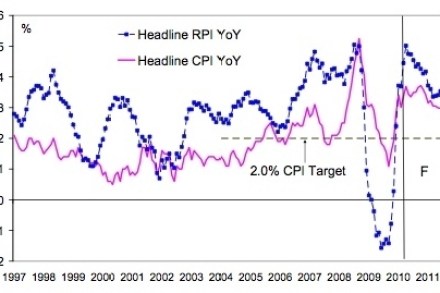
The inflation surge is now upon us. The CPI rate again “surprised” to the upside – Britain is the only major economy in the world to have inflation doing this. But given that the Bank of England’s printing presses have been working overtime to fund a fiscally irresponsible government then little wonder things are different here. To understand just how unusual the UK situation is, consider the below graph: despite suffering the longest recession in G20, we have one of highest rates of inflation in the developed world. The next few months will see this push higher, potentially reaching 4 percent in March and busting the 2 percent target.

The Tories should resist any temptation to go soft on debt

Of all the findings from today's ICM poll for the Guardian, I imagine this one will concern the Tory leadership most: "Just two months ago, 49 percent of voters said they thought Cameron and Osborne would do better than Darling and Brown, but that figure is 38 percent today." They're still ahead of Brown and Darling – who are langushing on 31 percent – but the drop is still pretty striking.  What's more, it seems to go against conventional wisdom about fixing the fiscal mess we're in.  While they could still go further in setting out a few specifics, the fact is that the Tory pair have spent the last couple of months railing against the the twin debt and deficit burdens, and stressing the need for spending cuts.

How long until the plug is pulled?<br />

Moody’s AAA sovereign monitor was published today, and whilst the UK’s AAA status remains ‘resilient’ the situation is far from rosy. The report states: ‘The UK economy entered the crisis in a vulnerable position, owing to the (overly) large size of its banking sector and the high level of household indebtedness. Both continue to weigh on economic performance. Net bank lending to the UK business sector has continued to contract through Q3 2009, and repairs to household balance sheets (i.e. the rising savings ratio) may weigh on demand for some time to come. The depth of the crisis has been mirrored by the ongoing deterioration of public finances (with gross debt/GDP having risen from 44% at the end of 2007 to an estimated 69% at the end of 2009).

Ever the optimist

It seems absurd to describe our dour and jowly Prime Minister as an eternal optimist, but he is. Rachel Sylvester’s column contains this delicious snippet of gossip: ‘When Mr Darling said that Britain was facing the worst recession for 60 years, Mr Brown telephoned him to tell him the downturn would be over in six months.’ Prudent foresight, there's nothing like it.

Obama & Reagan

I've remarked before that Barack Obama is, in many ways, American liberalism's long-delayed response to Ronald Reagan. This chart, found via Andrew Sullivan, comparing their Gallup approval ratings, is uncanny: Clearly, none of this is predictive, far-less guaranteeing that Obama will recover and romp to a second term as Reagan did. But what it does do is permit one to imagine both the upper and lower set of expectations one may reaonably hold for the rest of Obama's Presidency. (This has nothing to do with the wisdom of Obama's policies or one's approval of them). It's also a reminder to pundits everywhere that Presidents' ability to "make the political weather" is seriously limited.

Copenhagen dispatch

I make my second foray into the climate debate with trepidation. But visiting Denmark a few days before COP 15, it is impossible to escape the subject. Whether I speak to friends, family or strangers on the bus, everyone has a view and wants to share it. TV coverage of the forthcoming climate talks is relentless and there is even a separate passport queue for COP participants at Copenhagen’s stylish airport.   The latest “story” to emerge has pitted the new Climate Change Minister, the former commentator Lykke Friis against the Speaker of Parliament, Thor Pedersen. Though they are both from the same centre-right/liberal party, Mr.

Countdown to Copenhagen

How seriously are we to take Lord Stern on the economics of climate change? At the LSE yesterday, he rather hysterically claimed that the Copenhagen summit will be "the most important international gathering since the Second World War". Crucially, he added that the cost of dealing with the problem may reach 5 percent of GDP. Even so, "it would still be a good deal," he said. Really? Losing world economic growth condemns millions in the Third World to poverty: the globalisation of the last 15 years has been the greatest anti-poverty tool ever invented. So we should not be blasé about sacrificing growth, as if all it means is smaller cars for the rich. Poverty kills, and so will forfeited economic growth. Stern would argue that climate change also kills.

Turning Japanese

Is the British economy turning Japanese? Since asking the question last year on Coffee House, the evidence has been piling up – and it makes for a cover story in this week's magazine (which I have written with Mark Bathgate). The similarities are as follows: 1. Japan’s bust followed years of debt-fuelled growth which vain politicians saw as prosperity. 2. When the bust came, Japan’s government kept on spending. They did so in the name of Keynsian stimulus, thinking this would in itself kick start a recovery. All it achieved was to sink Japan deeper into debt. 3. Crucially, Japan didn’t do full disclosure on the collapsed banks. To fix the banks was, they figured, painful root canal surgery that this recession-struck country could do without. 4.

Saving the world | 25 November 2009

Today’s revised GDP data confirms that the UK remained alone of the world’s major economies in recession in the third quarter of this year*. The fact that the UK remains mired in recession long after most economies have recovered makes clear how uniquely badly positioned the UK economy was to handle a downturn.  While some investment banks continue to argue that this performance reflects the inability of the Office of National Statistics to calculate the data correctly, there is good reason to believe that this huge underperformance is grounded in reality. Economic history teaches that bank crises are amongst the worst things that can ever hit an economy. The collapse in credit availability and soaring bank margins have posed very substantial risks to economic growth.

There are more pressing financial concerns than this

The two top dogs at the Treasury Select Committee, John McFall and Michael Fallon, give remarkably different reactions to the news that ministers withheld details of emergency loans to RBS and Lloyds for over a year. McFall argues that secrecy was necessary to avoid a run on the banks; Fallon expresses outrage that Lloyds’ shareholders were not privy to all information when considering the disastrous purchase of HBOS, urged on them by the Prime Minister.   Both have their points. Blind panic is the defining recollection of those autumnal days. If the situation had been exacerbated by full disclosure of the mess RBS and Lloyds were in then God alone knows what pandemonium would have ensued.

Brown goes for growth – fails

So the dividing line persists.  Today, both Gordon Brown and David Cameron will talk about "going for growth" at the CBI's annual conference.  But it all, more or less, comes down to the same, dreary "investment vs cuts" line that we've heard countless times before.  According to the Times, Brown is going to say that growth is the best way of tackling the deficit, rather than those nasty Tory cuts.  And, what's more, "he hopes investment from China will drive the recovery". Of course, growth will have a role to play in reducing the deficit.  A vibrant economy will have a better chance of tackling record deficits and debt levels than a sinking one.  But to indicate that extensive cuts will not be necessary is disingenuous in the extreme.

Portillo: the Tories won’t succeed in cutting public spending – they’ll have to raise taxes

Ever the contrarian, Michael Portillo makes a case that you don't hear from many on the right in his interview with Andrew Neil on Straight Talk this weekend.  George Osborne has given "a fair amout of detail" about the Tories' debt-reduction plans, he says, but that could be the wrong approach: "I wouldn’t seek probably to give very much more detail ....  You know, I was with Margaret Thatcher when she came in to Government in 1979, we faced a big public spending problem.  It was terrible.  It was a hard slog but she didn’t cut public spending.  I was Chief Secretary between ’92 and ’94 – big public spending problem – I was trying to cut public spending; I did not succeed in cutting public spending.

Fatal inexperience

The Government debt mountain grew by a further £11.4billion in October. The UK now has one of the most expensive governments in the European Union – now materially above the Eurozone average and within touching distance of France and Sweden in spending above 50% of GDP.  Blaming large Government per se for economic problems is overly simplistic – larger Government spending countries like Sweden and Finland have managed to build export market shares and provided stock market returns over the past couple of decades that put the UK to shame. Spain now has thousands of miles of high speed railways and over 50% of their energy needs come from renewables.

The gathering storm

The UK inflation rate again “surprised” to the upside today, registering at 1.5%. As the above chart shows, the UK now has by some margin the highest inflation rate in G7. Were it not for the temporary VAT cut – which takes about 1% off the current CPI rate – the rate would be moving quickly above the Bank of England’s target of 2%. It would seem that the deflation threat, used as justification for the Bank of England deciding to finance the Government’s deficit this year through printing money, has not transpired. A severe recession and rise in unemployment has hit the economy, but this seems to be one where wages stagnate but the prices of what we consume continue to rise.