Economy

How much attention should politicians pay the competing groups of economists?

The recession has been intellectually thrilling, and I write that without a note of sarcasm. First, politicians argued as to whose understanding of Keynes was greatest; and now they’re in Keynes versus Hayek territory, over the timing and depth of cuts. The Chancellor and his Shadow have marshalled the various authorities who support their respective cases. The science of economics, if it is science, is in its adolescence. Should necessarily equivalent government policy be detirmined by pure intellectual opinions and reputations, especially as those are being forged for posterity by current events? Economics is as much history as science - like Coleridge’s lantern on the stern of the ship; it illuminates the waters through which we have sailed.

The numbers spoil Labour’s narrative

Labour have certainly come out of the traps snarling and gnashing this morning.  For one, they're making the most of two letters in the FT, signed by 60 economists, which ostensibly support their position on the public finances.  And then there's Gordon Brown's speech to European leaders, in which he implores them to tackle the "hatred" of "the right".  Naturally, by "the right", he means "David Cameron". It's those letters which really grab the attention, though.  Not really because of what they say, or who has signed them, but because they're suggestive of how the debate over the public finances is going to go.  Yep, the Tories get 20 economists to write a letter in support of their deficit-reduction plans, so Labour respond with 60 economists of their own.

Cameron and the power of the bully pulpit

I must be one of the very few people who would genuinely like to see David Cameron give another speech on chocolate oranges. There was much mockery of it but it contained a very important point: there are some things that a business can do that have negative externalities to which the appropriate response is not taxation or regulation but social disapprobation. So, it was good to see Cameron promising both to use the power of his office to call out companies that sell age inappropriate products and to make it easier for people to protest against such behaviour. There are other areas where I expect social pressure could be effective. It would be fantastic if Cameron would say that only people who are domiciled and resident in this country for tax purposes are eligible for honours.

Can it get much worse than this?

£4.3bn in the red, that is the gruesome fact of the government’s January accounts. Never before has the government borrowed money in January, usually a month of surplus as self-assessed income and corporation tax receipts line government coffers. Analysts forecast a surplus of £2.8bn, denoting just how bad the situation is. This is an exact copy of last July’s accounts, lending weight to the analysis that Britain’s recovery is slow and very precarious, an analysis confirmed by the weakest mortgage lending figures for ten years. Obviously tax revenues have collapsed.

The Tories’ new poster campaign is a massive improvement over the last

I know there's a danger of expending too many words on poster campaigns, so just a quick post to flag up the designs the Tories launched this morning.  There's one of them above, and two more based on the same theme - "I've never voted Tory before, but..." - which you can see here. To my eyes, at least, they're a massive improvement over the last, graveyard poster: refreshingly positive, while also attacking The Way Things Are Now.   Now, I know there are CoffeeHousers who liked the Death Tax poster precisely because it got down 'n' dirty, taking the fight to Labour.  But, despite their sunnier front, these latest posters will also hit Labour where it hurts.  After all, one of the ideas that Brown & Co.

It is Brown and Balls versus Darling and Mandelson again

If there was a story in the Sunday papers of a split between David Cameron and the two most senior figures in the shadow Cabinet over economic strategy it would be the talk of the town. But because it is about Brown and Balls versus Darling and Mandelson it is on the inside pages; it is as if the split over economic policy between these four men is priced into Labour’s standing. Patrick Hennessy reports that Brown and Balls would like to use the Budget as a pre-election springboard, announcing larger than scheduled increases in public spending and challenging the Tories to match them.

Brown wants to discuss nothing besides the middle class

Aspiration is Gordon’s middle name. The Observer has an extensive interview with Brown and though the classification has changed class remains his obsession: Brown wants to fight the election on the middle classes. He spoke of little else. Education and family policy will be defined by Sure Start, child tax credits and the school leaving age; the NHS will offer yet more choice and unaffordable luxuries, such as one to one care. It may seem peculiar for a man who is synonymous with stealth taxes, and whose time in government will be remembered for the polarisation of society, to frame his arguments in such terms; but his reason is clear: Brown doesn’t want to debate the economy.

Parris versus Nelson

Here’s a question: to be a good angel or a bad angel? We know what Fraser thinks; Matthew Parris differs. Writing in the Times today, he asserts that he would give David Cameron the same advice he offered Margaret Thatcher in 1979: agree a gloriously unspecific manifesto. The details of hard-edged manifestos are ambushed well before polling day; discretion is the better part of valour. In the immediate circumstances of the Tory wobble both arguments are commendable. The Tories have unwound when trying to supply detail to flesh out their broadly radical ideas. Recognising marriage in the tax system has been their foremost blunder.

Practice – not pay – may be the key to public sector workforce savings

Great article from my former boss, Andrew Haldenby of Reform, in today's Telegraph.  He makes the general case that spending less on public services needn't mean worse public service – far from it, in fact – and is scathing about the political class's inability to soak up this lesson.  But it's this passage which jumped out at me: "Another path to reform is to get more out of the workforce. Simple changes have tremendous results. If public-sector workers took the same amount of sick leave as those in the private sector, that would save 3 per cent of their wage bill, which adds up to £6 billion per year. If they worked the same number of hours per week as in the private sector, that would save a further 10 per cent, or £20 billion per year.

The Old Lady is becoming more pessimistic

Faisal Islam, Channel 4’s economic correspondent,  is one of the journalists who best understands what the Bank of England’s institutional view is. So it is interesting to see him writing this today: “I’m convinced that at Threadneedle Street, they were shocked by the limpness of Britain’s exit from recession. They have been running their big computer model in the past weeks. When it reveals new economic forecasts next Wednesday, we are likely to see a marked downgrade to Britain’s economic prospects.” Politically this could have an impact as Labour’s, to put it charitably, extremely optimistic growth forecasts are what allow it to claim that it will cut the deficit in half in four years.

Mandelson is spinning to his heart’s content

Peter Mandelson was doing his full Alan Rickman impression at Labour’s press conference this morning. His aim was to imply that every time Labour put the Tories under pressure they wobble. As so often since his return to British politics, Mandelson delivered lines that were so memorable that they were bound to make it into copy. He said that the Tories “would strangle the recovery at birth”, that David Cameron was “bobbing around like a cork in water”, and that George Osborne was the Tories’ “weakest link”. As I type, Mandleson’s sound bites are being replayed yet again on News 24. Now, these lines aren’t going to cut through to the British public.

The economy has gone precisely nowhere in 5 years, but at considerable cost

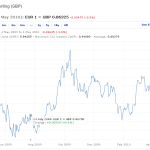
The longest recession suffered by any major country in this cycle seems thankfully to be drawing to an end, even if only by the narrowest of margins.  Such has been the severity of the downturn though, that, as the above chart shows, GDP has fallen back to the levels of mid-2005. The economy is basically the same size as at the time of the last election. This means for probably the first time in modern British history, living standards have failed to rise for almost the entire duration of a Parliament.   Sadly, the cost of the economy going nowhere has not been as lacking as the growth or living standard increases. The national debt has virtually doubled since the last general election, rising from £440 billion to £870 billion now.

Growth but of the weakest possible sort

So Britain did grow in the fourth quarter of last year but only by 0.1 percent. Many on the Labour side had hoped that the moment that the country started growing again, Brown would be able to go on the offensive; arguing that his handling of the economy had steered Britain through the crisis. But the fact that the growth number is considerably lower than expected, most predictions were for growth of 0.3 to 0.4 percent, has rather stymied that plan. There are now only one more set of GDP figures before the election, presuming that it is held in May. So, it is now almost certain that Brown will not be able to go to the country boasting of a robust recovery. (The worst case scenario for Brown is that these figures are revised downwards meaning we are still in recession).

Out of recession and into debt

The deficit is in the Tories' crosshairs this morning. George Osborne pens an article in the Times, castigating Brown's obsession with continuity: ‘We need a new British economic model that learns from the mistakes of the past. First, that new economic model requires government to live within its means. We entered the recession, after years of growth, with one of the highest deficits in the developed world and we leave the recession with our credit rating under threat. That will have potentially disastrous consequences for international confidence. If Britain starts to pay the sort of risk premiums that Greece is paying, the interest bill on a £150,000 mortgage would go up by more than £200 a month.

When it comes to localism, absolute clarity of aim is essential

How deep is David Cameron’s commitment top empowering local government? His response to the New Local Government Network’s latest report will be an indication. The report argues that elected mayors should raise or cut business rates and council tax, and spend the proceeds on local services. Mayoral coffers will hardly match the riches of the Spanish Main, the Times reports: ‘The authors have calculated that a 4p levy on business rates could raise £30 million for Birmingham, £10 million for Newcastle, £26 million for Leeds and £11 million for Milton Keynes.

Darling talks sense on public sector pay

How things change.  A few months ago, Alistair Darling would only go so far as to not rule out a public sector pay freeze.  By the time of the Pre-Budget Report, that became a 1 percent cap on pay rises.  And now, in an interview with the Sunday Times, he's talking explicitly about public sector pay cuts.  He cites the example of the private sector, where workers have accepted cuts to hang onto their jobs. It certainly makes sense.  Wages make up such a hefty proportion of public spending, that any serious plan to cut the deficit will have to take them into account.

Why Osborne is getting it right on banking

Oh dear. After Massachussetts, it seems like the usual sneering about "populist" politicians, and about voters who aren't happy with the bankers, is back.  So here are a few facts of life for those knocking people who think the banking sector could still do with a lot of fixing: 1) The financial performance of the financial services industry over the past decade, in aggregate, has been shocking. Someone who had invested in the US or UK stock market would have seen their investment in real terms (net of inflation) fall by over a third. Shareholders have been brutalized for the best part of a generation now.

The public aren’t seeing Brown’s “green shoots”

We've been rather starved of opinion polls over the past week, which is probably no bad thing.  But this PoliticsHome poll on the economy has come along to give us at least something to mull over.  And its findings aren't good news for Labour. First, only thirty-four percent of repondents think that the economy has turned a corner into recovery.  And, crucially, only 36 percent are willing to give Labour "a lot" or "some" credit for their handling of the recession (down from 40 percent last August).  That's against 29 percent saying "not very much," and 34 percent saying "none at all". As we saw on Wednesday, Labour is eager to seize on any potential "green shoots," and sell them as successes for government policy.

Rompuy wants the EU to slither onto the world stage

Well hello there, Rompuy. We haven’t heard much from the new EU president so far – he was upstaged by Barroso at the Copenhagen conference, showing that the EU stage only has room for one super-ego*. But with the Lisbon Treaty ratified, in defiance of public opinion in Britain (and Labour’s manifesto pledge), he now has powers to advance the EU project further. His idea today: the possible development of a "humanitarian rapid reaction force" for the EU. This rung a bell with me. When I did my tour of duty in the Scottish Parliament, this was a goal of the SNP. They want to creep on to the world stage, without asking permission. One step is to send “observers” to various committees. But aid is the softest target.

Turnbull savages chancellor Brown

Andrew Turnbull, who was permanent secretary at the Treasury from 1998 to 2002 and Cabinet Secretary from 2003 to 2005, has previous when it comes to criticising Gordon Brown. But his recent piece in the FT — ‘Six steps to salvage the Treasury’ — is one long barely coded attack on the PM. Take this line: “First and perhaps foremost, it [the Treasury] needs a strong ministerial team – a chancellor who wants to be chancellor for the full term rather than coveting the prime minister’s job.” Interestingly, Turnbull comes out in favour of the Tories’ plans to create an Office of Budgetary Responsibility. I know this is derided by some as yet another quango, but I actually think it will be an important reform.