Economy

What Harriet Harman won’t tell you

By her usual standards, Harriet Harman was quite effective in her response to George Osborne's Budget earlier.  She was clear, direct and had a few gags at Vince Cable's expense.  And she also benefitted from what, on the surface, was a strong central attack: the Office for Budget Responsibility, she said, has downgraded its jobs forecasts on the back of the Budget.  And so, she followed, this is a Budget which destroys jobs. But there were a few things that Harman wasn't letting on.  First, as Jim Pickard points out at the FT, the OBR forecasts haven't shifted by all that much from their previous incarnation.  And, second, they are still more optmistic than most independent forecasts (conveniently collected by the Treasury here).

George Osborne must put spending cuts ahead of tax rises

In 2009, Britain borrowed more, as a share of its national income, than any country that isn't being bailed out by the IMF and the Eurozone (Greece) or already making drastic spending cuts (Ireland).  That huge deficit is the critical challenge to our economic stability that George Osborne needs to tackle with the Budget today.  We have got away with high borrowing so far on the understanding that cuts are coming now the election is out of the way.   If you think tax hikes are the answer, then you're asking the wrong question.  Our present fiscal crisis is built on a decade of bumper rises in spending, not tax cuts.  Over the last decade, spending rose from 36.6 per cent of GDP to 53.4 per cent this year according to OECD data.

Back into the black

George Osborne has an historic opportunity to begin to turn the UK's public finances back into the black. As Reform noted in an alternative budget released last week, while this will require making the toughest spending choices for a generation, history will smile on him if he does this in the right way. What the right way is will largely reflect three key things. First, George Osborne's Budget needs to be ambitious in its timeframe for reducing the deficit. Setting out to, say, simply "eliminate the bulk of the structural deficit in the term of this Parliament" will not be enough. Delay will make fiscal consolidation harder as interest payments on debt and the costs of unreformed programmes and entitlements will continue to rise.

Osborne makes the “progressive” case

During the Brown years it was "stability," but it looks as though the watchword for Chancellor Osborne's first Budget will be "progressive".  This is the word that's being bandied about behind-the-scenes, and the coalition seems confident that it has the policies to match the rhetoric.  As the Guardian reports today, it's likely that the personal income tax allowance will be raised by £1,000 or so, to help shield the least well-off from tax rises elsewhere.  And the paper quotes a Tory aide saying that the richest will pay more, "both in absolute terms and as a percentage of their income." Whether he drops the p-word or not, the arguments behind it are comfortable territory for Osborne.

Osborne’s massive opportunity

I’m quite optimistic about George Osborne’s budget – in the same sense that one might have been optimistic when Churchill took over from Chamberlain. Not because the situation is good, or because you think the road ahead will be easy or enjoyable, but because the road no longer leads to disaster. Not that Osborne is a Churchill – even though he will have his own fair share of blood, sweat toil and tears for us on Tuesday. I’m pretty confident he’ll head in the right direction, and at the right speed. I discuss this in my News of the World column today, but will say a little more here: 1. This Budget will probably mark the point when the UK started to recover. For two months now, the economic data has been favourable.

The Budget: compromise and non-compromise

It's hard to overestimate the significance of Tuesday's Budget. George Osborne's statement won't just determine the course of our economy for the next few years, but also the political life of this government. Spending cuts and tax rises may not inevitably "fracture the coalition," as Peter Oborne puts it in the Mail today. But they certainly have the potential to. Happily for the coalition, the current political mood is so geared towards fiscal restraint that there will be little immediate opposition to Osborne's general plans.  That will come once the effects of spending cuts are felt in individual constituencies  – months, even years, down the line.

The Big Society reincarnated

The Big Society is a great idea. But its problem has always been that it lacks definition; voters and even some Tory MPs aren’t quite sure what it means. But an idea being floated today gives you a sense of its practical and political potential. It is being suggested that the community right to buy, the idea that the community should have first refusal on any asset being sold off, should be applied to the port of Dover. The last government wanted to privatise the port but the new MP for Dover, a Tory called Charlie Elphicke has proposed that a community trust be allowed to buy the port and then lease it out to an operator.

The coalition is edging the public spending debate

Danny Alexander acquitted himself effectively this morning. The restructuring of government spending has gone beyond bland clichés about ‘efficiencies’; with care, the government is dismantling Labour’s unfunded spending projects. £8.5bn in unfunded projects signed-off since 1 January 2010 are on a stay of execution until the autumn; £1bn of unfunded projects signed-off before 1 January 2010 are also on their way to the block. £2bn will be saved almost immediately with the cancellation of the 2 year jobseekers’ guarantee, the young person’s guarantee, CLG regional leader board, the local authority business growth incentive and the county sports partnerships.

Cameron’s European balancing act

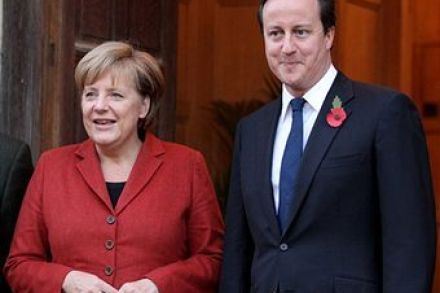
So David Cameron strides onto the European stage today, with his first EU summit since becoming Prime Minister. And early signs are that it's going to be a peculiar day for him. As Ben Brogan writes in the Telegraph, Europe seems to be liking the (liberal-democratised) Tories more than they thought they would. Sarkozy is, apparently, "smitten" with our PM, while Angela Merkel "has come to admire his directness". So after pitching himself against the Lisbon Treaty, and broadly selling himself as a eurosceptic over the past few years, Cameron now faces the prospect of cuddles over the coffee and croissants in Brussels. Like I say: peculiar. I suspect Cameron will be keen to avoid being hugged too tight, though.

A good war

As Allister Heath notes in City AM this morning, Mervyn King has had a good war. Well, not so much a good war as a profitable peace. King contributed to the domestic crisis by sustaining very low interest rates whilst ignoring asset prices. Brown may have forced the Governor’s hand, but King was groggily supine until a sovereign debt crisis threatened. George Osborne is dismantling Gordon Brown’s regulatory imperium. King is the major beneficiary as the FSA is subsumed by the Bank of England. How will exercise that power? Obviously, time will tell; but monetary tightening will moderate excess (and spruce up banks' balance sheets) in the short-term.

Osborne gets upfront about our debt burden

A couple of weeks on holiday, and there's plenty to catch up on.  First, though, George Osborne's speech to Mansion House yesterday evening.  In terms of substance, it was fairly radical stuff.  And it's encouraging that so many of the Tories' solid plans for reforming the financial regulatory system have survived the coalition process.  But, really, it was one simple, little sentence which jumped out at me.  This: "Debt [is] set to still rise even at the end of this five year Parliament." "So what?" you may be thinking, "we knew that already."  Ah, yes, but we've rarely heard a politician be quite so upfront about our debt position before – at least not voluntarily.

The debate opens as Darling is vindicated and condemned

As Fraser observed at the weekend, Alistair Darling has a point: it is not as bad as was feared. The new Office for Budget Responsibility agrees, reducing estimated public borrowing to £155bn 2010/11. Still, it’s hardly a picnic is it? And I wonder what response Darling will get if he presses Cameron and Osborne for an apology. His growth forecasts have been downgraded to 2.6 percent and the structural deficit is greater than he admitted to – Paul Mason reckons it’s about £5bn more than was forecast. Osborne’s hands are tied by these figures; his calculations will be based on them. There is, of course, the possibility that the OBR's predictions are no more accurate than the Treasury’s soothsayings.

Waiting on the OBR

The Office for Budget Responsibility is expected to downgrade the previous government’s growth forecasts. Alistair Darling’s rosy prediction that the economy would grow by 3-3.5 percent in 2011 will be replaced by a conservative estimate of 2-2.5 percent, in line with other independent forecasters. Also, according to the Guardian, the OBR will ‘trim’ the Treasury’s breezy estimates of growth until 2014-15.   There is no guarantee that the OBR’s forecast will be flawless – and the Treasury Select Committee's scrutiny will have to be exhaustive. But George Osborne is bound to the OBR’s figures, rather than the Treasury being bound to a political agenda. Balance and responsibility will be restored to Budget decisions.

Darling has a point

I had expected Alistair Darling to have slumped off to spend more time with his memoirs after the election, but here he is, fists aloft, fighting the government. About the only member of the Labour front bench effectively doing so. He has a point. The economy is looking better than expected, not worse - as David Cameron has been pretending. Each new forecast for the deficit seems to give a less ghastly picture. British house prices are on the rebound. And when the Office of Budget Responsibility announces its forecasts on Monday, it is likely to give a better picture than that in Darling's budget. Already Darling is telling the Guardian that he wants "an apology" if this is so.

Darling: it’s not as bad as all that

Alistair Darling is about to retire to the backbenches, though he stresses (and hopes) that it's a brief stint in obscurity. ‘I get bored,’ he tells the Guardian in an interview today. Darling is remarkable. He emerged from 13 years in cabinet and a hellish tenure as Chancellor with his reputation enhanced. There were rumours of a leadership bid, but those were fanciful. Darling was not an architect of New Labour, but he certainly laid the odd brick. Darling could not break the legacy of Blair and Brown, and reveals as much in his Guardian interview.

Cable, the free radical, dreams of a grand future

What is Vince Cable up to? He is on manoeuvres, keeps making attempted power grabs from George Osborne. Barely a week passes without him rattling the cage to which Cameron and Clegg have confined him  - that is, the unwieldy and yet fairly powerless Department for Business, Innovation & Skills. For all its bulk, the department doesn’t really do anything. It has the universities brief, which is important, but it is certainly not an economics department as Cable was pretending last week. “It is a bit like the German economics ministry and the finance ministry,” he claimed. “Two departments, working in parallel.” As if.

Lord Ashdown’s the right man for the Balkans

Last week, Europe’s foreign ministers gathered in Sarajevo under much fanfare – and did very little except issue a repetitive press release about the region’s future in the EU. The only highlight of the event was William Hague’s speech, which was excellent.   Enlargement, however, is deeply unpopular among European elites, and the gathered foreign ministers seemed to be acutely aware of how little the market will bear by way of new ideas and initiatives.   So the ideas I put out in a brief in the run-up to the summit for improving the EU’s accession process went nowhere. Only Austria and Estonia openly defended proposals at the meeting. Germany joined France as a major opponent of any change in enlargement policy.

Osborne’s successful first outing on the international stage

George Osborne’s Asia trip has now been rounded off with a meeting of the G20 finance ministers in South Korea and he is now heading back to Britain and his Budget preparations. The trip must be marked up as a success for Osborne. In its communiqué, the meeting implicitly endorsed Osborne’s two major moves since becoming Chancellor, cuts this year and the setting up of the Office of Budgetary Responsibility:  ‘We welcome the recent announcements by some countries to reduce their deficits in 2010 and strengthen their fiscal frameworks and institutions’ No one can doubt that the Tories have comprehensively won the argument for in-year cuts.

Pacific islands defy apocalyptic climate change scenarios

The President of the Maldives can sell his snorkel: he’ll be waving not drowning. The New Scientist carries a fascinating article, examining the research of Paul Kench of the University of Auckland and Arthur Webb of the South Pacific Applied Geoscience Commission. Using aerial photographs and high-resolution satellite images, Kench and Webb have found that 23 out of 27 low-lying Pacific islands, deemed to be vulnerable to rising sea levels, have grown by up to 10 percent in 40 years. Local sea levels have risen by 120 millimetres over the period. Coral is defying the apocalyptic flooding scenarios. Reef coral surrounding the islands is eroded and deposited to form atolls or coastal spurs.