Economy

Osborne emerges from the shadows

George Osborne has been quiet these past few weeks, tussling with ministers desperate to preserve some of their budget from his spending review. Today though, Osborne will emerge from the Treasury's recesses to launch a political attack on the ‘deficit denying’ opposition. Come on, Osborne will ask Darling et al, where are these £44bn of cuts you planned?   And answer comes there none, not even an incredible one. Labour’s refusal to countenance a spending review in government means it has very little to offer the spending debate in opposition.

Clegg must resist temptation

As Pete notes, Nick Clegg is moderating the debate over the spending review in David Cameron’s absence. It’s an unenviable task. IDS and Liam Fox have been the most cussed opponents of George Osborne, but all ministers are fighting for their budgets behind the scenes. This morning, reports suggest that Chris Huhne could break from the ranks of the silent. The Times gives details of ‘intense discussions’ over the future of nuclear clean-up and renewable energy funding, worth more than £2bn of the Energy department’s £3.4bn budget. Obviously, any reductions in environmentally friendly initiatives carry a political cost for the Liberal Democrats.

What to do with the defeated?

One of the challenges facing the next Labour leader will be what to do with Ed Balls. Balls, as he demonstrated in the last few months, has the right mentality for opposition. Labour will need his appetite for the fight in the coming year. But if a new leader makes Balls’ shadow Chancellor, he’ll have a shadow Chancellor whose position on the deficit is simply not going to seem credible to the public; Balls has already said that he thinks the plan Labour went into the election with for the deficit was too ambitious. The Tories are convinced that if Balls is shadow Chancellor, they’ll have the dividing lines they want on the economy. A better department for Balls to shadow would be the Home Office.

Where are the cuts?

John Redwood has entered the debate with a unique argument: spending isn't being cut. He points to figures in the Budget which show "current" spending rising from around £600 billion now to around £700 billion in 2015. As Alex says, that suggests an increase of 15 percent over five years – hardly what anyone would describe as a cut. And there's a similar picture for "total" spending, which will rise from around £670 billion to £737.5 billion.   Yet it's worth pointing out that Redwood isn't using inflation-adjusted figures (aka, "real terms" figures).

This is no time for salami slicing

You can often achieve a lot more by doing things a bit at a time rather than attempting one bold and sweeping reform. In the 1970s, for example, the trade unions had extraordinary legal privileges; strike votes were done on a show of hands at works meetings (usually late at night when everyone except the Trotskyists had gone to bed); there weren’t even secret ballots for union elections. Edward Heath took the unions head on with his all-embracing Industrial Relations Act. It was a disaster: there were widespread demonstrations and strikes, and one of these confrontations forced him from office. Margaret Thatcher learnt from this and took things much more slowly.

To Labour’s successors…

Following this morning’s coalition press conference, the Tories’ have released this video: Labour’s Legacy. It’s effective, especially in view of Labour’s continued refusal to acknowledge that Gordon Brown did to Britain what Peter Ridsdale did to Leeds United, albeit on a grander scale.

The government’s transparent approach to worklessness

Sometimes hope lies in the details. Take this morning's press release from the DWP, for instance. On the surface, it is a response to today's encouraging employment figures. But what it really is is a new way of approaching the problem of worklessness in this country. And all because of its headline: "Figures reveal five million on out of work benefits as Grayling pledges to make work pay." This is, as far as I can remember, the first time that the total out-of-work claimant count has reached the summit of an official release. The last government always knew what the figure was, of course, but never drew much attention to it. Instead, we heard Brown mumbling on about "3 million new jobs," while wilfully ignoring the millions who had been overtaken by globalisation.

Osborne needs to hold the line

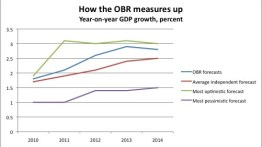
Even governors can be wrong. The Bank of England’s quarterly inflation report is expected to downgrade its original growth forecasts and predict a sharp increase in inflation, albeit one that peaks this year and returns to the target rate by 2012. A spike in inflation is scarcely surprising given the planned VAT rise, and the Bank’s original growth forecasts were, like Alistair Darling’s forecasts, absurdly over optimistic – predicting 3.4 percent growth next year and 3.6 percent the year after. The Bank’s revisions needn’t trouble George Osborne, whose forecasts of 2.3 percent growth next year and 2.8 percent in 2012 were drawn from the OBR. However, the OBR may have over-estimated recovery too.

Ominous signs in the housing market – but Osborne must remain undaunted

Are we on the verge of a double-dip in housing? The graph above, courtesy of Citi, certainly looks ominous enough. The blue line is a Royal Institute of Chartered Surveyors metric for the balance of surveyors reporting rising house prices - and, last month, it slipped into negative territory for the first time since July 2009. The pink line is the rise in house prices, year on year - and it's heading downwards too. At first glance, the picture looks a lot like the peak which preceded the crash in 2008. The question is whether we're going to plumb a similar trough. Citi, it must be said, are fairly sanguine about our prospects.

Cable’s 50-50 warning

As compliments go, there's something slightly backhanded about Vince Cable's claim that, "Having worked with [the Tories] at close quarters, I've been pleasantly surprised that they're not as I'd envisaged them." And that's just one of the little nuggets embedded within his interview with Decca Aitkenhead this morning. The Business Secretary touches on everything from what he thinks of George Osborne ("he's clearly able") to his own ability to craft a joke ("I'm actually quite good at one-liners"). If you want a sense of where Cable is at, then Aitkenhead's piece is worth a quick read.

Maintaining the private sector motor

There's a lot of economic speculation swirling around the Westminster washbowl at the momment, but little of it is as eyecatching as today's report from the Chartered Institute of Personnel and Development. Its finding that a third of employers are expecting to cut jobs in the next quarter is bound to spark double-dip fears, even if that expectation is more keenly felt in the public sector than in the private. 36 percent of public sector employers foresee job losses, against 30 percent in the private sector. Perhaps more worryingly, both sectors are expecting more redundancies than they did in last quarter's report. Look below the headline figures, though, and there are signs that the private sector is driving on ahead regardless.

Cameron makes the cuts more presentable

David Cameron's neatly-constructed article in the Sunday Times (£) perfectly typifies the balancing act he is performing ahead of this autumn's Spending Review. The Prime Minister has to sound tough on the deficit because, thanks to the fiscal brinksmanship of one G. Brown, that's the job he has been appointed to do. But he doesn't want to come across as sadistic or gloomy, lest it alienate voters and coalition partners alike. The edges of the cuts need to be rounded off, made more presentable. To that end, Cameron suggests first that the cuts aren't ideological. There are, he says, items of spending that he'd like to keep – but wider budget constraints mean that he can't.

Tyrie asserts himself once again

Few MPs have made quite so many waves recenty as last year's Spectator backbencher of the year, Andrew Tyrie. Under his chairmanship, the Treasury Select Committee seems to have gained a new vitality and edge. And it has certainly accumulated more powers, with the ability to veto the government's appointments to, and dismissals from, the Office for Budget Responsibility. As he put it himself in an interview with the Independent last week, "The fight back by Parliament is beginning now." Just how aggressively he intends to prosecute that fight back is suggested by his comments in the Times (£) today.

Getting credit flowing will be one of the coalition’s toughest challenges

In interview with the Sunday Telegraph today, George Osborne stresses that the banks have got to start lending again – and he's right to do so. The easy availability of cheap credit may have done much to get us into this mess, but now we face a converse problem. As a recent Bank of England report shows, net lending from the banks to businesses remains negative – or, in other words, more is being paid back than given out – and the situation is getting worse. With small and medium businesses so reliant on credit to get themselves off the ground, this doesn't augur well for a powerful recovery. But what can the government do to rectify the situation?

Beating up the ASBO

Theresa May has taken the truncheon to the previous government’s rather singular anti-social behaviour policy. The ASBO, of which more than half were ignored in 2008, will be a thing of the past; supermarkets will not be able to sell alcohol at less than cost price; and 24 four hour drinking licenses will be subject to local vetoes, even if the residents do not live near or adjacent to pubs and clubs. On confronting anti-social behaviour, May pledges that ultimate political cliché - a coherent and comprehensive strategy. At the moment, there are few details beyond fines for selling drink to underage drinkers. Limiting booze intake is welcome, but alcohol is not the sole problem. Some yobbism is born of lost opportunity; some is simply innate.

David Cameron is not cutting it with India’s media

The British press has worked itself into a gibbering mass of excitement about Cameron’s visit to India. The Indian press has barely noticed it. There is no mention of Cameron on the front page of The Times of India’s website, which is dominated by the spat between cricketing legends Bishen Bedi and Muttiah Muralitharan – in fact, those two are all over the press. Also, the Hindustan Times leads with a scintillating description of a parliamentary point of order; the Calcutta Telegraph splashes with an account of army operations against Maoist rebels in northern Bengal. India Daily has coverage of the Wikileaks saga.

Dave’s pageant is all very well, but India wants to talk immigration

In 1690, Thomas ‘Diamond’ Pitt led an opulent delegation of the East India Company’s Madras factors, bearing their wares, to the Nawab of the Carnatic, the richest man in southern India, with the intention of buying him out. They succeeded, but Pitt had nothing on David Cameron’s delegation.  Six cabinet ministers, more than 10 CEOs and God knows how many diplomats are accompanying the Prime Minister. The only person missing is Nick – but that sort of thing is frowned upon by Delhi’s Edwardianly genteel political classes. As I wrote yesterday, pageantry titillates commercial diplomacy, and Cameron is staking everything on this mission.

Forging a cheaper green policy

The debate over climate change is one of the most polarised in UK politics, between those advocating doing everything possible (no matter what the cost) and those who refuse to think about doing anything at all. If, like us, you take the view that the science tells us there are major risks from climate change – albeit with uncertainty around how bad, when and where the risks might bear out – but that costs matter, you are likely to find yourself simultaneously denounced by both sides as a ‘denialist’ and a ‘warmist’. Our new report, Greener, Cheaper explores how we can cut the costs of cutting carbon.

Cameron’s foreign policy is music to the ears of a resurgent FCO

Tim Montgomerie observes that the FCO now stands for Foreign and Commerce Office. David Cameron is determined to conduct British foreign policy in our economic interest. And, in that spirit, he is off to charm India in the hope of gaining access to that enormous emerging market – last week’s magazine has exhaustive coverage of the trip. Tim also claims that the Foreign Office won’t like this ‘redirection of their mission’. I’m not so sure. From what I hear, the Foreign Office is loving it; it’s just like old times. The FO was marginalised under the previous government; Labour cut staff in embassies and consulates around the globe.

The Hayward saga draws to a close

There has been an inevitability about Tony Hayward's departure from BP ever since the first aftershocks of the Deepwater Horizon disaster. But now, despite BP's peculiar denials this morning, that inevitability has reached fever pitch - and it's widely expected that Hayward will be booted out of his job tomorrow morning. As a thousand comment writers have quipped, he can now get his life back. The question on most observer's minds is, does he deserve it? And it's a question which Allister Heath answers persuasively in City AM today. My quick take is that, yes, Hayward came under unfair and politically-motivated fire at times, but much of the criticism flung in his direction was warranted and understandable.