Economy

Niall Ferguson: Britain should call the IMF now

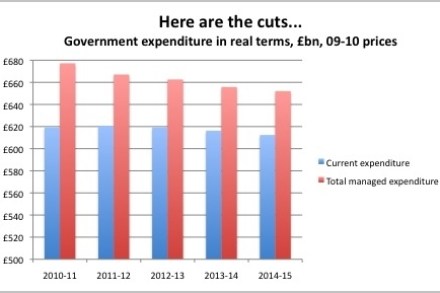
Should David Cameron just call the IMF immediately? Like, on Monday? This argument has been doing the rounds in Tory circles and tomorrow's Spectator has an important contribution from Niall Ferguson. He advises that Cameron takes a two-pronged approach. Prong one is to 'axe ruthlessly' and prong two is to call the IMF. He says: 'There is a very real danger that [things] could now spiral, Greek style, out of all control if foreign confidence in sterling slumps and long-term interest rates rise. Mr Cameron needs to do two things right away. He must instruct George Osborne to wield the axe ruthlessly with the aim of returning to a balanced budget over a credible eight- to ten-year timeframe.

EU revises British economic forecasts up

Faisal Islam has the story that the EU has revised Britain’s economic prospects up to 1.2 percent in 2010 from 0.9 percent. Next year, the EU predict to 2.1 percent, the highest of major European nations. Is this a crumb of comfort for Brown? Well yes, but the EU’s predictions are still someway off Alistair Darling’s forecasts. His growth prediction for 2010 is in the region of 1 percent to 1.5 percent, which is closer than his predictions for 2011, when he expects GDP to increase by 3 percent to 3.5 percent. In any event, the upgraded figures are probably too small to shift the polls at this stage.

Ten questions for Gordon Brown tonight

By rights, Gordon Brown should fear this debate on the economy more than any other. Here are ten questions I would like to hear him answer:   1. You told Gillian Duffy yesterday that you have a "deficit plan to cut the debt in half over four years." This was a lie, wasn't it? Our debt is £771bn now. Your deficit plan ­- ie, to run huge deficits for years - will actually double it to £1,406 billion within four years according to the Treasury. The debt for which Mrs Duffy and other taxpayers are liable would double under your plans ­- yet you told her it would halve. How can you tell a lie of that magnitude, to the very sort of women whose taxes you intend to use to service this extra debt? 2.

Dear Dave,

Tonight is about the economy - the most important issue troubling voters. Amazing, though, your economic mesage has not been particularly clear. Incredible given what the Labour government has done, I know, but true. George Osborne cannot seem to win over the City; the Lords of Finance never miss an opportunity to tell the FT that they don't like/trust him. Your deficit-reduction message is on the other hand clear - but voters don't seem to like it, believe it is actually necessary and seem worried about the "Sword of Cable", which, like that of Damocles, is said to hang over the country by a hair and can come plunging down if the deficit-slashing is too great.

Should Cameron attack Brown or Clegg?

Obviously, yesterday's disaster has written-off tonight's debate for Brown. But ‘Bigot-gate’ is obscuring the European bailout crisis. Allister Heath and Iain Martin surmise that the euro crisis gives David Cameron a further advantage, if he can exploit it. Iain writes: ‘Mr. Cameron has just been dealt a potential ace by the markets. It will be interesting to see if he realizes this and works out a way of playing it in a manner that voters understand. The worsening crisis in the euro zone has attracted very little attention in the general election, thus far. After all, the U.K. isn’t a member.

To what extent should Cameron and Clegg use Brown’s gaffe against him?

Given the timing of Brown's Mega Gaffe, you've got to wonder how it will play out in the TV debate tonight.  Will it, for instance, mean that he gets a hostile reception?  Will he try to defuse the situation by repeating his apologies, or perhaps by making some sort of light out of it ("Yesterday, I met a woman in Rochdale...")?  Will it overwhelm the deeply serious economic questions which need asking and answering?  And so on. There's one question, in particular, though, that I'd be keen to hear CoffeeHousers' views on: how much should Cameron and Clegg use Brown's gaffe against him?

Goodbye Euro?

I have just visited the two countries that are making the headlines in the European newspapers – Germany and Greece. During my trip, I met officials, journalists, and key advisers to both Prime Minister Papandréou and Chancellor Merkel. Sitting on the flight back to London I have regrettably come to the conclusion that the Euro is probably done for – or that Greece will default inside the Eurozone. Until now, I have dismissed the pessimists, thinking that the Euro would be saved. But after my trip I have changed my view for a number of reasons. Nothing I saw in Greece has convinced me that the Greek government is able, ready and willing to oversee the kind of austerity programme required to restore faith in its economy.

Ten reasons why this is a catastrophe for Brown and Labour

Every politician will be thinking "there but for the grace of God..." today - but the Gillian Duffy incident is not just a gaffe. It is bad for Gordon Brown and Labour on very many levels. Here are ten of them.   1. The image of the Politburo pulling away in the Jag, slagging off the proles. This confirms the idea of an elite, who sneer at voters in private but try to charm them in public. And the idea that politicians (of all parties) say one thing on camera, and another when they think no one is listening. 2. The is not just a gaffe, but the PM on tape insulting the voters. It's the worst thing you can do in an election campaign (ie Obama¹s "cling to guns and religion" remark). Far worse than if Brown were, say, caught swearing, Nixon-style.

Why Cameron was right about the regions

Given that Labour has put out a hilarious plea to discuss “issues” rather than personality (or lack thereof), I would like to rise to this challenge to discuss an excellent point raised by David Cameron on Friday: that the state spending/GDP ratio is far too high in many parts of the UK and needs to be lowered. Stating this utterly uncontroversial fact landed him in a bit of trouble, I suspect because of lack of understanding of the issues. So, in the spirit of Labour’s plea, here are some facts. Cameron told Paxo that: “In Northern Ireland, it is quite clear – and almost every party accepts this – that the size of the state has got too big. We need a bigger private sector.

No, Gordon, this recession hasn’t been milder than others

Today’s new economic data gives a handy piece of ammo to the Conservatives.  It is untrue that, as Gordon Brown says, this recession was somehow milder than others. The economy contracted by 6.3 percent this time – it was 3.8 percent in the 1980s recession and just 2.4 percent in the early 1990s recession. I feel confident that the Conservatives will get this point across clearly, next time that Brown boasts that this recession has been somehow milder, thanks to his decision to “intervene” (ie, double our national debt).

GDP grows by 0.2 percent in first quarter of 2010

Now we know: the official preliminary estimate says that GDP grew by 0.2 percent in the first quarter of the year. So the double dip looks to have been averted (for now) – but not by much. The figure is at the low end of economists' estimates and lower than the growth experienced in the final quarter of 2009. Labour, of course, will spin this as further proof that we can't risk the recovery by voting for those dastardly Tories.  And the Tories will say that it shows just how damaging Gordon Brown has been for our economy.  But I wonder whether voters will choose between the two messages, or come to see a hung parliament as a decent compromise between them.  If it's the latter, then fasten your seatbelts, etc.

Britain’s brain drain

Voting with one’s feet is always the most sincere sign of faith – or despair – in a country and its government. And for many the departure lounge, rather than the ballot box, is the surest route to better schools, lower tax and safer streets. The phrase “brain drain” was used in the 1970s and isn’t now – strange, because the emigration rate has doubled to 1,080 a day (ONS data here).  It’s not just Brits: over the years, even the immigrants who have lived here for long enough are scarpering. But because of our obsession with immigration, we haven’t really paid attention to those leaving. And incomers do outnumber emigrants by about 3-2.

Osborne comes out fighting

George Osborne put in a fiery and impressive performance in the Chancellor’s debate today, firing off some memorable one-liners as well as unveiling a letter from the former head of the anti-avoidance group at the Treasury questioning the sums on which the Lib Dems’ tax plans depend. Indeed, since the Lib Dems surged, Osborne has found another level to his public performances. Today’s debate win followed a good spot by Osborne on the Politics Show on Sunday.   One striking thing about the debate was how it was Darling who signaled the assault on Cable when he started querying Vince’s numbers. It’ll be fascinating to see if Brown takes any similar swipe at Clegg tomorrow; his interview in the Indyhttp://www.independent.co.

Cable catches a broadside

What is the difference between 'an alternative’ and 'an addition’? It is on this question that the Liberal Democrat manifesto turns. If there is a difference, then there is a substantial black hole in their deficit reduction plans. There is a difference. The manifesto presents a £3.4bn public sector payroll measure as an addition to existing government measures, when in fact the small-print discloses that it’s an alternative. Caught double counting, at best the Lib Dems would cut £36.6bn of the £40bn or so pledged. Under further scrutiny from Andrew Neil and Stephanie Flanders, Cable could not define where a further £10bn of cuts was coming from. £20bn of the remaining £26.

Taking the attack to Vince

With Cable's and Clegg’s personal ratings being so high, the trick is to play the ball not the man. Ken Clarke and George Osborne achieved that at this morning’s press conference. Clarke said: “(Nick Clegg’s father was) a very nice, very wise guy, he was a very successful City guy, but he wasn’t a flashy guy... he was a Tory. It would have been better if Nick had stuck to the political principles of his father. (Nick Clegg) must regret going into the strange wastelands of Liberal Democrat politics.” He added that whilst he agreed with “70 percent” of Vince Cable’s analysis on the financial collapse, Cable’s solutions left him “bewildered”.

The Tories need to get economical

Nick Clegg handed Gordon Brown a lifeline in one respect: the economy’s old hat compared to the Clegg frenzy. Not any more. The news that unemployment rose by 43,000 between December and February, together with yesterday’s dramatic inflation rise, has dumped the economy back onto the front pages. The Tories must keep it there; this election should be about the economy and nothing else. Obviously, these figures, which are worse than expected, lend weight to the argument that Brown’s policies impair recovery. Also, they demolish Brown’s claim that he ran up a deficit in the boom years to protect employment: unemployment is now higher than it was 16 years ago.

Inflation is the price of Brown’s recklessness

Who would have thunk it? Inflation has again “surprised” on the upside – 3.4 per cent against a 2.0 percent target. Why so high? Even the return of 17.5 percent VAT does not justify this bounce. Might it have something to do with all those bank notes which were being printed by the Bank of England? Might interest rates be going up now to control this inflation – and, if so, what impact would this have on a UK economy which is already the most indebted of any major economy in history? The March figures show Britain has, by some margin, the highest inflation of any major European economy: it’s way higher than that of France (1.7 percent) Spain (1.5 percent) Italy (1.4 percent) or Germany (1.2 percent). And in America, 1.1 percent.

A bumpy ride for Brown on Radio One

Gordon, meet disillusionment.  Disillusionment, the Prime Minister.  Ask him questions on whatever you want: the economy, jobs, immigration, expenses - the ball is in your court.  Make him squirm, if you like.  Confront him.  He is, after all, here at your pleasure. For that was the set-up of Radio One Newsbeat's interview with Gordon Brown earlier this afternoon.  It was one of those impossible situations for the PM.  He could hardly decline to be quizzed by a group of first time voters, aged between 18 and 28.  But it put him at the mercy of some pretty disgruntled members of the public.  And they took full advantage. The questions were direct and drew blood.  On the economy: "Where are the cuts going to come from?