Ecology

Seeing the wood for the trees

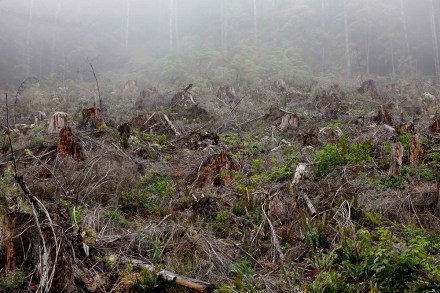
For a fortnight, four women have been combing through a 30-metre forest plot with infinite care. They have noted the age and height of every tree, measured every fallen branch and twig, identified every plant and assessed the depth and composition of the forest floor. The purpose of this backbreaking work is to understand the critical role played by old-growth forest in carbon storage. Unusually for a field experiment, the team includes a mother and her two daughters. Teenagers are not generally known for their willingness to spend weeks in the undergrowth, but then Suzanne Simard is not your average mother. She is the pioneering Canadian ecologist who has changed the way we think about forests.  Suddenly, lightning flashes overhead.

Haunted by my great-grandfather’s second wife – by Alice Mah

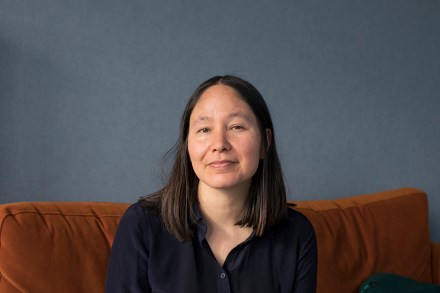
Alice Mah didn’t enjoy finding her roots. Even though ‘ancestor tourism’ is increasingly popular among westernised descendants of Chinese émigrés like her, she felt a nameless sort of dread when visiting the village in the Cantonese county of Taishan where her great-grandfather came from. It didn’t help that she’d just attended the morbid Qingming festival, when the Chinese remember their dead by sweeping their tombs. Mah’s memoir opens here, and we nervously anticipate the tragedy or horror that will surely strike – and are left waiting. Other than the pushiness of Taishanese cousins, who demand ‘red pockets’ (a traditional way of gifting money in small red envelopes) and donations for the village from their richer compatriots, the trip seems uneventful.

What sea slugs can teach us about organ transplants

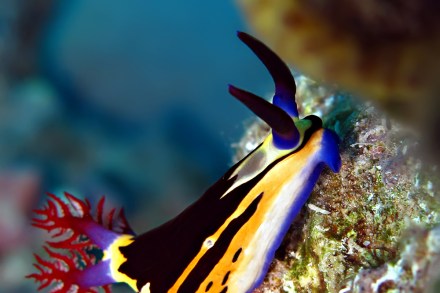
While they may be outnumbered and outweighed by insects, the terrestrial world is really the kingdom of the vertebrates. Mammals, birds, reptiles and amphibians dominate most ecosystems. Yet, as Drew Harvell points out in her fascinating new book, the seeming diversity of the terrestrial vertebrates is deceptive. In fact all are contained within just one of the 34 groups of animals that live on our planet, and their many designs are really variations on a quite narrow set of themes. This means that all share bilateral symmetry – heads with eyes and brains atop bodies with four limbs that contain their organs. By contrast, the other 33 groups of animals, the invertebrates, are astonishingly various in their design, with arsenals of adaptations and biological tricks.

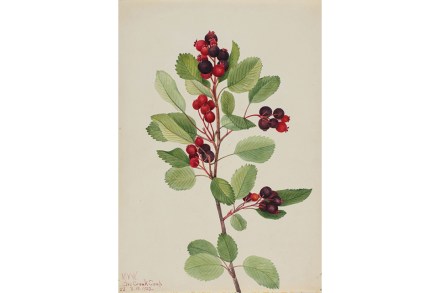
The North American fruit tree that provides a model for economics

Life on Earth is not a zero-sum affair. Most plants only exist thanks to partnerships with fungal filaments in the soil which mobilise essential nutrients for them and receive sugars made from sunlight in exchange. Without those partnerships, humans and most other land animals which depend on plants either directly or at one or two removes would not exist. Cooperation gives rise to a living world that is vastly more complex, productive and beautiful than the sum of its parts. An understanding of this reality is one of the key insights of an ecological worldview; and, argues Robin Wall Kimmerer in this short and charming book, it is of vital relevance when thinking about how human societies and individuals might organise, and think differently and more expansively about the future.

Blooming marvellous: the year’s best gardening books

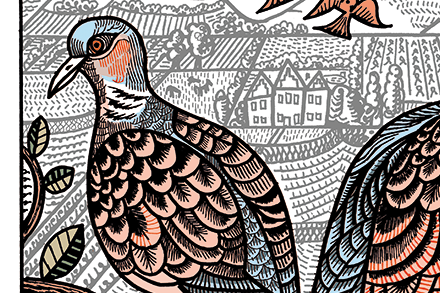
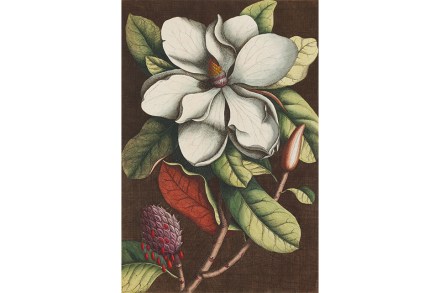
I am an absolute sucker for a handsome reproduction of a rare and highly illustrated natural history, preferably more than two centuries old. This may possibly be a niche interest, but Catesby’s Natural History was pronounced a wonder when it was first published and is a wonder still. Mark Catesby was ‘a procurer of plants’, sponsored by a group of rich, curious patrons, including William Sherard and Sir Hans Sloane, to explore and record the flora and fauna of the most southern of the Thirteen Colonies – the Carolinas and Florida, as well as the Bahamas Islands. He made several perilous trips in the 1720s, sketching his subjects live, and completing paintings in England. He finally published his text and 220 hand-coloured plates in 1747.

Roger Deakin – at ease in the countryside as a poacher with deep pockets

Few authors have left such an immediate legacy as Roger Deakin. When he died of a sudden illness in 2007, aged 63, he had written just two books: Waterlog, which set off the wild swimming craze, and the even more influential Wildwood, which helped kickstart the publishing phenomenon of nature writing. Yet both books only really became well known after his death. During his lifetime he was, at best, a cult taste. When I approached the BBC 20 years ago with the idea that he should present a televisual version of Waterlog in which he swam ‘across’ England, through its ponds, lakes and rivers, I was told no one was interested in wild swimming – and who was Roger Deakin anyway? Patrick Barkham has set out to answer that question.

A glimmer of hope for the blue planet

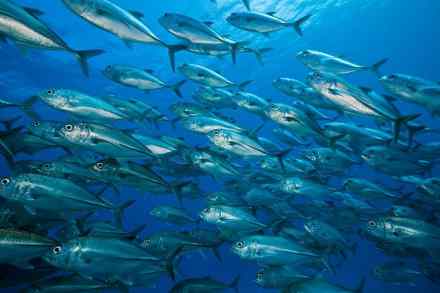
You might think – with its feeding frenzies, vertiginous seamounts, perilous weather and deep history of the monstrous – that the ocean was a wild enough place as it is; but according to the environmentalist Charles Clover it has systematically been ‘de-wilded’ by decades of commercial overfishing, and our seas are now in urgent need of healing. I believe him. When it comes to conservation, fish hold less appeal than terrestrial fauna: they are perceived as cold-blooded, mostly invisible, lacking in charisma, and often delicious – plus, for centuries, there existed the comfortable delusion that their stocks were inexhaustible (even a proof positive of divine benevolence).

We must all become Doctor Dolittles and listen to the wisdom of animals

One day the writer and artist James Bridle rented a hatchback, taped a smartphone to the steering wheel and installed some webcams in order to make his own self-driving car. Armed with software cut-and-pasted from the internet, his aim was to collaborate with the AI he’d thus devised and travel to Mount Parnassus, sacred to Dionysus and home of the Muses, ‘to be elevated to the peak of knowledge, craft and skill’. Just try telling that to the traffic cops. This batty project had a serious point. Bridle wanted to subvert the idea that we cede control to our dismal robot overlords every time we plug co-ordinates into the GPS. To that end, he went about training the car, which he had rigged up with what amounted to a neural network that functioned like a simplified brain.

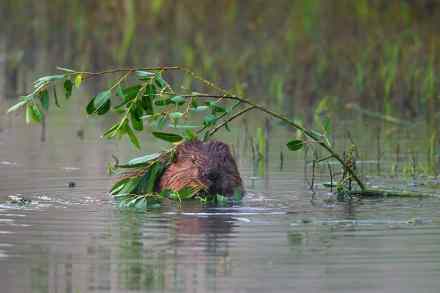
Beavers, not concrete barriers, can save Britain from floods

As the start date of COP26 draws closer, and just when we are assailed by daily proof of climate chaos, it is easy to think that this is the only threat to the global environment. It is not. Systemic biological loss assails the world and, while it is closely related to the issues of climate, it is a standalone matter with many separate antecedents. The English in particular should know all about it. On what is called the Biological Intactness Index we are judged to be the seventh most degraded national environment on Earth. Species loss here originates from many causes, but primarily from 80 years of intensive agriculture. This is the main theme of Karen Lloyd’s Abundance, but it is also about how we can reverse these losses.