Cooking

The Menu serves up clever and tangy social commentary

Several years ago, after I passed the bar exam, my wife and I went to dinner at Pineapple and Pearls — probably Washington, D.C.’s second swankiest restaurant. I recall eating some excellent duck, as well as imbibing a selection of craft cocktails served in ever-more exotic glasses and alembics. But what I remember most was dessert: a single gooseberry lacquered with honey. Yes, a single berry. (We ordered Domino’s when we got home.) The Menu is a lacerating bit of social commentary that doubles as a satire of this kind of fine dining — not all that surprising a blend, given the presence of Adam McKay on the production team.

The unruly chef

Joshua Weissman’s number-one bestselling An Unapologetic Cookbook is misnamed. You won’t catch the potty-mouthed, long- haired chef saying sorry for making a mild ethnic slur against Italians or a penis joke, but in a philosophical sense, apologetics is exactly what he’s doing: he champions the joys of home cooking to an uninitiated audience. Weissman’s unlikely following is made up of the type of guys who consume a lot of quasi-educational content on YouTube and Wikipedia. They won’t buy the latest Barefoot Contessa volume, but they are curious about how things are made, whether it’s bridges or Big Macs.

weissman

Serving up a Half Baked Harvest feast

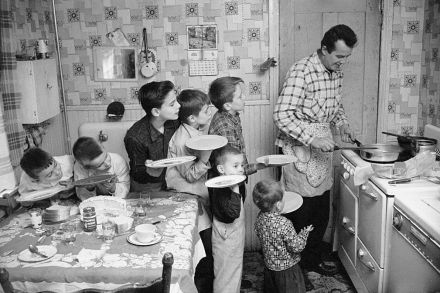
As one of eight children, I feel deep kinship with others who come from big families. Bunk beds, hand-me-down clothes, abject chaos at dinnertime — these are the staples of big-family life. Tieghan Gerard, the author of the food blog and cookbook series Half Baked Harvest, is one such kindred spirit. She comes from a family of ten, and began cooking as a tween to help with frenzied mealtimes. She soon started creating her own recipes for a food blog, which became three bestselling cookbooks and a four-million-follower Instagram. Her big-family backstory blends with her wholesome, rustic aesthetic: feeding a crowd, after all, involves creativity, resourcefulness and well-loved tools. I hoped I’d recognize some high-volume cooking tricks in Half Baked Harvest: Super Simple.

harvest

Has the Aga had its day?

From our UK edition

A whole chicken, not so much roasted as burnt to a crisp. Charred potatoes. Carrots so blackened they were welded to the pan. And don’t even get me started on the Yorkshire puddings, which resembled lumps of coal, still smoking amid the debris. Only once have I failed (catastrophically I might add, and in front of my entire extended family) to cook an edible roast dinner. And I blame the Aga. Long a middle-class status symbol, Agas – in varying shades of duck-egg blue and volcanic red – can be found in country piles, cosy cottages and even the odd city kitchen. Devotees rhapsodise about the cast-iron cookers, which cost upwards of £10,000, stay on 24/7 gobbling up energy and require specialist cookbooks to conquer their idiosyncratic ways.

The delicious joy of cooking for one

From our UK edition

I like to think of myself as the hostess with the mostest. A combination of my Type A personality, Jewish feeder tendencies and coming of age at the peak of Nigella’s Domestic Goddess era means I can’t resist pulling out all the stops if I'm having people over. (A theme! Welcome cocktails! Ingredients sourced from far-flung corners of Waitrose!) And yet the truth is, there’s no one I’d rather cook for than myself. It wasn’t until my late teens that I properly learnt my way around a kitchen. My mum always did all the cooking at home, so it was only when I moved 100 miles up the M1 to university that I finally had the impetus to explore.  My early attempts were pretty dismal; raw-in-the-middle jacket potatoes stand out as a particular low point.

Fit for a king: kedgeree is the most regal of all Anglo-Indian dishes

From our UK edition

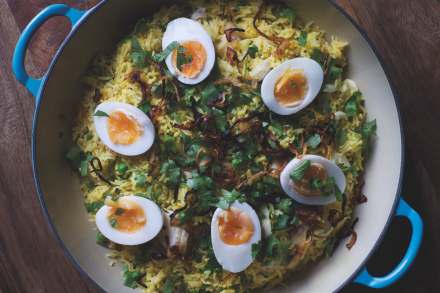
How does the saying go? ‘Eat breakfast like a king, lunch like a prince and dinner like a pauper.’ Well, if you’re looking for the highest possible status of breakfast, then kedgeree is the dish for you. Bran flakes just don’t quite scratch the same itch. Kedgeree cannot be casual; it requires time, both for preparation and enjoying, and it makes breakfast an occasion. It came to our breakfast tables (or mahogany sideboards) in Victorian times, brought back to Britain by returning colonial officers. It was served in silver chafing dishes, set alongside steaming urns of porridge. Kedgeree is a rice-based dish, flavoured with curried spices and cooked with smoked haddock, onions and boiled eggs.

The truth about cooking with an air fryer

From our UK edition

The phone rang, and on the other end of it was my father. ‘We’ve been thinking,’ he announced before we’d even exchanged pleasantries, ‘you need to get an air fryer. It’s the solution to these energy hikes.’ As a chef and writer with a couple of bestselling cookbooks under my belt, I was of course already familiar with the air fryer phenomenon. The countertop gadget, billed as more energy efficient than regular ovens, has been much hyped as a cost-saver as we face a winter of rocketing bills. But I’d quickly dismissed it as a fad.

Barbecue is America’s food

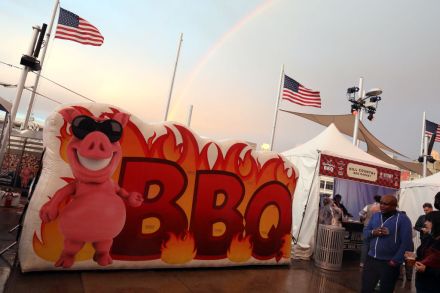
Summer is fading fast, and though, according to my calendar, “the Autumnal Equinox” (is that the newest model of Hyundai?) isn’t until September 22, all the things we love about the season — swimming, county fairs, outdoor drinking, the August congressional recess — are essentially over after this weekend. And while people mark Labor Day in different ways, one of the best is with a barbecue, one of the few culinary traditions America can truly call its own. Smithsonian Magazine tells us barbecue has its origins in the first indigenous tribes Christopher Columbus encountered, who had a “unique method for cooking meat over an indirect flame, created using green wood to keep the food (and wood) from burning.

Eating well at a time of inflation

Inflation having topped 9 percent this summer, Americans are looking for ways to cut their spending. Rising prices at the grocery store are impossible to avoid, but we can learn to adjust. There’s no better inspiration than M.F.K. Fisher. Fisher, a food writer who hung around with Julia Child and James Beard during her lifetime, felt the pain of wartime rationing acutely. Her 1942 book How to Cook a Wolf addressed the problem of hunger — “the wolf on the doorstep” — with a few clever recipes and a great deal of philosophy. Survival of the crisis, she predicted, would require first and foremost an attitude of abundance. Fisher ascribes virtues like honesty, dignity and nobility to simply prepared foods.

Five tips for a sumptuous summer barbecue

From our UK edition

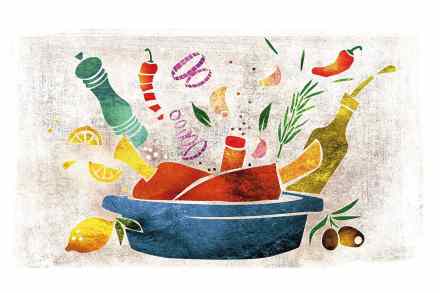
The sun is set to shine again this weekend, and those lucky enough to have access to a garden are turning their minds to al-fresco dining. So we’ve gathered together our top five tips to help you pull off your weekend barbecue – everything from how to get the best out of your meat, to barbecue-friendly puddings. 1. Marinating Marinating meat (and veg!) is a no-brainer when it comes to injecting flavour quickly and easily: using punchy spices, herbs, sugars and salts and letting them get to know the raw meat is minimal work for maximum reward.

The assorted joys of nasturtiums

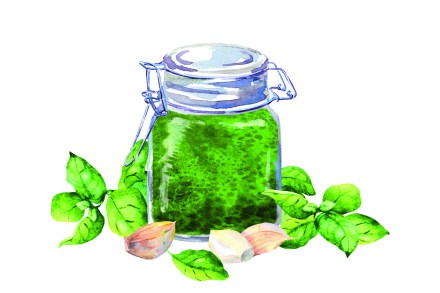
It’s still amazing to me how Instagram photos can bring such unexpected responses. And instantly! It happily happened to me last May and my creative juices — green, yellow, orange — started flowing. I had just posted a photo of the nasturtium pesto I’d made from the flowers and leaves in a nod to the exigencies of Covid-19: self-quarantining, fear of food shopping and the constant barrage of advice for oldies like me to not mix or mingle. I was going to forage for food, fool about with flavor and fun. Within minutes, Caroline, the flower girl at my Swiss wedding fifty years ago, commented, “Do you remember that you and Maman would take me foraging in the meadows above Lausanne for wild nasturtiums for salads?

nasturtium

My Easter recipe: Greek-style marinated lamb

From our UK edition

This is a delicious way to cook lamb with a distinctly Mediterranean feel. It’s super fresh, easy to prepare and would be perfect for Easter Sunday. I would serve it with pitta bread and chilli sauce. It pairs well with a chilled bottle of Sangiovese.

The cult of the extortionate ‘English’ kitchen

From our UK edition

A house around the corner is on its fourth kitchen in a decade. Every two or three years, the house changes hands, the pristine kitchen comes out and a newer, pristiner kitchen goes in. They are always white, they are always shiny, and when I peer through the basement windows there is nothing in the way of signs of life. I reckon I can predict the next kitchen. Think homespun, think rustic, think scullery maid in mobcap and pinny. What the rich want now is a plain old Plain English kitchen. Hand-crafted cabinets, antiqued brass, Delft tiles with authentic craquelure. Starting at £34,000 and going up to… well, how much have you got? Don’t you dare put Dulux on your artisan doors. Plain English has its own bespoke paint chart.

Spring’s perfect roast

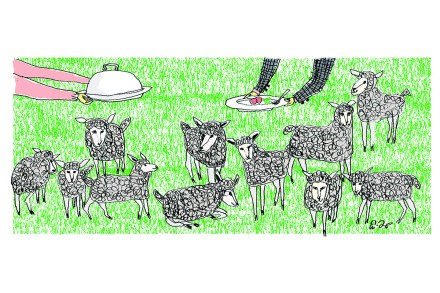
When I first moved to the country, I was intrigued by the sight of people walking sheep on a leash round and round the front garden of a neighboring farmer. City girl that I am, I wondered if they were receiving some kind of special therapy. Equine interaction is supposed to help with certain anxiety disorders, why not sheep-walking for, say, insomnia? It turned out, however, that the sheep-walkers were members of the local 4-H club preparing to show their market lambs at the fair, an event I was later privileged to witness. But I was put to the blush when the judge, a tall, competent-looking man in a checked shirt and green boots, commented loudly on the fine chops displayed by the winning entrant.

lamb

The pan handler

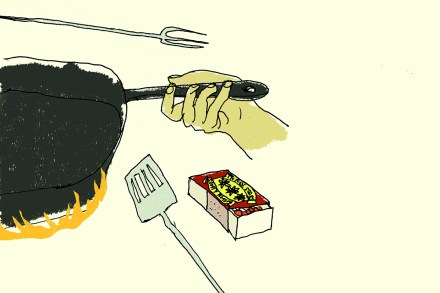
I have become a pan handler — a handler of cast-iron pans. I can think of few hobbies that are as rewarding as collecting and cooking on cast iron. Skillets, griddles, muffin tins, Dutch ovens, waffle irons, corn-stick pans and much else: there was a time when America produced the finest cast-iron cookware in the world. The iron ore was abundant. So was the coal to melt it. Foundries went up across this great land. American cuisine developed around it. From fried chicken to cornbread, the American menu should still be cooked on cast iron. Southern cooks never forgot this. The same goes for soul food; black America has always prized its cast-iron inheritance. Now I find I have little need to cook on anything else.

pan

Why restaurant food at home beats eating out

From our UK edition

‘The opposite of a correct statement is a false statement. But the opposite of a profound truth may well be another profound truth.’ That’s Niels Bohr. Or, as Oscar Wilde put it: ‘In art there is no such thing as a universal truth. A truth in art is that whose contradictory is also true.’ Like physics and art, many other fields require that you embrace contradictions — because you can’t avoid them. Take innovation. Yes, a great deal of progress is combinatory: two or more technologies are combined to accomplish some hitherto impossible task. But, as the Soviet-era scientist Genrich Altshuller noticed, much innovation follows the opposite path, separating things which were previously combined.

The millennial kitchen

However else we may criticize the late 90s and early 00s — its politics, its fashion, its music — this was undeniably the golden age of the celebrity chef. Barefoot Contessa, 30-Minute Meals and The Iron Chef franchises all debuted in the first decade of this millennium, minting stars like Bobby Flay, Guy Fieri and Nigella Lawson. I once found a collection of my brothers salivating over Giada de Laurentiis making meatballs on Everyday Italian, though they’d never demonstrated more interest in cooking than microwaving the odd Hot Pocket. The mid-aughts brought on the glory years of the “hands and pans” videos: the aerial-view clips of disembodied hands assembling cheeseburger pretzel balls or eighteen-layer taco dip.

millennial

What’s good from the goose

One of the more curious habits of the British is their tendency to publish opinion polls in national newspapers about their own food habits. Which way round, for example, are you meant to dress your scone? Is it clotted cream first, then jam — or jam first and cream second? Well, the Queen does it jam first, so that must be the way. Or that other national debate, tea and then milk, or the opposite? When I first arrived in the UK thirteen years ago, I was amused to see how worked up the British get about such questions. Try asking them sometime and see what happens. A new poll reveals that 58 percent of the British public admit to preferring roast potatoes over turkey. “How could you?” we’re supposed to gasp. “Everyone knows Christmas dinner is about the turkey!

goose

Why I retrained as a butcher

From our UK edition

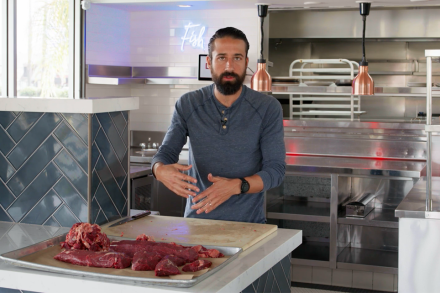
Two years ago, I enrolled on a butchery course. I rather fancied seeing how the sausage was made, and also envisaged taking home handsome pork chops and having an ‘in’ when I needed to order my Christmas turkey. But the amateur course was no longer offered by my local college. So instead of a four-week, two-hour evening course, I signed up for a year-long Level 2 NVQ in craft butchery that involved a lot more anatomical theory and hairnets than I had anticipated. Butchery work is physically demanding — I wasn’t made for carrying beef forequarters over my shoulder — and comes with the usual risks of a job involving knives and saws. It can be smelly and messy and bloody. It can also be hugely satisfying, but it is definitely not glamorous.

An intensely quiet and soulful performance from Nicolas Cage: Pig reviewed

From our UK edition

What use does a fallen and corrupted world have for a man of integrity? This was not the question I had anticipated walking away with after viewing the new Nicolas Cage indie Pig, but much of the film, from Cage’s intensely quiet and soulful performance to the new ideas it has to offer a very old narrative, was a satisfying surprise. The film is ultimately a story of revenge, but it plays out in unexpected ways. Cage is Robin Feld, a man living off the grid with only a truffle pig and a recording of his deceased wife for companions and a trade in the luxury food item as an income. But when his cabin is invaded and he is attacked and his pig is abducted, he’s forced to con-front his old life as a chef in Portland to get her back.