Conservative party

Around the Web: Conservative manifesto

You can read Fraser’s verdict here, but this is what the rest of the Web had to say: Janet Daley described it as ‘the perfect pitch’: 'The Conservatives have just given a launch performance for their manifesto which was as close to perfect as any I have seen. It was clear, coherent and genuinely compelling: the message was simple: people power rather than state power.' Ben Brogan welcomes less, not more: 'Today was also about David Cameron. He made a long speech, too long, and so reminded us that when he is scripted he is less effective.
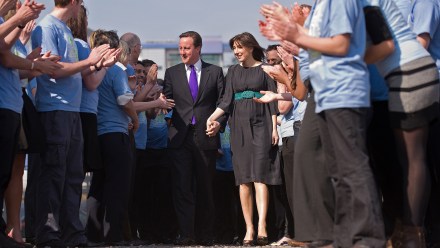

Tory manifesto launch – live blog

Stay tuned for live coverage from 1100. 1238: And that's it. Phew - quite a marathon.  A strong central message, I think, but it could have been said in fewer words.  Thanks for tuning in. 1235: The Guardian's Nick Watt asks why the Tories aren't talking more about the extent, and the consequences, of spending cuts.  Cameron's response is that he has "always been frank" with the public. 1233: Key question on whether withdrawing the state will mean worse public services for folk.  Cameron says that he not looking to pull the rug from under people, but just to introduce choice and competition to counter the "dead, dull hand of the state.

Don’t mention ze Europe

The Conservative Party’s departure from the European People's Party came down to a choice of expediency over principle. If you are inclined to accept that Britain will stay in the EU and that membership helps this country - even if it requires some compromises - you will likely find the move unfortunate. If you are more concerned about the principles at stake – and feel that Britain’s loss of sovereignty has gone too far – and do not care about the loss of influence on the legislative process, you are likely to be in favor of the Tory move.   David Cameron is keen to keep the issue of Europe away from the campaign - and he is likely to succeed.

Where’s the surprise?

Am I the only one who'd care for a bit more uncertainty and surprise when it comes to the election campaign?  I mean, yesterday, Labour released a manifesto which had been heavily trailed for weeks, even months, in advance.  And, today, it looks as though the Conservatives are going to do likewise – with the political barometer saying that their Invitation to Join the Government of Britain won't contain anything substantially new.  Its cover was even published last night.  And, if you want an sense of what Cameron will say today, then just read his article in this morning's Times. Of course, it's the job of a well-oiled campaign machine to build anticipation in advance, and to keep feeding the media beast along the way.

The Tories invite you to join government

Battersea Power Station was the site of one of the Tories' most effective publicity stunts of recent months – and it will be the venue for their manifesto launch tomorrow.  Details are already emerging about the document (ConHome has a good summary here), which sounds as though it won't contain much, if anything, that we haven't heard before.  As with Labour earlier, this approach risks an indifferent response from the media and the public.  But at least the Tories have clearer flagship policies to broadcast – the national insurance cut among them. While the manifesto may not contain any new policy, it sounds as though the Tories have gone to town on it presentationally.

Brown’s thin air manifesto

"You got that, Britain? We. Are. The. Future. Future, future, future. The Tories are the past. We are the Future. The future that is fair for all. We are that future. For all."  And so, more or less, went Gordon Brown's pitch to the nation at Labour's manifesto launch.  Except it lasted a good hour and a quarter.  And it involved a eye-wateringly fuzzy screen behind Brown's head.  And a needless introduction from Harriet Harman.  So if you managed to tune into it all, then well done: your enthusiasm for politics knows no bounds. But Labour's problems today weren't so much presentational as political.  After thirteen years in power, Brown was always going to struggle to convincingly sell this "future" shtick.

Come out, come out wherever you are

Chris Grayling, the Shadow Home Secretary and former attack dog, seems to have been cast into outer darkness. As with Oliver Letwin’s disappearing act in the 2001, Labour is toasting this unofficial scalp. Denis MacShane has been adding poison to the potion this morning. The Tories are paying a heavy price for Grayling’s B&B gaffe, but it’s self-inflicted. Grayling’s comments were cackhanded and I think he is wrong, but they were nowhere near as controversial as was claimed – he was seeking a clarification of the law, not calling for Sandi Toksvig to be lynched. I doubt Grayling will be Home Secretary but such a senior Shadow minister can’t hide away for ever.

Will Labour’s manifesto mean the end of VAT attacks on the Tories?

You know it's the day you've all been waiting for, CoffeeHousers – the day of Labour's manifesto launch.  Last Thursday, Douglas Alexander described the document as a "progressive programme worthy of these testing times".  So, well, it must be good, mustn't it? Problem is, this manifesto risks going the same way as the Budget.  So much of it has been so heavily trailed, that there's a danger we've already heard it all – and that it will be met with weary indifference by the media and the public alike.

What would you ask Cameron?

David Cameron takes a few journalists with him on each of his one-day tours, and it's my turn tomorrow: 6am start. I should be able to get  half an hour or so with him, to do an interview for The Spectator. As is customary, I'll try and ask him some questions on behalf of CoffeeHousers - so please add any thoughts as a comment below.

Even Cable can’t defend the Lib Dems’ misleading poster

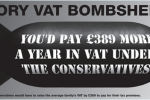
This poster by the LibDems is perhaps the most dishonest one of the campaign so far - and Vince Cable has pretty well admitted it to Jon Sopel on the Politics Show. Here's the exchange. Jon Sopel:  I mean let’s leave aside whether or whether not there is a black hole in the Tory’s finances. Leave that to one side. You don’t know factually, that they are going to raise VAT. That is your conjecture. St Vince Cable: It is a conjecture and it’s a reasonable assumption and I wouldn’t claim anymore than that. JS: And that £389 is a rough figure plucked... VC: "It’s a ball park estimate of what it would require in order to fill that gap, and it seems a reasonable way of expressing that argument.

Spectator readers and professional pollsters predict a Tory majority

Underneath the IoS poll which David mentioned earlier there's a set of election predictions from professional pollsters.  Differing margins of victory aside, seven-out-of-eight of them foresee a Tory majority in a few weeks time. I mention this not just because it's worth, erm, mentioning – but because a poll of readers over at our new Spectator Live election site produced a similar result.  85 percent of you predict that the election will produce a Tory majority.  That's very almost seven-out-of-eight. I promise I won't ram Spectator Live down your collective throat every minute, but do check out the full results on this page here.

Does it pay to be mendacious?

Lying is a politician's occupational hazard. The Independent on Sunday has published a Com Res poll confirming that truism. The majority of voters do not believe that David Cameron and Gordon Brown are being honest about how they will tackle the deficit. We voters resent being taken for fools. If Brown and Cameron are being disingenuous about the economy, the honest Sage of Twickenham benefits - the Liberals are storming the marginals, a hung parliament is odds-on according to some pollsters. Is Vince Cable honest about reducing the deficit? Emphatically not. One minute he’s against a VAT rise, but refuses to rule it out the next. He’s in favour of unilateral charges on banks, but not if they fund a tax break for some married couples.

Dirtier tactics

I think we all expected this election campaign to be fought a few inches below the belt.  But, as Iain Dale and Dizzy say, Labour's tactic of mailing scaremongering leaflets to cancer sufferers is some new kind of low.  I mean, just imagine how it would feel to receive, as a cancer patient or an immediate family member, a leaflet which politicises the problem to the point of suggesting that your care would be jeapordised by voting for another party.  And then imagine how it would feel if you have been specifically targeted because of your connections with the illness, as seems to have been the case here.  Well, it defies belief that this is how the party of government is going about "restoring trust in our broken politics," or whatever they say.

An ICM marginals poll points to a hung parliament

The News of the World has its expensive and much-awaited ICM poll of the marginals tomorrow. There is some good news for Cameron, and some not-so-good news. First: 66 percent of voters in the marginals agree with the message "it's time for change". Bad news: a surprisingly large number think that Nick Clegg represents that change. A Lib Dem surge means that Tory swing is just 6 percent in the marginals, versus 5 percent nationally. Where is the Lord Ashcroft magic? In James's political column this week, he says the Tories had been so confident about the marginals that they reckon they need a 5-point lead nationally to win, rather than the 8-point lead previously assumed. The News of the World/ICM poll challenges that narrative.

The Times is wrong about the Tories’ marriage tax break

Since The Times moved its leaders on to page two, they've also taken on a new vitality. For years, they were the voice of solid good sense. It was pretty difficult to disagree with them. Now, they are more polemical, more risk-taking - and more wrong. But I'm not complaining: I far prefer reading a fiesty opinion with which I disagree, than boring opinion that I nod quietly along with. And I could not disagree more with the leader today denouncing Cameron's marriage tax break. Let's kick off: "This is surely no time to be giving money away so that people can just carry on doing what they are already doing, namely being married. In a long philosophical journey in Opposition, the Tories appear to have alighted on moral authoritarianism advanced by economic interventionism.

The case for voting Conservative

Why vote for Cameron? The reasons for voting against Gordon Brown are so numerous that the positive pro-Tory reasons for voting are often lost. This week's Spectator gives you all the ammo you need to win around wavering friends, colleagues and family. We have restricted ourselves to the ten most compelling points. I summarise them below: 1. School reform. In itself, it's enough reason to vote Tory. Gove has specifically promise that within four years of a Tory government everyone will have an independent school offering to educate their kid for free. This should have been a 1981 Tory proposal, but Keith Joseph lost a battle with the civil service (after he recruited a young Cambridge graduate named Oliver Letwin to help him fight it). 2.

How Labour and the Lib Dems are attacking the Tories’ marriage tax break

This morning, we've already seen the two primary attacks which will be used against the marriage tax break outlined by George Osborne in the Times today.  The first came courtesy of Vince Cable, who said it represents a "derisory" sum of £3 a week for those who benefit from it.  And the second was from Ed Balls – who else? – who labelled the policy as "discriminatory," because it doesn't cover every married person, and nor does it account for couples who split.  Or as he rather suggestively put it: "if your husband beats you up and leaves you you get no support." One thing worth noting is how the Tories' opponents aren't majoring on a fiscal irresponsibility angle, as they've been trying to with the national insurance cut.