Conservative party

Sarah Wollaston: Tories are ‘pandering to election strategists’ on plain packaging

Sarah Wollaston is angry. Again. This time it's about plain packaging on cigarettes. She told the World at One that the decision to stall introducing plain packaging was 'pandering to election strategists' and that this was a 'very sad day for public health'. You can listen to the full interview below:- Now, this is obviously deeply annoying for the Tory leadership as it hardly helps them tackle the narrative that they're always caving into their friends in big business. Even more annoying, perhaps, for Anna Soubry, who unlike Wollaston had to back the decision in the Commons this morning even though she personally supports plain packaging.

We know Andrew Mitchell was framed. Now, give him his old job back

Andrew Mitchell was forced to resign as the Tory Chief Whip last autumn because he called policemen at the Downing Street gates ‘plebs’. Then it turned out, as I suggested at the time, that he had not done so. It emerged that there was a conspiracy — quite how deep has not yet been made public — by police and accomplices to attribute to Mr Mitchell words which he did not speak. People pretending to be by-standing members of the public said how shocked they were by Mr Mitchell’s remarks, and then it turned out that no bystanders had been within earshot of whatever it was that Mr Mitchell had said. Eventually, there was an investigation.

Reshuffle gossip points to ‘innocents’ and women

There's just a week left of the Parliamentary term to go before MPs go back to their constituencies to mull that awkward pay rise over the summer. But one thing that's keeping Tory MPs from relaxing is the possibility of a ministerial reshuffle next week. The word from reliable sources is that it will take place next Thursday with a sign-off meeting this Monday. This is a minister-of-state-level reshuffle. The names of supposedly vulnerable ministers are circulating. They include housing minister Mark Prisk, energy minister Greg Barker, universities minister David Willetts, and employment minister Mark Hoban. They're known as the 'innocents': ministers who are all thought to be doing a good job and who have not messed up but who are not considered likely to move up into the cabinet.

Why partisan columnists (like me) are doomed

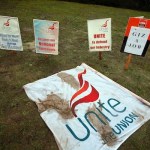
An email exchange with a Conservative-leaning friend this week left me feeling sheepish. But if shameful my behaviour be, I’m not alone in the shame. I thought it worth sharing the conversation. We were corresponding about Ed Miliband’s stand-off with the Unite trade union. In a message to my friend, I remarked: ‘It’s reaching the point where (paradoxically) EM’s tendency to take the line of least resistance may actually push him into confronting Unite.’ And that’s true: worms turn and it’s not always good politics to corner people. But it is the next part of the message that I’m hard-put to defend.

Can Theresa May avoid a Tory row on the European Arrest Warrant?

Walk down a corridor in the Palace of Westminster today and you’ll likely be taken aside by a Tory backbencher who wants to vent their frustration about Britain opting back into the European Arrest Warrant. At the moment, the mood is of concern rather than rebellion — a reflection of the fact that Tory MPs are in a fairly positive frame of mind after a good couple of political weeks for the party. But what should alarm Downing Street is that it isn’t just the usual Eurosceptic crowd expressing concern. Indeed, some of those who are most concerned are those who David Cameron has relied on recently to defend his European policy. Off the record, Number 10’s view is that with Theresa May’s help they can avoid a full-on row.

Labour MP makes amusing attempt to wreck Tory EU referendum bill

The Conservatives are a happy bunch at the moment. But for how much longer? They might be riding on the crest of a wave after the second reading of James Wharton's Private Member's Bill for an EU referendum. But already forces are at work to disrupt the happy harmony. Labour MP Mike Gapes has this week tabled a rather amusing series of amendments to the legislation which are almost certainly an attempt to sow division in the Tory ranks. They call for: - A referendum on the terms of Britain's membership of the EU rather than just on whether Britain should be a member. - A referendum on a date to be determined. - A referendum on a date to be decided by a Royal Commission on the future of the UK in Europe. - A referendum on 22 May 2014. - A referendum on 6 May 2015.

Miliband’s challenge is an opportunity for the Tories to reach out to union members

The warm reception to Ed Miliband's speech yesterday was so eerily positive that it could never have lasted. Today we get the first taste of the real battle to come, with the GMB warning that they'd be 'lucky if 10% of our current affiliation levels say yes, they want to be members of the Labour party' and that as a result the union could disaffiliate from the party. This is a challenge for Ed Miliband to show that he is determined to force these changes, even if it means calling a party-wide ballot to overrule the union bosses But this is also an opportunity for the Conservatives. If the unions accept that few of their members would choose to join Labour too, then there is a reasonable argument to make for giving members an option to join the Tory party too.

Exclusive: How the Tories plan to attack Ukip

Last week Lynton Crosby and David Cameron briefed Conservative MPs on the threat posed by Ukip. Their timing was impeccable: today's YouGov poll showing 19 per cent of Conservative members would seriously consider voting for Nigel Farage's party could have sent Tory MPs into orbit, but instead they have been reassured that the party has a proper plan to deal with the enemies to the right, rather than the messy 'fruitcake' strategy of the past few years. I am told by a number of MPs who were present that Crosby talked generally about what attracts people to Ukip, rather than the specific problem of next year's European elections. This was based on polling the party has been carrying out.

MPs back EU referendum bill 304 votes to 0

James Wharton's Private Member's Bill has passed its second reading in the House of Commons by 304 votes to 0. The Labour Party's decision to abstain on the vote, and Conservative backbenchers' insistence that a vote be held does make the chamber look rather North Korean this afternoon. But what have we learned from just under five hours of debate? Tory HQ's answer would be five neat points, all entitled 'Only the Tories will Let Britain Decide'. In reality, the result of the debate wasn't very interesting (aside from which Labour MPs backed the bill, on which more shortly), but there are still some useful lessons from the debate itself that are worth considering. 1.

#letbritaindecide fever grips excited nation

It's eurosceptic party-time in Westminster today. Finally, the time has come for the Conservatives to show that they are the only ones who will #letbritaindecide. When I arrived in Parliament this morning, I was half-expecting a brass band and bunting to celebrate the momentous occasion of the second reading of James Wharton's Private Member's Bill, so excited are Tory MPs. But instead, CCHQ has placed digital posters at a number of sites across London, including the Vauxhall roundabout. You could be forgiven for thinking that the general election is this year, not 2015.

I’ll tell you what really devalues marriage: patronising, preachy little tax breaks

The Conservative party is trying to redefine marriage. I can’t believe they think they’re going to get away with this. Throughout human history it has been one thing, which is a loving commitment between two people who want to share a life. Now they’re trying to turn it into something completely different. A tax break. It wouldn’t benefit me, even though I am married. Although I swear that isn’t the root of my objection. Honest. My wife and I are in the same tax bracket, you see, so sharing our allowance wouldn’t make much difference. What it amounts to, really, is an incentive for one of us to stop working and stay at home. Granted, it would never be much of an incentive.

Henry Addington thought Robert Peel was bad. What would he have made of David Cameron?

Henry Addington, first Viscount Sidmouth, was briefly and, on the whole, ingloriously Prime Minister at the beginning of the nineteenth century and then spent nearly ten years as Home Secretary at a time when Britain seemed as close as it had ever been to violent revolution. In both capacities he displayed an unwavering conservatism which seemed inexcusable to his political opponents and sometimes even caused disquiet among his supporters. He was a relic of the eighteenth century who signally failed to adjust to the realities of the nineteenth: when the Great Reform Bill was passed in 1832 it seemed to him bound to lead within a few years to the collapse of civilised society. 'I hope,' he told Lord Grey, 'God will forgive you on account of this Bill. I don't think I can.

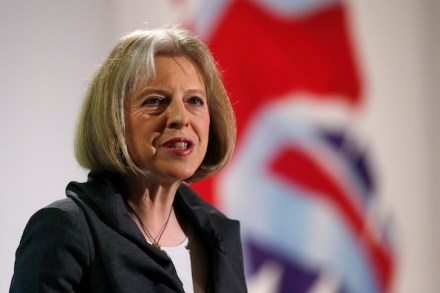
Theresa May’s modernising moment on stop and search

Theresa May’s statement in the Commons today on stop and search strikes me as an important moment. Here, we had a Tory Home Secretary standing up and saying that she understood why some communities felt that stop and search was used unfairly and announcing a review of it. This is, as I said on Sunday, is quite a change in Tory attitudes. William Hague, who was Tory leader at the time, criticised the Macpherson report for making police reluctant to use stop and search. Just five years ago, David Cameron was emphasising the need to ‘free the police to do far more stopping and far more searching’. Now, May doesn’t want to scrap stop and search. But her concerns about its use are a reminder that Tory modernisation is not finished yet.

Kenneth Minogue RIP

The weekend brought the sad news of the death of Kenneth Minogue. Intellectually and physically active to the last, he died on Friday at the age of 82, while returning from a conference on the Galapagos Islands. Spectator readers will remember his essays and reviews for the magazine stretching over many decades. Some may have been fortunate enough to have been taught by him at the London School of Economics. Ken was, needless to say, one of the most brilliant conservative political thinkers of his generation. He was also the most wonderful man. He had that rare mixture of great intelligence and twinkly, irrepressible good-humour.

‘What’s more important obeying a Brussels directive or keeping the lights on?’

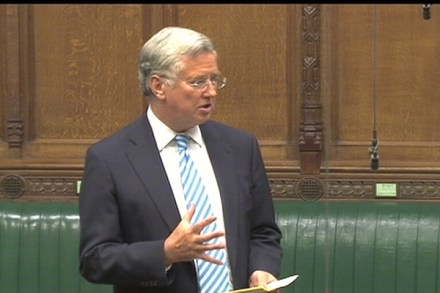
Andrew Neil’s interview of Michael Fallon on The Sunday Politics was a reminder of just how much of UK energy policy is determined by EU rules. When pressed on why there’s such a capacity crunch that there’s a risk of blackouts in the winter of 2015-16, Fallon explained that this was because a whole series of ‘dirtier’ plants are coming off-stream because of EU rules. If this wasn’t happening, there wouldn’t be a problem. Intriguingly, when asked ‘what’s more important obeying a Brussels directive or keeping the lights on?’ Fallon responded that ‘Keeping the lights on is the job of the government’. But he stressed that the government was ‘not planning to break any particular laws’.

Miliband’s EU referendum dilemma

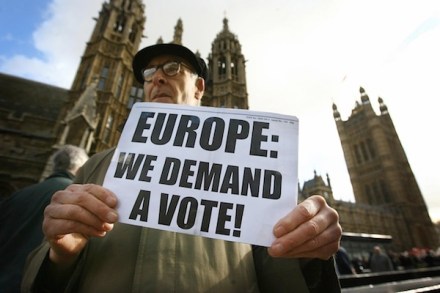
Friday’s vote on James Wharton’s EU referendum bill is going to push the whole Europe question right back up the political agenda. The Tories will try and use it to highlight their support for a vote and the opposition of the other major parliamentary parties. It will be very hard for Ed Miliband to go into the next election opposed to a referendum. It would look like he was opposed to giving the public a say. I also suspect that it will become almost politically impossible to oppose a referendum after the European Elections in 2014. Patrick Wintour reports today that Labour is toying with the idea of either amending the Wharton Bill to back an instant In / Out vote or committing to one within the six months of the next election.

The ‘conservative wing of the coalition’ toast Maggie and roast Dave

Margaret Thatcher’s death has reinvigorated her devout following in the Conservative Party. The current Prime Minister was wise to give the House of Lord’s terrace a wide berth last night. It was packed out for the summer party of Conservative Way Forward. This is the pressure group that was established to preserve ‘the lady’s legacy’. Young Dave was not the most popular person in the room. This became clear after the minute’s silence for the group’s deceased honorary president, when former defence minister Gerald Howarth took to the podium to greet ‘the conservative wing of the coalition’. He went on to slam the PM for ‘slashing defence spending while protecting international aid’.

My six-point plan to save Britain

As Britain gets fit for what David Cameron calls the ‘global economic race’, figures out this morning confirm Britain remains hamstrung by poor productivity. UK productivity per hour has remained stagnant over the last year (having fallen by 1.76 per cent since 2008). When he eyed the competition at last week’s G8 summit, the Prime Minister will have clocked that only sclerotic Russia and stagnant Japan have worse productivity than the UK. According to a recent Office of National Statistics (ONS) review, Britain lags 16 percentage points behind the G7 average, 27 behind the US. Ageing infrastructure and under-investment has blighted the oil and gas sector.  Manufacturing productivity last year fell by 5.

Spending review – a response from a Tory marginal

If there was one thing the spending review has proved, it is that the Conservative-led coalition is a compassionate government. In fact, I would go further and argue that it is a government that has given true meaning to ‘cradle to grave’ conservatism. From the beginning of the life-cycle to the end, the coalition is investing in ways that are profoundly Conservative, while also passing known socialist yardsticks, such as the redistribution of wealth from the rich to the poor, by ensuring that the wealthiest bear the greatest burden of taxation and that resources are targeted at to those most in need.

Boris Johnson: an eminently likeable politician who poses little threat to David Cameron

Even Boris can't help the toxic Tories. That's the upshot of Lord Ashcroft's latest polling, which asked 8,000 people (including several focus groups outside of London) about what they think of the mayor. Although Boris Johnson is the country’s most loved politician, he is not the voters’, or even Conservatives’, top choice as prime minister. David Cameron remains the favourite at 33 per cent to Boris’ 29: Half of those polled said that if Johnson was leader of the Conservative party, it would 'make no difference' as to whether they were more or less likely to vote Conservative. This is a blow to the Cameron dissenters, who have always believed that Boris would encourage more people to vote Tory.