Brexit

Mark Carney has a shot at redemption tomorrow. Will he take it?

There are not many predictions that are safe to make in the financial markets. M&S’s results will always be disappointing is perhaps one. Sir Philip Green will never apologise for anything is another. And there is one more that can now be added to the list. The Bank of England won’t raise interest rates when it meets this week. But it should. Why? Because the ‘emergency’ post-Brexit cut is already looking like an over-reaction. In truth, the Bank’s Governor Mark Carney is already looking dangerously over-committed to Project Remain. The best thing the Bank could do now would be to admit that it had a made a mistake – and

Another poll shows that Brexit hasn’t changed Scottish appetite for independence

Throughout the EU referendum campaign, we heard that Brexit would not only sink the UK economy but destroy the Union because Scots were likely to vote Remain. In the event there was a difference at the polls—38 per cent of Scots voted for Brexit, vs 52 per cent in the UK as a whole—but was it enough to destroy, or even threaten, the Union? Polls in the immediate aftermath showed an uptick for support for Scottish separation which has since ebbed away. Kantar TNS has today published a poll showing that 53 per cent of Scots are against independence, which confirms the YouGov poll taken at the end of August showing 54

The Brexiteers will always blame everything but Brexit

The worst men always find themselves in others. If they are instinctive liars, they accuse their opponents of lying. If they mistreat women, they assume all other men do the same. If they are sleazy, over-promoted know-nothings, they see their angry faces in every stranger they meet. On this reading, Liam Fox’s barroom tirades are just the voice of his own subconscious speaking truth to a man who should be a thousand miles from power. When Fox said the British were ‘too lazy and fat’ to be a free-trading people, he did not realise he was describing himself.  When he said British managers were not up to the task of

David Davis: Brexit is the sexiest area of politics

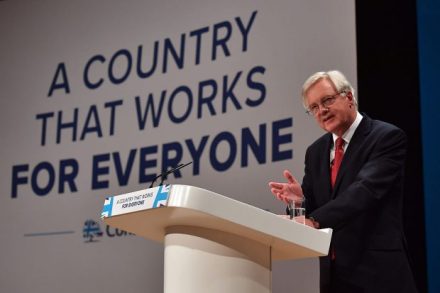
Since the nation voted to leave the European Union in the referendum, Brexit has been described as a lot of things by a lot of people. However, until now Mr S had not heard it be described as sexy. At today’s European Union Select Committee, David Davis — the Brexit secretary — claimed that his brief is the ‘sexiest area of politics’. He made the comments as he answered a question on the possibility of establishing a ‘clearing house’ where interested parties can get in touch with the department: ‘As you can imagine — because this really is the sexiest area of politics at the moment — everybody writes to us. And my

Liam Fox confirms that Britain now has a nationalist government

Unlike the boss, I thought Liam Fox’s comments on fat and lazy British businesses that could be exporting more but aren’t because, well, an afternoon on the golf course is more comfortable than striving for Britain were deplorable. But they were also telling. Because they were a further confirmation that the United Kingdom now has a nationalist government. The liberal Toryism of the Cameron era is gone, sunk with a whimper in record time. In its place is a Conservative nationalism that envisages SS Britannia buccaneering its way across the world’s oceans. This, after all, was the animating spirit of what we might call the Brexit campaign’s more cheerful wing. Well, it’s a nice

Liam Fox is right: we need to talk about Britain’s trade problem

When Theresa May appointed three of the most outspoken and free-minded Brexiteers to her Cabinet, her fellow Remainers were delighted. Surely the only question is what they’d do first: implode or disembowel each other? Ever since, the speeches they’ve made have been seen through this narrative. First, David Davis was seen to have gaffed for pointing out that it’s “improbable” that the UK stays in the European single market. And today, we have Liam Fox’s remarks to Conservative Way Forward about Britain’s trade problem. A friend of mine was at the event, and took a video. Here’s the transcript: CoffeeHousers can judge for themselves if his remarks are really so outrageous. “This country is not

Imagine there’s no countries… and therefore no museums

I’m not a great optimist about the whole Brexit thing, although my colleagues would mostly disagree. It’s as if we were expecting a storm and we’re now cheering because it’s gone quiet. Strangely, eerily quiet. Anyway, like with climate change, I hope I’m wrong, and whenever I have my doubts about the whole thing, I think about the ‘Remain’ protests led by Eddie Izzard. Let’s hope these obviously counter-productive demonstrations continue for the next five years. However, one disaster that doesn’t seem to have materialised yet is the warning that Brexit would lead to a brain drain. One guy in the Guardian, called Mr Imhof, says he’s going, which is a shame, as

The Spectator podcast: The Brexit bounce | 10 September 2016

On the morning of the 24th June, Britain woke to find its stock market shattered and its pound pummelled. It appeared – for a brief moment – like all the prophecies of the Brexit doomsayers, not least the Great Seer Osborne, had come true. But then, from the wreckage of that mid-summer morning, green shoots began to appear, and now, more than two months down the line, it seems that Britain has bounced back. In his cover piece this week, Ross Clark argues that the Remain campaign fell victim to the perils of believing their opinion to be ‘objective fact’, and that economic recovery has humiliated the Treasury, Bank of

Aristotle on Brexit voters

It comes as no surprise to find that there has recently been much talk among Brexit supporters about ‘the wisdom of crowds’. The question fascinated Aristotle, who discussed it at some length in his Politics. Aristotle (4th century BC) firmly believed that only the ‘best’ should rule. Nevertheless, he had lived in a direct people’s democracy in Athens, and agreed that ‘perhaps, for all its difficulties, it has something to be said for it’. He proceeded to make the case by a series of analogies. The many, he suggested, might be collectively better than the few ‘in the same way that a feast to which all contribute is better than one

Portrait of the Week – 8 September 2016

Home David Davis, the Secretary of State for Exiting the European Union, made his first statement to the Commons and said that if membership of a single market meant having to give up control of United Kingdom borders, ‘that makes it very improbable’. The official spokesman for Theresa May, the Prime Minister, who was away in China, disagreed, claiming that Mr Davis was merely ‘setting out his opinion’. ‘Saying something is probable or improbable,’ she said, ‘I don’t think is necessarily a policy.’ Speaking in China about freedom of movement after Brexit, Mrs May said: ‘I want a system where the government is able to decide who comes into the

Migrant benefits

Calm is slowly returning to the debate about Britain and Europe. The shrillness of the referendum campaign, and the hysteria from people who ought to have known better, is giving way to an acceptance that the end is not nigh and that things could be as good, if not better, than before. The idea that the British public had somehow voted for a recession is being steadily abandoned. The next stage is to accept that Brexit was not a populist yawp about protecting our borders. It was not a demand to stop immigration, but to manage it better. So when Theresa May rejected an Australian-style points-based immigration system this week,

Ken Livingstone reneges on his pledge to flee Brexit Britain

This week Ken Livingstone has managed to cause a stir after he appeared on the BBC to defend Keith Vaz — but ended up talking about Hitler. However, there was another reason Livingstone’s appearance on television piqued Mr S’s interest: why is he still in Britain? During the EU referendum campaign, Livingstone threatened to emigrate if Brexit triumphed: ‘I would personally start thinking about emigrating to somewhere the economy is not going to collapse.’ Yet three months on and Livingstone remains in Brexit Britain, showing no signs of making a quick getaway. While it’s certainly true — as this week’s Spectator cover story details — that the economy is confounding Remain doom-mongers such as

The Brexit bounce

Next time it comes to redesigning the PPE course at Oxford, I suggest a module beginning with a quotation from George Osborne. It’s something he said to the Treasury Select Committee in May, back when he was still Chancellor: ‘If you look at the sheer weight of opinion, it is overwhelmingly the case that people who look at the case for leaving the EU come to the conclusion it would make the country poorer, and it would make the individuals in the country poorer, too.’ There might be advantages to Brexit, he said, ‘but let’s not pretend we’d be economically better off’. In other words: it wasn’t just George Osborne’s

Mrs May the ‘Student Killer’ should count the cost of her visa crackdown

In the post-Brexit landscape whose shape was barely glimpsed in G20 discussions at Hangzhou, one thing is clear: soon we’ll have to stop waffling about trade deals and start pushing British products the world wants to buy. One such is education, at our universities, independent schools and English-language colleges — an export sector calculated in 2011 by the now defunct Department for Business, Innovation and Skills to be worth £17.5 billion. Not only does this sector attract foreign exchange, plug funding gaps for cash-strapped universities and support thousands of jobs, it also lays the ground for future relationships with students who return home to embark on business careers. And as

Out but not down

No group of the population voted to remain in the EU more enthusiastically than students. According to the polling organisation YouthSight, 85 per cent of them voted to remain, and among the 15 per cent who voted leave, 17 per cent say they now regret it. Moreover, the idea that students were too lazy or drunk to turn out to vote is a gross calumny on the young, according to the survey. It found that 87 per cent of eligible students turned out to vote — compared with 72 per cent of the general population. What it didn’t reveal is how many students voted more than once. My biggest shock

Theresa May: We have selection in state schools already, selection by house price

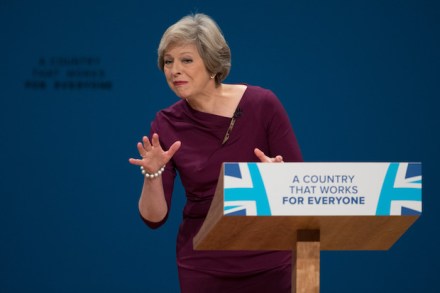
Theresa May received the traditional desk banging reception when she addressed the 1922 Committee of Tory backbenchers. May pleased Tory MPs by emphasising that they  would have more opportunity to feed into policy making process now through George Freeman and the policy board and the green papers that will—once again—precede white papers. But what most excited Tory MPs was what May said about opportunity and grammar schools. May said that she would give a speech on a 21st century education system soon, explaining how selective schools–in other words, grammars–fit into the mix. Strikingly, she defended an ‘element of selection’ arguing that there is selection already in the system, and it

What we learnt about Brexit from Theresa May today

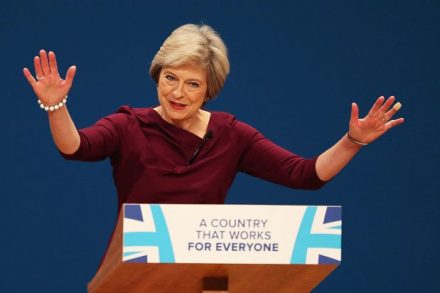
Theresa May began her statement on the G20 by talking about Brexit. She insisted that she wasn’t going to give a ‘running commentary’ or reveal the government’s negotiating hand as, she said, that would not deliver the best deal for Britain. In other words, we’ll all just have to wait and see what she negotiates. May’s insistence that she won’t rule anything in or out does lead to some rather bizarre moments. May repeatedly, and rightly, stressed the trade deals that the UK would seek to do outside the EU. But when Labour’s Emma Reynolds asked her to confirm that these deals would require leaving the customs union, May ducked

Theresa May reveals her weakness

Bit early for a lap of honour. At PMQs Mrs May congratulated her government (i.e. herself) on fifty marvellous days in government. And she drew comparisons between her polished style and the Corbyn car-wreck. One view is that the chimpanzees’ tea-party currently posing as Her Majesty’s opposition should remain beneath the attention of Number 10. Mrs May disagrees and she used Labour’s woes as the starting point for some carefully scripted comedy. With mixed results. Delivering gags is tough. Delivering someone else’s gags is tougher. Delivering someone else’s out-of-date gags is so tough that it borders on crazy. But the PM is, understandably perhaps, tempted by the illusion of omnipotence

‘Serene’ Mark Carney tries to take credit for Brexit bounceback

How does Mark Carney feel about his ‘Project Fear’ warnings in the run-up to the referendum? His mild-mannered nemesis Jacob Rees-Mogg probably wouldn’t have been prepared for the Bank of England Governor’s choice of words to describe his mood. Carney was ‘serene’ about how he handled himself before Brexit, he told the Treasury Select Committee this afternoon. But Carney didn’t stop there: he also did his best to bait Rees-Mogg, who has clashed with Carney several times before at these hearings, suggesting the session was being wasted ‘going through counterfactuals’. He then went on to slap down any suggestion from the Tory MP that his warnings had been ‘dire’. Yet