Brexit

Theresa May, left-wing Tory

Curbs on executive pay, restrictions on foreign takeovers and workers on boards. Not Jeremy Corbyn’s plan for Britain, but ideas raised by Theresa May and put forward for discussion at her cabinet committee on the economy and industrial strategy. Not for 40 years have the Tories had a Prime Minister so firmly on the left of the party. May joined the Tories before Margaret Thatcher became leader and in many ways she represents a bridge back to the pre-Thatcher era. That is why comparisons between Britain’s two female prime ministers don’t reveal much — they come from very different traditions. Since Thatcherism took over the party, many Tories have looked

Mark Carney strikes a different tone on Brexit

Mark Carney made himself some enemies during the referendum. It wasn’t only his gloomy prophecies that caused trouble. His willingness to speak out in the first place was enough to anger those who thought he should keep shtum on a politically-loaded topic like Brexit. Today, though, we saw a different Carney. Gone was the gloominess, and in place of his warning that the referendum was ‘the most significant’ risk to Britain’s financial stability, came the verdict that Britain was largely out of that particular storm. He told the Treasury select committee that: ‘Having got through the night, if you will, and the day after, the scale of the immediate risks

Full text: Jeremy Corbyn’s Brexit speech

Listen to the whole speech here: Whether you voted to Leave or to Remain, you voted for a better future for Britain. One thing is clear, the Tories cannot deliver that. So today I want to set how Labour will deliver that vision of a better Britain. This government is in disarray over Brexit. As the Prime Minister made clear herself  they didn’t plan for it before the referendum and they still don’t have a plan now. I voted and campaigned to remain and reform as many of you may know I was not uncritical of the European Union. It has many failings. Some people argued that we should have

Dominic Cummings: how the Brexit referendum was won

Politics is gambling for high stakes with other people’s money… Politics is a job that can be compared with navigation in uncharted waters. One has no idea how the weather or the currents will be or what storms one is in for. In politics, there is the added fact that one is largely dependent on the decisions of others, decisions on which one was counting and which then do not materialise; one’s actions are never completely one’s own. And if the friends on whose support one is relying change their minds, which is something that one cannot vouch for, the whole plan miscarries… One’s enemies one can count on – but

A Donald-Boris alliance would be good for Brexit

It’s a shame that protocol, being protocol, prevents Foreign Secretary Boris Johnson from meeting President-elect Donald Trump during his trip to Washington. Boris can’t even meet Rex Tillerson, the man Trump has chosen as his Secretary of State, until Tillerson is confirmed by the senate. A Trump-Johnson encounter would be a meeting of considerable media and public interest: the Donald and the Boris have become aligned in people’s minds ever since the EU referendum, when Nick Clegg and others called Johnson ‘Trump with a thesaurus’ and so on. It’s true that Boris is, in a tabloid sense, a thinking man’s Trump. The two men are born New Yorkers. They share

Nicola Sturgeon is making it up as she goes along

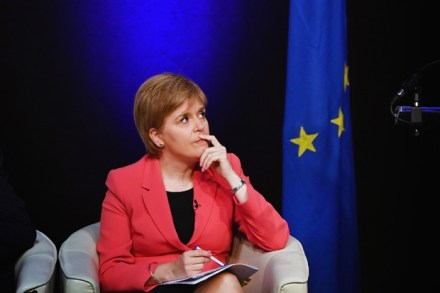
Because the SNP have won so often and so conclusively in recent years there is an understandable temptation to suppose they must always know what they are doing. Accordingly, Nicola Sturgeon sits in Bute House like some political Moriarty: motionless, perhaps, but like a spider at the centre of its web. And ‘that web has a thousand radiations, and [s]he knows well every quiver of each of them’. Other political parties may plan, but the SNP plots. Everything is done for a reason and nothing is left to chance. The nationalists are relentless and implacable. No wonder they put the fear of God into their foes (especially a Labour party they

Bitcoin is booming – is drug-taking the reason why?

The FTSE 100 ended the year strong, at 7142, and reopened even stronger. For 2016 overall the index gained 14 per cent, with multinational mining giants as top performers, while the pound lost 16.5 per cent against the dollar — those facts being closely related, since they mean London blue-chips are still cheaper in dollars than they were 12 months ago. Current optimism rests on the idea of a Trump spending spree on US infrastructure, but such is the perversity of markets that if common City wisdom decides that Brexit will actually boost the UK economy, stocks may fall as the pound resurges and foreign investors take profits. Meanwhile bitcoin,

There’s life after Brexit for Cambridge University

As a former student of English at Cambridge, I am sent the faculty magazine, 9 West Road. Its latest issue leads with a long article by Peter de Bolla, chair of the faculty, headlined — with intentionally bitter irony — ‘Now we are in control’. On and on he goes — the shocked perplexity of ‘French locals’ in ‘our holiday village’ that we could be Brexiting, the putative loss of the EU exchange students who ‘amaze and challenge’ him, how you cannot study for the tripos’ famous Tragedy paper ‘from the perspective of a monocultural and inwardly facing society or polis’. Prof. de Bolla himself is so monocultural and inward-facing

The problem for Jamie’s Italian isn’t Brexit. It’s the menu, the prices and the narcissism

Jamie’s Italian is closing six branches, blaming Brexit. After all, what else could explain the lack of customers? The below Spectator review, from August 2015, offers some suggestions Jamie’s Italian is squeezed into the Devonshire Arms on Denman Street, Soho, borne on the duplicitous winds of TV shows and book deals. It’s an odd fit, like a Flump meeting Dante. The Devonshire was a pub at the end of the world, a Victorian dystopia made of violence and despair. Now Jamie Oliver — an aghast teenager running to fat even as he declares war on the Turkey Twizzler and the civilisation that wrought it — has sucked it into his

The other lesson that Theresa May must learn from Cameron’s failed EU negotiation

Theresa May has clearly learnt one lesson from David Cameron’s failed negotiation with the EU. As I write in The Sun this morning. she has realised that if she just asks for what cautious officials think she can get, then she won’t get enough to satisfy the voters—hence Sir Ivan Roger’s resignation as the UK representative to the EU. But an even bigger problem for Cameron’s renegotiation was that the other side never believed he would walk away from the deal. Cameron compounded this problem when he made clear that he wanted the whole thing done quickly, further reducing his negotiating leverage. So, when May makes her big Brexit speech

Theresa May’s extraordinary opportunity

It is the fate of all new prime ministers to be compared with their recent predecessors. Theresa May has already been accused of being the heir to the micro-managing Gordon Brown. Her allies, meanwhile, see a new Margaret Thatcher, an uncompromising Boadicea destined to retrieve sovereignty from Europe. But perhaps a more fitting model for May would be a less recent Labour prime minister: Clement Attlee. When Labourites reminisce about Attlee, it isn’t so much the man himself who makes them misty-eyed. It is the achievements of those who worked for him — Nye Bevan, Ernest Bevin and the rest. Attlee’s government created the welfare state and the National Health

Banality not Brexit is to blame for Jamie’s Italian restaurants shutting

So, yet another business in trouble thanks to this foul recession caused by Brexit. Or that’s what chief executive of Jamie’s Italian, Simon Blagden, wants us to think, anyway. Announcing the closure of six restaurants he said: ‘As every restaurant owner knows, this is a tough market and, post-Brexit, the pressures and unknowns have made it even harder’ Well, not as every restaurant-owner knows, no. According to the ONS’ figures, published at the end of November, its economic index for hotels and restaurants was up 1.1 per cent in the third quarter – following the vote for Brexit. The latest Purchasing Managers’ Index (PMI), published yesterday, shows accelerating growth in

Theresa May won’t get a better chance to deal with the social care crisis

What is the greatest problem facing Theresa May this year? The Prime Minister is preparing for her speech on what Brexit means (in which she will presumably have to speak in sentences rather than using random and meaningless slogans), but that’s not the only major policy issue that she should deal with in 2017. As I explain in this week’s magazine, Cabinet ministers are growing increasingly agitated at what they see as a paltry response to the social care crisis. As MPs, they are being lobbied by furious council leaders who say that nothing announced so far even comes close to alleviating the crisis. As ministers, many of them see the

What the papers say: Britain’s booming economy and ‘whinging’ Whitehall

The front page of the Times makes happy reading for the Government this morning with its news that Britain’s economy grew at a faster rate than any other leading economy in the world last year. But while politicians are keen to act as cheerleaders on occasions like this, they are somewhat more reluctant to mention another ‘metric of success: immigration’. So says the Guardian in its editorial in which it argues that foreign workers wanting to come to Britain is a sign of just how healthy our economy is. Theresa May faces a challenge, the paper says, in addressing the worries of workers who want immigration to be controlled, while not

From Socrates to Osborne

Ex-chancellor George Osborne is planning a book to be titled The Age of Unreason. He says that ‘it will be my attempt to understand why populist nationalism is on the rise in our western democracies’. An Athenian would have been most surprised by that title’s implications. If the ancient Greeks are famous for anything, it is for the invention of western ‘philosophy’. By that is usually meant the attempt to explain the world in humanly intelligible terms, i.e. by the exclusive use of reason and evidence, without calling in aid the supernatural. This sort of thinking, begun by eastern Greeks in the 7th century BC, reached something of an apogee

Sir Ivan’s exit

The wonder about Sir Ivan Rogers’s resignation as Britain’s ambassador to the EU is that he was still in the job. He may have possessed useful knowledge about the workings of the EU, but he was also heavily associated with a failed way of conducting negotiations with it. It was he who advised David Cameron last February on his unsuccessful renegotiations of Britain’s relationship with the EU, which failed to convince the British people to vote to remain in the union. It would have been better and less disruptive had he resigned in the wake of the referendum last June, along with the Prime Minister. That Sir Ivan was not

What the papers say: The Sir Ivan Rogers row rumbles on

Sir Tim Barrow has been appointed as Britain’s ambassador to the EU. Yet still the row over his predecessor’s departure rages in today’s papers. Sir Ivan Rogers may well have thought that the country made a mistake in backing Brexit, says the Daily Telegraph, but it is ‘not his place to make that impression public in the way that he did’. There was ‘nothing even-handed about the way in which he left, according to the paper’s editorial, which hits out at Rogers’ apparent inability to deal with politicians not always taking on board his advice. But the Telegraph’s most stinging criticism for Rogers is the way in which this row

May’s big chance

It is the fate of all new prime ministers to be compared with their recent predecessors. Theresa May has already been accused of being the heir to the micro-managing Gordon Brown. Her allies, meanwhile, see a new Margaret Thatcher, an uncompromising Boadicea destined to retrieve sovereignty from Europe. But perhaps a more fitting model for May would be a less recent Labour prime minister: Clement Attlee. When Labourites reminisce about Attlee, it isn’t so much the man himself who makes them misty-eyed. It is the achievements of those who worked for him — Nye Bevan, Ernest Bevin and the rest. Attlee’s government created the welfare state and the National Health

My poster girl for free speech

Now is the time of year to take down the Christmas decorations from your front window and put up, in their place, the anti-immigration posters. Please display them prominently and make sure the message on each is suitably strident. It behoves all of us to do this, as quickly as possible, even — perhaps especially — if we are liberally minded. For this is not about immigration, per se. It is to show solidarity with Ms Anne Maple, who is aged 61 and unfortunate enough to live in Lewisham. I do not know Ms Maple personally. It may well be that, rather than a sainted individual, she is a meddlesome