Boris johnson

Johnson’s reshuffle rumours won’t go away

When Boris Johnson was asked at this week's Covid press conference whether he could rule out an imminent cabinet reshuffle, he didn't give anything away. The Prime Minister joked that it was a question for the chief medical officer before avoiding offering an answer himself. While Johnson may take the view that the focus on a reshuffle was a distraction from his Covid winter plan announcement, it's also the case that the constant rumours are starting to become a serious distraction for ministers, aides and civil servants.  Given the decision to hold a reshuffle is down to one person, predicting the timings of any such shake-up is a fool's game.

How Charlotte Wahl Johnson’s troubled life shaped her son Boris

Attractive, accomplished and admired as an artist, friend and mother, Charlotte Wahl’s promising life could have been wrecked, first by cruel sicknesses and then by an adulterous husband. Instead, she bravely defied adversity and found happiness in a second marriage, her four children’s success, her friendships and painting. Her death at 79 will be particularly painful for Boris Johnson, the eldest of her remarkable children. Despite all the pressures, he regularly visited his mother at her comfortable flat in Notting Hill Gate, recognising how much he owed her. In frail health from Parkinson's and other complications, Charlotte agreed to meet me in September 2019 for the biography I was writing about Boris. I had met her several times over the previous 20 years.

Assetocracy: the inversion of the welfare state

To understand how the Tories ended up in such a muddle about who they are and what they stand for, take a walk down any of the nicer streets in Boris Johnson’s constituency. North Hillingdon is as idyllic now as it was a generation ago: spacious houses, with large drives, built before the war. The houses were, once, more or less affordable. One property on Parkway, for example, was bought for £175,000 just over 20 years ago. It’s now valued at £1 million. And what’s true in Hillingdon is true of the rest of the country too. The asset boom that started at the turn of the century has transformed the finances of families across the country, turning modest-income retirees into unexpected millionaires: a new ‘assetocracy’.

The emergency is over. Now the government must relinquish its emergency powers

For 18 months, the government has held power over us as never before in peacetime. The emergency powers granted by parliament in March last year can cancel our events, separate families and send us back into our homes. The argument for giving politicians this kind of control was that leaders needed to make huge decisions at short notice because an invisible enemy was surging through Britain and posed a deadly threat to our elderly and vulnerable. There was no time for proper democratic debate or scrutiny. That emergency has passed, but the government wishes to keep the powers. What’s the case for doing so? Vaccines have significantly weakened the link between Covid infections and severe illness.

Boris’s premiership is entering a dangerous new phase

The announcement of a tax increase for both workers and employers to fund more spending on health and social care is Boris Johnson’s biggest gamble since he won the 2019 general election. He is betting that, under the cover of Covid, he can get away with breaking his manifesto commitment not to raise personal taxes. Voters can be unforgiving of politicians who break their promises. Johnson is aware of this danger. Earlier in the crisis, when the Treasury pushed to drop the pensions triple lock — which ensures that the state pension goes up by inflation, earnings or 2.5 per cent, whichever is highest — because the Covid crisis was making it unaffordable, Johnson resisted on the grounds it was a manifesto commitment.

Starmer and the Speaker struggled for the same reason at PMQs

PMQs thundered back to life today. Boris was clearly thrilled to be there. Sir Keir seemed to be up to his eyeballs in self-doubt.  Evidently the Labour leader preferred the old pandemic days when the chamber was like a coroner’s court or a half-empty library at Lambeth Palace. The atmosphere back then was calm, studious and considered. This afternoon the playground riot was in full swing. It opened with a Boris special. He was asked by Craig MacKinlay if the next generation could seriously rely on cars powered by Duracell batteries and by houses heated with warm zephyrs that rise by magic through air-vents in the floor. Boris crushed this cynical view and he urged MacKinlay to ‘embrace the Promethean spirit of technological optimism.

PMQs: Starmer’s caution lets Boris off again

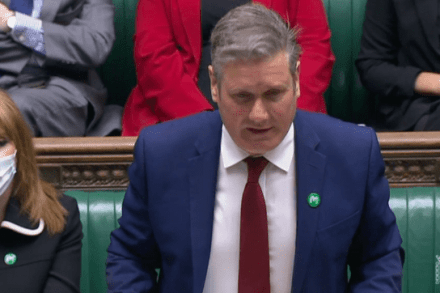
Today was the first PMQs clash between Boris Johnson and Keir Starmer in a packed Commons chamber. Starmer tried to pin down Johnson on whether he could guarantee that no one would have to pay their home to fund their care. Johnson dodged the question. But Starmer was limited by the fact that Labour can’t say how it would raise funds for the NHS backlog and social care, allowing Johnson to claim that Labour has no plan. Starmer is a naturally cautious politician, but his caution is leaving the field clear for Johnson on social care. Things would have been more difficult for the Prime Minister today if Labour was explicitly backing a tax on assets.

Boris should keep copying Blair

Having written here at least once before that Boris Johnson is the heir to Blair, my first thought on the Prime Minister's tax-to-spend announcement on the NHS and social care is a petty one: I told you so. The striking thing about making the Boris-Blair comparison is how resistant some people are to it. Among Bozza fans on the Leave-voting right, there is often fury at the suggestion that their man, the hero of Brexit, is anything like the Europhile they used to call ‘Bliar’. On the left, there is an almost pathological determination to believe that a Tory PM must, by definition, be a small-state free-marketeer intent on starving and privatising public services. That latter point is why Labour people sometimes struggle to respond to Johnson.

The rise and rise of Rishi Sunak

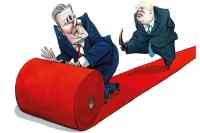
When Victoria Beckham noticed that her husband David had developed a winning way, not just with her but with almost everyone else too, she came up with a wry nickname for him: Goldenballs. What billionaire’s daughter Akshata Murthy calls her husband Rishi Sunak within the confines of their family homes is anybody’s guess but there is no doubt that he is on a golden run of his own right now. As his rivals to succeed Boris Johnson blow up — both Foreign Secretary Dominic Raab and Home Secretary Priti Patel are currently subject to heavy speculation about imminent demotion — nobody seriously believes that Sunak’s position as Chancellor is in jeopardy.

When will the real Keir Starmer stand up?

Who is Keir Starmer, and what does ‘Starmerism’ stand for? Well into his second year as Labour leader and most Britons remain unsure. It’s not as if Starmer hasn’t spent a lot of time and effort – and so many words – in trying to define himself: he was even interviewed by Piers Morgan for an hour on ITV to highlight his human side.  But something has gone wrong. Is it the message or the messenger? Or is the difficult Covid-dominated times in which he became leader that is to blame? Whatever the reason for Starmer's curiously forgettable leadership, it is now imperative that Starmer starts to make a clear and positive impression on voters: he needs to be more than 'Not Jeremy Corbyn'.

Boris dodges a tax hike Tory rebellion – for now

After emerging relatively unscathed from his appearance in front of MPs, Boris Johnson addressed the public in a bid to sell his plan to raise taxes as part of a a new health and social care levy. Given that polling suggests broad support for the proposals, the press conference was – at least on paper – the easier outing of the two. Appearing alongside Health Secretary Sajid Javid and Chancellor Rishi Sunak, the Prime Minister tried to justify his decision to break a manifesto pledge and raise national insurance in order to clear the NHS backlog and fund social care.  Johnson said he was fully aware it meant reneging on an election promise – but said 'a global pandemic wasn't in our manifesto either'.

Boris and Priti can’t blame France for the Channel migrant crisis

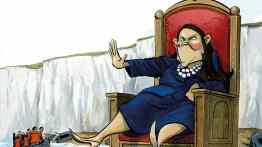
The sun is beating down again, the waves are less choppy in the English Channel and the small boats full of irregular migrants are pouring across once more. At least 1,000 men, women and children were reportedly spotted landing on the south coast yesterday. If these numbers are correct, it would have shattered the previous daily record of 828, recorded on 21 August. But Home Office sources were today briefing that was an over-estimate and the likely official number will be about 740, merely the second highest daily total ever. The graphs plotting the staggering acceleration of this traffic make grim reading indeed – this is one curve that has never been flattened.

Why Johnson’s tax gamble will pay off

Boris Johnson's announcement today, promising he will fix the £15 billion hole in health and social care, may well be the decision that determines his and his party's fate at the next election — and, by implication, Keir Starmer's reaction will also determine his destiny.  Probably the most important point is that after the 18 months we've had, most people would argue that putting the NHS and care for the elderly and vulnerable on a stable financial footing should be the Prime Minister's number one priority.

Can Johnson win round his social care critics?

Is Boris Johnson's social care plan about to sail through the House of Commons? Today the Prime Minister will unveil the details of the package he is proposing. After putting his plans to the cabinet, it will be set out in the Commons before a 5 p.m. press conference where Johnson will appear alongside Rishi Sunak and Sajid Javid. There are rumours afoot that No. 10 then may opt for a vote in the Commons this week at short notice — in a bid to push the plans through before the rebels have time to get organised. However, slightly raining on Johnson's parade is the fact that cabinet ministers have so far been kept out of the loop.

Will Johnson’s cabinet of cardboard cutouts make a stand?

Cabinet government has become a very degraded thing. When I checked last night, cabinet ministers had still not been told whether the PM's planned breaches of his 2019 manifesto would even be on the formal agenda for discussion at the 8.30 a.m. cabinet meeting today. But as of last night, Boris Johnson is going ahead with: a manifesto-breaking 1.

On Afghanistan, Boris Johnson has escaped again

Boris Johnson took a strangely upbeat tone when he updated MPs on Afghanistan this afternoon. He argued that British planning for the US withdrawal had been months in the making and that the evacuation effort had exceeded expectations with twice the number of people getting out than had been expected.  He even made some big promises, saying repeatedly that every MP who had contacted the Foreign Office about Afghans who still need assistance would receive a response 'by close of play today', and adding that councils taking in refugees would get the funding they needed. Johnson was even rather combative with Defence Select Committee chair Tobias Ellwood, scolding him for not appearing to acknowledge that the British military activity in the country had ended in 2014.

Why are Boris’s tax rises so popular?

It is a curious thing to exclude a vast group of generally quite well-heeled voters from funding a policy innovation that they will benefit from more than any other group. One might almost call it blatant favouritism. But Boris Johnson’s plan to pay for a big increase in resources going into social care long-term and the NHS short-term amounts to just that. By opting for a National Insurance increase to fund his proposals, the PM is ensuring that nobody over the state pension age of 66 will have to put their hands in their pockets. Neither will the extra financial burden fall on so-called 'unearned' income such as dividends on shares or interest on savings. Instead, working people under 66 will suffer a direct hit to their pay packet.

Is Boris weaponising reshuffle rumours?

Parliament is back today and the Prime Minister is facing an autumn filled with problems. Boris Johnson had hoped to use the last week before the summer recess to reset his premiership by announcing reforms to social care, more money for the NHS and potentially reshuffling his top team. Instead, he found himself in self-isolation after coming into contact with Sajid Javid, who had tested positive for Covid. Now there are plans afoot to use the first week back to return to unfinished business. Once again there are rumours of a reshuffle — while Johnson is expected to finally unveil his social care plans on Tuesday. They too are not without problems.