Book review

Between the woods and the water

From our UK edition

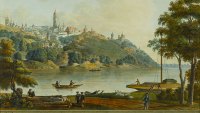
At the beginning of the historical record, the lands that we now call Ukraine were a reservoir of fantasy. Achilles probably did not sail from a Greek port on the north of the Black Sea up the rapids of the Dnipro River to find his final resting place, as some Greeks once believed. Nor is it likely that Ukraine, or the Pontic steppe as the Greeks had it, was the homeland of the Amazons. That said, it was Herodotus who supplied the south-to-north physical geography that Serhii Plokhy wisely follows: the ports of Crimea and the coast, the rich steppe heartland, and the forests. For Plokhy, the formation of Ukraine is the establishment of a unity among these three zones, and his themes are ‘geography, ecology and culture’.

The wandering Jew

From our UK edition

It’s been a long time coming for György Spiró. However much Hungarian writers complain about the isolation forced upon them by their non-Indo-European agglutinative language, the big names have always got through, maybe to a global shrug from the reading public, but they have made it out. And in fact, recently, the Magyar dead have done particularly well: Bánffy, Szabó, Szerb, Márai and Karinthy have found many British fans. Though he’s better known as a dramatist in Hungary, Spiró’s massive novel Captivity was published there in 2005 to great acclaim.

The rarest blend of white and gold

From our UK edition

This unusual book is beautifully written, produced and illustrated, but its subject — the small Slender-billed curlew — is strangely absent. In his ‘introduction to a ghost’, Horatio Clare explains that, when he was commissioned to tell the story of the western world’s rarest bird, it did, at least officially, still exist. This grail of the birding world, which he has never seen, he describes as a beautiful creature, a species of curlew plumaged in a blend of whites and golds, with dark spots on the flanks, slim and graceful of form, more refined than the plump common curlew, with a thinner down-curving beak which makes it look as though it is chewing a stem of grass. He tries to trace it in Sicily, Italy, the Peloponnese, the Balkans and Turkey.

Agony and ecstasy in the garden

From our UK edition

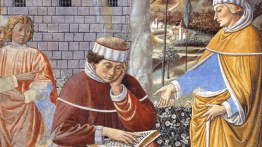
I usually throw away dust jackets but Robin Lane Fox chose his for a reason. He originally encountered Augustine of Hippo in the spring of 1966, after lunch and his first taste of brandy, in frescoes by Benozzo Gozzoli at San Gimigniano. The quattrocento painter showed a figure with an academic air, in a gown and cake-tin-shaped hat, sitting beneath a tall, smooth-barked fig tree in the garden of a villa, his head in one hand and the fingers of the other on some lines of script in an open book on his knee. Beside him stands a man gesturing towards him. This scene is the heart of an intense (if extensive) study by the ancient historian and garden master of New College of a man ‘educated to write like a marvel’.

A step too far

From our UK edition

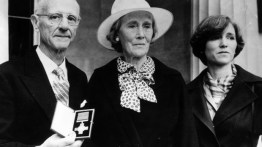
Captain Robert Nairac was a Grenadier Guards officer serving in Northern Ireland when on 14 May 1977 he was abducted and murdered by the Provisional IRA. Mystery surrounding the circumstances of his abduction and the fact that his body has never been found have provoked a minor literary industry. This must be the most comprehensive account yet. Nairac was serving in South Armagh as a liaison officer between the army, the SAS and police Special Branch. He was not a member of the SAS but had vastly more freedom of action than most soldiers, able to travel where and when he chose in civilian clothes with a pistol under his left armpit.

Telling tales | 31 December 2015

From our UK edition

Medea says ‘hiiiiiiii’ on the first page of Mallory Ortberg’s hilarious book, which puts smartphones in the hands of literary heroes, heroines and their writers; ‘it’s Glauce right??’, Medea continues, squealing ‘when is the WEDDING/ I hope you guys have the Argonauts as groomsmen/ and they do the sword thing/ you know where they make the little roof with their swords/ and you run down underneath it’. From this startling opening, Ortberg romps through the canon. Hamlet has teenage tantrums about the sandwiches his mother brings up on a tray. Keats gushes about ‘THIS URN’ and Mrs Danvers upbraids Rebecca for bringing in ‘BAGGED tea?

Family divisions

From our UK edition

The geological title of this unhappy memoir is an apt metaphor for fissures in the relationships between individuals of David Pryce-Jones’s extended family. Emotionally and financially competitive but interdependent, benefactors and beneficiaries, Jews and gentiles of various sexual proclivities are depicted grinding away against each other like so many incompatible tectonic plates. Pryce-Jones offers a candid expression of filial impiety for which Eton, Oxford and the Brigade of Guards surely cannot be entirely to blame, although it is true that education far from home, from an early age, has been known to piss children off, as they say. Young boys banished to boarding school may feel tormented by Oedipal yearnings and resentment of paternal indifference.

Scratching a living

From our UK edition

John Gross’s The Rise and Fall of the Man of Letters: English Literary Life since 1800, a standard text for anyone set on a life of writing about books, was intentionally truncated, ending its chronology before Gross’s own time of eminence. Two decades after the book’s publication in 1969, Gross explained in a new afterword that he had not wanted to comment on his peers and colleagues, for fear of misunderstanding or offence. A perfectly justifiable approach, but it made the book uncomfortably tantalising for those who prefer their gossip to be at the expense of the living. The Prose Factory is dedicated to Gross, and partially overlaps with The Rise and Fall, beginning in 1918.

A touch of class | 31 December 2015

From our UK edition

The New Yorker, not far off its centenary now, has moved beyond rivalry to a position of supremacy among American magazines. It has attained this not by taking a particular political position, although it certainly has one — it represents, obviously, a metro-politan, liberal, outward-facing attitude to the world. Rather, its pre-eminence is down to its valuing, above all, the quality of writing. Of course, aspects of the New Yorker have always irritated people. It possesses a somewhat supercilious quality — the one-page comic sketch, ‘Shouts and Murmurs’, invariably leaves me straight-faced, and sometimes even a bit depressed. I can never decide whether the restaurant reviews are meant to be a joke, so absurd do they make their subjects sound.

Following yonder star

From our UK edition

It’s hard to imagine Christmas without stars. They perch at the top of fir trees, glitter from greeting cards and dangle festively over shopping precincts. This year, even the John Lewis advert and Selfridges’ Oxford Street window display — two of the holiest icons of our modern, commercialised Christmas —both have astronomical themes. The origin of this celestial obsession is of course the Star of Bethlehem, whose apparition, according to the Gospel of Matthew, first alerted the Three Wise Men to the birth of Jesus, then guided them across the desert to pay homage to the new-born Messiah.

O Rose thou art sick

From our UK edition

Choosing to smell of something other than ourselves, and then perhaps in time coming to view that fragrance as ‘our’ smell — essence of us — is an odd business. I can’t wear Mitsouko because it smells of my great-aunt, for instance, which is at least relatively straightforward, but I also can’t wear Angel by Thierry Mugler because it smells of the Nineties and desperation; or L’Eau D’Issey because it smells of makeupless women in oversized clothing, stranded balefully in minimalist interiors; or anything with tuberose, tragically, because it powerfully reminds me of having morning sickness while wearing Fracas (‘my’ scent, until suddenly it became my kryptonite — so disgusting, now).

Here’s to Bill

From our UK edition

Often, Christmas is a time for moaning after the night before, when the seasonal drinking is remembered (if remembered at all) with bewilderment and a degree of guilt. The illusion of drink-fuelled happiness — what James Joyce called ‘tighteousness’ — is familiar to most of us, even if the hangover seems a cruel price. The most effective remedy for a thumping head is to take a hair of the dog that bit you. Eddie Condon, the jazzman, recommended two quarts of bourbon; Samuel Taylor Coleridge swore by a breakfast of laudanum and fried eggs. By rights, the hangover should curb further drinking. Nobody wants to see their tongue pale and furry again in the bathroom mirror.

The Ghost in the machine

From our UK edition

One of the great joys of the late Brian Sewell’s style of writing was his almost child-like bluntness. He had a three-year-old’s lack of tact when it came to saying what he thought of things, be it art or food or life in general. The fact that he combined such unflinching honesty with intelligence, insight and erudite delivery was what made him one of the great critics. Always entertaining, occasionally right, cheerfully abusive, he showed us the world through his pince-nez, and it was both terrifying and magnificent. Despite a weakness for baroque vocabulary, he was a master of economy.

The smoking diary of Gregor Hens

From our UK edition

The link between smoking and self-expression is long-established. The only thing worse than not being able to smoke, says Will Self in his excellent introduction, is ‘not being able to talk about it’. ‘Scriva! Scriva! Vedrà come arriverà a vedersi intero.’ ‘Write! Write! See what happens when you look into yourself.’ That’s the advice given by a psychiatrist in Italo Svevo’s The Confessions of Zeno, his 1923 novel about giving up smoking again and again, as per the line apocryphally from Mark Twain about giving up being so easy, he’s done it hundreds of times.

A life well lived

From our UK edition

‘I cannot say there is no vanity in making this funeral oration of myself, but I hope it is not a misplaced one,’ wrote David Hume on the eve of his death in 1776, under the title, ‘My Own Life’. It is with this same title that, accepting the inevitable progression of metastatic cancer in his liver at the age of 81, Oliver Sacks paid tribute to his favourite philosopher. Like Hume, the charge of vanity was not unfamiliar to Sacks when writing about his achievements and the shapes of his inner life. In a way rare for a doctor, Sacks was prepared to admit that vanity is part of the medical endeavour: a restless pursuit to know the goings-on of your mind, to understand your heart, your lungs and your legs, to look again and again and again.

Larkin’s misty parks and moors — in all their lacerating beauty

From our UK edition

When Philip Larkin went up to St John’s College, Oxford, in the early 1940s, he found himself in a world of deprivation and departures. The arrival of war had ruined any hope he might have had of living the sybaritic student life mythologised by Evelyn Waugh; the majority of the younger dons had departed to serve in the forces or the ministries; the few undergraduates at the college who hadn’t already followed suit could expect to be called up soon. And most were. But Larkin was not. Deemed unfit for active service because of his poor eyesight, he remained at Oxford for the full three years of his degree, while friend after friend was carried away to combat. It was in this environment that he began to think seriously about photography.

Vanity fair and foul | 10 December 2015

From our UK edition

People tend to use the term ‘fashion victim’ somewhat damningly — and maybe jealously — to describe someone obsessed by the latest look. I’m not sure I agree. There’s something endearing about anyone who wants to dress in the newest style, and anyway, isn’t being up-to-date the whole point of fashion? It’s no more reprehensible than wanting the newest car, or iPhone, or flattest TV. ‘Victims’ are surely those who get it wrong — the mutton and lamb syndrome. More like what my beloved friend Melissa Wyndham called ‘fashion casualties’. But now Alison Matthews David has brass-tackled the subject.

Osbert Lancaster: a national treasure rediscovered

From our UK edition

True to his saw that ours is ‘a land of rugged individualists’, Osbert Lancaster, in his self-appointed role of popular architectural historian, presented the 1,000-year history of Britain’s built environment from a resolutely personal perspective. Like the majority of his generation — Lancaster was born in 1908 and published Pillar to Post in 1938, following it with Homes Sweet Homes a year later — he cultivated a vigorous dislike of all things Victorian. Again and again he demolished the earnest conceits of 19th-century orthodoxy: ‘the antiquarian heresy’; ‘the great dreary moth of Victorian revivalism’; ‘the jackdaw strain inherent in every true Victorian’.