Barack obama

Fiscal cliff: what happens next?

Last night Congress agreed on a deal to avert the fiscal cliff. If you're a little hazy on the detail of what that cliff actually was, it's well worth reading Jonathan's excellent briefing, while below are the details of last night's drama, and what we can expect in the weeks and months ahead: What happened last night? Congress agreed on legislation which will avert the 'fiscal cliff', with a 257-167 vote just after 11pm in the House of Representatives. Out of 236 Republicans, 151, including Majority leader Eric Cantor, voted against the Bill. The Senate had approved the measure the night before by 89 votes to 8. The US Treasury has also confirmed that the government had hit its $16.4 trillion debt ceiling.

Barack Obama’s best voice: Michael Grunwald

No Obama policy – not even ‘Obamacare’ – has been derided quite as much as his stimulus package and the $787 billion Recovery Act passed in February 2009. It became a byword for failed big-government liberalism, and the Republicans’ staunch opposition to it underpinned their 63-seat gain in the House of Representatives in 2010. Yet, in this engaging and insightful attack upon the received wisdom of Obama’s failure, Michael Grunwald launches a lucid defence of the Recovery Act. Grunwald’s key argument is that, whatever its imperfections, the US would have been a far worse place without the Recovery Act. Independent analysts agree that it has saved or created over 2.5 million jobs. But its impact went far beyond these jobs.

Lord Ashdown: Get out of Afghanistan quickly

The headline on Lord Ashdown’s piece on Afghanistan in today’s Times (£) will please Lib Dem strategists. ‘This awful mistake mustn’t claim more lives.’ It allows the Lib Dems to play the anti-war card: we are the party that will bring Our Boys (and Girls) home. The strategists could take plenty of other lines from Ashdown’s quotable article. ‘All that we can achieve has been achieved. All that we might have achieved if we had done things differently, has been lost… Our failure in Afghanistan has not been military. It has been political.

The Petraeus and Allen business raises questions about US defence

Leaving aside the moral implications of the scandal which caused General Petraeus to resign as head of the CIA, this is an issue which demands serious attention from the American defence establishment. We know that Petraeus’ alleged mistress Paula Broadwell is said to have accessed his emails, and that she sent threatening emails to another lady, Jill Kelly, who she believed was getting too close to the General. Now it also transpires that General John Allen has been sending between 20,000 and 30,000 pages of ‘inappropriate emails’ to Kelly. The emails are said to have been sent from 2010-2012 which, even using the lowest figure amounts to something like 27 emails a day.

Israel’s public relations problem

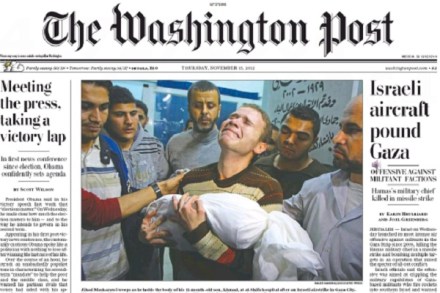
The front page of today’s Washington Post shows a picture of the BBC's Jihad Masharawi holding his dead 11-month-old son, an innocent victim of Israeli action against Hamas’ paramilitary targets following months of indiscriminate rocket attacks against civilians in southern Israel*. The Post’s front page reinforces the fact that Israel has a public relations problem when it retaliates in Gaza; a fact that friends of Israel ought to accept. My colleague Douglas Murray is right to assert that the western media often applies a double standard when reporting Israeli and Palestinian casualties: the suffering of Israeli citizens is not given the coverage it deserves.

Annals of Neoconservative Delusion: Leaving Iraq Edition – Spectator Blogs

Douglas Murray's latest post is a rum 'un indeed. He asks us to believe that Barack Obama's "foreign policy boasts" are unraveling now that the American election is usefully out the way. I must say that the evidence for this is thin, not least since it seems to rely upon 1. A reported Iranian attack on a US drone, 2. General Petraeus having an affair, 3. The existence of long-planned Congressional hearings on the Benghazi nonsense and 4. The Iraqi government's decision to release from gaol a suspected Hezbollah operative responsible for an ambush in which five American troops were killed. If this amounts to "unraveling" then I guess the President can live with it.

Barack Obama’s foreign policy boast unravels after election

What a lot of things President Obama seems to have been holding back until after his re-election. Each day brings something new. There has been the news of an attack by Iran on a US drone in the Persian Gulf. Then there is the Petraeus affair – known about for months, but only leading to the CIA chief's resignation immediately after Obama's re-election. The Benghazi hearings are yet to come. And now another surprise. It transpires that the Iraqi government, a body which is only in power because of the sacrifice of thousands of American, British and other allied troops, is releasing from custody a senior Hezbollah terrorist who was in detention for killing American troops.

Race, gay marriage and modern Conservatism. Lessons for David Cameron from America. – Spectator Blogs

So, we've had nearly a week to digest the results of the American election and contemplate what, if anything, it might all mean for politics there and, naturally, in this country too. Let's begin with a necessary caveat: the "read-across" from American elections to the British political scene is something that must be handled deftly. If considered with a sensible measure of proportion, however, it can be instructive since some of the challenges facing political leaders in Britain are comparable in kind (though not always in degree) to those faced by their cousins in the United States. Demographics aren't destiny and policy matters more than journalists sometimes liked to pretend.

George Osborne, the insubstantial chancellor?

George Osborne’s public interventions on issues other than the economy are few and far between, which is why his article in today’s Times merits attention. In it, Osborne analyses some of the causes of Barack Obama’s victory and then applies his findings to the 2015 election in Britain. On the basis of this article, we can conclude that the Tories’ leading strategist expects to fight the next election in a challenging economic climate against two men, Ed Balls and Ed Miliband (in that order), who he intends to blame for causing Britain’s ills.

David Petraeus quits as CIA director over affair

Few people have been more important in America’s recent wars than David Petraeus. Petraeus led the surge of US forces in Iraq and Afghanistan and redefined the US approach to counter-insurgency warfare. He was the most influential military figure of the post-war era and successful enough for some of those close to Obama to hold deep concerns about the prospect of Petraeus running against Obama. 14 months ago, he was put in charge of the CIA by President Obama. There he expanded Predator strikes to Yemen and pushed for a larger drone fleet. But yesterday, Petraeus resigned over an extra-marital affair with his biographer. It is a sad end to a remarkable career.

Briefing: The US fiscal cliff

With the elections over and Barack Obama returned to the White House for four more years, the attention of US politicians has turned to the so-called ‘fiscal cliff’ — a collection of tax hikes and spending cuts that threaten to send the country back into recession. But what exactly is going on, and why? The Bush tax cuts George W Bush passed two major tax cut packages during the first term of his Presidency: the Economic Growth and Tax Relief Reconciliation Act of 2001 and the Jobs and Growth Tax Relief Reconciliation Act of 2003. Together, they lowered federal tax rates on income (for example, the top rate fell from 39.6 to 35 per cent, and the bottom rate from 15 to 10 per cent), capital gains and dividends.

Obama’s top foreign policy concerns for his second term

With Barack Obama being returned to the White House, it’s worth considering what his key foreign policy challenges will be during the second term. I’ve outlined a few areas I think will dominate his thinking over the next four years. 1. Afghanistan and Pakistan Obama has committed to withdrawing American forces from Afghanistan by the end of 2014. This will be a far from smooth transition. As the number of US forces declines, expect to see a resurgence of the Taliban, greater instability across the country, and the accelerated erosion of Hamid Karzai’s authority.

A clear message for the second half of this Parliament

Yesterday in the House, both parties welcomed the re-election of Barack Obama. An incumbent leader has been returned to the White House. Incumbency is of course a massive factor in US politics – an incumbent has been unseated only a handful of times in history. The reason for this is clear. For all the bumps and knocks you get along the way as a government, getting your message out is much easier when you’re already standing on the podium. For the four years of his first term, Obama’s grassroots and digital campaigns never ceased. It’s an important lesson for UK politics. This week, as we enter the second half of this parliament, there won’t be any fireworks to mark the midterm. Yet on the ground, the campaign has already begun.

The View from 22 – Barack Obama’s hollow victory and remodernising the Tories

Is there something underwhelming about Obama's reelection? In this week's cover feature, John O'Sullivan discusses impact of changing demographics of the America electorate and the challenges this poses for the Republicans in 2016. On the latest View from 22 podcast, the Spectator's assistant editor Freddy Gray and political editor James Forsyth explain why the American right needs to rediscover its purpose: 'I think eight years ago there was a lot of talk of 'values voters' and how Karl Rove had pulled off this amazing masterstroke talking about the culture of life without scaring off people who might be worried about being anti-abortion. But I think that now seems incredibly out of date as an analysis' 'Part of the problem is self-inflicted wounds on the Republican party.

The View from the Cocoon of Denial and Epistemic Closure – Spectator Blogs

William F Buckley has, alas, gone the way of all flesh but his National Review lives on and arguably remains the flagship journal of contemporary American conservatism. It certainly considers itself such. As the Republican inquest into last night's election disaster begins, National Review offers a useful - and perhaps telling - glimpse into the contemporary conservative soul (American edition). Here's what its contributors have been writing today: Mary Matalin: What happened? A political narcissistic sociopath leveraged fear and ignorance with a campaign marked by mendacity and malice rather than a mandate for resurgence and reform.

Barack Obama’s new ethnic majority

‘I’ve come back to Iowa one more time to ask for your vote,’ said President Obama at an emotional ‘last ever’ campaign meeting. ‘Because this is where our movement for change began, right here. Right here.’ And his eyes briefly moistened. The nostalgia was doubtless sincere, and the address correct, but it was misleading to describe his 2012 election campaign as a continuation of his earlier ‘movement for change’. In reality, it has been a smoothly ruthless operation to distract attention from a record that has been disappointingly bereft of change. He triumphed over himself as much as over the hapless Mitt Romney.

Obama’s victory is a great solace to Cameron, and No.10 will exploit it to the full

Four years ago, in opposition, the Cameron offices were a swing state in the US election. Most were for Obama but there was still a sizable number who held a torch for John McCain. But this time round it is hard to think of anyone in Downing Street who wanted a Romney win. I asked several people in No. 10 who would have voted for Romney, but only one name ever came up. The idea of a Tory Downing Street urging on a Democratic President would come as a shock to those who served in the Thatcher and Major governments. In the 1980s, Ronald Reagan and Margaret Thatcher had common foes at home and abroad. But it would be a mistake to think that the relationship between Tories and the Republican party went into decline when they both left office. Instead, it got even closer.

US election 2012: Obama’s victory is a relief for David Cameron

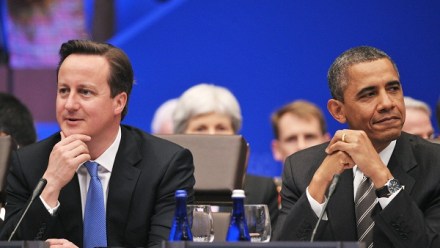
David Cameron welcomed Barack Obama's re-election in the early hours of this morning, tweeting: 'Warm congratulations to my friend @BarackObama. Look forward to continuing to work together.' He later released this statement: 'I would like to congratulate Barack Obama on his re-election. I have really enjoyed working with him over the last few years and I look forward to working with him again over the next four years. There are so many things that we need to do: we need to kick start the world economy and I want to see an EU-US trade deal. Right here in Jordan I am hearing appalling stories about what has happened inside Syria so one of the first things I want to talk to Barack about is how we must do more to try and solve this crisis. Above all, congratulations to Barack.

Obama keeps that hopey-changey thing going in victory speech

Even though Obama's victory speech in Chicago was far less hopey-changey than his rockstar delivery four years ago, the re-elected president did still manage to sound a little as though he was delivering an address at a wedding, smoothing over the ugly bits and telling America that 'the best is yet to come'. Both he and Mitt Romney made calls for co-operation between Republicans and Democrats, with Obama saying: 'Tonight, you voted for action, not politics as usual. You elected us to focus on your jobs, not ours, and in the coming weeks and months I am looking forward to reaching out and working with leaders of both parties to solve problems we can only solve together.' He said he wanted to speak to Romney about where the Republican candidate might be able to work with him.