Ancient rome

Tax returns to boast about

As Jeremy Corbyn and John McDonnell whinge away about how rich David Cameron’s family is, they might consider that in the last six years he has funded schools ’n’ hospitals to the tune of £402,283. How much have they put in? Since wealthy ancient Athenians loved to boast about the vast sums they contributed via property taxes to the public benefit, they would have been amazed that Cameron did not long to reveal how rich he was. The 5th-century BC thinker Democritus argued that there was nothing like the rich giving to the poor to produce concord that strengthened the community.

Seneca on bouncers

The papers are full of top stories about important people who cannot get into important parties because the doorman does not recognise them and tells them to shove orf, and other stories about the wizard wheezes that various nobodies employ to bluff their way in. The Stoic Seneca (c. 4 BC–AD 65), multimillionaire adviser to Nero, has stern words to say on these piffling urges. Seneca’s basic point is that there are indeed things that will hurt the wise man — infirmity, death of loved ones, the ruin of his country — but he will be able to deal with them. When it comes to trivial rebuffs, the truly wise man will exhibit gracious magnanimity and laugh them off.

…Long live ENO!

The three most moving, transporting death scenes in 19th-century opera all involve the respective heroines mounting a funeral pyre — partly, no doubt, a matter of operatic convention and fashion, but also recalling opera to its duty as a rite of purification. Berlioz’s Didon in Les Troyens, like her creator, is so relentless in her grasp of the truth that she fails to achieve anything but a vision of Carthage overcome by Rome, and ends in despair and execration. Brünnhilde in Götterdämmerung rides into Siegfried’s pyre in a state of ecstasy, imparted to the audience with all Wagner’s unlimited capacity for exaltation.

Oscar vs Augustus

There was something admirable about the spirit of careful mockery behind the doggy bags on offer to the finalists in this year’s Oscars and Daftas. The chance to hire a car or visit a New Zealand winery (pay your own airfare) cannot be very high on even the most grasping star’s list of ultimate desiderata. That said, the organisers are missing a trick here — the element of chance. The Roman emperors can come to their aid. Apophoreta, literally ‘takeaways’, were standard features of Roman dinner parties (the satirical poet Martial wrote a book of 221 couplets about them, celebrating everything from bras to nail-scissors and food for dealing with stretchmarks). But the emperors’ dinner parties were something different.

Moving statues

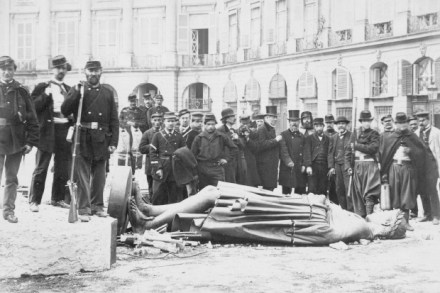
One of the stranger disputes of the past few weeks has concerned a Victorian figure that has occupied a niche in the centre of Oxford for more than a century without, for the most part, attracting any attention at all. Now, of course, the Rhodes Must Fall campaign is demanding that the sculpture — its subject having been posthumously found guilty of racism and imperialism — should be taken down from the façade of Oriel College. The controversy is a reminder of the fact, sometimes forgotten by the British, that public statues are intensely political. This was clear — until quite recently, at least — when one drove into the Syrian city of Hama. There, dominating a roundabout, was a large bronze representation of the late President Hafez al-Assad.

Corbyn, Nero and the Bomb

Chief of the Defence Staff Sir Nicholas Houghton is worried that Labour leader Jeremy Corbyn will never use the existing means of defence — Trident — to defend the country. Mr Corbyn is incandescent that a mere Chief of Defence Staff has the sheer effrontery to express a view on a matter that is (apparently) irrelevant to the defence of country but is purely political. One is reminded of the accession of Nero to Rome’s imperial throne in ad 54. According to the Roman historian Tacitus, it was dirty work by the controlling empress Agrippina that did for her husband Claudius, with the result that Nero, her son from an earlier marriage, was installed as emperor, aged 17. At that time there was trouble on Rome’s eastern frontier.

Of gods and men

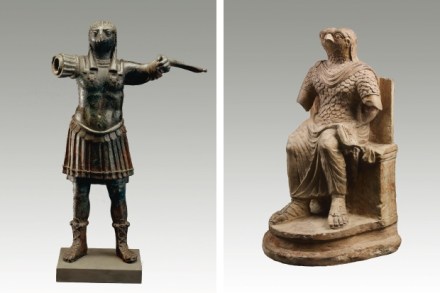
Over the stupefyingly long course of Egyptian history, gods have been born and they have died. Some 4,000 years ago, amid the chaos that marked the fragmentation of the original pharaonic state, an incantation was inscribed on the side of a coffin. It imagined a time when there had been nothing in existence save a single divine Creator. ‘I was alone in the emptiness,’ the god proclaimed, ‘and could find no place to stand.’ Nevertheless, beside him, he could feel the gods that were yet to exist. ‘They were with me, these deities waiting to be born. I came into being and Becoming became.’ The gods emerged, to reign first on earth and then in the heavens, and history began.

The emperors of Brussels

As both sides of the great EU debate line up their forces, it is worth reflecting on the implications of the collapse of the Roman republic in the 1st century bc and its transformation into an imperial system under the first emperor Augustus. Romans dated the start of the collapse to 133 bc. Up till then, they felt that relations between the senate, the traditional, if de facto, ruling authority, and the Plebeian assembly, with its tribunes who could veto senatorial proposals, had worked pretty well, without any serious clashes. This all changed when the ambitious aristocrat Tiberius Gracchus got himself elected tribune in order to use the Plebeian assembly to introduce legislation without senatorial agreement.

John McDonnell’s true economic guru: the emperor Nero

John McDonnell, shadow chancellor in the Corbynite splinter-group, has announced that £120 billion is waiting to be reclaimed from tax avoidance, evasion and other schemes. Nero was equally detached from reality. The Roman historian Tacitus tells us that in ad 65 a fantasist from Carthage by name of Caesellius Bassus bribed his way into an interview with Nero and told him that on his estate there was hidden a vast quantity of gold, not in coin but in unworked bullion — great columns of it. It had been hidden there, he said, by Dido, the Phoenician queen who had founded Carthage. Nero was thrilled.

Corbyn’s democracy

The virtuous Mr Corbyn is insisting that New Old Labour should return to its traditional republican ways and take decisions ‘democratically’. The emperor Tiberius (ad 14–37) tried this one and it did not work. The first Roman emperor Augustus agreed to his stepson Tiberius’ accession only because death had cheated him of all his preferred options. The problem was that Tiberius’ heart was not really in it. A man with republican sympathies, he seemed to be keen to persuade the senate to return to involvement in the full process of ‘democratic’ rule and decision-making, duties which that body had embraced for nearly 500 years under the republic, but which Augustus had rather sidelined as he single-handedly turned the republic into a monarchy.

Livy on immigration policy

In the migration crisis, the EU is currently acting just like the ancients, as if border controls did not exist, though the mass, peaceful migration we see today was not a tremendously common occurrence then. The reason is that in the ancient world, every male was a potential warrior. So in conflict they would either fight to defend their land and, if they lost, be killed or sold into slavery, or they would flee, en masse, as Germanic tribes did into the Roman Empire in the 4th century ad, escaping the Hun onslaught. Since this represented a potential threat, Romans fought off some, but welcomed others, giving them land and status in return for service in the army. Many did well out of it.

Corbyn and the plebs

Last week, guru Corbyn was invited to reflect on the 2,500-year-old Roman origins of the republicanism to which he is so devoted. This week, the ageing seer may care to ponder the plebeian fight for equality, a struggle Corbyn holds dear. The picture as the historian Livy (c. 60 BC–AD 17) paints it is that Romans were full of hopes in 509 BC that, with the king thrown out, all would be peace and love. But now it was the patricians — the hereditary advisers to the kings — who were doing the exploiting: holding a monopoly of power and running the show in their own interests, with serious consequences for the plebeians (the non-patrician families), especially the poor.

Just how republican is Jeremy Corbyn?

True to his antique, bearded ideology, guru Corbyn is a ‘republican’, a form of government invented 2,500 years ago. ‘Republic’ derives from the Latin res publica — ‘people’s property, business’ (not politicians’). It defined Rome in contrast to its earliest condition as a monarchy, under the control of kings. Romans dated the republican revolution to 509 bc, when the last king, Tarquinius Superbus (‘arrogant’), was thrown out after his son Sextus raped the noblewoman Lucretia. From then on, at least in theory, the people could always have the last word through the various people’s assemblies. One can be quite sure that Corbyn will welcome popular control of the Labour party — in theory.

Boris’s waiting game

While the Labour party rakes over its past in an effort to find a policy for its future, the commentators continue to speculate about Boris’s role, if any, in a Tory party increasingly dominated by chancellor George Osborne. Romans would have sympathised. Life in the imperial court in Rome was not necessarily one long orgy. One’s fortunes rested precariously on the good will of the emperor, who could inspire both love, hate and fear, as the philosopher Epictetus pointed out, because he had the ‘power to confer the greatest advantages’ such as ‘wealth and office — tribunates, praetorships, consulships’. In a striking image Epictetus envisaged men in the court scrabbling for positions like children at parties scrambling for nuts and figs.

Barometer | 23 July 2015

Gesture politics A royal home movie from 1933 apparently showed the future Queen, aged seven, and her mother giving a Nazi salute. Like the Swastika, the stiff-armed salute was not invented by the Nazis. In this case they took it from the Mussolini and his Fascists, who thought it came from ancient Rome. Three Roman soldiers are shown making such a gesture in Jacques-Louis David’s 1784 painting ‘Oath of the Horatii’.But the US beat both Nazi Germany and Fascist Italy by using the gesture to accompany the pledge of allegiance. Hitler himself claimed the salute was one of peace, saying it meant ‘Look! I am holding no weapon.

Vespasian vs Islamic State

As Ahmed Rashid argued last week, it is hard to see what the West is doing in the Middle East, occasionally dropping bombs on Isis, whose effect may well be to hand Syria over to al-Qaeda. The Roman general Vespasian (ad 9–79) would propose a different strategy. The Romans had never found the Jews easy to get on with — the feeling was mutual — and semi-provincialising Judea in ad 6 had not helped matters. In ad 66 a major revolt broke out there, and the legate in Syria, Cestius Gallus, was ordered to crush it. He was driven off in disorder, and in ad 67 the emperor Nero sent Vespasian with a much larger force to restore Roman control. He attacked rebel towns, dealt out punishments and took Galilee.

Shaw hand

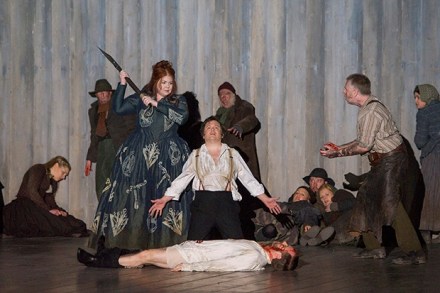
When is a rape not a rape? It’s an unsettling question — far more so than anything offered up by the current headline-grabbing William Tell at the Royal Opera House — and one that lies beneath the meticulous dramatic archaeology of Fiona Shaw’s The Rape of Lucretia. Unlike William Tell, however, there seems little chance of this attack starting riots. Where the director of Tell asserts, Shaw interrogates — a delicate, insistent questioning that probes further and more intrusively, a violation of ideological rather than physical absolutes. Debuted in 2013 as part of the company’s touring season, Shaw’s production now returns to the main festival, where the chamber opera had its première in 1946.

The game of survival

Apparently Fifa emperor Sepp Blatter received a ten-minute standing ovation from his 400 staff when he addressed them after his resignation. But why? Were they expressing sorrow at his departure? Relief? Or prudently watching their backs? Life was never easy around the Roman emperor either, whether he was among the people or in the imperial court. When the shamelessly dissolute Nero performed on-stage, his claqueurs made sure the applause went on and on. The historian Tacitus tells us that people from out of town or the provinces, ‘shocked at the outrageous spectacle, found that their unpractised hands were not up to the degrading task’ and consequently disrupted the professional applauders. But the heavies moved in, and they were soon clapping away again.

Pliny the Younger on Fifa

In any huge enterprise (like Fifa), where does the rot begin? Pliny the Younger mused on this question in a letter to a friend about a games festival held in the Roman colony Vienna (Vienne, south of Lyons). Vienna had been celebrating Greek-style gymnastic games as a result of a bequest, when the town’s mayor decided to abolish them; they were corrupting, unlike good, honest Roman games. The case was contested and came before the emperor in Rome, with Pliny one of the assessors. There the mayor, ‘a true Roman and fine citizen’, came out on top. He was supported, Pliny wrote, by one Mauricus, another Roman famed for straight talking. Courageously, in Pliny’s view, Mauricus expressed the opinion that such Greek fripperies had no place in Rome either.

The fall of the Roman republic and the rise of Alex Salmond

Alex Salmond, the ex-first minister who proved incapable of making Scotland independent, has assured the world that he and his handful of SNP MPs will force Westminster to dance to his tune, or else. So his response to humiliating failure is the threat of political blackmail. At least it is now clear what the SNP stands for. For Cicero (106–43 bc), surveying the ruins of the Roman republic at the hands of ruthless dynasts such as Caesar and Pompey fighting for power with personal armies at their back, the question of the ethics of public service — the duty one owed to the state — loomed large.