Ancient rome

Corbyn and the plebs

Last week, guru Corbyn was invited to reflect on the 2,500-year-old Roman origins of the republicanism to which he is so devoted. This week, the ageing seer may care to ponder the plebeian fight for equality, a struggle Corbyn holds dear. The picture as the historian Livy (c. 60 BC–AD 17) paints it is that Romans were full of hopes in 509 BC that, with the king thrown out, all would be peace and love. But now it was the patricians — the hereditary advisers to the kings — who were doing the exploiting: holding a monopoly of power and running the show in their own interests, with serious consequences for the plebeians (the non-patrician families), especially the poor.

Just how republican is Jeremy Corbyn?

True to his antique, bearded ideology, guru Corbyn is a ‘republican’, a form of government invented 2,500 years ago. ‘Republic’ derives from the Latin res publica — ‘people’s property, business’ (not politicians’). It defined Rome in contrast to its earliest condition as a monarchy, under the control of kings. Romans dated the republican revolution to 509 bc, when the last king, Tarquinius Superbus (‘arrogant’), was thrown out after his son Sextus raped the noblewoman Lucretia. From then on, at least in theory, the people could always have the last word through the various people’s assemblies. One can be quite sure that Corbyn will welcome popular control of the Labour party — in theory.

Boris’s waiting game

While the Labour party rakes over its past in an effort to find a policy for its future, the commentators continue to speculate about Boris’s role, if any, in a Tory party increasingly dominated by chancellor George Osborne. Romans would have sympathised. Life in the imperial court in Rome was not necessarily one long orgy. One’s fortunes rested precariously on the good will of the emperor, who could inspire both love, hate and fear, as the philosopher Epictetus pointed out, because he had the ‘power to confer the greatest advantages’ such as ‘wealth and office — tribunates, praetorships, consulships’. In a striking image Epictetus envisaged men in the court scrabbling for positions like children at parties scrambling for nuts and figs.

Barometer | 23 July 2015

Gesture politics A royal home movie from 1933 apparently showed the future Queen, aged seven, and her mother giving a Nazi salute. Like the Swastika, the stiff-armed salute was not invented by the Nazis. In this case they took it from the Mussolini and his Fascists, who thought it came from ancient Rome. Three Roman soldiers are shown making such a gesture in Jacques-Louis David’s 1784 painting ‘Oath of the Horatii’.But the US beat both Nazi Germany and Fascist Italy by using the gesture to accompany the pledge of allegiance. Hitler himself claimed the salute was one of peace, saying it meant ‘Look! I am holding no weapon.

Vespasian vs Islamic State

As Ahmed Rashid argued last week, it is hard to see what the West is doing in the Middle East, occasionally dropping bombs on Isis, whose effect may well be to hand Syria over to al-Qaeda. The Roman general Vespasian (ad 9–79) would propose a different strategy. The Romans had never found the Jews easy to get on with — the feeling was mutual — and semi-provincialising Judea in ad 6 had not helped matters. In ad 66 a major revolt broke out there, and the legate in Syria, Cestius Gallus, was ordered to crush it. He was driven off in disorder, and in ad 67 the emperor Nero sent Vespasian with a much larger force to restore Roman control. He attacked rebel towns, dealt out punishments and took Galilee.

Shaw hand

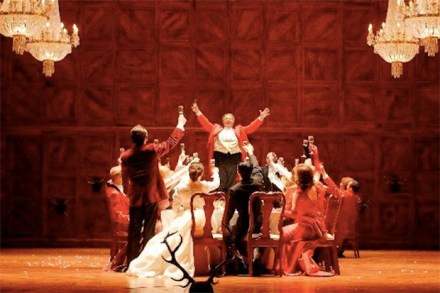
When is a rape not a rape? It’s an unsettling question — far more so than anything offered up by the current headline-grabbing William Tell at the Royal Opera House — and one that lies beneath the meticulous dramatic archaeology of Fiona Shaw’s The Rape of Lucretia. Unlike William Tell, however, there seems little chance of this attack starting riots. Where the director of Tell asserts, Shaw interrogates — a delicate, insistent questioning that probes further and more intrusively, a violation of ideological rather than physical absolutes. Debuted in 2013 as part of the company’s touring season, Shaw’s production now returns to the main festival, where the chamber opera had its première in 1946.

The game of survival

Apparently Fifa emperor Sepp Blatter received a ten-minute standing ovation from his 400 staff when he addressed them after his resignation. But why? Were they expressing sorrow at his departure? Relief? Or prudently watching their backs? Life was never easy around the Roman emperor either, whether he was among the people or in the imperial court. When the shamelessly dissolute Nero performed on-stage, his claqueurs made sure the applause went on and on. The historian Tacitus tells us that people from out of town or the provinces, ‘shocked at the outrageous spectacle, found that their unpractised hands were not up to the degrading task’ and consequently disrupted the professional applauders. But the heavies moved in, and they were soon clapping away again.

Pliny the Younger on Fifa

In any huge enterprise (like Fifa), where does the rot begin? Pliny the Younger mused on this question in a letter to a friend about a games festival held in the Roman colony Vienna (Vienne, south of Lyons). Vienna had been celebrating Greek-style gymnastic games as a result of a bequest, when the town’s mayor decided to abolish them; they were corrupting, unlike good, honest Roman games. The case was contested and came before the emperor in Rome, with Pliny one of the assessors. There the mayor, ‘a true Roman and fine citizen’, came out on top. He was supported, Pliny wrote, by one Mauricus, another Roman famed for straight talking. Courageously, in Pliny’s view, Mauricus expressed the opinion that such Greek fripperies had no place in Rome either.

The fall of the Roman republic and the rise of Alex Salmond

Alex Salmond, the ex-first minister who proved incapable of making Scotland independent, has assured the world that he and his handful of SNP MPs will force Westminster to dance to his tune, or else. So his response to humiliating failure is the threat of political blackmail. At least it is now clear what the SNP stands for. For Cicero (106–43 bc), surveying the ruins of the Roman republic at the hands of ruthless dynasts such as Caesar and Pompey fighting for power with personal armies at their back, the question of the ethics of public service — the duty one owed to the state — loomed large.

When Rome’s 99 per cent stood up

In the UK the richest 1 per cent — 300,000 — of the working population control 23 per cent of the nation’s total wealth. Austerity and cuts loom. Oxfam says there are 13 million ‘relatively’ poor in the country. But the poor seem rather relaxed about it. The ancients, however, knew the poor could not be ignored. In the Athenian radical democracy, the poor were in fact the bosses, having total control of Athens’ courts and sovereign assembly. They could have voted themselves pensions for life had they so wished, or stripped the rich of everything they owned. They did not. Instead the rich were taxed in times of war and made to pay for festivals — games, theatre, poetry, music — and the running of the state navy.

Reimaging the lost masterpieces of antiquity

For centuries there has been a note of yearning in our feelings about ancient Greek and Roman art. We can’t help mourning for what has irretrievably vanished. In 1764 Johann Joachim Winckelmann wrote that we have ‘nothing but a shadowy outline left of the object of our wishes, but that very indistinctness awakens only a more earnest longing for what we have lost’. In the same spirit, Power and Pathos, an exhibition of Hellenistic bronze sculpture at the Palazzo Strozzi, Florence, begins with an empty plinth. It is the marble base of a statue, found in Corinth, on which are written the words ‘Lysippos made [this]’. The inscription is poignant for a series of reasons.

The Green party isn’t nearly tough enough on Ancient Greece

The Green party’s manifesto appears to make saving the planet only a small element in its otherwise painfully unoriginal agenda. This is a pity. People have been wreaking environmental havoc for thousands of years, Greeks and Romans included. Deforestation and subsequent soil erosion were the most serious example of such havoc in the ancient world. Wood was the equivalent of today’s coal and plastic. It provided fuel for houses, baths and industry, especially pottery-firing. We hear of one Phaenippus who made a useful income from his six donkeys bringing firewood into Athens every day. It was the basic building material for everything from chairs to houses and ships (even the pitch with which to caulk them).

Cicero’s advice for Sir Malcolm Rifkind and Jack Straw

In responding as they did to the Daily Telegraph ‘sting’, Jack Straw and Sir Malcolm Rifkind may well have done nothing wrong by the letter of parliamentary law. But people’s perception of behaviour is quite another matter. The MPs’ bloated self-importance and Rifkind’s shameful defence of his actions, that no one would want to become an MP unless they could also line their pockets, did them no credit at all. The ancients knew all about this sort of thing. Roman senators, for example, made millions if they were posted abroad to run provinces. As cynics said, they had to make three fortunes: one to recoup election expenses from climbing the greasy pole; one to bribe the jury on charges of provincial mismanagement; and one to live off in exile thereafter.

Julius Caesar could teach Isis a thing or two

Isis disseminates videos of beheaded captives to spread simple terror. Julius Caesar knew all about it. In his diaries of his conquest of Gaul (58–51 bc), he constantly acknowledges the power terror wielded. When it became clear, for example, that in 58 bc he would have to take on the powerful German king Ariovistus who had crossed the Rhine into Gaul, his ‘whole army was suddenly gripped by such a panic that their judgement and nerve was seriously undermined’. Caesar, naturally, rallied the troops and in the ensuing engagement drove Ariovistus’ army back across the Rhine with massive losses. Ariovistus had been a ‘friend of Rome’. That is what Caesar did to ‘friends’ who threatened him. In 55 bc, two other German tribes crossed the Rhine.

Socrates, Aristophanes and Charlie Hebdo

What would the ancients have made of Charlie Hebdo? The First Amendment tolerates the expression of opinions, however offensive, but not behaviour that can be construed as an outright threat. It is a distinction that Greeks and Romans might have applauded. The comedies of Aristophanes (5th century bc) dealt with the issues of the day. They were characterised by language of Shakespearean inventiveness, covering the whole range of imaginable scatological, sexual and verbal abuse, aimed directly at named or easily recognisable individuals. Used in the street, such language would have met with a pretty instant, and probably violent, response. But, it seems, the conventions of public performance at the comic festival in honour of the god of theatre, Dionysus, made it permissible.

What MPs need is an oath with consequences

Before taking their seats in Parliament, all MPs must swear an oath of allegiance to the Queen. Mark Durkan, MP for Foyle in Northern Ireland, recently suggested that they should also swear an oath to do no wrong. In this election year, that could set a useful precedent. Political orators in the Greek world talked of the good citizen as one who cared for the like-mindedness of all citizens and for his city’s interests — defending the fatherland, obeying the laws and authorities, and honouring the state’s cults — and young Athenian males swore to this effect when they reached the age of 18.

How the Romans taught Latin (N.M. Gwynne would not approve)

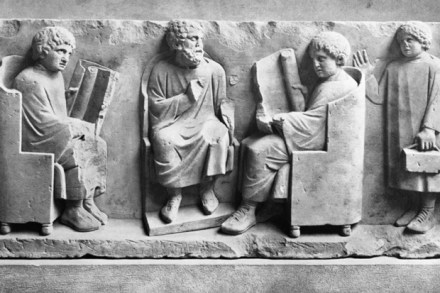
Barely a week passes without someone complaining about the teaching of English or foreign languages, usually because it involves too much, or too little, grammar. The ancients also had to face the problem. Clearly, non-Romans who wanted a career in Roman high society, the courts, civil administration or the army needed to learn Latin. So they did, and by the 2nd century AD, the Greek essayist Plutarch was able to say that almost all men used Latin. Certainly, as the Vindolanda tablets demonstrate, the Latin of the Germanic officer Cerealis was very respectable. But Romans also admired Greek culture enormously, and Latin literature drank deeply at its well (the statesman Cicero could switch effortlessly between Latin and Greek).

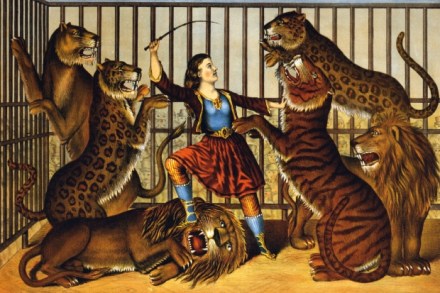
Roll up, roll up! A history of the circus from Ancient Egypt to the present

Linda Simon’s compact and colourful circus history is, in many ways, a jewel of a publication. It is hard to say anything new about the circus because almost impossible to uncover quotes and stories that cannot be found in other books. The circus itself — disregarding the circus of ancient Rome — is a modern form and so the stock of images available for this type of illustrated history is quite limited and well known. But here are some interesting photographs of ceramic Mexican acrobats, and an Egyptian fresco of a female contortionist which back up one of Simon’s themes: using the body as a spectacle is an ancient impulse, of which the circus as we know it is just one manifestation.

No, Richard Branson, our greatest achievements don’t come from our greatest pain

Explaining the death of a pilot testing a Virgin Galactic rocket-ship, Sir Richard Branson intoned: ‘I truly believe that humanity’s greatest achievements come out of the greatest pain.’ The ancients would have been appalled, both at the crass ignorance of the sentiment and its implication. It is hard to see how papyrus, made out of marsh plants in Egypt since about 3,000 BC, resulted from ‘the greatest pain’. Yet, in combination with the presumably pain-free invention of the Greek alphabet, from which the Roman and our alphabet derive, this material was to drive literacy and a knowledge revolution across the Mediterranean.

Hannibal (and Alexander the Great) vs the Islamic State

Whatever the Islamic State hopes ultimately to achieve by its current onslaught on all and sundry in the Middle East, Philip II of Macedon, father of Alexander the Great, would certainly understand why it has been successful (so far); but Hannibal, who came within an ace of conquering Italy, might offer a word of warning. In the ancient world, conquest of territory was the route to enrichment: other people’s resources became yours to use as you wished. By 358 BC Philip had trained up what would turn out to be an almost unbeatable army. Moving south from Macedon, he picked off Greek city-states one by one, until by 338 BC he had gained effective control over all of Greece. He then planned an assault on Persia, but was assassinated in 336 BC. Alexander fulfilled his father’s ambitions.