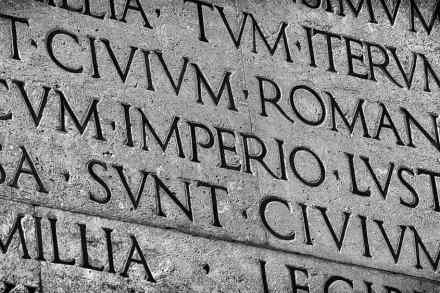
Ancient rome

Why some men are obsessed with the Roman Empire

Why do men think about the Roman Empire so much? That’s the subject of a new social media trend, where women ask their partners how often they think about ancient Rome.  Some men do it every day; one admitted to doing it three times a day. But why is it men who love the Empire so obsessively? 'There’s so much to think about,' one man said to his fiancée on TikTok. Another admitted he loved 'their aqueducts and the fact that they had concrete that could harden'. He’s right. The Pantheon in Rome was built out of a special Roman concrete that has held up its extremely delicate dome since 126 AD. Some academics say that the teaching of Roman history has concentrated on its masculine aspects: gladiators, legions, warfare and imperial eagles.

The lessons of ancient Rome’s dangerous doctors

From our US edition

"I died of a surfeit of doctors,” read one Roman funerary inscription. But where did this surfeit come from? Let Pliny the Elder (d. AD 79) explain. Pliny devoted book twenty-nine of his Natural History (a vast encyclopedia of Roman life) to the history of medicine. Claiming that no discipline “undergoes more frequent changes, and none is more profitable either,” Pliny pointed the finger at Greek doctors. These had been welcomed into Rome from the third century bc with their fancy philosophical ideas — all different — which their eloquence persuaded people immediately to adopt in place of the good old experience-based Roman herbal treatments, overseen by the trusty master of the house.

doctors

Roman politicians were the ultimate gossips

The ancients were as fascinated by rumour as, to judge by recent events in Russia and the BBC, we are. Homer called rumour ‘the messenger of Zeus’, with a fondness for racing through crowds. Virgil described it as a winged monster, with an unsleeping eye under every feather, a mouth and tongue never silent and an ear always pricked, combining truth with lies and distortions. Ovid saw it as a sort of clearing-house ‘from which the whole world is in view’ – a structure of echoing brass, with thousands of entrances and exits, echoing back, and so increasing the volume of, the ‘murmured whisperings’ it picked up. Roman politicians were well aware that rumour was an important force in creating public opinion.

Jeremy Clarke would have felt at home in Pompeii

Classical literature has the reputation of being pretty serious stuff, far removed from the world that Jeremy Clarke inhabited. But he would have felt perfectly at home in Pompeii. Take the conversation decorating the grave monument of the bar-owners Lucius Calidius Eroticus and Fannia Voluptas (beat that, Frankie Howerd!): ‘Innkeeper! The bill!’ ‘You’ve had a sextarius of wine, and bread: one as. Relish, two asses.’ ‘Right.’ ‘The girl, eight asses.’ ‘Right.’ ‘Hay for the mule, two asses.’ ‘That mule – it’ll be the ruin of me.’ Jeremy would also surely have admired the lifestyle and works of the scandalous author Petronius, whom the historian Tacitus described as follows: ‘He slept during the day and spent the nights in business and pleasure.

Is America a republic in name only?

From our US edition

Is the United States a one-party state? Surely not. Just look at the ballots the next time you vote. There are nearly always Republican as well as Democratic candidates, and often there are candidates from other parties as well (Green, Working Families, Libertarian, etc.). But when you go beyond the labels, what do you find? Tucker Carlson, a recent victim of the uniparty monopoly, put it very well. “Suddenly, the United States looks very much like a one-party state,” he said in a post-Fox video. “That’s a depressing realization,” he added. “But it’s not permanent.” I think he is right about both things: the depressing reality that the United States looks more and more like a one-party state and the fact that the situation is not, at least not necessarily, permanent.

republic

Augustus and a lesson in self-publicity

The death of Her Majesty raises the question of a commemoration of her extraordinary years of service. Augustus ruled the Roman empire from 27 bc to ad 14 and was the longest serving of the roughly 70 emperors of the western empire (which ended technically in ad 476). He may have cracked a joke on his deathbed, asking those around him to applaud if he had played his part well in the comedy of life, but he was in deadly earnest about documenting in the first person a selective record of his own achievements (res gestae) for posting across the empire in both Greek and Latin. For example, he tells how he gave every Roman citizen 400ss. (nearly half a soldier’s annual pay) in 29, 24 and 11 bc and more than 1.2 billion ss. in handouts to soldiers.

The Roman roots of Tony Blair’s approach to education

Sir Tony Blair’s Tone-deaf suggestion that Stem subjects should dominate the curriculum of all schools would paradoxically take education back to the ancient world, when education was designed to benefit only the few. Take Rome. Wealth in the ancient world lay in land, which the rich exploited for all it was worth. Needing to protect their investment, Romans used their power to ensure that it was they who governed the state. The education system was designed to train them in winning arguments in the Senate and to protect themselves and their money in the courts. That left the remaining 90 per cent to fend for themselves, most trying to survive on a small land-holding, providing enough of a surplus to sell at market and buy what they could not themselves produce.

Do we need a Roman-style Water Czar?

It is clear that the country will soon need a Water Czar. Augustus’s right-hand man Agrippa would be the one to reshape the whole system, and Frontinus to ensure it all worked. Of Rome’s aqueducts, ‘cut-and cover’ masonry channels, following the contours of the ground, made up 80 to 90 per cent of their total mileage, with tunnels and arches only as necessary. Rome’s first three aqueducts, built between 312 bc and 144 bc, were ten miles, 40 miles and 56 miles long, the last with arches along the final flat seven miles into the city.

Which monarchs have had the longest reigns?

Long to reign over us The Queen is the world’s current longest-serving monarch, but two in history have had longer reigns. – Louis XIV of France ascended the throne aged four in 1643 and served until his death in 1715 aged 76 – 72 years, 110 days on the throne. He was succeeded by his five-year-old great-grandson. – Rama IX was king of Thailand from 9 June 1946 until his death on 13 October 2016 – a period of 70 years, 126 days. – The Queen will overtake Rama IX on 12 June this year, but will have to reign until 21 May 2024 before she eclipses Louis XIV to become the longest-ever reigning monarch. Set in stone What should the next jubilees be called (to go by a selection of jewellers’ websites)?

Putin is repeating Emperor Vitellius’s mistakes

Given Putin’s less than triumphant operation in Chechnya, where the Russian army suffered catastrophic losses, it is hardly surprising that his control of the ‘special operation’ in Ukraine does not seem to be a howling success. His inability to deal with the situation there bears a striking resemblance to that of the short-lived Roman emperor Vitellius. After the chaos that followed Nero’s suicide in ad 68, the year 69 is known as ‘the year of the four emperors’. Vitellius was the third to try for the throne, before falling to the ultimately successful pro-Vespasian forces. The Roman historian Tacitus was scathing about his military abilities.

Putin’s emperor complex

Did Vladimir Putin ever use his infamous ‘historical’ account of Russia-Ukraine relations to consider how Ukrainians might react to his decision to attack them? Clearly not. The Roman historian Tacitus (d. c. ad 120) knew better what history was for. Tacitus acknowledged that Rome under the tyranny of the emperors had become corrupted. As a result, it had lost that moral compass evident in its early history. Discussing the tribes of Germany, for example, he commented on the laudable strictness of their marriage laws (one man, one wife) and a life free of vice: ‘No one thinks vice funny, no one calls corrupting or being corrupted “modern life”.’ The implied contrast with imperial Rome was obvious.

What makes a ‘just’ war?

What is a just war? Those who, from St Augustine onwards, have debated the question usually begin with Cicero, the Roman philosopher and statesman, who first attempted a definition in 44 bc. Cicero’s general understanding of the nature of justice, which was a central duty of those in power, went as follows: ‘Justice instructs us to spare all men, to consider the interests of the whole human race, to give everyone his due, and not to touch property which belongs to others.’ The foundation of justice was good faith, i.e. ‘truth and fidelity to promises and agreements’. There should be ‘a limit to retribution and punishment for wrongdoing’: much better to encourage repentance.

Ukraine, the Roman army and why morale matters

Commentators talk much about the morale of the Ukrainian troops and the edge that this has given them over the Russians, even in a technology-dominated conflict. Ancient warfare was a matter of hand-to-hand fighting, where morale is absolutely crucial – ‘defeat in battle always starts with the eyes’, said Tacitus – and the imperial Roman army offers a masterclass in how to generate it. That army was, uniquely, professional. The soldiers’ physical fitness, kit, mastery of weapons and technical training in battle tactics were second to none.

The rise and fall of the Tsarist legal system

St. Petersburg University in Russia is (desperately?) inviting scholars worldwide to a conference in September celebrating Mikhail Speransky. It was he who, on the orders of the Russian emperor Nicholas I, published in 1830 a 45-volume compilation of all the laws of the Russian Empire, which he reduced to a 15-volume digest by 1839. It was to form the basis of the Tsarist legal system. The precedent for this was, of course, the legal Digest of Rome’s eastern emperor Justinian (AD 533). This was a compendium of 2,000 volumes of Roman law published between the 1st and 3rd centuries ad. Its purpose was to produce a contemporary, definitive account of all Roman private law. For student use, a handy four-book summary (the Institutes), also with legal force, appeared alongside it.

The Russians aren’t the first to rewrite history

Historians in Russia have a long and craven record, now going back centuries, of being economical with the truth about their current regime. The Roman historian Tacitus had a fascinating explanation for why such economy was also the case under the early Roman emperors. First, some background. Livy’s 142-book moral and romantic history of Rome stretched from earliest times to 9 bc, including the end of the republic in 27 bc when Augustus became emperor.

Patriarch Kirill, Archbishop Ambrose and a lesson for Putin

Patriarch Kirill is Patriarch of Moscow and all Rus’ and Primate of the Russian Orthodox Church; and one of his flock is that committed Orthodox Christian Vladimir Putin. Kirill applauds Putin’s genocidal assault on Ukraine. Has he never heard of Archbishop Ambrose of Milan and his dealings with the Christian Roman emperor Theodosius? It all began in ad 390, in the important Greek city of Thessalonica, when Butheric, the commanding general of the Roman field army and a friend of Theodosius, imprisoned a popular chariot-racer. The mob, determined to see him racing at the next games, demanded his release. Butheric refused. A major riot ensued, and since much of the army was on duty elsewhere, Butheric and other officers were murdered.

What Tacitus knew about tyrants

Last week Aristotle offered a lesson in tyrant theory. This week Tacitus (ad 56-c.120) offers one in tyrant practice. Tacitus was a Roman historian who enjoyed a successful political career, rising to consul and provincial governor. He admitted that he laid its foundations under the tyrannical emperor Domitian (d. ad 96) – he memorably contrasted Domitian’s red face with the pallor his gaze induced in his victims – and thought his duty as a historian was to ensure that those responsible for murderous deeds or heroic actions should never be forgotten. His judgment of Domitian’s reign was worthy of Orwell: ‘Rome of old [i.e.

How the ancients approached the three Rs

German archaeologists have found ancient Egyptian tablets covered in repetitive writing exercises and ask — were they pupil punishments? But if classical examples are anything to go by, they sound more like normal education. For elite Roman boys, education began with elementary reading, writing and numbers. From about the age of nine, they developed these skills further, especially in the study of poetry, and began Greek; and at 15, they were taught the arts of political and legal argument, drawing widely on mythical, historical and philosophical precedents, to prepare them for life at the top of Roman society. Rote learning, memorisation, repetition (and the whip) were the means of ‘driving into the memory the lessons to be learned’. The educationist Quintilian (d.

The ancient problem of unscrupulous ‘doctors’

Yet again ‘doctors’ with no qualifications have been found advertising dodgy but expensive products and treatments, in this case, injections of unregulated Botox variants to remove wrinkles. Pliny the Elder (d. ad 79) inveighed against such practices 2,000 years ago. Romans had a love-hate relationship with the Greeks, and medicine was no exception. In his massive Naturalis Historia — a 36-book encyclopaedia of the animal, vegetable and mineral world — Pliny acknowledged the enormous influence of Greek medical theory, i.e. that health required a balance between the four bodily liquids (blood, phlegm, yellow bile and black bile) and their many associated ‘powers’ in matching groups of four (e.g.

Claudius, Messalina and how not to choose political advisers

The Prime Minister has been having some trouble with his inner circle of advisers. Tacitus supplies fine examples of how they worked in Rome. Emperors chose whomever they liked to advise them. Augustus, for example, chose men like Agrippa and Maecenas, who had provided excellent service for him while Rome was still (just) a republic. The fourth emperor C-C-Claudius, by contrast, despised by the imperial family but thrust into power by the military, put his trust in politically experienced and highly efficient Greek freedmen (ex-slaves). Pallas was put in charge of the treasury, Narcissus in charge of correspondence (nothing got past him), and Callistus in charge of justice and law. One incident illustrates the way Narcissus worked.