Ancient greece

Silent films

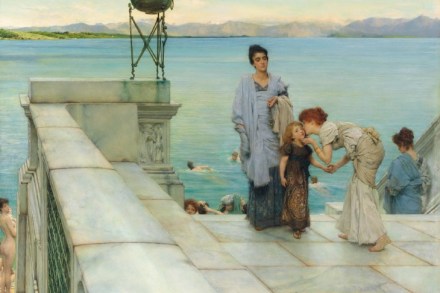
On 15 September 1888 Vincent van Gogh was intrigued to read an account of an up-to-date artist’s house in the literary supplement of Le Figaro. This described a purple house in the middle of a garden, the paths of which were made of yellow sand. The walls were glass bricks ‘in the shape of purple eggs’. Such aesthetic dwellings were all the rage; Van Gogh dreamed of having one himself in Arles. But as one learns from an exhibition at Leighton House, it was another 19th-century Dutch artist, Lawrence Alma-Tadema, who actually inhabited two such establishments — one off Regent’s Park, the other in St John’s Wood. On paper, Van Gogh and Alma-Tadema have a great deal in common.

Property’s not theft

Sir Trevor Nunn is directing a play called ‘Dessert’. It seems to be a virtue-signalling riff on the evil of possessions. Doubtless Cicero and Aratus will not feature. On the face of it, the Roman statesman Cicero (1st c bc) was a passionate upholder of property rights. He said ‘it is the proper function of the state and its citizens to ensure for everyone the free and undisturbed guardianship of their possessions’. But that did not mean ownership of property overrode the state’s central purpose and therefore duty — the maintenance of social cohesion and so social harmony, that concordia to which Cicero returned again and again.

The post-truth is out there

In a political ‘post-truth’ world, currently the subject of a slew of books, emotions and personal belief are said to shape opinion more than ‘objective’ fact. But as Aristotle pointed out in his Art of Rhetoric (4th century bc), there are facts only about the present and past; about the future, politics’ main concern, there are only interests and aspirations.

Music matters | 1 June 2017

The ancient Greeks had a word for it —katabasis, descending into the depths, to the underworld itself, in search of answers. To cross the threshold between life and death, innocence and knowledge, the everyday and what lies beyond, is an act woven through art, resurfacing in each generation. For Orpheus, and for Monteverdi, the journey may be a literal one, but for Bartok’s Bluebeard, imagined in the age of Freud and Jung, hell is not found outside, or even in other people, but within the darkest recesses of our own selves. When we speak of Orpheus it is of music, of birds and beasts beguiled, and men and women drawn into dance.

Thucydides on McGuinness

When Gerry Adams rose to announce at his funeral that Martin McGuinness was no terrorist but a ‘freedom fighter’, the historian Thucydides probably allowed himself a grim smile. He knew all about these sort of people. In 427 BC, Corcyra (ancient Greek Kerkura, now Corfu) was in the grip of a ferocious civil war between oligarchic and democratic factions for control of the state. The feature that stood out for Thucydides was the reversal of all normal, civilised values on both sides of the divide. Most striking of all, ‘men reversed the usual evaluative force of words to suit their own assessment of the situation’.

How to make the rich love tax

Now that Philip Hammond is promising yet more tax hikes, he might consider how Athens managed it. During the whole period of their direct democracy (which ended in 323 BC), the decision-making assembly was dominated by the poor. Their empire made Athens a wealthy place, and the poor ensured that wealth came their way, not that of the rich, in forms such as payment for jury service, rowing the triremes (which kept the empire together) and much more. Meanwhile, tax was paid only by the rich. The 300 top richest every year paid property taxes to, for example, construct and maintain Athens’ triremes and fund state festivals for public enjoyment.

Enemies of the people

Hardly a week goes by without someone applauding Thomas Carlyle’s objection to democracy: ‘I do not believe in the collective wisdom of individual ignorance.’ In other words, infinitely wise politicians should tell the unenlightened mob what to think, not vice versa. Such feelings have been common ever since the Athenians invented direct democracy in 508 BC, which lasted till 323 BC and handed to citizens in the assembly (the dêmos) the power to decide all Athenian policy. One anonymous writer described the dêmos as ‘ignorant, ill-disciplined and immoral’, ascribing it to their ‘poverty and lack of education’. The philosopher Plato thought a state could be well governed only by Platonic philosophers.

Socrates on expertise

The governor of the Bank of England, Mark Carney, raises his growth forecasts and suddenly everyone believes the ‘expert’. So is it wrong to say that people ‘have had enough of experts’? Yes, totally wrong. Expertise exists: the question is, with what scope? Socrates dissected the problem. In debates in Athens’ democratic Assembly, he pointed out, topics such as building or ship construction were taken to be the business of builders and shipwrights, and anyone who, though no expert, attempted to give advice in those areas was jeered off the platform.

Beyond words | 26 January 2017

In his inaugural speech last week, the new President Trump said, among much else, the ‘American carnage’ of poverty, ignorance and criminal gangs ‘stops right here and stops right now’. Since nobody with the slightest intelligence would offer such hostages to fortune, there is no point in paying attention to what he says, any more than to what he tweets. This disrespect for words would have appalled the ancient Greeks, who were well aware of the power of language, both for good and ill. The sophist Gorgias, for example (d. c. 380 bc), talked of the superhuman might of logos (‘speech, utterance’) which was such that it could make you feel happy, putan end to fear, remove feelings of grief,and so on.

From Socrates to Osborne

Ex-chancellor George Osborne is planning a book to be titled The Age of Unreason. He says that ‘it will be my attempt to understand why populist nationalism is on the rise in our western democracies’. An Athenian would have been most surprised by that title’s implications. If the ancient Greeks are famous for anything, it is for the invention of western ‘philosophy’. By that is usually meant the attempt to explain the world in humanly intelligible terms, i.e. by the exclusive use of reason and evidence, without calling in aid the supernatural. This sort of thinking, begun by eastern Greeks in the 7th century BC, reached something of an apogee (at least in the eyes of most later generations) in 5th- to 4th-century BC Athens with Socrates, Plato and Aristotle.

Aristophanes on Trump

As self-important comics fantasise about unseating Donald Trump with their wit, they should remember the great Aristophanes. In 424 BC, he presented a comedy about the controversial politician Cleon. He was (apparently) the son of a tanner (ugh!), and was seen by contemporaries, including the historian Thucydides, as a ‘brutal’, ‘insolent’ but ‘very persuasive’ braggart — and all too successful. The play opens with two slaves driven out of their house after a beating by their new master Paphlagon (Cleon); he has risen to power by fawning on and flattering the gullible and senile Demos (‘the people’) and telling outrageous lies about his political rivals. So far, so Trump.

Ripeness is all

‘Blessed are the cheesemakers.’ The line from Life of Brian is followed by: ‘It’s not meant to be taken literally. It refers to any manufacturer of dairy products.’ In fact, cheese animates the Bible and — building on Job’s searing image of the womb — its coagulation became an emblem of the Immaculate Conception, endorsed by no less than Hildegard of Bingen. This is just one of innumerable thoughts prompted by this Oxford Companion’s elegant, double-columned, well-illustrated pages. Here is a strong, pleasingly ripe case for cheese’s global role in social, political and economic history. It all makes for many ‘cheese adventures’.

Thucydides on Donald Trump

‘America’s journey into the great unknown’, screamed a headline greeting Donald Trump’s election as next President of the United States. Most of us call it the future, which has a long and distinguished tradition of being unknown. In the ancient world there was quite an industry in attempting to foretell the future: oracles, auguries, dream interpreters and so on.

Order, order | 10 November 2016

The catalogue to Pallant House Gallery’s latest exhibition features a favourite anecdote. It is 1924 and a competition is being held to find the woman with the most pleasing vital statistics. As a paradigm, the judges choose the Venus de Milo. Thousands of women queue up to find out whether their measurements — not only bust, waist and hips, but thighs, calves, neck, wrists even —approximate closely enough to those of the ancient sculpture to earn them the prize of £5. No one thinks to mention that the Venus is missing both arms. Classical myth was all the rage after the first world war. When the world felt like chaos, it was only logical to go back to the beginning.

From Socrates to Boris

In writing an article that argued both for and against the European Union, Boris Johnson was following a solidly classical precedent — that the finest exponents of the art of persuasion were those able to argue equally convincingly on both sides of any question. An anonymous document entitled Dissoi Logoi (‘Two-sided arguments’, c. 4th Century BC) provided a long list of examples: ‘Death is bad for those who die, but good for the undertakers and the grave-diggers. Farming, when it makes a handsome success of producing crops, is good for the farmers, but bad for the merchants… It is shameful for a husband to adorn himself with white lead and wear gold ornaments, but proper for a wife. It is proper to do good to friends, but shameful to do it to enemies.

Shady past

David Hockney: It is a kind of joke, but I really mean it when I say Caravaggio invented Hollywood lighting. It is an invention, in that he quickly worked out how to light things dramatically. I’ve always used shadows a bit, because that’s what you need below a figure to ground it, but mine are more like Giotto’s than Caravaggio’s. I use shadows that you see in ordinary lighting conditions; you don’t find ones like Caravaggio’s in nature. But there are other varieties of Hollywood lighting. The ‘Mona Lisa’ is one of the first portraits with very blended shadows. That face is marvellously lit, the shadow under the nose, and that smile. The soft transition from the cheekbone down to underneath the jaw is extraordinary.

Plato on grammar schools

Theresa May wants to use grammar schools to create a meritocratic, ‘socially mobile’ society at a cost of £50 million. But that raises the question: merit in what, precisely? In his Republic, Plato envisaged Socrates wondering how society was created, with a view to determining how best to establish a just one. Socrates suggested that society originated out of universal needs which individuals could not necessarily satisfy themselves. Food, shelter and clothing were the most basic ones, demanding therefore farmers, builders and weavers; and since everyone had different aptitudes, workers best served the whole community by sticking to their last. Then again, the farmer needed his plough, the builder his tools, etc.

Aristotle on Brexit voters

It comes as no surprise to find that there has recently been much talk among Brexit supporters about ‘the wisdom of crowds’. The question fascinated Aristotle, who discussed it at some length in his Politics. Aristotle (4th century BC) firmly believed that only the ‘best’ should rule. Nevertheless, he had lived in a direct people’s democracy in Athens, and agreed that ‘perhaps, for all its difficulties, it has something to be said for it’. He proceeded to make the case by a series of analogies. The many, he suggested, might be collectively better than the few ‘in the same way that a feast to which all contribute is better than one supplied at one man’s expense’.

How Olympia beat the cheats

What to do about today’s Olympic drug cheats? Since ancient Greeks did not do chemistry, drugs were not a problem. They could, however, be banned from competing on many other grounds. The system worked as follows. The one-week games, always staged at Olympia, were overseen by a panel of judges from the nearby town of Elis (36 miles away), and it was these judges who determined the eligibility or otherwise of any competitor. Their key requirement was that every contestant turn up at Elis a month before the games began. Here the athletes completed their final training in the facilities provided for the events (various categories of running, jumping, throwing, fighting and riding), under the eye of Elean trainers and judges.

Corbyn’s shadow puppets

Wrapped in his fantasy world of a Labour party ruling the country in accordance with the diktats of those of its members who support him, Jeremy Corbyn reminds one of Plato’s image of humans trapped in a cave, able only to see the wall in front of them. Behind them, at the opposite end of the cave, is a fire, and in front of that, a puppet show. The shadows of those puppets, cavorting on the wall in front of him, are man’s reality. And Corbyn’s. His MPs are right to want a party connected to the real world, but is a leadership battle the right way to go about it? The contest should be a purely rhetorical one, though Corbyn’s followers will not hesitate to use force instead.