Aliens

Clarkson’s Farm remains the best drama on TV

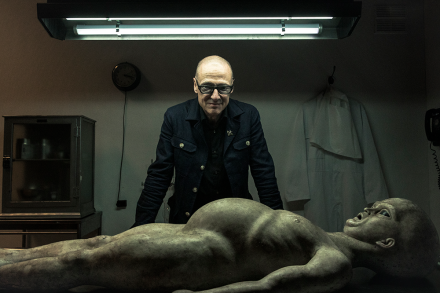
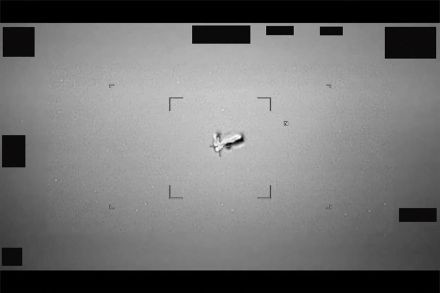
Aliens are very fashionable right now. Steven Spielberg recently announced that they are real and have been visiting us since for ever – but then he does have a poorly reviewed new movie to push. Trump’s White House, meanwhile, has been busily trolling us with hints that it knows more about the subject than it has hitherto let on. I personally think it’s all bollocks – or, if you believe Project Blue Beam, worse than bollocks. But whichever camp you fit into, I think you’ll thoroughly enjoy the three-part documentary series The Alien Autopsy Scandal.

How to listen for alien life

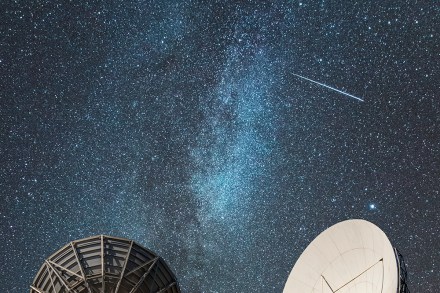
For more than 60 years, scientists have been on the stealthiest stakeout in history. Using state-of-the-art listening devices, they’ve tapped into thousands of homes, waiting patiently for their targets to reveal their presence, and ultimately been rewarded with silence. If this covert activity were occurring in our own country, one might have become impatient and simply walked up and knocked down the door. But the targets are not living in our country, or even on our planet or in our solar system. Our persons of interest are aliens. This is Seti: the Search for Extraterrestrial Intelligence, focused on life on planets orbiting other suns. So far, we’ve found no sign of them.

The scientific case for the existence of intelligent alien life

The foundation of science is based on the humility to learn, not the arrogance of expertise. When comet experts argued that the interstellar object 3I/ATLAS must be a familiar water-rich comet as soon as it was discovered in July, they behaved like artificial intelligence systems: only able to reflect the data sets they were trained on. For decades, the data set that established comet expertise largely comprised icy rocks in the solar system. My counterpoint is simple: humanity launched technological objects into space, so we must conclude that alien life forms could do the same. This possibility must be added to the training data set of comet experts when studying interstellar objects.

Amid the alien corn: Beautyland, by Marie-Helene Bertino

‘I am an Adina,’ the four-year-old protagonist of Marie-Helene Bertino’s Beautyland writes to her extraterrestrial superiors on Planet Cricket Rice, which is light years away from Earth. ‘Yesterday I saw bunnies on the grass,’ she adds, using the fax machine her mother retrieved from their neighbour’s trash. ‘DESCRIBE BUNNIES,’ they respond, sparking a dialogue that continues well into her adulthood. Adina’s premature birth in September 1977 coincided with the departure of the Voyager 1 probe, which was launched with a phonograph record of sounds intended to explain human life to intelligent extra-terrestrials. The timing is significant because Adina was sent to Earth from Planet Cricket Rice to report on human life.

We should be excited about signs of alien life

Last week, a team of astronomers led by the University of Cambridge professor Nikku Madhusudhan announced that they had found tentative evidence for a ‘biosignature’ embedded in the light from a distant planet. Scientists and non-scientists around the world tried to interpret the results. Was this it? Was this the moment when humanity could finally claim it had answered that ancient question: are we alone? As an astrophysicist involved in the search for life beyond Earth, I can tell you that the results were not that moment. But that doesn’t make them any less exciting.

Keir Starmer’s plan to soften Brexit

42 min listen

This week: Keir Starmer’s plan to soften BrexitKaty Balls writes this week’s cover piece on Labour’s plans to establish close ties with the EU. Every member of Starmer’s cabinet voted Remain, and the government is trying to ‘reset EU relations through a charm offensive’. Brussels figures are hopeful: ‘There was no real goodwill for the Conservative government.’ There are tests coming: the first deal, Katy writes, could be harmonisation on veterinary standards. But will the UK have to abide by the European Court of Justice? Then there’s the issue of Chinese electric cars: will Starmer accept cheap imports, or follow the EU in raising tariffs on them? For now, EU officials see the new PM as ‘workman-like and not playing to the gallery’. How long will that last?

Aliens exist? Prove it

At Wright-Patterson Air Force Base in Ohio there is, it is rumoured, a secret underground room where a crashed alien spacecraft is kept. It’s warm to the touch, buzzing with a strange energy, an indication of technology light years ahead of ours. Meanwhile, over at Groom Lake Air Force Base in Nevada, otherwise known as Area 51, there are apparently more alien spaceships, some intact, as well as the preserved bodies of alien pilots. Is it true? Well, a recent survey indicated that half of the US population believed their government was covering up evidence of aliens. As someone involved in the scientific search for life in space, however, I put that down to poor journalism, a lack of critical thought and shallow scientific knowledge.

Under pressure: what might life look like on another planet?

Over the past three decades, astronomers have discovered planets orbiting Sun-like stars throughout the universe. This discovery ended 2,500 years of debate about whether worlds existed beyond our solar system, but it came with a shock. The most common kind of planet in the universe is the type of world that doesn’t exist in our small corner of the cosmos: what astronomers call ‘Super-Earths’ and ‘Sub-Neptunes’, planets with much greater masses than ours and which could, in theory, sustain life. Astronomers concluded a little over a decade ago that every star in the night sky hosts a family of worlds. Importantly for the search for life, one in five of those stars will have a planet in the ‘Goldilocks’ zone (sometimes referred to as the ‘habitable zone’).