Alcohol

How to implement a minimum price for alcohol

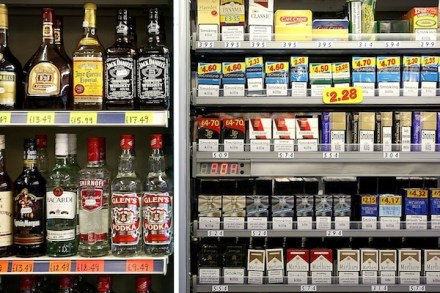
Pete posted earlier on the Prime Minister’s latest intervention on the issue of problem drinking. The new proposals — like a greater police presence in A&Es, and ‘drunk tanks’, special units where drunks are taken to sober up — are sensible enough, but seem small relative to the scale of the supposed problem, and focus on peripheral (though important) side-effects, rather than the core of the issue. The ‘big idea’ seems to be missing, even though the Conservatives have been flirting with it for some years, is a minimum unit price (MUP) for alcohol: far more controversial, but potentially far more effective. The last Labour government, in which I was an adviser, looked at this idea in some depth.

Minimum pricing, maximum controversy

Just because there's no PMQs today, it doesn't mean you won't hear from David Cameron. The Prime Minister is readying his anti-booze cruise once again, and taking it on tour to a hospital in the North East. Once there, he will rail against ‘alcohol abuse’ and its consequences, which include, he will say, a £2.7 billion a year bill for the NHS. And he will preview some of the solutions that may make it into the government's ‘alcohol strategy’ next month: ‘drunk tank’ cells where binge drinkers can be dumped overnight; ‘booze buses’ to deliver people to these cells; police heavies in A&E wards; and, possibly, minimum pricing for alcohol. Confusion abounds on the last of these.

A minimum price for alcohol will have a high political cost

The Telegraph reports today that the Prime Minister has asked for work to be done across Whitehall on how a minimum price for alcohol could be set. As the paper's leader column makes clear, this will not be a politically easy thing to do. When I interviewed the Health Secretary Andrew Lansley for the Christmas issue of The Spectator a few weeks back, he was clear about why he didn’t like the concept of a minimum price: 'I don’t like a minimum price, we are acting against below cost selling. My problem with a minimum price, well I have two problems. One is it’s regressive, so there are perfectly normal families who just don’t happen to have much money who like to buy cheap beer or cheap wine. Should they be prevented?

Feverish Fairy

No prizes for guessing who wrote this, or what the drink is: ‘There was very little left of it [in his hipflask] and one cup of it took the place of the evening papers, of all the old evenings in the cafés, of all the chestnut trees that would be in bloom now in this month, of the great slow horses of the outer boulevards, of bookshops, and kiosks, and of galleries, and of the Parc Montsouris, of the Stade Buffalo, and of the Butte Chaumont, of Foyet’s old hotel, and of being able to relax and read in the evening, of all the old things he had enjoyed and forgotten and that came back to him when he tasted that opaque, bitter, tongue numbing, brain warming, stomach warming, idea changing liquid alchemy.

Sugar daddy

Rum is a relatively young drink – 15th century – and still under-appreciated, but at its best can match any whisky or brandy for complexity and sophistication. Peter Grogan enters the darkness A long time ago a knuckle-dragging ancestor of mine left a gourd-ful of palm sugar out in the rain. Trolling along, the right little speck of yeast eventually came to rest in it, causing the sugar to spontaneously ferment. The result probably didn’t taste too good but it had something that helped the day pass in a pleasant blur. Fast-forward 10,000 years — at a guess — and that same something can apparently be had from mixing some mashed-up tinned fruit with water, bread (for the yeast), sugar and a dollop of ketchup (to improve the taste) in a zip-loc bag.

Time is of the essence

We move through silent streets walled by shuttered houses and closed stores. I know that the French leave en masse in August, but in Cognac the ritual seems also to extend to wintertime. Even the landscape seems somnambulant. Skeletal vines whose cordons point crabbed fingers towards where the sun should be line the roadsides. Yet there is life. Something is stirring in the region’s black, mould-covered, thick-walled chais. At the bottom of a set of worn stone steps in Remy-Martin’s Domaine de Grollet is a collection of large and clearly ancient casks. It is here where the blend of Cognacs which comprise the house’s iconic prestige blend Louis XIII spends the final four years of its life. A sample is drawn, glasses are filled.

Hine: the vintage house

Bernard Hine has impeccable manners. However, as we meet for an apéritif at Hine House, he is a little disgruntled. The source of his unhappiness is a stomach upset which means he is unable to indulge in the foie gras and the 1953 Vintage port, among other treats. A lesser man would have made his excuses, but Bernard’s sense of duty and hospitality doesn’t permit such a course of action. Indeed, his discontent appears to be based more on his inability to fully participate in the dinner than any personal inconvenience. The surroundings are historic: Hine House, one of the oldest in Jarnac, has stood on the banks of the Charente for more than 250 years.

Liquid hideaways

Last year, in a nod towards austerity, I gave up my membership to Milk and Honey, a cocktail club in Soho. I rationalised that as a non-member, I could still book a dimly lit, silver-toned booth downstairs to enjoy their delicious Penicillin — a reviving concoction of peaty whisky, honey, ginger and lemon — at least until 11 p.m. However, as I sipped my farewell M&H dry martini, made with a twist of lemon and some fragrant Junipero gin, it struck me that there is something comforting in having a regular drinking den. Clearly, research was needed. My requirements were simple: superlative cocktails, convivial atmosphere and within walking distance of home. Life takes on a different perspective if you can stroll through London streets after a negroni or two.

To combat binge drinking among the young, make it easier for people to drink under-age in pubs

Mary Ann Sieghart has a great piece in the Independent today about how, inadvertently, we have designed a system that almost encourages young people to drink irresponsibly. As she argues, a lot of problems have come, oddly, from making it harder for people to drink under age in pubs.  As Sieghart puts it, ‘And because we were under 18, we knew we had to remain inconspicuous. The landlord would tolerate our presence as long as we didn't embarrass ourselves or him. We didn't dare get smashed or he wouldn't allow us back. And because we tended to meet the same group of friends in the same pub, being banned was not a good move.’ There are, by contrast, no such constraints when under 18s buy drink--or get someone to buy them drink--from an off license.

Cameron devolves the tricky issue of alcohol pricing

Politicians often get nervous around alcohol – and not just because, in these straitened times, a glass of champagne can broadcast the wrong image. No, the real concern is the more basic, fiscal one: how should it be taxed and priced? There's a difficult trade-off involved. Pushing up the cost of alcohol could halt the staggering advance of binge drinking and all its associated social and medical ills. But, depending on what booze is targeted, it could also hit the least well-off harder than anyone else. And who's to say whether the effect on drinking habits would be that substantial anyway? The trickiness of the situation was clearly demonstrated by Labour's internal ding-dong over minimum pricing back in January.

Beating up the ASBO

Theresa May has taken the truncheon to the previous government’s rather singular anti-social behaviour policy. The ASBO, of which more than half were ignored in 2008, will be a thing of the past; supermarkets will not be able to sell alcohol at less than cost price; and 24 four hour drinking licenses will be subject to local vetoes, even if the residents do not live near or adjacent to pubs and clubs. On confronting anti-social behaviour, May pledges that ultimate political cliché - a coherent and comprehensive strategy. At the moment, there are few details beyond fines for selling drink to underage drinkers. Limiting booze intake is welcome, but alcohol is not the sole problem. Some yobbism is born of lost opportunity; some is simply innate.

Here’s to a boozy New Year

Happy New Year – and have a drink! That’s the message from the new year issue of The Spectator, where Leah McLaren has written a superb piece answering the Liam Donaldsons of this world. Here she is, in full flow: “Almost all of this country’s most famous names been unapologetic boozers. From Kate Moss to Francis Bacon to Christopher Hitchens to the Queen Mum, Brits have a great tradition of not letting their functional alcoholism drag them down. Without it, arguably, we would not have punk rock, romantic poetry or basic democratic freedoms — for as Churchill urged us to remember, he ‘took more out of alcohol’ than alcohol took out of him.

Repairing the broken society

One line from the Sunday papers is still haunting me today. In the Mail on Sunday, Phillip Blond wrote that, “one million children have alcohol-addicted parents”. Think about that for a minute. What hope can these children have growing up in these kind of households? How can we as a society ensure that these children have a decent chance in life despite such a challenging start? There are no easy answers to these questions. Considering the state’s appalling record with children in care, taking these children away from their parents is not the answer. But then what is? It seems that the only answer is to deal with the problem at source, to ensure that there are fewer alcoholic adults and that people take the responsibility of being a parent more seriously.