Africa

What a comic treat: The Game of Love and Chance at the Arcola reviewed

Lady Sylvia is a gorgeous aristocrat whose hand is sought by the charming Dorante whom she has never met. To avoid the stiff formalities of courtship, Lady Sylvia swaps places with her maid and observes Dorante from the safety of pretended servitude. But instead of falling for Dorante, she becomes enamoured of his manservant. However, there’s another wrinkle coming in Marivaux’s classic comedy. Deronte’s manservant, unbeknown to Lady Sylvia, is actually Dorante himself, who has pulled an identical switcheroo with his valet. The story is so hopelessly contrived that its sheer artificiality becomes part of the joke. This production of The Game of Love and Chance, directed by Jack Gamble, captures the fun-loving spirit of the original.

What’s behind the South African riots?

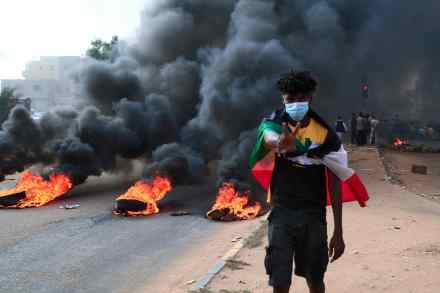
South Africa is ablaze once more. In the provinces of KwaZulu-Natal (formerly Natal) and Gauteng (which includes Johannesburg and Pretoria), the cities are burning. Shops and businesses have been turned to ashes; trucks are on fire; mobs of excited young men are smashing and looting; a Durban ambulance, trying to take a critically ill patient to hospital, was attacked; in the middle of a crippling Covid-19 lockdown, pharmacies have been plundered and vaccination sites have been suspended; motorways have been closed; over 70 people have been killed. The South African president, Cyril Ramaphosa, has called out the army. These rioting young men lead wretched lives, mainly because of the ANC government, which has ruled South Africa for 27 years.

Thirty years ago, I saw the rebels take Addis Ababa

Kenya The evening before the assault on Addis Ababa, my guide Girmay and I ventured into a complex stuffed with bombs, bullets and missiles that must have been booby-trapped. A few minutes into taking photos, I heard detonations, and a bunker on the hill above us exploded. We dashed away as the rumbles and bangs behind us gathered in fury and then the earth burst in an eruption of fire, sending a mushroom cloud into the sky. As we ran, rockets and shells rained down on all sides, shrapnel and earth bursting in plumes. We took cover in a dry riverbed and I worked my way through a packet of cigarettes while the ground shook under the relentless explosions until dusk, when we raced madly across ploughed fields until we reached safety.

Boko Haram’s demise will only strengthen Isis in Africa

Multiple reports have confirmed that the Boko Haram chief Abubakar Shekau is dead. Shekau’s demise came after Boko Haram last week clashed with Isis in Sambisa forest in northeast Nigeria. Some reports suggested that the Boko Haram leader detonated a suicide vest rather than be captured by the Isis militants. Isis’s West African Province (ISWAP) is often characterised as being under the Boko Haram umbrella, but the two factions have become deadly rivals in the region. And with terror engulfing the continent, along with the rise of an African Islamic State, it is Isis that is now the beneficiary of Shekau’s death.

Black African lives should matter too

The treatment of black people, particularly by law enforcement, has become a principal point of protest in the western world. But little it said about the millions of black Africans mistreated by the ruthless security forces of authoritarian African regimes. If black lives matter regardless of where they are in the world, then it’s time to challenge the immensely privileged black African ruling elite that clings to power by persecuting its often-voiceless Black African citizens. The numbers tell the story. An estimated 5.4 million people or 8 per cent of the Democratic Republic of Congo’s population died in the 1997-2003 conflict at the hands of government security forces and non-state armed militia.

Why I’m investing in sheep

Laikipia In the past I had a low opinion of sheep. During my first forays into farming I saw them as creatures hell-bent on dying, with lung diseases, rotten feet or nasal maggots. Their legs snapped in ant-bear holes and hyenas tore them to pieces. To stem tides of oviform death we dipped, injected, dewormed and castrated. Many hours evaporated searching for stray animals. I found them dreary, sold off my flock and concentrated on cattle. Up here, north of Mount Kenya, people name their sons after special bulls and men hold important conversations in among the cattle at evening, so that the talk can be inspired in bold and manly ways. Everybody loves cattle.

How terror took over the African continent

Eight law enforcement officials, including three policemen and five members of a local anti-jihadist force, were killed in a jihadist attack in Burkina Faso on Tuesday. Jihadist raids on two military bases in Somalia, using suicide car bombers, killed 23 on Saturday. On Friday, South Africa decided to deploy its troops in bordering Mozambique, days after Islamist militants took over the town of Palma, killing dozens of locals and forcing thousands to flee. The past week is only a sample of the jihadist peril currently engulfing Africa. These terror attacks reaffirm the growing strength of the world’s deadliest jihadist groups, including al-Shabaab, Isis, al-Qaeda, Boko Haram and their affiliates.

Eccentric, artist and storyteller: in memory of my mother Doreen Sanders

Indian Ocean coast ‘I love you’ became just ‘love’, and that was the last word Mum was able to say to me. Her children had been in and out for days, she had met her great-grandson from America for the first time and messages flooded in on the phone, from all around Kenya and from her grandchildren in Europe. Then one evening the two of us were alone together in her bedroom, surrounded by family photos and all her memories of India, Arabia and great-grandson. She was in my arms and it became so quiet I decided to play Vera Lynn’s ‘We’ll Meet Again’ on my phone, since it might remind her of her years of war service in Burma, when she was still a teenager.

Uganda faces a fraught election

On 14 January, Ugandans go to the polls in what is likely to be the closest election the country has ever had. Their unusual choice: embattled incumbent Yoweri Museveni or popstar-turned-politician Robert Kyagulanyi, better known by his stage name Bobi Wine. Yoweri Museveni is Africa’s third-longest ruling leader. He is a political chameleon — once a Maoist revolutionary, he has posed as both a liberal progressive and a nationalist conservative while in office. The three-and-a-half decades of the Museveni administration are difficult to describe in a sentence or two, perhaps because most Ugandans cannot remember them all: the average Ugandan was born in 2004 (compared to the average American, who was born in 1982).

The many good things to come out of lockdown

Laikipia I was drinking in the fresh air on the high earth wall of my farm dam last week, when I saw a low white cloud coming straight at me from the northwest. The distances you can see up here are immense, across tawny savannah towards blue hills on the horizon, an unfenced land stretching for days and days of travel to the Ethiopian frontier. As I was standing there, filling my lungs and feeling free and happy, the white mist got ever closer and began to resemble confetti. The low, fluttering cloud was entirely silent. And then I saw it was a multitude of white butterflies, all flying on exactly the same southeasterly bearing. In the days since, they have migrated in never-ending millions from dawn to dusk, pausing on flowers to fill up on nectar, before taking to the skies again.

Things fall apart: Ethiopia’s terrifying descent into civil war

The world’s first conflict triggered by Covid-19 exploded on 4 November in Ethiopia’s northern region of Tigray. Before your eyes glaze over at news of fresh African horrors — hundreds dead in battles and air strikes, ethnic massacres, civilians fleeing, charities calling for food aid — consider this frightening new reality. For the first time in modern history, wars and insecurity now ravage a continuous line of African states from Mauretania’s Atlantic shores to the Red Sea — a 6,000km Sahelian suicide belt of jihadis, state failure and starvation. Intervene too hard in this mess and you get David Cameron’s ill-conceived 2011 Libyan bombing raids. Gaddafi gets butchered in a storm drain, the arsenals are pillaged and weapons flood the Sahara.

The perils of being a Kenyan farmer’s wife

Laikipia As the train pulled into Victoria my wife Claire, back home on the farm in Kenya, revealed that a buffalo was charging her. ‘Oh dear!’ she exclaimed as the phone line went dead. She called back minutes later, out of breath, to explain she had been walking our three dogs when the beast came thundering across the savannah and chased her half a mile. It later turned out that lions had injured the buffalo, which put it in a foul mood, gave it a bad limp and — thankfully — slowed it down. That was just the first drama for Claire, when she put on her gumboots and ran the ranch for me while I was away.

What a relief it is to be back among level-headed Kenyans

Kenya I stood under huge skies in the open country of our farm in northern Kenya and, after months of London lockdown, I remembered those Japanese tourists I had once seen, weeping with wonder at the sight of Africa’s savannah after their lives imprisoned in cities. I’ve been savouring every little detail of home since we returned the other day: the taste of water and mangoes, the joys of talking cattle with the stockmen, seeing my 95-year-old mother at last, birdsong and crickets, long treks with our dogs tearing off wildly after baboons and buck. I woke up before dawn when several lions noisily killed a zebra in front of our house. I lay in bed listening to them scrunch up the animal’s bones and felt that all was well in the world.

Why is the WHO so worried about Tanzania?

Dar es Salaam The World Health Organisation has drawn up a shortlist of countries it’s most concerned about during the pandemic. Tanzania is at the top. The government’s lack of transparency during the crisis is a big part of the problem. In recent years the country has imposed increasingly repressive laws to muffle the media — newspapers fined and journalists arrested. Or worse. For the purposes of this piece I am ‘Tom James’; I’m either more circumspect or less courageous than my fellow journos here. When the international media — fed by stringers whose identities are disguised — try to report on the pandemic, they are accused of scaremongering, their attempts described by the government as a ‘form of warfare’.

Another plague is enveloping the world – locusts

As if 2020 hasn’t already scared the hell out of us all, a plague of locusts is upon us. When I first witnessed a swarm swirling across my farm in Kenya, it was hard to see them in the nightmarish way they’re depicted in Exodus or the Book of Revelation. They were millions of pink and golden Tinker Bell fairies, flying in a halo around the sun, filling the air with the sound of rustling skirts. But the breeding cycle of a locust is only a few months and they are growing in numbers exponentially. Soon, it’s predicted, we will see individual swarms equivalent to the size of London, each of which consumes as much food as half the population of the United Kingdom on a daily basis.

Why we’ll all be fleeing to Nigeria

I keep thinking what I’ll do when we regain our liberty — and I picture that beer at the end of Ice Cold in Alex, when after surviving his trek through the Sahara, a sweaty John Mills traces his finger up the frosted schooner, drinks the golden liquid down in one and says: ‘Worth waiting for.’ A month ago I had big ambitions for the future at home on the farm in Kenya. We were planting thousands of avocado trees, we were about to start rearing organic broiler chickens, there was a tilapia farm to expand, a new dairy project, and preparations for the Nairobi livestock breeders’ show later this year, when we hoped to compete with a string of Boran beef cattle. The event was cancelled and all my farm plans were delayed when the flights home to Kenya were closed.

Africa’s invisible epidemics

Africa   ‘Ah, Africa,’ the French scientist sighed contentedly. This was 1995 and all around us was an Ebola epidemic ravaging Kikwit, a village in what they now call the Democratic Republic of Congo. ‘No lawyers to sue us!’ I had just asked him why doctors in the local hospital ward had shown me Ebola victims, lying in beds next to patients suffering milder diseases. In the Kikwit outbreak, the hemorrhagic fever killed eight out of ten people infected — 245 in all. People became sick after kissing and hugging the bodies of their loved ones at their funerals.

The joy of a Rwandan airport

Our plane touched down in Rwanda at 7 p.m. Stepping outside on to the metal steps, I smelt that unmistakable peppery, earthy, decomposing smell that says you have landed in tropical Africa and that for the foreseeable future things will be different. I crossed the tarmac to the arrivals halls and, sweating already, lined up to show my passport and visa. Stupidly and inadvertently I had applied for the visa via a private online company called the Rwanda Visa Service, which charges a handling fee of nearly 200 per cent on top of the normal visa price. Four weeks before my departure date, I had successfully gone through all the online hoops and was informed that my visa was ‘pending approval’. Three and a half weeks later it was still the case. I wrote an email. No reply.

The man with the inside story on Tiny Rowland

Kenya   At his house on Kenya’s coast our neighbour Paul Spicer kept a photograph of himself as quite a young man stepping out with his boss Tiny Rowland, our founding President Jomo Kenyatta and 1970s MI6 chief Sir John Ogilvy Rennie (known as ‘C’). In the image they are all sharply dressed — by perhaps the same Savile Row tailor Tiny acquired to pamper his friends — and they look like the kings of the world. Edward Heath called Tiny the unacceptable face of capitalism — but I always admired the Lonrho boss and Paul was for many years his right-hand man. Naturally when you have been so successful you’re going to make a few enemies, but as Tiny so wisely said, ‘I don’t know why he hates me so much — I never did him a favour.

Britain is following in the footsteps of Africa’s former failed states

Kenya   ‘In the past months the people of Uganda have been following with sorrow the alarming economic crisis befalling on Britain,’ Uganda’s President Idi Amin telegrammed the Queen in 1973. ‘The sad fact is that it is the ordinary British citizen who is suffering the most… I’m sending a cargo ship full of bananas.’ Back then Fleet Street hooted with laughter at this African buffoon trying to patronise the United Kingdom and its leaders. Yet I wonder what Idi Amin would be able to say about Britain and its leaders today.