Afghanistan

Don’t expect much from Biden’s Middle East trip

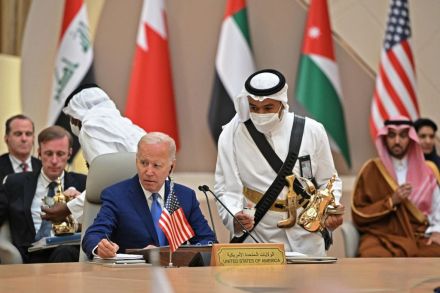
It took Barack Obama less than three months to fly to the Middle East for a visit, landing in Iraq to visit the tens of thousands of US troops stationed there at the time. Donald Trump’s first overseas trip as president was to the Kingdom of Saudi Arabia (also three months into his tenure), where he basked in the limelight, watched in awe as his face was plastered on buildings in Riyadh, and hovered over a glowing orb with King Salman. Now, eighteen months into his presidency, Joe Biden will be spending a few days this week in the region, making stops in Israel, the West Bank, and Jeddah, Saudi Arabia, for a summit of the Gulf Cooperation Council.

The Taliban’s rough year in power

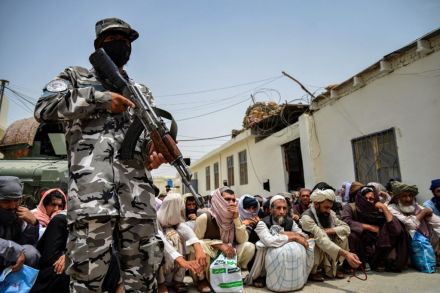
Next month will mark the first anniversary of the Taliban’s second stint in power in Afghanistan after a twenty-year insurgency against the US-backed government. In August 2021, Taliban fighters, flush with captured American military equipment and the jubilation of victory, were openly walking the streets of Kabul. While the disgraced Afghan president, Ashraf Ghani, was preparing for a life of exile in the United Arab Emirates, Taliban officials were converting his offices into their headquarters. The Taliban’s first year in power, however, hasn’t been pretty. The group has quickly come to understand that administering a poor and faction-prone country is a lot more difficult than taking up arms against a deeply unpopular, corrupt, foreign-dependent government.

What happens to US fighters captured in Ukraine?

Alex Drueke and Andy Huynh are two former American military members now in Russian custody, captured by the Russians in Ukraine, where they were fighting for the Ukrainian government. What is going to happen to them? The most likely thing is that both men will eventually be traded to the US in return for captured Russians. Prisoners are very valuable and rarely wasted in executions unless those carry much more value than the prisoners held by the other side. The deal may be public or secret, and the US can expect to pay a premium. Israel usually releases ten or more Palestinian prisoners in exchange for one of its captured troops.

Russia is sidestepping American oil sanctions

When the European Union finally made the decision to ban 90 percent of Russia’s crude oil imports by the end of the year, the bureaucrats in Brussels were jubilant. The EU’s adoption of oil sanctions was thought be a big blow to Russian President Vladimir Putin, who depends on the revenue generated by his country's oil exports to fund his war in Ukraine. It doesn’t take a genius to figure out why European officials were so thrilled. The EU imported 2.2 million barrels per day of Russian crude last year, amounting to tens of billions of dollars in profits for the Kremlin every month.

America the busybody neighbor

Imagine a neighbor who is constantly in everyone’s business. Perhaps you have such a person, or persons, in your own community. The neighbor complains about the paint colors of shutters, the height of lawn grass, and the number of cars parked on the street. You better hope he doesn’t find out about your backyard chicken coop if it's prohibited in your county. It’s bad enough to have neighbors like this, constantly on the alert, monitoring everyone’s behavior, and complaining to everyone in earshot. But imagine if an entire country was like this. Actually, you don’t have to imagine. For that is America — at least the foreign policy establishment and the powerful elite institutions like corporate media and the academy that influence it.

neighbor

The Taliban’s Afghanistan quagmire

Hibatullah Akhundzada is a secretive man who is only occasionally heard and seldom seen. But on May 1, the Taliban’s supreme leader was delivering a sermon in Kandahar’s central mosque, bragging about his organization’s supposed successes. “Congratulations on this victory, freedom and success,” said the reclusive Akhundzada, surrounded by armed bodyguards. Nine months after the Taliban captured Afghanistan and forced the hapless Ashraf Ghani to flee the country in a helicopter, its chief official remains content with relishing the past. But truth be told, the Taliban has nothing to brag about.

Is Joe Biden’s Easter bunny running the country?

Cockburn has long regarded the Easter bunny as the least convincing of all the holiday-themed characters. Give him jelly beans, malt eggs, even a couple verses from “All Creatures of Our God and King” — but leave the giant rabbits out of it, says he. That’s why he was so alarmed by video that emerged from the president’s annual Easter egg roll on Monday. The footage shows Biden chatting with a reporter who asks him a question about Afghanistan. He’s just beginning to answer when suddenly the White House’s resident Easter bunny lunges between him and the press. The creature turns to Biden and waves, while the leader of the free world turns obediently and walks away. Far be it from Cockburn to deny that the rotund rabbit had a point.

Remember Afghanistan?

For Americans, neglecting Afghanistan has long been the norm. Almost from its inception, it was the forgotten war, fought “over there so we do not have to face them” here, as President George W. Bush once put it. It was a campaign to crush the Taliban only to abruptly become a democratic nation building project and then just as quickly be sidelined for the “real war” in Iraq. Even as far back as 2009, when the United States still had 62,000 troops in the country, David Folkenflik, NPR’s media correspondent, was asking, “Hey, Media: Where’s the Afghanistan Coverage?” This all appeared to change last August — at least for a time.

The decline of drone killings

On the very same day that Joe Biden was inaugurated, he imposed an order on the national security bureaucracy that received little attention at the time: drone strikes in Yemen and Somalia were to be curtailed until further notice. If American commanders wanted to strike a target in those countries, they would have to bring the request directly to the White House for debate. The new, temporary guidelines would be in place until the Biden administration completed its inter-agency review on America's policy of targeted killings. That review is still in the process of being finalized. And while we don’t necessarily know what the Biden administration’s new rules and procedures will be, we do know that the White House is ramping down the pace of drone strikes.

The next chapter in American foreign policy

The new year begins a new chapter in American foreign policy. For the first time since 2001, we are not at war in Afghanistan. More than that, we no longer have an architectonic strategy for our role in world affairs. We had one during the Cold War: to win it. And we had one afterward, too: a decade before 9/11, our policy elite had already committed to the idea that we must police the world for the good of the liberal international order. The lead-up to the first Gulf War was the opening paragraph of that chapter, the ignominious retreat from Afghanistan its last line. Our policy mandarins have not changed their minds, but the world has changed too much for their grand design to have any meaning in 2022.

foreign policy

No, the media doesn’t treat Biden worse than Trump

A Washington Post opinion writer believes that President Biden is receiving worse treatment from the media than Trump did. It is a laughable theory, so naturally the media loves it. Dana Milbank’s piece is headlined, “The media treats Biden as badly as — or worse than — Trump. Here’s proof.” Using a data analytics unit, called forge.ai, the writer claims he was able to confirm his sneaking suspicion: journalists are being meaner to the “empathizer-in-chief”, as the Hill once dubbed Biden, than they are to “The Monster Who Feeds on Fear”, as the New York Times once dubbed Trump.

american media biden

Joe Biden takes his failures on tour

How’s the ice cream in Rome? Joe Biden is about to find out. Word is he is excited about the gelato, which is A-OK, since it may distract him from the fact that he has nothing to report when he gets there. The president — I mean, Joe Biden — was supposed to reestablish “normality” to an office so badly bruised by the mad tweeter — no, make that “ex-tweeter” — who came before. “Normality” was one big selling point. The other was Biden’s vaunted foreign policy experience. Reality check one: was Joe Biden’s performance at that town hall with Anderson Cooper last week an exhibition of “normality”? Or was it yet another disagreeable instance of elder abuse, parading a man suffering from senile dementia before the cameras?

failures g20 cop26 biden

The Taliban learn just how hard governing Afghanistan is

For the first time in two decades, and arguably for the first time since the late 1970s, there is a semblance of calm in Afghanistan’s countryside. The US troop withdrawal last August, ending Washington’s 20-year misadventure in the country, has ushered in a period when airstrikes, IEDs, and Taliban-orchestrated bombings are no longer daily facts of life. Afghans who haven’t seen their relatives for years are now able to travel the roads without worrying about getting menaced by Taliban gunmen or fleeced by corrupt Afghan army troops. At the same time, Afghanistan is at a perilous moment in its history.

taliban

The foreign policy amateur

Since Joe Biden was elected in part as a salve for Donald Trump's perceived foreign policy blunders, it seems reasonable nine months in to go searching for the Biden Doctrine, to assess his initial foreign policy moves, to see what paths he has sketched out for the next three years. ...is that a tumbleweed? Well, OK, there was Afghanistan, Biden's most significant foreign policy action. Biden won election in November and took office in January. There was ample time for replanning and renegotiating anything that had been left behind by Trump, especially since Biden and his team had muddled in Afghanistan during the Obama era and knew well the mess they'd helped create. The rush for the last plane out was a fully expected unexpected event.

biden foreign policy

The Biden presidency is in free-fall

Eight months in and I am perilously close to employing one of the worst political clichés in existence — Joe Biden’s honeymoon is over. You’re not imagining things — the Biden presidency is in a state of free-fall. This is not a joke. It’s not an overreaction. It’s not about Biden’s opponents pouncing or seizing. Biden’s presidency has a very real chance of completely foundering within its first year. After a promising start where he inherited a vaccination process that was already in progress, albeit briefly, under Trump, his vaccine strategy has stalled to the point of him now demanding mandates on private businesses, a step he assured the electorate he would not take.

free-fall

History returns for Putin and Erdogan

Washington’s allies are deploring the Biden administration’s mismanaged withdrawal from Afghanistan, and they’re worrying publicly about its implications for Nato. Russian leaders, resisting the urge to gloat, express well-founded concerns over the spread of jihadist terrorism northward into Central Asia. And China is moving in, cutting deals with the Taliban to mine lithium and other critical minerals. The reaction in Turkey has been more ambiguous, but also more interesting. Early in the evacuation, Turkey sent soldiers to Kabul to secure the airport. It is already clear that Turkey’s Islamist government is ready to recognize and work with the Taliban — while also loudly discouraging Afghan refugees from trying to enter Turkey.

turkey
climate change

Afghanistan and climate change: the West’s twin failures

The West’s humiliation in Afghanistan has an older brother: climate change. As siblings, the two share characteristics, most obviously an inability to confront unwelcome facts. In Afghanistan, there was a large constituency led by the Pentagon invested in the mantra of proclaiming progress in the fight against the Taliban. Climate has its own industrial complex of NGOs, climate scientists, renewable energy lobbyists profiting from the energy transition, eager helpers in the media, and politicians posing as world saviors. Energy experts tell us renewable energy is cheaper than building new fossil fuel power stations. If they’re right, why did China build the equivalent of more than one large coal plant a week last year?

The great unraveling

The smart money says that Donald Trump will not run in 2024. The smarter money says that he might, but that he shouldn’t because he’s too old and too divisive. I have no accounts at either of those depositories, so am not going to participate in that panel discussion. Instead, I propose to make a few obvious points. If they’re obvious, why make them? Because the obvious is not always so obvious. René Descartes is widely detested by all the clever people, for whom ‘Cartesian’ is term of snobbish contempt. I think Descartes was a great genius but one who was wrong about a couple of important things. No, I do not mean what he says about ‘extended substance’, the ‘Cogito’ or any of his other epistemological and metaphysical flights.

biden
taliban

Will Biden deal with the Taliban?

When President Joe Biden tapped longtime aide Antony Blinken to be his secretary of state last November, Blinken landed his dream job. Here he was, a man widely respected in foreign policy circles, continuing the family business (his father and uncle were both ambassadors and his stepfather was an adviser to John F. Kennedy). What Blinken could have lived without, however, was the grandstanding, bravado and livid speeches from lawmakers responsible for overseeing his work. Unfortunately, fielding self-righteous questions is a part of the job description.

The myth of the good Afghan war

There’s a disgusting scene I can’t stop thinking about. It comes about midway through This Is What Winning Looks Like, a 2013 VICE documentary about America’s efforts in Afghanistan you can watch for free on YouTube. The film switches between the documentary footage itself and a sort of metafilm in which the filmmaker, Ben Anderson, discusses aspects of his work with Eddy Moretti of VICE, with Anderson’s footage from his time overseas frozen on a computer monitor behind them. The scene in question starts at 51:00 in the YouTube cut, was filmed around 2012, and involves a series of horrific murders. These were perpetrated not by the Taliban, but by America’s supposed allies: the country’s nascent police force.

afghanistan