Books and Arts

Bored of the rings: ‘wokery’ takes on Tolkien

"Woke” is a term much overused by those on both sides of the culture war but — a little like pornography — while it may be difficult to define, you absolutely know it when you see it. The capture of the entertainment industry by an ideology — perhaps more accurately described as a group of roughly consanguineous ideas that seem, superficially, to be the Right, Kind and Thoughtful beliefs to hold — seems now to be absolute. Fiction of all kinds has been affected, but heroic narratives have proved especially vulnerable, perhaps because of the size and dedication of their audiences. You will doubtless know the kind of thing I mean.

Rings

The powerful, brutal story of Polish resistance fighter Elżbieta Zawacka

In May 1942, Agent Zo was in the home stretch after a long and risky mission that had placed her in Berlin, at the heart of Nazi Germany. As usual, she picked up a small stone and threw it at the second-floor window of her sister’s apartment in a grimy industrial city in occupied Poland, south of Warsaw. But no one in the flat turned on a light, the agreed signal. She threw another. Nothing happened. With a mounting sense of unease, she knocked at the door of a first-floor apartment, and a pallid face appeared. The terrified neighbor told her that the Gestapo had appeared two days ago and arrested the occupants. “Get away, by God. They are here!” she urged.

Zo

How music can be weaponized

A noise booms from a downtown district of Kyiv. It’s not the screech of a piercing siren or a building collapsing into rubble but the pumping beat of electronica. Throughout the deafening clamor of the Russia-Ukraine war, Gasoline Radio has kept broadcasting, mixing contemporary electronic music with traditional folk to fortify Ukrainian national identity. Whether pumped out by electronica DJs, violinists playing for families in shelters or singers performing in the shelled-out carcasses of cities, all is far from quiet on the cultural front of Ukraine. Wherever there is oppression, there is resistance, and music has long been a weapon for these war-weary civilians.

Rebel

The Position of Spoons is flawed but fascinating

"When you take a flower in your hand and really look at it, it’s your world for the moment. I want to give that world to someone else.” The final installment of Deborah Levy’s “Living” biographies, Real Estate, begins with this quote from the artist Georgia O’Keefe. It would be neat — oh, so neat! — for me to remark that if her memoirs were each a single flower — the world of the writer unfurling between its papery leaves — her latest book, The Position of Spoons, is a bouquet: a collection of variously published and unpublished letters, essays, short stories and poems spanning her entire life as a writer. But The Position of Spoons is not neat. Instead, reading it feels rather like rummaging through Levy’s desk.

Levy
Kennedy

The real Kennedy men

Long before the #MeToo movement shattered the careers and reputations of people like Harvey Weinstein and Kevin Spacey; long before Jeffrey Epstein and R. Kelly were locked up for committing heinous sex crimes; and long before we’d become familiar with names like Monica Lewinsky and Virginia Roberts Giuffre, there were the Kennedys. In very basic terms, that’s the premise of Maureen Callahan’s book Ask Not — a title that riffs on JFK’s inaugural address — which salaciously chronicles how men from three generations of one of America’s most exalted families spent their lives perpetrating violent misogyny and psychological abuse without suffering so much as a polite slap on the wrist.

Trump

How controversial is The Apprentice?

Ali Abbasi’s new film, The Apprentice, may be named after the TV show that fatefully beamed Donald Trump into millions of homes for fourteen seasons before its star’s even more fateful run for the US presidency. But after watching Abbasi’s twisted and wildly entertaining bildungsroman, featuring Sebastian Stan as a young Donald and Jeremy Strong as his dark-arts mentor Roy Cohn, you recognize an echo of the sorcerer’s apprentice too. Abbasi starts the film with footage of Richard Nixon telling the world he is not a crook, before segueing to a punk-soundtracked montage of broke-down Seventies New York.

Fight Club

Twenty-five years of Fight Club and American Beauty

Sound the alarm: hypermasc beefcakes all over the world have an anniversary to celebrate! Beware women, children and the effete, this year marks the twenty-fifth birthday of both David Fincher’s notorious psychodrama Fight Club, adapted from the debut novel by Chuck Palahniuk, and Sam Mendes’s equally notorious American Beauty, which has gone from Oscar-winning acclaim to being a punchline on chat shows and animated comedies alike. If you haven’t seen Fight Club, shame on you. Go to Hulu and binge away. Revel in its anarchic ludicrousness and head-to-head carnage; inhale the feculent atmospheres of Lou’s Tavern and Tyler’s dilapidated mansion house, all tied together through Fincher’s iconic desaturated color palette. It is all too easy to taste the blood, sweat and tears.

art

War, one artwork at a time

The chaos of the conflict in Ukraine is difficult to track, let alone to reflect on a human scale. After ten years of destruction and occupation, analyzing the situation from afar is a challenge. For many in Ukraine, art provides a way to communicate about a culture under siege, a sense of identity and a concrete way of engaging with people outside the country. While art can speak for itself, it requires human cultural ambassadors. To this end, Ukrainian nationals and their allies have been working tirelessly to promote the voices of a people under siege through museum exhibitions and events the world over.

Memorial

A classic monument for World War One

I was standing in front of “A Soldier’s Journey,” the centerpiece of the new National World War One Memorial in Washington, DC, chatting with its creator, sculptor Sabin Howard, when I raised a question. “So, are you the new Saint-Gaudens?” I asked. “No! No, God no!” exclaimed Howard. “That guy sucks.” Sabin Howard is nothing if not direct in expressing his opinions, which are refreshingly free of the artspeak that saturates most of the contemporary art world. It’s a frankness that is best appreciated by examining his current commission as well as trying to understand the artist himself.

Culture

This month in culture: November 2024

Here In theaters November 1 What happens when the director, writer and stars of Forrest Gump get together in 2024? A goosebump-inducing story of family, time, space, home and the enduring nature of love. The “Here” in question is taken from the graphic novel by Richard McGuire, which tells the story of a location through generations and eras, transcending time. Director Robert Zemeckis plays on the panel-frames of graphic literature by employing a fixed camera angle throughout the film. AI de-aging technology is used to depict the actors from teenagerhood through their eighties. Tom Hanks, Robin Wright, Paul Bettany, Kelly Reilly and Michelle Dockery star.

Michael Richards’s memoir is heavier on introspection than laughs

An unusual disclaimer greets the reader on the title page of this memoir of an actor chiefly known for starring as the lovable goofball Cosmo Kramer on the hit TV sitcom Seinfeld. “Neither the US Army nor any other component of the Department of Defense has approved, endorsed, or authorized this book,” it notes. But in the event the Pentagon probably needn’t have worried. Drafted into the army in 1970, the actor in question, Michael Richards, seems to have avoided any Sergeant Bilko-like shenanigans and instead separated from the service with a heightened appreciation for the punctuality, discipline and meticulous preparation that characterized his later career.

Richards

Charles Baxter’s Blood Test is a necessary novel

The books that most vividly and expansively illustrate the human experience are not the ones that grapple with life’s most romantic or fantastical tribulations. Charles Baxter’s latest work is splendid proof of this abiding literary fact. Baxter, a Minnesotan who is author of a multitude of novels and short story collections, returns with Blood Test, a book that delves into some quotidian yet disconcerting aspects of modern American life. He is well-known for 2000’s The Feast of Love, which garnered a National Book Award nomination, and 2020’s The Sun Collective, among others; his new offering continues his tradition of blending the mundane with the extraordinary.

Blood Test

Will Self’s impressive paean to his mother’s frustrating life in the US

Will Self’s recent, exceptional fictional trilogy, comprising Umbrella, Shark and Phone, displays a deep preoccupation with the ways that time, memory, family, psychosis and history interact. The novels are complex, multigenerational narratives, composed in a late modernist style as engaging as it is experimental. Formal playfulness, with the prose switching between its characters’ consciousnesses, sometimes even midsentence, is married to solidly satisfying plots. Having already excavated his own life in a memoir, Will, Self has now turned to his mother in a novel, Elaine. Self has written about Elaine Rosenbloom before (in the short story “North London Book of the Dead”); she also appears as the narrator, Lily Bloom, in How the Dead Live.

Self

Back to the birth of the Greenwich Village music scene

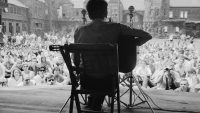
In 1961, the folk guitarist Barry Kornfeld moved back to Manhattan after spending a year in Boston. The Greenwich Village folk musicians he called friends, who before his trip to Boston had been enduring a hand-to-mouth existence, were now making a living playing their music in clubs along MacDougal Street — not necessarily “a good living,” Kornfeld noted, but certainly enough to get by. Kornfeld spotted another difference, too. Audiences at clubs weren’t merely clapping; they were snapping their fingers in appreciation, which felt like the hippest thing ever. Rolling Stone writer David Browne’s latest book, chronicling the history of Greenwich Village music, pivots around 1961.

Greenwich
von trier

The world needs more Lars von Triers

In 2009, cinema audiences were faced with a choice between two talking-fox pictures. The first, most obviously user-friendly option was Wes Anderson’s Roald Dahl adaptation Fantastic Mr. Fox, with the eponymous reynard voiced by none other than George Clooney. If your tastes verged on the darker and more perverse, the Danish director Lars von Trier had a treat in store for you with his controversy-laden psychodrama Antichrist. In one key moment, the male protagonist played by Willem Dafoe is approached by a mangy-looking fox — voiced, uncredited, by Dafoe himself — that declares, in maniacal bass tones, “Chaos reigns!” You wouldn’t get that with George Clooney.

Powell

Bud Powell should be a household name

Late one January night in 1945, a young black man stumbled drunkenly toward Broad Street Station in Philadelphia. He was exhausted after playing a long set in a grotty club half a mile away. The naturally nervous musician often used alcohol to settle his unbearable over-excitements and debilitating despairs. On this occasion he had one too many. His awkward gait caught the attention of two policemen. They went to shoo him away, but instead of escorting him peacefully along, something about the twenty-year-old vexed the pair and they began to bash him about the head repeatedly with their truncheons. When the seriousness of his injuries became apparent, after he’d been slung into a frozen cell, he was taken to a hospital to recuperate.

Böcklin

Böcklin brings out the dead

In the fall, a middle-aged man’s fancy turns to thoughts of death. As shadows lengthen, decay takes root in the raised beds, and the “spooky season” recalls the shortening of our days. It also provides an opportunity to reflect on how one artist embraced this time of year. Much of the life of the Basel-born Symbolist Arnold Böcklin (1827-1901) was haunted by the specter of death. His first fiancée died before they could marry; he himself nearly died of typhus. Of his fourteen children, five died in childhood; three others predeceased him. His daughter Maria was buried in the English Cemetery in Florence, where Böcklin spent much of his life. Scholars believe that the cemetery partly inspired Böcklin’s most famous work, 1880’s eerie “The Isle of the Dead.

Culture

This month in culture: October 2024

Joker: Folie à Deux In theaters October 4 Set in the aftermath of the first Joker film, Folie à Deux returns to Joaquin Phoenix’s Arthur Fleck in the Arkham State Hospital as he faces trial for five murders. While under treatment, he meets and falls in love with fellow patient Harleen “Lee” Quinzel, a woman obsessed with his Joker alter ego. The sequel is a smudgy Seventies crime noir deviation from the canonical material of DC Comics characters Joker and Harley Quinn; this Joker does not become the Clown Prince of Crime. With no Batman in sight, Joaquin Phoenix engages in a chaotic pas de deux with Lady Gaga as he stops taking his medication and descends into an MGM dreamscape of musical fantasia.