Theatre

Peter and Alice

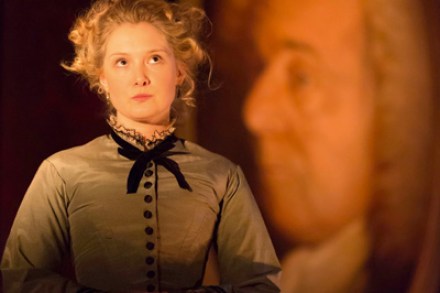
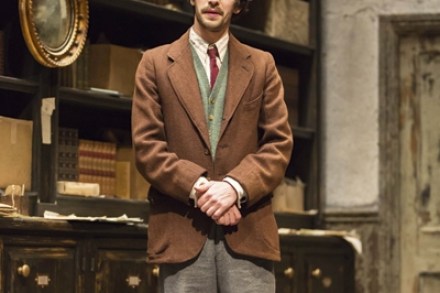
Inspired writer, John Logan. His 2009 play, Red, delved brilliantly into the gloom-ridden, suicidal mind of the misanthropic modernist painter Mark Rothko. The play’s unflinching and sordid honesty earned the author, and his director Michael Grandage, a bagful of gongs on either side of the Atlantic. The pair have reunited for Logan’s new play, Peter and Alice, which opens with a meeting between Alice Liddell (of Wonderland fame) and Peter Llewellyn Davies, who inspired J.M. Barrie’s Peter Pan. Alice and Peter, now grown up, compare notes about the books they featured in, about the writers who used them as models, about childhood, about adulthood, about this, about that. The writers themselves wander on stage and add to the floaty mood of inconsequential nostaglia.
The Book of Mormon is toothless, jokeless, plotless and pointless

Impossible, surely. The Book of Mormon could never live up to the accolades lavished on it by America’s critics. ‘Blissfully original, outspoken, irreverent and hilarious,’ was a typical review. The three authors are formidably gifted. Trey Parker and Matt Stone gave us South Park, while Robert Lopez is the co-writer of Avenue Q. As a fan of both shows, I was fearful that Mormon would turn out to be as much fun as underwater paintballing. So, up goes the curtain. A posse of geeky Yanks in crisp white shirts are being dispatched to Mormon missions around the world. We focus on two characters, a big handsome jock and a fat needy blob. Their destination is revealed: Uganda. Everyone is shocked and sad.

‘In the beginning was breath’

Declan Donnellan is riding high. His acclaimed production of the burlesque classic Ubu Roi has confirmed his membership of the elite group of British directors who enjoy renown across Continental Europe and beyond. The critics cheered his French-language production of Alfred Jarry’s anarchic satire when it reached Paris earlier this month. The show, created by Donnellan’s company Cheek by Jowl, is currently bunny-hopping between venues on either side of the Channel. It arrives at the Barbican on 10 April where it forms part of the Dancing around Duchamp season. I meet Donellan in a Hampstead café. ‘My local,’ he says as two cappuccinos are clattered down in front us.

Juvenile delinquency

Study the greats. That’s the advice to all budding playwrights. And there are few contemporary dramatists more worthy of appreciative scrutiny than Bruce Norris, whose savage and hilarious comedy, Clybourne Park, bagged the Pulitzer Prize in America before transferring to the West End where it stunned audiences with its macabre revelations about bourgeois attitudes to racism. But an apprentice writer analysing such an accomplished work will probably be overawed by its self-confidence and polish. Far more interesting to study Norris in an earlier phase of his development. Purple Heart, from 2003, was the first of his plays to be performed outside the United States. The date is 1972. The setting is a crummy house in the Midwest occupied by a trio of trailer-park losers.

The Audience review: Helen Mirren leads a Mike Yarwood show with Oscar-level talent

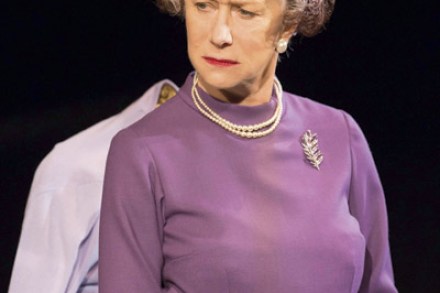
Peter Morgan has extracted more cash from the royal ‘brand’ than the Buckingham Palace giftshop. He’s at it again with The Audience, a fictional dramatisation of the weekly conversations between the Queen and her first ministers. This is a smart idea carried off with intelligence and plenty of style. Morgan dispenses with a linear parade of PMs and leaps to and fro across the decades. A youthful Harold Wilson bustles in full of self-confidence and jokes. The Queen takes to him immediately. Barely ten years later, the Yorkshireman has dwindled into a broken figure and his legendary memory is fading fast. But as he shrinks, the bond of affection between himself and the monarch grows. It’s one of the play’s few attempts at emotional depth.

Aversion therapy

It’s been a while, I have to say, but last week I saw a show that thrilled me to the core. Trelawny of the Wells, the Donmar’s latest offering, is a tribute to the theatre written by actor-turned-writer Arthur Wing Pinero. A simple set-up. Gorgeous young luvvie, Rose Trelawny, has forsaken the greasepaint to marry a greaseball called Arthur Gower. He’s loaded. Rosie’s actor chums treat her to a farewell bash complete with antique gags, tuneless ditties, snatches from half-remembered dramas and long-winded orations consisting entirely of in-jokes. (You’ll have spotted that this is not the show that thrilled me to the core.

Transatlantic traffic

There has been a lot of discussion recently, prompted by the start of President Obama’s second term, about the ‘Special Relationship’ between the United Kingdom and the United States. What seems to have been overlooked in the analysis of politics, economics and diplomatic relations is that the strongest and most culturally important link between the two countries is their shared passion for theatre. For all the razzle-dazzle of Broadway, the London of Elizabeth II remains, as it has since the rule of Elizabeth I, the world capital of the stage. Transferring from London to New York is a huge buzz for British actors, but it is a chance to sample the delights of Manhattan rather than a cultural pilgrimage.

Losing the plot | 28 February 2013

Who got the most out of the credit crunch? Security guards, repossession firms, bailed-out banks and, of course, playwrights. Anders Lustgarten is the latest to cash in on five years of global misery with If You Don’t Let Us Dream, We Won’t Let You Sleep. The play, like the title, is effortful, disjointed and cumbersome. In the first half, a gang of fatcat bankers sets up a new financial instrument, Unity Bonds, which will generate profits from socially useful behaviour. This intriguing idea is sidelined in the second half. The action moves to a squatter camp where the banking system is about to be put on trial. Lustgarten assumes, no doubt correctly, that the audience is more in sympathy with anti-capitalists than with high finance.

Moving heaven and earth

Although I’ve some doubt — and this would be applauded by Galileo — whether in everyday life it matters very much to know whether the sun goes round the earth or vice versa, I don’t for one minute doubt that the great physicist’s conflict with Mother Church mattered profoundly and resonates to this day. To Brecht, writing Das Leben des Galilei in exile in 1938, shortly after the disastrous Chamberlain appeasement, his play asserted unprejudiced scientific inquiry not just against religious dogma but also the controls that fascism and profiteering have ever sought to impose upon it. He gets to this issue way ahead of Michael Frayn’s treatment in Copenhagen of the 1941 debate  between Werner Heisenberg and the Danish physicist Niels Bohr.

Sheer torture

Ever been to a ‘promenade performance’? Barmy, really. The audience is conducted through a makeshift theatre space — often a disused ironworks — where the show is performed in disjointed snatches amid atmospheric clutter. Invariably hopeless as drama, promenade shows can be revealing as social anthropology. They lay bare a secret that lies at the heart of theatrical life: actors loathe play-goers. Without a paying audience, all theatre is simply am-dram. And actors have a morbid fear of slipping into the underclass of voluntary performance. So they covertly resent ticket-buying audiences who alone have the power to convert an unpaid show-off into a self-regarding thesp, with his agent and his Spotlight listing and his drink problem.

Fatal flaw | 14 February 2013

A new play about the banking crisis at the Bush. Writer, Clare Duffy, has spent a year or two badgering financiers and economists with questions about ‘the fundamentals’. ‘What is the value of money?’ she asks. ‘What do we want and need money to be?’ Her play has lots of zing and energy, and opens as a TV game show. The audience is divided into teams and individuals are hauled out of their seats and asked to engage in sporting contests with a big stash of 10,000 pound coins that gleam in coppery piles on the stage. Then the show becomes a drama. We’re in 2007. Two bankers, Queenie and Casino, hatch a scheme to short the American housing market. A tiny investment of £5 million will net billions, should the bubble go pop.

English eccentrics

Quartermaine’s Terms is a period piece within a period piece. It’s set in that part of the early 1960s which was still effectively the 1950s. St John Quartermaine, a shy bumbler, is the oldest and most useless teacher at a Cambridge language school. All his colleagues are lovable freaks. There’s the Jesus-worshipping spinster shackled to her ailing mum. There’s the caravanning dad who takes calamitous holidays in rain-swept Norfolk. There’s the wannabe novelist ditched by his wife while writing a particularly heartfelt chapter about marital bliss. And there’s the boss, a fogeyish queen, who has no idea the school is heading for the buffers.

Women only

A triple thick dose of chicklit at Hampstead. Amelia Bullmore’s good-natured comedy has three girls sharing a student house in 1983. Those were the days. Back then we received ‘grants’ to attend university, i.e., we were paid to look occupied, like job-seekers and politicians. I’m glad to report that Bullmore accurately evokes the culture and language of the time. Just a couple of blunders. We didn’t say ‘PJs’ to mean pyjamas. And ‘what is she like?’, to express affectionate exasperation, didn’t arrive till the 1990s. The girls don’t smoke, nor do they mention Greenham, which is odd, but the play wishes to focus on their emotional and professional development.

Unacceptable faces

A play called Rutherford & Son gripped audiences in London 101 years ago. Set on Tyneside, it was the David Hare-style leftie hit of its season. It depicted the unacceptable face of capitalism, a face that belonged to John Rutherford, who rules the family glassworks by fear, hated by his workers and his children alike. It’s still a fresh, brutal-up-north story of a monstrous control freak devoted to work and money and nothing else. The show has a terrific twist at the end and it was an instant hit in London, went to New York and was widely translated. But it became a big news story when the unknown author, K.G. Sowerby, was revealed to be a woman. Women did not write plays back then.

Seeing the light | 24 January 2013

Meet Fenton. He’s a psycho. A year or so back he was banged up for murdering a preppy teenage girl in one of America’s less-enlightened southern states. Enter a campaigning congressman, John Daniels, who hopes to teach Fenton to read and write and to help him make something of his ruined life. The opening of Richard Vergette’s play is intriguing enough but a savage twist is on its way. Fenton rejects all the congressman’s overtures. Asked to recite the alphabet, he glares and grunts and spits out monosyllabic expletives. The only expressive medium for which he shows any talent is the flinging of furniture at high speed across the interrogation room.

Curiouser and curiouser | 17 January 2013

A tragicomic curiosity at the Finborough written by Hebridean exile Iain Finlay Macleod. The show opens with James, a young Gaelic-speaker, running an internet start-up in London. Business booms. He grows rich and marries his gorgeous university squeeze. The only snag in his life, and it’s quite a serious one, is that he suffers from a constant urge to turn a somersault whenever something remarkable happens. Bust-up with the wife. Somersault! Best mate arrives from college. Somersault! Business goes broke. Somersault! Dad contracts cancer. Somersault! Short of cash and plunged into despair, James is visited by a creepy bailiff who engages him in obliquely amiable conversation while bagging up his collection of LPs.

Decline and fall | 10 January 2013

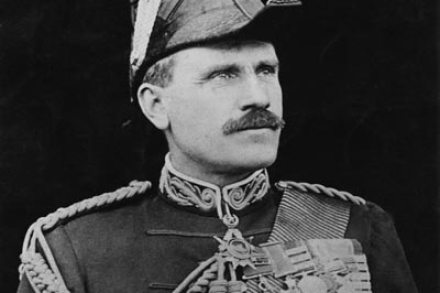
Filmic structures are always tricky on stage. David Mamet, an exception, can get away with writing long chains of scenes that last a couple of minutes each. But the theatre prefers to relax, to snuggle down, to linger slowly over every morsel of a many-layered spread. Encountering a screenplay on stage is like receiving a box of Milk Tray in a restaurant and being told it’s a 32-course meal. David Gooderson’s made-for-TV script concerns an Edwardian sex scandal featuring teenage boys and lauded grandees. Sir Hector MacDonald (aka Fighting Mac) was a crofter’s son who enlisted as an infantryman and reached the rank of major-general during a 20-year career. To rise so high without a private income was pretty rare in Britain’s gentry-loving military.

Wrong, wrong, wrong

I wasn’t the only one desperate that Viva Forever! would be a blast. There were hundreds of us eager to leap to our feet and holler through the Spice Girls’ greatest hits as a band of teenage lookalikes led the tribute on stage. Didn’t happen, I’m afraid. The Spice Girls are not in this show. I’ll say that again. The Spice Girls are not in the Spice Girls musical. Jennifer Saunders has penned an arch and scabrous spoof of TV talent contests like Pop Idol and The X Factor. Wrong, wrong, wrong. Even celebrity culture has its epochs and phases, its stratifications and its correct chronology. The Spice Girls date from 1996. Pop Idol didn’t appear till five years later. In slebs-ville, that’s centuries.

Age limit

Michael Grandage is homeless. After a near-faultless decade in charge of the Donmar Warehouse, he now reinvents himself as a roving thesp, a buskined vagabond, a theatrical mendicant wandering the byways and the turnpike lanes and ushering his troupe of all-stars into any pen that will accommodate them. It’s a medieval conception. The strolling players. His team of celebrity vagrants has taken a 15-month lease on the Noël Coward theatre where its residency kicks off with Privates on Parade, a 1977 play by Peter Nichols, examining life in an army concert party in Malaya in 1948. In shorthand, it’s the BBC sitcom It Ain’t Half Hot Mum  without the spitting bullies and the pouting misfits. Everything is tremendous fun.

Male bonding

Both these plays are about concealed sexuality. Straight, by D.C. Moore, is based on an American indie flick named Humpday. The play has one of the funniest openings you’ll ever see. We’re in a flat occupied by suburban nonentity Lewis and his wife Morgan. Lewis’s old college mucker, Waldorf, has come home after seven years in Mongolia and he cheekily decides to announce his return to western civilisation by inserting his unsheathed tumescence through the letterbox. Lewis doesn’t see it. His wife does and she has to persuade him that she isn’t hallucinating. The gate-crashing phallus symbolises the play’s theme of male eroticism thrusting itself uninvited into soporific domesticity.