Theatre

The National Theatre of Scotland has done more to demean Scotland’s cultural reputation than anything I can think of

West End producers are itching to get their hands on the new show at the Bush. Mama Mia’s director, Phyllida Lloyd, takes charge of a script written by the Torchwood actress Cush Jumbo about the world’s first black female celebrity. Josephine Baker was born to wow the crowds. A child cabaret artiste from St Louis, she performed as a chorus girl in New York and then leapt the Atlantic to become the toast of Paris in the 1920s. Aged 19, she was one of the biggest theatrical stars in Europe. She married an Italian count, adopted 12 children, bought a château, went bankrupt, fought for the Resistance during the war, returned to America in the 1950s and became a heroine of the civil rights movement. Cush Jumbo brings a formidable range of skills to the role.

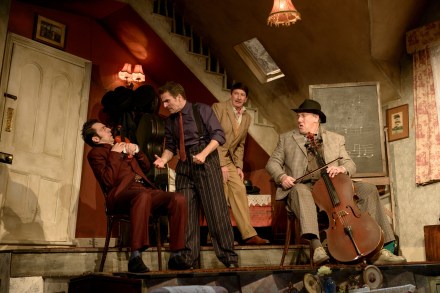
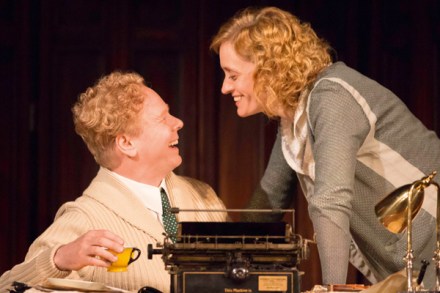
A cast of celebs fails to bring any oomph to The Ladykillers

The Ladykillers is back. Sean Foley’s adaptation of the classic Ealing comedy introduces us to a crew of villains who stage a train heist while lodging in the house of a sweet old lady. She discovers their crime and when they try to bump her off she proves indestructible. The 1955 movie makes a huge effort to manage the plot’s credibility. The audience is never quite sure if this is a criminal gang in a comic predicament or comic gang in a criminal one. Sean Foley abjures such nuances and gives us a bunch of clowns in a two-hour slapstick routine. This approach deprives the tale of all its subtlety and shadowy strangeness. Michael Taylor’s complex, expressionist design adds to the sense of artifice. A cast of celebs compete to get the most laughs.

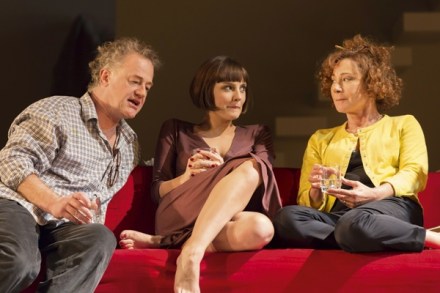
Private Lives at the Gielgud: Spot the sexual tension between Anna Chancellor and Toby Stephens

It’s always a problem with Macbeth: what accents to use? The Globe is applying the traditional remedy. Lord and Lady Macbeth come from Epsom. Everyone else comes from Glasgow. This is a highly entertaining production — one of the best at the Globe in recent years — but it’s not entirely perfect. Joseph Millson has pretty much everything you need to play Macbeth, good looks, physical stature, a soldierly bearing and a dash of melancholy. But he has something you don’t need at all. A gift for laughter. He’s such an instinctive comedian that he sends the audience into fits, without noticing it, by accident almost. And in the oddest places, too. Macduff and Lennox arrive at the castle where Duncan lies murdered.

Theatre: Responsible Other: an assured effort from newcomer Melanie Spencer; The Moment of Truth: Peter Ustinov fails to impress as a playwright

Dominic Cooke did it at the Royal Court. Now Ed Hall is having crack as well. Cooke’s crazy decision to place his theatre at the disposal of young scribblers prompted the emergence of several brilliant new female playwrights, some barely out of their teens. Ed Hall, following suit, has brought a play by newcomer Melanie Spencer into the Hampstead’s studio space downstairs. Responsible Other is a relationship drama set in Northampton. Teenage Daisy has just lost her mum to cancer. And she’s afflicted by a rare condition, lupus, which damages the organs and prevents sufferers from venturing outdoors. Her best mate Alice tries to cheer her up with newsflashes from the classroom and romantic chitchat about fit young shelf-stackers at Sainsbury’s.

A Mad World, My Masters: the funniest play in Stratford in a long while

It’s hard to say anything about this uproarious show without falling into the appalling sexual wordplay which besmirches Sean Foley and Phil Porter’s version of A Mad World, My Masters, Thomas Middleton’s satiric comedy of 1605. Putting in its first ever appearance on a Stratford stage, Middleton’s play, as written, is itself as cornucopian a feast of Jacobean rudery as you could imagine. In updating the play to 1950s Soho - shortly before the Christine Keeler scandal began, Foley and Porter have had no need to modernise the scurrility, merely to trim away obscurities so that it scores as riotously, sometimes groaningly so, as it would have done four centuries ago. Nothing so timeless in language, nothing so inexhaustible, as obscenity.

Theatre review: Wonka will create enough kiddie glee to guarantee its survival. What a pity it isn’t good!; Four farces: two weak; two excellent

Off to Wonka. With no preconceptions either. I’ve never seen this story on stage, page or screen and it strikes me as a dysfunctional hybrid of Oz and Twist. The show kicks off with a cartoon history of chocolate which — whoopsidaisy! — omits to mention sugar as an ingredient. We meet Charlie Bucket, an angelic drudge, who must win a prize in order to rescue his whining, crippled parents from impoverishment. He visits Willy Wonka’s candy emporium along with four surpassingly obnoxious child-rivals. There are two grotesque beauty queens (one is slaughtered early on in an industrial accident). There’s a Bavarian fatso who scoffs garbage non-stop and belches into the microphone.

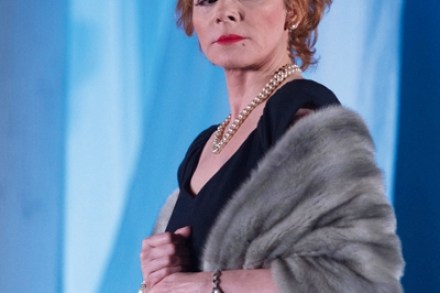
Theatre: James Baldwin’s The Amen Corner is dazzlingly funny. Kim Cattrall is a revelation in a monstrous role

Good and bad at the National. The Amen Corner by James Baldwin is a wryly observed comedy drama written for a studio theatre. It’s an excellent small play. The director Rufus Norris pumps it full of steroids and tries to turn it into a great American epic like Streetcar or The Crucible. His staging suggests the finale of a country-house opera festival. Costly baggage impedes the script’s sprightly flow. On-stage jazzmen snivel through trombones and hack at double basses. Preening choirs warble and sway. Spare actors hang out of windows trying to look cool and indolent. The running time reaches a Napoleonic 155 minutes. Megalomania infects the furniture too. Baldwin asked for two cheap sets, a ramshackle kitchen and a dingy meeting-room.

Theatre review: Despite the wordiness and monstrous plotlines, Strange Interlude is gripping

First the good news. Strange Interlude by Eugene O’Neill has been cut down from five hours to just under three and a half. The action, if you can call it that, begins at 7 p.m. but if you reach the Lyttelton theatre at the more civilised hour of 8 you’ll have missed very little. The first act could be disposed of in six words, ‘my fiancé died in the war’, but O’Neill is such a colossal twaddler that he wastes absolutely ages gabbling on about this and that before plunging into his story. The main character, Nina, is a bourgeois flapper who approaches life in a spirit of cynical pragmatism. In the middle of Act II (at roughly 8.10 p.m., in real time), she marries an impotent jerk whose bloodline turns out to be infested with lunacy.

Theatre review: Below par Mamet is still more fun than a personal-best performance from a second-rater

Mamet is back. His 2009 play Race is an offbeat courtroom drama set entirely in a lawyers’ office before the trial begins. Jack and Henry are two hotshot attorneys, one white, one black, who must decide whether to accept the case of a prosperous banker, Charles, accused of raping a black woman in a hotel. Jack and Henry have a young black trainee, Susan, whose ethnicity and gender may help them sway the jury. The case against Charles turns on sequins. The victim swears that her dress was torn off during the attack but a hotel cleaner found no sequins on the floor. Sequinned attire is naturally deciduous, or, as Jack puts it, ‘a sequined dress, you look at it wrong, they start to fall off’.

Interview: Theatre director Marianne Elliott on really, really good and bad plays

Ah! Here comes the girl from the temping agency. That’s my first reaction when I meet Marianne Elliott, director of the global hit War Horse, and winner of this year’s Olivier for her work on The Curious Incident of the Dog in the Night-time. She’s a trim, attractive fortysomething with a neat blonde bob and she wears a shrill turquoise blouse of the kind favoured by Romford copy typists in the 1980s. Her blue eyes are amazing — huge, screen-goddess orbs, which shine with an exceptional brilliance and clarity. She’s two weeks into the rehearsal period for her next play, Sweet Bird of Youth, at the Old Vic, which stars Kim Cattrall. ‘And how are the actors? Complaining like mad?

Theatre review: Relatively Speaking, Disgraced

Here are your instructions. Relatively Speaking by Alan Ayckbourn is a comedy classic so you’d better enjoy it or else. The play dates from 1967 when Ayckbourn was working as a sketch writer for Ronnie Barker. It was his first hit. Notes in the programme testify to the play’s excellence. A telegram sent to Ayckbourn by Noël Coward is quoted twice.  ‘Congratulations on a beautifully constructed and very, very funny play.’ Take the Master’s kindness with a pinch of salt. The script is ingeniously strung out from a rather threadbare premise. Two couples, both with infidelity problems, meet and talk at cross-purposes for an afternoon.

Are theatre critics on drugs? Fallen in Love and Pastoral reviewed

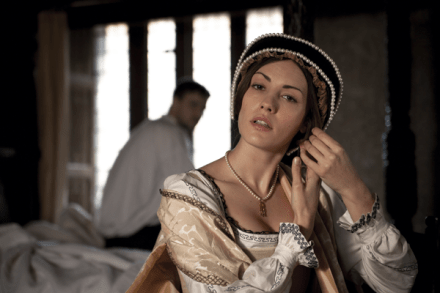
A marvellous novelty at the Tower of London. The Banqueting Suite of the New Armouries has been converted into a pop-up theatre and the Tower authorities have welcomed a new play following the rise and fall (into two pieces) of Anne Boleyn. Joanna Carrick, who directs her own script, has chosen a tricky format. Two characters, Anne and her brother George, tell the story of Anne’s fatal marriage to Henry VIII. Even Aeschylus found this ancient format rather constricting and introduced a third character. Perhaps Carrick knows better. Anne and George are evidently attracted to each other and they romp around a four-poster bed exchanging gossip in fits of giggles. At first the characterisation is a little thin. Then it gets thinner.

Passion Play; The Match Box

How fashions change. Peter Nichols’s adultery drama, Passion Play, will seem tame and rather conventional to modern audiences. It was written in 1981 at a time when the rites and idioms of therapy hadn’t penetrated every level of our culture. Back then the candid scrutiny of one’s emotions, supervised by a ruminating analyst, was a thrilling and sophisticated novelty available only to high-earning fashion junkies. Today’s self-elevators choose different proofs of social altitude. They drink Bhutanese champagne, they purchase dachas in Moldova, or they holiday on the Great Barrier Reef in the family bathyscaphe.

Josie Rourke has a hit at last with The Weir, The Tempest: a karaoke version of all

The Weir is the ultimate hit-from-nowhere. It was written in 1997 by the 26-year-old Conor McPherson. It opened at the Royal Court Upstairs and glided over to Broadway and then toured America. The script defies every rule of theatrical physics. It’s wordy and static, it’s entirely devoid of action or spectacle, and the atmosphere is mired in gloom. Four morose drinkers, stuck in a pub in the west of Ireland, try to impress a pretty incomer from Dublin by telling her ghost stories. Nothing else happens. The faint stirring of a romance between the Dublin girl and the handsome deadbeat behind the bar provides a tiny note of optimism at the end. And yet McPherson is a miracle-worker.

You can’t judge the RSC’s As You Like It with the crude star system

Grumbler: I suppose I have to begin by asking whether, if you’ll forgive the obvious question, you actually did like it? Optimist: Equally obviously, your question is too simple. Remember The Spectator rates its readers’ intelligence, abjuring the crudity of the ‘stars out of five’ system beloved of its competitors. G: You could at least begin by telling me about the starring role, for isn’t the play all about Rosalind? Doesn’t it stand or fall on whether it’s ‘love at first sight’ for the audience as well as for the actors? How can any of today’s actors charm the birds from the trees as the likes of Vanessa Redgrave once did? O: Times change, theatre is ‘written on the wind’.

Adrian Lester is one of the great Othellos; Glory Dazed

Amazing news at the National. Nicholas Hytner has invented a time machine that can bring Shakespeare to bumpkins who’ve never bothered to read him. His up-to-date Othello begins with Venice’s powerful élite dressed in two-piece suits, like Manchester Utd on tour, and striding around a war-room plotting military action against ‘the Turk’. In Act II, Othello and his task force are choppered out to Cyprus where a heavily fortified compound is ready and waiting for them. Crikey. Looks as though they conquered the enemy and built Camp Bastion in 24 hours flat. Fast work, chaps. Othello’s squadron boasts two strange new recruits.

Theatre: Children of the Sun; The Arrest of Ai Wei Wei

They’re back. Howard Davies and his translator Andrew Upton had a well-deserved hit in 2007 with Gorky’s Philistines at the Lyttelton. Children of the Sun, which Gorky wrote in jail in 1905, is a prophetic allegory that foretells the destruction of Russia’s weak, idle and pretentious upper classes. We’re in a country mansion where a mad professor, stuck in his laboratory, conducts daft experiments while rhapsodising about the redeeming power of science. He stands for the tsar, I think. Around him clusters a gang of artists and drifters who settle into a quadrangle of doomed eroticism. This one loves this one but that one loves this one who loves someone else, and so on. Each is too self-involved to respond to a romantic overture.

Upstairs, downstairs

Never a dull moment at the Jermyn Street Theatre. It’s a titchy venue, the size of a gents’ loo, nestling beneath a cavernous flight of stairs in the nameless hinterland between druggy Soho and tarty Mayfair. The current proprietors, aiming for an air of scholastic amateurism, are on the hunt for ‘unknown and forgotten classics’. The theatre boasts a Resident Academic and an eccentric register of patrons including ‘Victoria Biggs, Euan Borland and the Duchess of Cambridge (pub)’. Currently it’s sifting the 1920s for treasure. Others have prospected here before. Ben Travers’s bourgeois farces no longer entertain us because middle-class morality has changed too much in the past 90 years. Frederick Lonsdale may stand a better chance.

Theatre review: The Low Road and Quasimodo

A lap of honour at the Royal Court. Bruce Norris has been one of the big discoveries of artistic director Dominic Cooke, who takes his bow by directing The Low Road. Norris’s greatest hit, Clybourne Park, was a savage and illuminating satire about racism. His next trick is to examine the burning issue of the day, unfettered greed. A great start. But he can’t decide whether he’s for or against the profit motive. And he has no idea where to mount his attack. He time-travels to 18th-century America and imagines an unscrupulous spiv, a bit like Barry Lyndon, who climbs from destitution to wealth and whose life touches American history at various crucial moments.

Jonathan Slinger’s Hamlet

In his ‘Love Song’, T.S. Eliot’s ageing bank-clerk J. Alfred Prufrock protests he isn’t ‘Prince Hamlet, nor was meant to be...’. David Farr’s new production sets out to put this to rights. The result is indeed a very strange affair. It is built around Jonathan Slinger, who last season starred memorably as Prospero in The Tempest and as Lenny in Pinter’s The Homecoming. A little further back he’s been Macbeth in a curiously Popish staging by Michael Boyd and Richards II and III in Boyd’s great Histories sequence. A less Eliotian conceit is the director’s notion that Hamlet is about sword fighting or, in this modern-dress interpretation, specifically fencing.