Music

Let’s hear it for the Girls

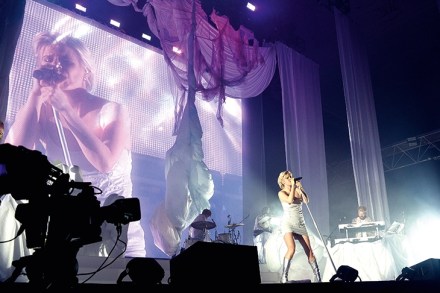
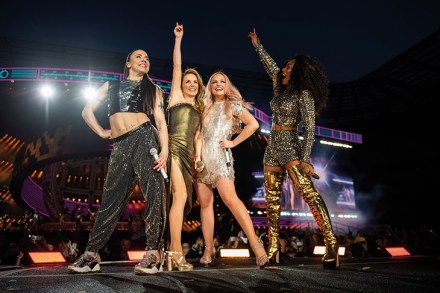
If you’ve paid even passing attention to early reports of the Spice Girls comeback tour, you will be aware of problems with the sound, the car parking, the lax and/or overbearing security checks, the bad weather, bad tempers, bad karma, bad you name it… Some of it may even be true. But having observed the Spice Girls sashay through a maelstrom of fake news since long before the phrase was invented, I was not altogether surprised to discover that the show was far better performed and produced, and certainly a lot more fun, than the media mavens would have us believe. No one would describe the Ricoh Arena in Coventry as a place of visual or acoustic beauty.
Real Housewives of Windsor

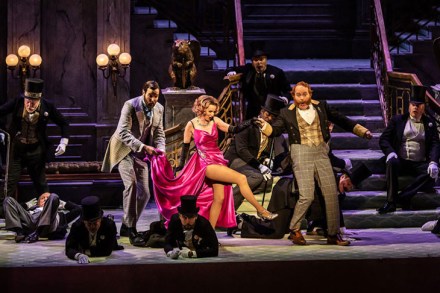
‘Tutto nel mondo e burla’ sings the company at the end of Verdi’s Falstaff — ‘All the world’s a joke’ — and how much you enjoy this opera probably depends upon how far you accept that truth. The 79-year-old Verdi coming out of retirement for one last laugh, finding in Arrigo Boito a librettist who could remake Shakespeare in the sun-kissed Italian of Boccaccio and Petrarch, and then composing a score that saves its deepest compassion for old fools and young lovers, its sweetness (according to Boito) ‘sprinkled across the comedy as one sprinkles sugar on a tart’: seriously, what right-thinking opera-lover, experiencing all of that, wouldn’t want to clink glasses with Sir John Falstaff?

More sex, please

Where was the desire, the frisson, the flicker of attraction? Hell, where was the sex? I ask because a week spent at the seedier end of the romance spectrum has left me feeling profoundly unsatisfied. Two classic femmes fatales — Puccini’s convent-girl manqué Manon Lescaut and Janacek’s dark-eyed gypsy Zefka — had their chance to beguile and blew it. There was disquiet, revulsion, confusion and a certain amount of modish awkwardness, but the itchy urgency of it all was absent — the emotional ignition without which neither Manon Lescaut nor The Diary of One Who Disappeared can find their flame. A chilly night launched Opera Holland Park’s 2019 season, and there wasn’t much more heat coming from the stage.

The weakest link

May was a cruel month for those middle-aged liberals who treasure their old alternative rock heroes. There was Morrissey, appearing on American TV wearing a For Britain badge. There was XTC’s Andy Partridge tweeting that ‘the holocaust is not holy writ, it isn’t a religion, it can be historically revised’. And there was Bobby Gillespie of Primal Scream — the idiot inter pares of rock stars who foment revolution from the gates of their kids’ private school — appearing on Newsnight to say Madonna was ‘a total prostitute’ for performing at the Eurovision Song Contest in Israel (has he said the same to his friend Nick Cave, who has played Israel and called the cultural boycott ‘cowardly and shameful’?).

Shock tactics | 30 May 2019

Igor Levit has rapidly achieved cult status, as he certainly deserves. He has already reached the stage where he can programme enormous and pretty obscure works, such as Ronald Stevenson’s Passacaglia. Clearly, Levit’s taste runs to large-scale works, but his recently released disc, Life, shows his command of shorter pieces too. His first concert in this run of three was Bach’s Goldberg Variations, a performance that commanded an instant hush and was greeted with almost unseemly cheering and stamping from the Wigmore audience. Levit began this masterpiece in a remarkably quiet way, almost casually, but with an amazing singing tone.

Life’s a Beach

At the Wigmore Hall last Friday, the Takacs String Quartet and Garrick Ohlsson played a piano quintet that was once revered as a masterpiece but then fell out of fashion and wasn’t heard for decades. It’s by Amy Beach, a name which always makes me smile because it looks so incongruous underneath her photograph. ‘Amy Beach’ sounds like an old hippie who sells ethnic tapestries and hogs the limelight at her women-only Seattle book club. But the photos show a Bostonian society hostess straight out of Henry James: unsmiling, with eyes peeled for a social climber who picks up the wrong knife at dinner. The 21st-century musical establishment portrays Beach (1867–1944) as a prisoner of social convention.

The odd couple | 23 May 2019

Many is the pop star who has craved gravitas. Only Sting, however, has pursued it by covering John Dowland on an album on which he played the lute. Only Sting has released an album of winter-themed madrigals. Only Sting has written a musical about the closing of the shipyards in Wallsend. He’s the rare pop star who could, should he wish, have a pop at Slavoj Zizek for being just a bit too populist and crowdpleasing. All of which makes his current activities — an album and a tour with Shaggy, the reggae star who’s the reduced-for-quick-sale ready meal of the genre, and a man who is to gravitas as Chris Grayling is to competence — rather astonishing.

Yesterday once more

Being old is big business in live music nowadays, in a way it wasn’t even 25 years ago. When Take That were still a boy band in the early 1990s, as opposed to a man band, the idea that in middle age they would be one of the most successful live groups in Britain would have been laughable. Yet here they are, playing eight nights at the O2 Arena, making it a total of 34 shows they have played there since it opened, more than any other act. Just as fanciful would have been the idea that Pink Floyd’s drummer could put together a group featuring Gary Kemp of Spandau Ballet, and tour the world performing only songs Pink Floyd recorded before 1973’s The Dark Side of the Moon, the ones his former bandmates David Gilmour and Roger Waters don’t play. Yet here they are, too.

All about that bass

Are Beethoven’s 'Diabelli' Variations really ‘the greatest of all piano works’, as Alfred Brendel claims? It’s hardly what you would call received wisdom. Even Stephen Kovacevich, who has given us two visionary recordings of the Diabellis, thinks some of the 33 variations are ‘boring’. I don’t agree, but I can understand why Brendel’s judgment seems odd. When the minor composer-cum-publisher Anton Diabelli sent his jaunty ‘waltz’ — really more of a country dance — to dozens of composers, he was hoping they’d each write one variation.

Vocal heroes | 9 May 2019

We’ve all read the article. It does the rounds with the dispiriting regularity of an unwanted dish on a sushi train. Classical concerts are dying and if they are to survive they need to evolve, to innovate, to banish (variously) seating, silence, dress codes (for musicians), dress codes (for audience), programme notes, formal venues… But among so much institutional hand-wringing and professional self-loathing I’d like to take a moment to celebrate one classical tribe getting innovation exactly right: period music groups.

Reaching the Tippett point

In Oliver Soden’s new biography of Michael Tippett, he describes how Tippett wanted to open his Fourth Symphony with the sound of breathing: ‘as if the orchestra itself had lungs.’ Tippett had no idea how to achieve this effect, and at the première in 1977 they used an orchestral wind machine — a canvas band rubbing against a wooden drum. It proved about as convincing as it sounds, so at later performances a musician exhaled down a microphone. The effect, writes Soden, was reminiscent of an obscene phone call.

All at sea | 2 May 2019

The climactic central scene of Benjamin Britten’s Billy Budd ends unexpectedly. The naval court has reached a verdict of death, and Captain Vere must depart to tell Billy his fate. Voices fall silent, the stage empties, and for two whole minutes the unseen drama is distilled into just 34 chords. And not sprawling elbowfuls of notes either, but plain old triads — the child’s building blocks of harmony. It’s wilfully, maddeningly ambiguous and utterly inspired. It’s also a touchstone for any performance — the moment the opera reveals itself either as a parable, groping gradually but surely towards redemption, or a darker tale of the indiscriminate cruelty of fate.

Prima le parole

‘I consider that music is, by its very nature, essentially powerless to express anything at all,’ wrote Stravinsky in one of his more honest moments, and when it comes to humour the old fox had a point. Strip away words, visuals, parody and extra-musical associations (the flatulent bassoon; the raspberry-blowing trumpet) and Orpheus, unaided, doesn’t have much left in his comic armoury. Two concerts at the Queen Elizabeth Hall could almost have been test cases. Geoffrey Paterson conducted the London Sinfonietta in the UK première of No. 50 (The Garden) by Richard Ayres, a composer whose playful, surreal sensibility cheerfully jettisons any idea of music as an end in itself.

Ecstatic misery

Last autumn, anyone who a) has an interest in pop music, and b) reads the weightier end of the press, would have come to the conclusion that the world was shortly to enter some kind of musical singularity, in which all of civilisation would be transformed by the 39-year-old Swedish pop singer Robyn. ‘After more than a half-decade of psycho-analysis, a relationship meltdown, the death of one of her closest collaborators and four years spent working on her masterpiece… a new Robyn is ready to return,’ a profile in the New York Times solemnly pronounced, ahead of Honey, her first album for eight years. The Guardian devoted 6,000 words — 6,000! — to her ‘seismic cultural impact’.

Sister act | 17 April 2019

Total immersion weekends can prove tricky. The established masters don’t need them, while lesser-known figures often turn out to be relatively obscure for sound reasons. Nonetheless, there are plenty of composers whose works are too rarely performed, not so much through neglect as because of the awkwardness of their demands — huge orchestras and choruses, or unlikely combinations of forces. The Boulangers present in all respects a special case.

Hey Judith

‘When a man takes it upon himself to write an oratorio — perhaps the most gratuitous exploit open to a 19th-century Englishman — he must take the consequences,’ wrote George Bernard Shaw, reviewing Parry’s oratorio Judith in 1888. The consequences for Judith seem to have been unusually drastic. Premiered at the Birmingham Triennial Festival, it was a major success: if not quite on the scale of its obvious model, Mendelssohn’s Elijah, then certainly not far behind it. And then it vanished. The most recent UK performance seems to have been in 1951, and while enterprising record labels have blown the dust off Victoriana ranging from Sullivan’s Kenilworth to Ethel Smyth’s Mass in D, there’s no recording of Judith.

Splitting headache | 4 April 2019

Back when the UK was assumed to be leaving the European Union on 29 March, the Aurora Orchestra was invited to Brussels to participate in Klarafestival: specifically, an evening of words and music ‘celebrating cultural links between Europe and the UK’. And because arts organisations in general (and orchestras in particular) change direction with the agility of a supertanker in pack ice, it went ahead regardless. The cellist Nicolas Altstaedt played John Tavener’s The Protecting Veil with exquisite purity of tone. Ian Bostridge sang Britten’s Les illuminations: brisk, earthy, vividly theatrical. The Aurora Orchestra’s strings, playing standing up, flashed and bristled back at him. Musicians like to talk about the power of their art to unite and heal.

Out of tune with the times

A few years ago, I hooked up with a BBC team in Berlin to record a programme with Daniel Barenboim. We were shown in to his spartan offices at the Staatsoper and, without preliminaries, I conducted an interview with him across a low table for 45 minutes. When our time was up, Barenboim rose and left. I am not even sure if we shook hands. Knowing him from previous encounters, I was not particularly bothered. What did shock me was the sight of my BBC colleagues, their faces white with stress, their limbs rendered catatonic. No one creates tension in a room like Daniel Barenboim. Last month, seven musicians in his Staatsoper orchestra complained of a threatening atmosphere at work and added charges of bullying which, in post-#MeToo times, have to be taken very seriously.

Everything he’s done

On 29 June 1991, a record called ‘(Everything I Do) I Do It For You’ by Bryan Adams entered the UK charts, at No. 8. At that point, I was blissfully in love with my girlfriend, had just got a first at university and had won a scholarship to a postgraduate journalism course. By the time it departed from the charts, on 14 December — after a run that included a still-record 16 weeks at No. 1 — I had been dumped by my girlfriend, had dropped out of the journalism course, and my dad, who had been poorly when the record entered the charts, was a month away from dying. During the course of one single’s chart run, all the certainties in my life had been overturned.

Sinking the unsinkable

Garrick Ohlsson is one of the finest pianists of his generation. Why, then, was the Wigmore Hall not much more than half full for his recital last week? Brahms. Ohlsson is at present touring with four programmes, all Brahms’s solo piano music. He treated us mainly to solid chunks, though he ended with the enchanting and almost light-hearted Paganini Variations, fiendish for Ohlsson but enlivening for us. Actually, he played an encore by Chopin, the solitary Op. 45 Prelude, preceding it with a charming lecturette about how Brahmsian, avant la lettre, Chopin could be. Ohlsson was a student of the great Claudio Arrau, whose attitude to Brahms verged on the frosty.