More from life

Cobb salad: a bright idea for summer suppers

They do salads differently in America. Caesar salad, Waldorf salad, even their egg salads and potato salads: they’re big, they’re gutsy and often they’re the main event, not an afterthought shoved to one side. This is never more true than when it comes to the Cobb salad: a riot of colour and instantly recognisable thanks to its various components being plated in tidy rows. The dish was invented at the Hollywood Brown Derby restaurant, probably in the 1930s, and is named after the owner, Robert Howard Cobb. Stories abound as to who exactly at the restaurant was responsible for the creation: was it Robert Kreis, the executive chef; Paul J. Posti, another chef; or Cobb himself?

Yoghurt pot cake: the perfect sugary blank canvas

I’m pretty easygoing when it comes to most aspects of cooking. I don’t think there’s much to be gained from being dogmatic or dictatorial. It’s just supper, at the end of the day. There are, as they say, many ways to skin a rabbit. And cooking is supposed to be about joy; it’s not an exam. But the exception is measuring ingredients for baking. Oh boy, do I get on my high horse about this. I can be very boring indeed about the need to measure accurately. The American system of cups and tablespoons drives me mad. Cups are inexact and inaccurate, they rely on scooping and sweeping, they don’t account for the varying density of dry ingredients. Scales, I will declaim – with only the slightest impetus – are inexpensive and an essential piece of kitchen equipment.

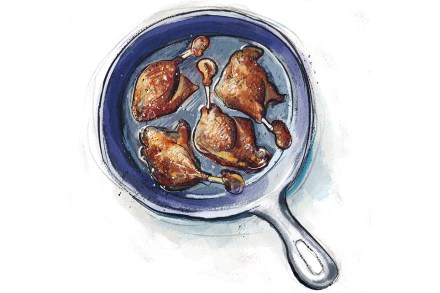
Confit: the best (and most delicious) way of cooking duck

Of all the myriad ways of preserving, confit always strikes me as wonderfully improbable. The ability to preserve meat just through cooking it slowly in its own fat feels particularly wild. And the fact that this simple, unlikely process makes the meat more tender, more flavoursome than any other way of handling it only adds to the magic. Of course, if I pause for a moment and engage my brain, it’s very obvious why it’s such a successful method: most preservation relies on salting to reduce water levels, or excluding oxygen from the preserved food, both of which prevent bacteria from growing. Duck confit takes a belt and braces approach. The duck is salted (and sometimes spiced) for 24 hours – and once cooked, it is entirely submerged in fat, which protects it from air.

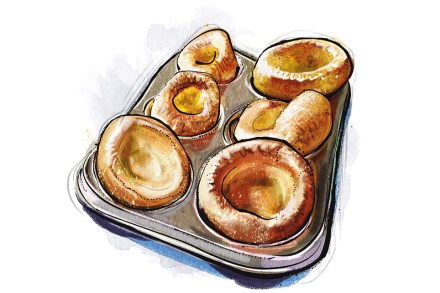
Yorkshire puddings: is there anything as satisfying?

My mother, a Yorkshire woman, would occasionally take shortcuts in the kitchen, but not when it came to a roast, and certainly not when it concerned a Yorkshire pudding. She even owned a specific Tupperware shaker for the job: like a plastic cocktail shaker, in 1970s orange colour, with a propellor insert, and a lidded pouring spout. The batter would be prepared in this shaker and handed to anyone foolish enough to pass through the kitchen, and woe betide anyone who stopped shaking before they were so instructed. There are few things more satisfying than filling a perfect Yorkshire pudding with gravy I didn’t inherit my mother’s Yorkshire pudding shaker, but I make do with a vigorous whisk and then a short rest.

Chess pie: how to make the flakiest pastry

Chess pie was, in one sense, new to me when I started learning about it a few months ago. I’d never heard of this favourite of the American South until I came across it in a pie-centric cookery book. But in another sense, it’s extremely familiar – both to me and to anyone who’s ever eaten a pie or a tart before. Chess pie is a bit like an ur-pie, made with the most simple, most essential of pie ingredients. That’s possibly where its name comes from: the story goes that in the 1800s in Alabama, where nuts and other common pie fillings were expensive, a freed slave made a pie with the most basic of ingredients – eggs, sugar, butter, cream. When asked about it, she replied: ‘Oh it’s jes’ pie.’ And, lo, thanks to a mishearing, chess pie was born.

Bring back the savoury!

For a while now, we’ve been living through a renaissance of classical British cooking: a whole host of restaurants have been embracing the joy of the old school, the pies and puddings, the traditional and the retro. But there’s something missing. Bring back the savoury! An Edwardian favourite, a ‘savoury’ was an extra course that came towards the end of the meal, either just before or after pudding, or as an alternative to it. A savoury should be small – a ‘morsel’ – and strongly flavoured. To this end, the main ingredients are usually cheese, smoked or salted fish, bacon, or spice in the form of devilling. It is often served on toast or with a small pastry croute, and with something creamy as a foil.

Kugelhopf: a reassuring introduction to baking with yeast

Yeast scares even some of the most proficient cooks. I know home cooks and professionals alike, food writers and fanatics, who wouldn’t think twice about deboning a duck or rustling up a feast for 14, who quail the moment they hear the word ‘yeast’. I understand the trepidation: yeast is a living thing and, as such, capricious and unpredictable. Its behaviour is influenced by the season, the warmth, the humidity and how it is handled. Put like that, it sounds quite relatable, doesn’t it? Despite its intimidating reputation, yeast is actually pretty good at showing us what’s going on: it visibly inflates the dough or batter before cooking. And if the mixture hasn’t yet grown, it often just needs more time. This is an exercise in patience and trust.

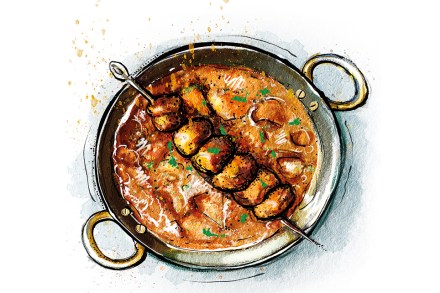
In defence of chicken tikka masala

Chicken tikka masala has become something of a joke. When, in the late 2000s, it was topping lists of the nation’s favourite dishes, its popularity was seen as an indictment of British cuisine: we nick stuff from other cultures, strip out its character and call it our own. This is all deeply unfair: chicken tikka masala is a fantastic, aromatic dish that has earned its place in British culinary history. But there is an element of truth to some of the accusations. Chicken tikka masala is indeed a curry which probably was invented in the UK to appeal to British palates. It is mild and creamy, much more so than most authentically Indian curries.

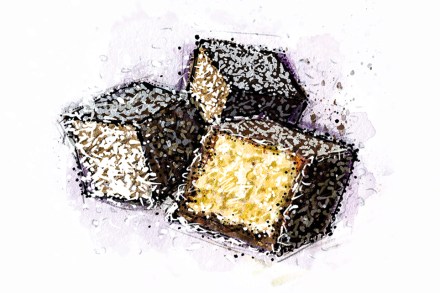
The life lessons of making lamingtons

A confession: I don’t like being messy. I think this is something of a failing in a home baker, but I can’t deny it. I can’t stand dough on my hands. I don’t like getting buttercream on myself when I ice a cake. I love arancini, but my God, the mess! I might as well breadcrumb my own hands. It’s not that I’m a neat freak (I wish), I just don’t like being sticky. So in some ways, lamingtons are my worst nightmare. Because, as I have learned, there is no way of making these cakes without getting a bit messy. Lamingtons, the (unofficial) national cake of Australia, are little cubes of sponge cake coated in a thin chocolate sauce and tossed in desiccated coconut until they look like shag cushions.

A French revelation: how to make Breton galette complête

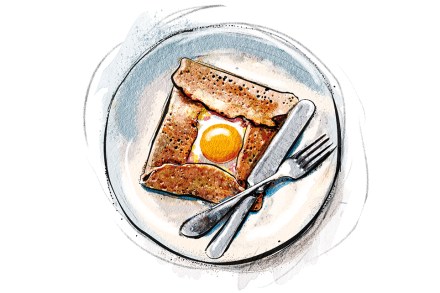
When we were little we used to go on holiday to the same place in Brittany, a picturesque, quiet coastal town. There wasn’t a lot to do there for children, but I always looked forward to the holidays because of the food. It was the first time I was exposed to French food, and it was a revelation. The finished galette, unlike paler, softer crèpes, is dark gold, crisp and lacy I was an adventurous eater, taking after my father. Anything he ordered, I would try. Even as a little girl, I remember a sense of pride in my fearless eating: huge pots of mussels, big shell-on prawns, strong  cheeses – I was game for anything. But there was one exception. Brittany has its own crèpe, the savoury  galette, and I could not get on with it.

Sussex pond pudding: the perfect January pick-me-up

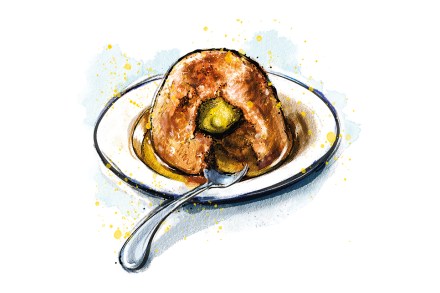
I always feel pulled toward citrus at the start of the year. Initially it was subconscious: I’d just find myself in the kitchen making a lemon drizzle cake. But now I actively plan my citrusy January. As Christmas recedes, I make notes of recipes that I’m craving, and almost all of them call for a whack of lemon or grapefruit or orange. It doesn’t take much analysis, does it? It’s a bit like having a dream about doing an exam unprepared – what could it possibly mean?! The literal brightness of the fruit and the figurative brightness of the flavour – its zinginess – bring you back to life; it is the perfect ingredient for fresh starts, for leaves turned over. This is so much more than a lemony sauced pud.

In defence of duck à l’orange

Duck à l’orange is so deliciously retro, it’s almost a cliché of kitsch. It seems hard to believe that there was a time when it was genuinely regarded as elegant, or subtle-flavoured, let alone exciting; that it wasn’t always a byword for naff. But as its name suggests, duck à l’orange had chic origins. And perhaps (contrary to its name) Italian ones. The French may have made it one of their defining dishes, but it’s often suggested that it may have Italian roots: brought to the French court by Catherine de Medici when she married the Duke of Orléans, the son of the King of France, in 1533.

A last-minute alternative to Christmas cake: boiled fruit cake

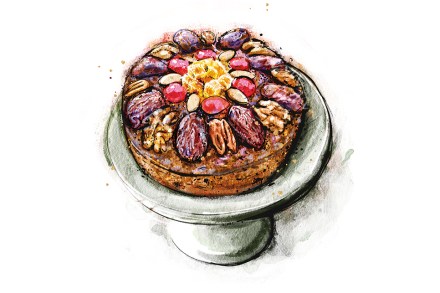
This time last year, I was disgustingly well organised. Awaiting the arrival of my first baby, with a late December due date, I’d ensured everything was squirrelled or squared away. I’d bought all my presents by October, wrapped them by December; I’d made my Christmas cakes and bought my Terry’s Chocolate Orange. For the first time in my life, I sent Christmas cards to everyone in my address book. I’d even made and frozen the gravy weeks in advance. It was my way of nesting – the baby could arrive when it liked. I was prepared. It can feel that every homemade edible component of Christmas demands commitment: puddings, cakes, mincemeat, it should all be made wildly in advance, and given time to mature. Well, that level of forward-planning has gone out of the window.

You don’t need a fondue set to make fondue

‘This dish is very you,’ my husband says, as I serve up 650g of melted, boozy cheese to the two of us for a weekday lunch, alongside a teetering pile of bread cubes. He is, I’m afraid, right: it really is my favourite kind of eating. There’s nothing better than a communal pot in the centre of the table, with everyone leaning over each other. Fondue is fun, as well as being pleasingly old-fashioned, its gooey and silky texture demanding dunking and swooping. And I’d probably treat anyone who didn’t leap at the chance to eat a lot of stringy cheese and bread with mild suspicion. Until now, my life has been mostly fondue-less, thanks to not owning a fondue set. The caquelon, or cauldron, has a low flame underneath it, which keeps the cheese hot while diners eat it.

Bread pudding is the perfect bridge from autumn to winter

I am incapable of throwing anything away in the kitchen. In my fridge, there must be at least half a dozen pots of bits and bobs, dishes of leftovers and scraps. In my freezer, a bag of parmesan rinds has filled slowly, each intended to be chucked into a pot of soup or stew to bring savoury depth, and there’s even an optimistic box of pea pods that I’m convinced I will one day turn into a stock to make an authentic risi e bisi. All await a future transformation, some kitchen wizardry that will rescue something that is a little past its best. Although I confess I sometimes find myself buying a bunch of ingredients just to use up something I’ve squirrelled away, or plain forgotten about and left a touch too long.

The ultimate American comfort food: how to make meatloaf

Meatloaf has some obstacles to overcome: it has an unprepossessing appearance, and an uninspiring, slightly off-putting name, which it shares with the famous singer. And it wasn’t a compliment when it was given to him: the singer’s father took one look at his newborn son and said he looked like ‘nine pounds of ground chuck’, before persuading the hospital staff to put the name ‘Meat’ on his crib (which is real commitment to a joke). I can’t speak for baby Meat Loaf, but when it comes to the dish, the name is at least an extremely accurate description. Meatloaf is made up of ground meat (often beef, sometimes pork, occasionally veal, or a mixture thereof), cut with bread or other carbs, and bound together with egg.

Hot, cold, sweet, salty, boozy, spiced: Bananas Foster has everything

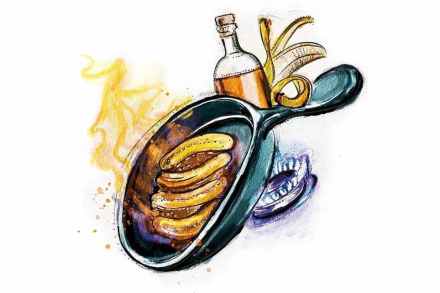
I’m a sucker for a challenge. I absolutely cannot resist a little competition. Throw down a gauntlet, and I am compelled to pick it up. That’s probably one of the reasons that I love bananas Foster so much: it owes its existence to a challenge. In the 1950s, New Orleans was a major port of entry for bananas shipped from Latin America. Owen Brennan, owner of the eponymous French-Creole restaurant Brennan’s, was no fool: his brother Joe’s produce firm, Brennan’s Processed Potato Company, was running a large surplus of bananas and he wanted to make the most of these readily available fruit. He challenged one of his chefs to come up with a banana dish that could be served at his restaurant.

Moules mouclade, as big a hit as Beyoncé

Mussels were probably the first thing I ate as a child that I knew at the time was ‘an acquired taste’. They made me feel impossibly grown up, coming with a brigade of bowls, one for the mussels themselves, one for chips, one for bread, one for empty mussel shells, and a little lemon-scented bowl of water to dip my fingers in. My dinner alone must have taken up half the table. From then on, I ordered mussels every time they were on the menu, knowing they would transform me from a gawky 12-year-old girl wearing cargo pants into a veritable sophisticate. But I never once tried moules mouclade. Like Socrates, Casanova and Beyoncé, mouclade is usually known only by its first name, la mouclade – the ‘moules’ implied by the ‘mouclade’.

The sweet satisfaction of a burnt Cambridge cream

If a rose by any other name would smell as sweet, then a Trinity or Cambridge burnt cream must taste as sweet as its French twin, the crème brûlée. The two cooked custard dishes are essentially identical: an egg yolk-rich baked custard served cold and topped with a layer of hard caramel. Both are similar to the crema Catalana you find throughout Spain (known as ‘crema cremada’ in Catalan cuisine), but Catalana is made with milk rather than cream. It means it is lighter, and tends to have a thinner, paler caramel layer. Lemon or orange zest and a cinnamon stick are often used as flavouring for the Spanish pudding, whereas a burnt cream or crème brûlée is traditionally only flavoured with vanilla.

The ultimate chicken pie recipe

Laurie Colwin wrote: ‘No one who cooks, cooks alone. Even at her most solitary, a cook in the kitchen is surrounded by generations of cooks past, the advice and menus of cooks present, the wisdom of cookbook writers.’ It is one of my favourite quotes about cooking, mainly because it feels true: everything you cook is informed by other dishes, those that you’ve cooked, those that you’ve tasted or read about, the successes and the failures. In quiet moments of kitchen solitude, it is reassuring to know that there is an army of cooks behind me, each offering their experience, their recipes and books, a hand to hold when I feel uncertain. I never feel the truth of Colwin’s words more than when I’m making a chicken pie.