More from Arts

A last dose of vitamin D before the clocks go back: Royal Ballet’s triple bill reviewed

Were those gerberas in Francesca Hayward’s bouquet on opening night? Gentlemen admirers take note: no woman, ballerina or otherwise, has ever welcomed a bunch of gerberas. Hayward deserved better for her adorable Dorabella in Enigma Variations. In white flounces and gathered bloomers she lighted the stage with sprightly sweetness in Frederick Ashton’s one-act ballet set to music by Edward Elgar. The moment: Edwardian. The mood: lamentation in the drawing room. The look: tweed, knickerbockers, pipes, monocles, moustaches held on with glue. Julia Trevelyan Oman’s designs set us at a country-house party — William Morris wallpaper, parlour games, cold tea — in a palette of somnolent drabness.

Why Lucian Freud hated having his picture taken

One of Lucian Freud’s firmly fixed views about himself was ‘I’m not at all introspective’. This was, like many opinions we hold about ourselves, both true and not true. Perhaps it was more that he did not want to look within: his gaze was directed outwards. Lucian had trained himself to see everything — animate and inanimate — without preconceptions (one of his anxieties was that his own feelings would leak into a picture and spoil it). But looking at oneself and at another person are processes that are fundamentally dissimilar, both practically and psychologically. This puts his self-portraits, which are on show in an exhibition at the Royal Academy next week, in a separate category to the rest of his work.

The beauty of Soviet anti-religious propaganda

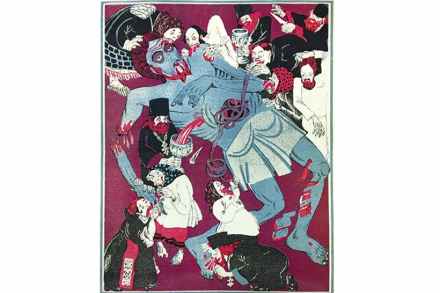
Deep in the guts of Russian library stacks exists what remains — little acknowledged or discussed — of a dead and buried atheist dream. The dream first took shape among Russian radicals of the mid-19th century, to whom the prospect of mass atheism seemed the key to Russia’s salvation. When Lenin seized power in 1917, the Bolsheviks integrated it into their vision of heaven on earth. To the extent that people in the West have heard of this atheist dream, it has come to them mainly through the voices of its enemies. In 1983, Ronald Reagan put Lenin’s rejection of religion at the heart of Soviet unfreedom in his ‘Evil Empire’ speech.

Manon can be magnificent, this one was merely meh

Manon: minx or martyr? There are two ways to play Kenneth MacMillan’s courtesan. Is Manon an ingénue, a guileless country girl, pimped by her own brother and corrupted by Monsieur G.M.? Or is she a pleasure hunter, a man-manipulator, a schemer out for all she can get? In the Royal Ballet’s revival of Kenneth MacMillan’s Manon, Sarah Lamb is somewhere in the unsatisfactory middle. Primrose innocence in the first act, half-hearted harlot in the second, shorn urchin in the third. Ryoichi Hirano, as Manon’s brother Lescaut, knows what he’s about. Hirano has a nice line in matadors and caped scoundrels. Every duplicitous turn, every dismissive flick of the wrist, speaks of mercenary betrayal. His Lescaut is superbly disturbing.

Imagine ZZ Top stuck in a lift with Gary Numan: Sturgill Simpson’s Sound & Fury reviewed

Grade: A– The outlaw country genre has shifted a little over the decades since Waylon and Willie, with each proponent trying to out-badass each other, the guitars getting louder, the lyrics either more obtuse or (in the case of David Allan Coe) more obscene. This takes it all one stage further. I don’t think Sound & Fury would go down too well at the Grand Ole Opry: it is more Seattle than Nashville, 40 minutes of howling rawk guitar, ferocious boogies and cheap synths. It sounds, at times, like ZZ Top stuck in a lift with Gary Numan. Grunge, blues, heavy metal, all rendered darkly as if Mark Lanegan were somewhere in the mix.

Do Jews think differently?

Sixteen years into a stop-go production saga, I got a call from the director of The Song of Names with a suggested script change. What, said François Girard, if one of the two protagonists was perhaps, er, not Jewish? My reply cannot be repeated. I was, for a minute or so, completely speechless. My novel, winner of a 2002 Whitbread Award, is the story of two boys bonding in wartime London. One is a refugee violinist from Poland, the other a middle-class kid of average abilities. ‘I am genius,’ says Dovidl to Martin. ‘You are — a bit everything.’ Beyond bomb sites, their friendship is rooted in a common heritage. The bond is savagely betrayed when Dovidl vanishes. Martin spends the rest of his life obsessively in pursuit.

Proggery beyond parody: Iggy Pop’s Free reviewed

Grade: D+ Pleasant memories — of hearing ‘Raw Power’ for the first time and later the amiably shambolic chug of ‘The Passenger’. And of watching my daughter, aged ten, dragged along to some open-air concert where she danced, an ingenue, to ‘Cock In My Pocket’. At least I hope she was an ingenue. All gone. Iggy has been reconditioned. No longer a mentalist drug fiend from Detroit, which was how we liked him, he is now a godforsaken rock institution for the hip middle-class twats who hated him first time around. James Newell Osterberg Jr is an agreeable interviewee and hosts a decent radio show. But sadly someone has told him he is a sage and a great singer. Both verdicts are miles wide of the mark. So there are TRUMPETS on this album.

In praise of cultural elitism

At present we have a series of ‘culture wars’ over a wide range of issues — race, gender, sexuality, power and privilege. But the one culture war we don’t have any more is over culture. Yes, we fight about the ideological messages of literary texts, but not about matters of personal taste. We scrutinise and interrogate works of art for their latent — or blatant — sexism and racism. Often what matters is what the work in question says about marginalised groups — not what it says about us as cultured individuals. It hasn’t always been so. There was a time when we judged people, labelled them, loved them or hated them because of their taste in literature, art and even pop music.

Nothing sings and shimmies like Alvin Ailey

Hit them with your best shot? Or save the best till last? Almost 30 years after Alvin Ailey’s death in 1989, his dance company still ends every night with Revelations, an autobiography in ballet and gospel music.  First danced in 1960, and presented at Olympic opening ceremonies and presidential inaugurations, Revelations remains an electrifying piece. Ailey’s gift was to borrow elements of African, Asian and Native American dance and set them to a score of traditional spirituals and gospel rock. On the strength of this bill — the second of three programmes the troupe is performing at Sadler’s Wells — his successors have yet to make anything that sings and shimmies with anything like Ailey’s inventive energy. The first three acts are slack.

Why has figurative painting become fashionable again?

The figure is back. Faces stare, bodies sprawl, fingers swipe, mums clutch, hands loll. The Venice Biennale was full of it. After decades of being pushed to the margins, figurative painting is once again dominating the art world. Peter Doig, Alex Katz, Chris Ofili and Jenny Saville head the sales at auction houses, but there is a whole market of up-and-comers snapping at the heels of these established names. How has this happened? Until quite recently, the figure, like melody in music, was associated with the most reactionary elements within art. The body emerged out of the second world war a wreck, blinking amid the glare and slash of abstract expressionism, pop art and conceptualism.

Great title – shame about the songs: Lana Del Rey’s Norman Fucking Rockwell reviewed

Grade: B+ Get the razor blades out, Ms Misery is back. Only the truly affluent can immerse themselves in such morose and earnest introspection. Listen to the music of Africa’s most benighted countries and, on the whole, you will hear very cheerful fellows. Not so with the USA. Lana, a middle-class New Yorker of some talent, doesn’t actually tell you in every song that she’s about to top herself, as does, say, Billie Eilish. But you get the suspicion the thought is always hanging around her pretty head. This is her sixth album and what you get is the usual string- and synth-drenched chamber pop, plangent minor-key piano chords or a tastefully plucked acoustic guitar, agreeable profanities and, occasionally, a tune you might remember for a while.

Needed a shot of Stolichnaya: The Tchaikovsky Project reviewed

Grade: B+ I’m not sure about ‘Projects’. Aren’t those what ageing rockers produce, in a haze of sedatives, when their ego finally outgrows their talent? In classical music, there’s something unseemly about the idea of Maestro X condescending to bestow their attention upon music that is — or should be — bigger than they’ll ever be. Still, the conductor here is the Russian-born Semyon Bychkov, unambiguously one of the good guys, who, after decades spent paying his dues, has recently hit the sweet spot where every note speaks, every gesture ignites, and — crucially — critics actually notice.

Bright, and batty

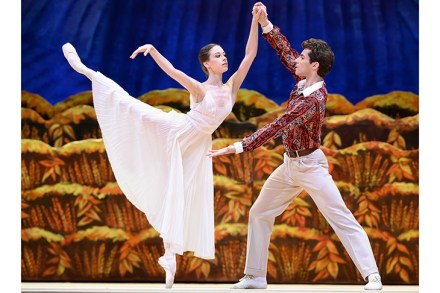
The Bright Stream is a ballet about a collective farm. Forget everything you know about collectivism — the failed harvests, the famines — this is Soviet agriculture without mud or hunger. The Bright Stream, which opened in Leningrad in 1935, was Dmitri Shostakovich’s attempt to write a ‘socialist realist’ ballet. Our heroine is Zina (Daria Khoklova), the Bright Stream Collective’s Morale Officer. The curtain rises on a scene of sunny, saturated bounty: hay stooks, horns of plenty, pumpkins as big as cartwheels. Tractors soar across the backcloth like three flying ducks. This is collectivism in white tights and Liberty print. The plot is batty.

Eye-frazzlers

The old observatory on Edinburgh’s Calton Hill may be the most favourably positioned art venue in the world. Recently resurrected by a group called Collective, the space, with its panoramic views and Enlightenment history, is an ambitious and imaginative addition to Edinburgh’s art scene. In their Hillside gallery there’s a firing-range warning sign on the screen, a few seconds of stillness and silence, then a sudden machine-gun rattle. The sound is revealed to be a stick, dragged by a child along corrugated iron, and the juxtaposition is the strongest moment in Helen McCrorie’s portentously titled video work, ‘If play is neither inside nor outside, where is it?’ (until 6 October).

The Flaming Lips: King’s Mouth

Grade: B- So a queen dies as her giant baby is being born. The baby grows very big indeed and soon everything in the universe is inside his necessarily large head. One day he sacrifices himself to save his subjects from a deluge of snow. The townspeople cut off his head and preserve it in steel so that it will last for ever. Some of them climb inside his mouth to have a look around. They see thunderstorms and stars, apparently. Exactly what you’d expect from another Flaming Lips concept album, I suppose, this time narrated by a bemused Mick Jones of the Clash.

Spartacus in spandex

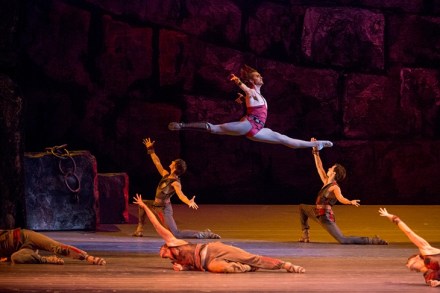
It’s togas-a-go-go as the Bolshoi bring Yuri Grigorovich’s 1956 ballet Spartacus to the Royal Opera House. Oh dear, I did giggle. This is Spartacus in spandex with gladiatorial G-strings and slave girls dressed for Thracian strip shows. On comes Crassus (Artemy Belyakov) in the Roman empire’s tiniest tunic with a legion of soldiers swinging their shields like Gucci manbags. But what dancing: disciplined, muscular, nakedly heroic. Very Soviet. Denis Rodkin is a mighty Spartacus, all vengeful savagery and outraged buttocks. There isn’t a dancer in the Royal Ballet to match his stamina, his power, his splits and leaps, his reckless stretching beyond possible endurance. True, there is more gurning than acting, but naturalism has never been a hallmark of Russian ballet.

Bruce Springsteen: Western Stars

Grade: B– The first Springsteen song I ever heard was ‘Born To Run’, back when I was 14. I clocked the impassioned, overwrought self-mythologising, the grandiosity of the opening riff, the strange lack of a chorus given the promise of the verse. Well, OK, interesting, I reckoned — maybe even good. But great? Never. I shifted my judgment only once over the following 45 years. Born in the USA had the tunes and stories and the sheer heft that for once matched the chutzpah and the looks. The rest has been either just good or, more often than not, quite a bit less than good. I always reckoned that perpetual sideman Nils Lofgren was by far the superior songwriter, but Nils isn’t quite as alpha male as Bruce.

Morrissey: California Son

Grade: B Rock stars who utter something a little gamey, something a tad right-wingish, are usually coerced by the lefties into a cringing apology before you can say a-wop-bop-a-lu-bop. This is not a new thing — it happened to Eric Clapton after his ‘Enoch’s right’ outburst in 1976 (which very quickly spawned the Socialist Workers Party-led Rock Against Racism movement). The message has always been: get with the programme, right-wing scum, or we’ll hate you and your career will be over. Credit, then, to Morrissey for refusing to resile from his belief that England is ceasing to be the England he knew and loved and that there are too many foreigners in the country. I kind of agree with him, up to a point. But the liberal bullies will have their way.

Serial genius

‘It’s no use at all,’ says Posy Simmonds in mock despair, holding up her hands. ‘I can’t tell my left from my right.’ She is ambidextrous. ‘This hand [her right] writes and draws; and this hand [her left] cuts out, sharpens pencils, throws balls, plays tennis… I can’t drive. I’ve never taken a test. I’m always on the wrong side of the road.’ Looking at these wonderful hands, elegant and almost limp, one would never suppose they had created, over the past 50 years, such a large volume of intensely enjoyable and astute drawings.

Poetry in motion | 30 May 2019

T.S. Eliot’s Four Quartets is full of music and movement. The players, such as they are, slip, slide, shake, tumble, wrestle, leap, kick, whirl, fold and kneel. There are lines like stage directions: ‘stillness’, ‘quick now’, ‘the dancers are all gone under the hill’. In her rendering of Four Quartets, the American choreographer Pam Tanowitz has denied reviewers the satisfaction of ‘Eliot in leotards’ jokes. Her dancers wear diaphanous ruched onesies. No Cats spandex here.