More from Arts

Impossible questions

‘I wish I knew,’ said the doctor in a rare moment of candour when asked, ‘What do you do with children who don’t want to take the tablets? ‘I wish I knew,’ said the doctor in a rare moment of candour when asked, ‘What do you do with children who don’t want to take the tablets?’ He was talking about Tanya, an HIV-positive teenager who was refusing to take the life-giving anti-viral drugs he had recommended. She’d been born with HIV, her mother had died of Aids when she was still a baby, and she’d been raised by an aunt in ignorance of why she was always falling ill with chest infections. No one in the family wanted her to know. Can Tanya be treated against her family’s wishes? Should she be told against their wishes?

Summer round-up | 31 July 2010

Cornwall is looking beautiful under summer sun and outdoor pursuits beckon, but St Ives provides the perfect alternative when the beach palls or rain threatens. Besides the Tate, there are a number of commercial galleries, and chief among them is Wills Lane, which offers a stimulating variety of fine and applied art. For the summer period I have selected a Critic’s Choice for the gallery (until 5 September); of 14 artists, some better-known than others: Maggi Hambling, David Inshaw and Colin Self rubbing shoulders with Tyrel Broadbent, Roland Collins and Nigel Ellis. Landscape is one theme, the sea another.

Great expectations

La Traviata Royal Opera House Jette Parker Young Artists Summer Performance Royal Opera House The Royal Opera ended its season with yet another revival of Richard Eyre’s production of La Traviata, and the Jette Parker Young Artists Summer Performance, the latter a most interesting affair, but without much of a critical presence, presumably because it was at 1 p.m. on a Saturday. The distinctive feature of the Traviata revival was that Angela Gheorghiu returned to sing the role of Violetta, in which she had her first great international success, and which she has not sung at Covent Garden since 1996. I attended the third performance (First Capital Connect had thwarted my attempt to go to the first) and was somewhat disappointed. I had very high expectations.

Trail of wounds

Beautiful Kate 15, Key Cities Beautiful Kate is one of those emotional-journey films that begins with a family member returning home after a long, unexplained absence and, whatever else happens, you know they are not all going to settle down to a nice cup of tea and a cheerful catch-up. Instead, old wounds will be reopened, secrets from the past will be reawakened, skeletons will clamour to be released from cupboards and the flashbacks will do what flashbacks do: that is, flash back, rupturing the narrative before bringing it together and creating that satisfying whole. As a cinematic plot, this is as old as the hills, but if you like this sort of thing, and I rather do, then you will like this film. It’s absorbingly intriguing, emotionally involving and it will get under your skin.

Beauty and the beasts

Some 13 years ago, a six-year-old girl called JonBenet Ramsey was murdered in Boulder, Colorado. It was the only murder in the city that year, and a particularly brutal one; she had been dragged from her bed and apparently attacked with an electric cattle prod before being strangled. Which made it all the more astounding that the police quickly came to the conclusion that it was the parents who had killed her. There were, they said, no signs of forced entry to the house, or any indication of how the murderer might have got out. Even more astonishingly, most people in Boulder agreed with the police. The case became famous internationally. The Ramseys fled Boulder, and Peggy, the mother, later died of cancer.

Crackle of the universe

‘Is there anybody there?’ is the question that Anne McElvoy could have asked Diane Abbott in their now-infamous Today programme interview last Wednesday. ‘Is there anybody there?’ is the question that Anne McElvoy could have asked Diane Abbott in their now-infamous Today programme interview last Wednesday. If by chance you missed this classic radio moment, Ms Abbott had just been telling us how she intends (as a candidate for the leadership of the Labour party) to address the issues that ‘ordinary members’ of the party want to talk about — rather than to indulge in the highfalutin conversations of those who walk the corridors of power. With remarkable adroitness, Ms McElvoy then dropped the bombshell question.

Psychological approach

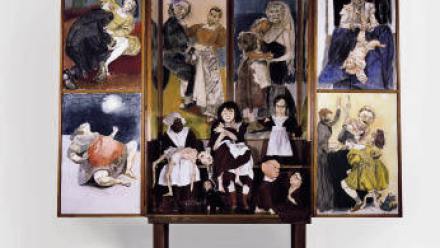
Alice Neel: Painted Truths Whitechapel Gallery, until 17 September Paula Rego: Oratorio Marlborough Fine Art, 6 Albemarle Street, W1, until 20 August The last time I wrote about Alice Neel (1900–84), on the occasion of an exhibition mounted six years ago by the commercial gallery Victoria Miro, a reader wrote in to correct my statement that Neel’s work had not been shown outside her native America. The point I was making was how relatively little known Neel was, particularly in England, though that situation has now changed. At Victoria Miro (until 30 July) a host of international artists pay tribute to Neel’s work, and at the Whitechapel there’s a major survey of her paintings.

Easy listening

The Prisoner of Second Avenue Vaudeville, until 25 September Lingua Franca Finborough, until 7 August Neil Simon has received more nominations from Oscar and Tony than any other dramatist in history, so his comedies ought to be playing constantly in London. But revivals of his plays are rarities. Something of the Simonian essence seems to fall off the plane mid-Atlantic. Perhaps it’s the awareness that we’ve seen his favourite terrain, bourgeois anguish, charted more vividly and tellingly by homegrown talents. Simon’s conception of human character is fundamentally soppy. More trickster than magician, he builds his drama by postulating secure, loving relationships and smothering them in frothy layers of petty bickering.

Cooking up a rom-com

The Rebound 15, Nationwide Here is my recipe for making your very own lame rom-com. It is a good recipe and a sound recipe but you will need to follow it to the letter — for example, never ever add fully rounded, believable characters — should you wish to make a film like The Rebound, as well as so many others. This recipe can serve an entire Odeon at one sitting and, astonishingly and depressingly, will probably even make money at the box office, even though the best accompaniments are boredom and ennui.  Ingredients: A woman; a man; a few secondary characters (don’t worry too much about these.

Life experience

The Proms are back, hoorah, and along with them the nightly treat on Radio 3 of interval talks: those 20-minute sessions of directed chat, either through an interview or often just one person speaking about an idea, a memory, a transformative experience. It’s the perfect radio format: long enough to have some real content but not too long to permit the invasion of those distracting thoughts that swirl around like angry bluebottles, waiting for the right moment to settle and take over your mind. On TV such few precious minutes would be gone in a flish-flash of camera angles and tricksy music; on radio you can be taken right inside a person’s head.

Religious conversion

The other week Simon Hoggart had a go at Rev — the new comedy about an inner city vicar played by Tom Hollander (BBC2, Monday) — and I don’t blame him. The other week Simon Hoggart had a go at Rev — the new comedy about an inner city vicar played by Tom Hollander (BBC2, Monday) — and I don’t blame him. We had a similar reaction in our household when we watched about ten minutes of the first episode before deciding it wasn’t for us and switching off. And now it’s our favourite must-watch comedy of the week. What happened? Did James Woods’s scripts suddenly sharpen up? Did the superb cast raise their acting skills a notch? Of course not. The only thing that had changed was us — i.e., me and the Fawn.

Game for a laugh | 17 July 2010

Rude Britannia: British Comic Art Tate Britain, until 5 September If each age gets the art it deserves, it might also be said that each age gets the exhibitions it deserves. The robust tradition of British Comic Art has never looked so unfunny and anaemic as it does in this current overworked examination at Tate Millbank. My visit coincided with some voluble OAPs up from the country, a know-it-all guide manqué and a couple of solemn Americans who were evidently seeking enlightenment as to the strange habits of this island race. There were sighs aplenty but I’d reached Room 3 before I heard a single laugh, and this response was directed (not surprisingly) at a video screen and headphones replaying old episodes of Spitting Image.

Pick-and-mix fantasy

Welcome to Thebes Olivier, in rep until 18 August La Bête Comedy, booking to 4 September My mind didn’t just boggle. My whole body did. Every sensory organ joined in the process — ears, eyes, nose, teeth, tongue. All boggled. Even my left shoulder started boggling at one point, although this turned out to be the oscillating snuffles of my neighbour as he dozed serenely against my arm. The source of these disturbances was Moira Buffini’s reconfiguration of Sophocles’ Antigone, which is currently chasing its tail around the Olivier. The setting is a hyper-muddle. We’re in Thebes, a failed third-world state, where kids armed with machine guns strut about the place jabbering in the gangsta patois of east London.

Elusive Mozart

Don Giovanni Glyndebourne, until 27 August Rigoletto Welsh National Opera, on tour Glyndebourne’s new production, by Jonathan Kent, of Don Giovanni is a wretched failure, not gross like its last one, in which the characters waded around in shit and Don Giovanni disembowelled a dead horse to eat its innards, but as irrelevant to the essence of what now seems to be Mozart’s most elusive dramatic work. In 15 years of reviewing I haven’t seen a production which was even approximately adequate, presumably because, while Mozart could perform a miraculous balancing act with his central figure, we no longer can. Gerald Finley, the extremely experienced performer of the title role, here makes him a man without qualities.

Labour of love

Toy Story 3 U, Nationwide The third and final film in a franchise isn’t usually up to much, but not so with Toy Story 3. It may even be cinema’s first must-see sequel to a sequel. It is wondrous and a delight and because those deliriously talented people at Pixar obviously love these characters to death, then so too do we. In fact, it’s the only press screening I’ve ever attended where everyone stayed right to the very end of the final credits, presumably because the characters were still chatting away in a frame to the side, and no one wanted to leave them behind; no one wanted to say that final goodbye to Woody or Buzz or Jessie or Slinky Dog or Mrs Potato Head, who, in the five years since the last movie, may have had work done on her nose.

In deep water

What a strange organisation the BBC is! Imagine the meeting at which they discussed the cancellation of Hole in the Wall, the world’s most mindless game show. What a strange organisation the BBC is! Imagine the meeting at which they discussed the cancellation of Hole in the Wall, the world’s most mindless game show. It didn’t have terrible ratings, but was stoned to death by jeering critics and Harry Hill’s mockery. ‘Gentlemen, I am delighted to inform you,’ says HOCMIGS, (head of commissioning, mindless game shows), ‘that we have found a replacement even more mindless, more tooth-furringly, goose-bumpingly dreadful than Hole.’ A rather odd individual at the end of the table squeaks up.

Male fix

The hotly tipped new Men’s Hour programme on Radio 5 Live sounds so 21st century. The hotly tipped new Men’s Hour programme on Radio 5 Live sounds so 21st century. Its presenter Tim Samuels promises a potent mix of emotional candour (inspired by Tony Soprano’s sessions on the couch) combined with, and I quote, ‘the intelligence’ of Woman’s Hour. So are women at long last truly going to be credited with thinking power and talent while male idols such as Jamie Cullum and José Mourinho are to provide merely therapeutic gravitas? I wish.