More from Arts

Bach is made for dancing

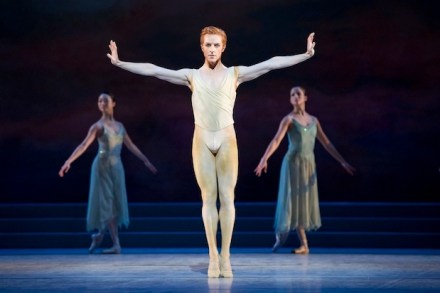
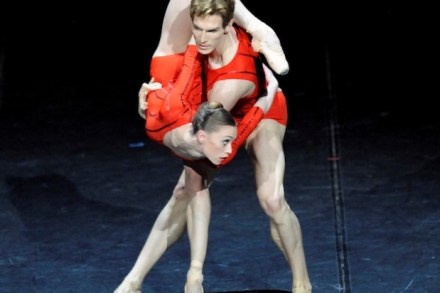
It appears that J.S. Bach’s music is to theatre-dance what whipped cream is to chocolate. Masterworks such as Trisha Brown’s MO, George Balanchine’s Concerto Barocco and a plethora of less-known, though equally acclaimed compositions owe a great deal to the giant of baroque music. Wayne McGregor is the most recent addition to this illustrious roster of successful Bach-inspired dance-makers with Tetractys —The Art of Fugue, which world-premièred last Friday. Set, as the title implies, to Michael Berkeley’s orchestration of The Art of Fugue, played on the piano by Kate Shipway, the new work stands out for the intensity of the dialogue between music and dance.

How to fight back when ‘public art’ is not for the public

In recent years contemporary art and regeneration have gone hand in hand. Works such as Antony Gormley’s ‘Angel of the North’ have been visible and celebrated examples of regeneration. So when, last year, Southwark Council decided to sell Elephant and Castle’s seemingly unloved Heygate Estate (above) to Lend Lease for development into new homes, it seemed inevitable that public art would be utilised. Artangel, the country’s most respected public art commissioning agency, announced plans for a work by the artist Mike Nelson that would take the form of a pyramid made from the estate’s building materials as it was dismantled.

All the fun of the fair | 30 January 2014

The Works on Paper annual fair runs from 6 to 9 February at the Science Museum. Its name is a bit of a giveaway: all art must be on paper. There is a huge range of work on display: early, modern and contemporary watercolours, prints, posters and photographs — from the late-15th century to the present day, with prices ranging from £250 to £75,000. So whether you want to buy a Japanese woodblock print, a series of studies by Edward Burne-Jones or one by Stanley Spencer, a drawing by Picasso, Cézanne or Ben Nicholson, South Kensington is the place to go.

Would you have been let in to an ’80s club? 

People will go to extraordinary lengths to get into a nightclub. Nowadays you must wear something tight, and look slinky. But, as Club to Catwalk: London Fashion in the 1980s at the V&A shows (until 16 February), a handful of Eighties doormen were into something a bit more deviant. The combination of a new London Fashion Week, a vibrant club scene and a coterie of ambitious designers emerging from the London art schools was potent. On Thursdays and Fridays, St Martin’s was deserted. Everybody was at home working on their costumes for the weekend. Over two floors, a mixture of clubbing outfits and catwalk designs are showcased. There is a mirror with the slogan ‘Would you let you in?’ stamped across it.

Why is there no God in the British Library’s latest exhibition?   

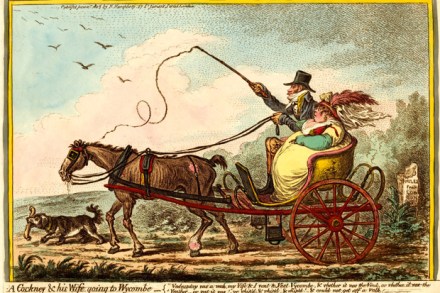
Georgians Revealed: Life, Style and the Making of Modern Britain at the British Library (until 11 March) would have you believe that the religious life was not a feature of Georgian Britain. God is an invisible force in this exhibition and the viewer has to know a fair amount about the period’s history to see Him at work among the exhibits. Josiah Wedgwood’s famous anti-slavery medallion is shown; but there is nothing about the non-conformist religious tradition that inspired him and other abolitionists. The decision to ignore that religious past means that the viewer cannot learn about the century-long tension between the established Church of England and the other protestant churches; the resolution of which helped to form the basis of our tolerant, liberal society.

The man who transformed houses

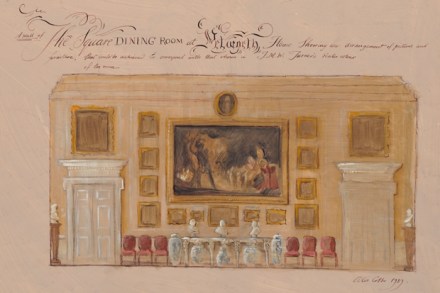
Alec Cobbe is a designer, painter, musician, picture restorer and collector, and has recently donated drawings, photographs and other archives to the V&A, where some of this collection is now on display. Cobbe was born in Dublin and aged four moved to the family house Newbridge, an 18th-century, 50-room country villa designed by James Gibbs, which, he says, was the ‘single greatest influence on my life’. He had an ‘idyllic lamp-lit childhood’ — there was no electricity — where the ‘running water was rainwater, which had to be pumped daily to a tank at the top of the house’.

Walk on the wild side with the Gruffalo

If, like me, you are allergic to pantomime (‘Oh, no you’re not!’; ‘Oh, yes I am!’) then help is at hand: the Gruffalo is in town and strutting his stuff, to the delight of legions of tiny fans, at the Lyric, Shaftesbury Avenue until 12 January. Julia Donaldson and Axel Scheffler’s much-loved verse fable tells of a feisty, wily mouse who goes for a stroll in a ‘deep dark wood’ where he confronts his demons. Having encountered and outsmarted a series of peckish predators by inventing the Gruffalo, a black-tongued, orange-eyed monster, he comes face to face with (and outwits) his own terrifying fantasy creation.

The most inspiring gift for your child this Christmas

One of the big differences between Frank Lloyd Wright and me is that, when he was nine, his mother gave him a set of wooden building bricks. When I was the same age, I wanted Lego for Christmas, but my own mother thought it a mere toy, a puerile gift. So she put away childish things and I was given something more high-minded. Perhaps a boring encyclopaedia or a hated chemistry set, useful only for making obnoxious smells. It was 1876 when Anna Wright presented her boy Frank with Froebelgaben, or ‘Froebel Gifts’, an educational tool devised by ur-pedagogue Friedrich Froebel, who also gifted us the Kindergarten idea: the belief that children’s intellects can be cultivated like flowers.

How I felt when I stepped inside the Hadron Collider

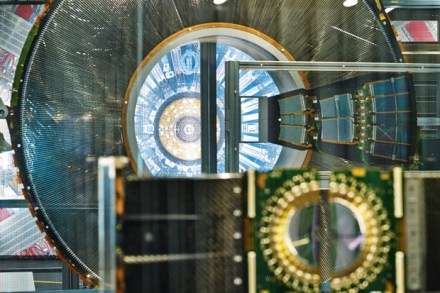
I have a new party piece. I can explain, with a degree of clarity and precision, how the Hadron Collider at Cern works and what it is looking for. I can’t claim credit for this feat of exposition myself; as any science teacher who had the misfortune to encounter me at school would testify. I owe everything to Collider: step inside the world’s greatest experiment, an exhibition at the Science Museum (until 6 May 2014). Collider shows how the contents of a cylinder of hydrogen and 27 kilometres of magnetic subterranean tubes are changing humanity’s understanding of life, the universe and everything. Why is gravity so weak that even you or I can defy its laws with our puny muscles? Are there more than three dimensions?

Blackfish and the scandal of caged killer whales

If you were in a bathtub for 25 years, don’t you think you’d get a little bit psychotic? Well, yes, probably. But this is how captive killer whales live. Tilikum is no different from many of these. A 31-year-old orca who was scooped out of the North Atlantic in 1983, aged two, he has spent the remainder of his life in captivity. Over that time, he has grown to weigh five tons, and has been ‘involved’ in the deaths of three humans. He currently lives at SeaWorld in Orlando, and the documentary Blackfish tells his tale. Much of the video footage in the film speaks for itself; but the interviews that accompany it are equally gripping.

Stuttgart Ballet – still John Cranko’s company

Stuttgart Ballet’s rapid ascent to fame is at the core of one of the most interesting chapters of ballet history. Between 1961 and 1973, the year of his untimely death, the South African Royal Ballet-trained choreographer John Cranko turned what had been a fairly standard ballet ensemble into a unique dance phenomenon. Although Stuttgart is still known as a ‘choreographer’s company’, his legacy was never artistically constraining. His successors took his powerful vision on board and broadened the repertoire in line with it. It was thus a pleasure to see the history of the company celebrated through the composite programme Made in Germany, in which past and present were seamlessly combined.

Mass destruction in an age of mass media

Catalyst: Contemporary Art and War at the Imperial War Museum North (until 23 February) is alone worth a trip to Manchester. The exhibition shows how artists living in the age of mass media have explored conflict in the age of mass destruction. The most successful works are not those that ‘make a statement’ but those which address the viewer, usually by embarrassing their indifference and inspiring empathy. Taysir Batniji’s ‘Gaza Homes’ is a set of mock estate agents’ particulars for bomb-damaged houses. Captions about ‘well appointed’ rooms, ‘airy living space’ and ‘beach access’ are a joke in bad taste.

The Royal Ballet’s triple bill was danced to perfection

There was a time when the term ‘world première’ was not as fashionable as it is these days. Great works simply ‘premièred’, and their artistic status was not diminished by the fact that the opening had not been advertised as a globally significant event. Which is what ‘world première’ implies, even though it is seldom the case. The term has a sensationalistic ring to it, and should therefore be used carefully and sparingly. According to a recent press release, David Dawson’s The Human Seasons is the second of the five ‘world premières’ that the Royal Ballet will perform this season.

The Discerning Eye show is full of great art pieces. I know because I chose them

If you want to buy a picture or a piece of sculpture and have lots of money or not very much, or if you just want to look at more than 450 contemporary works, then the Mall Galleries is the place to go. For some 20 years the Discerning Eye charity has held an annual exhibition of work by invited artists, plus contributions from an open submission, selected by a panel of six — two artists, two collectors and two critics. The charity’s aim is to encourage a wider understanding of the visual arts — an aim that surely no one can disagree with — and the commission it charges on sales helps to fund study bursaries.

Is there or isn’t there a hanged man in ‘Sun’?

Sun is one of those performances that confront reviewers with the eternal dilemma of whether or not it is appropriate to give things away. Yet a reference to what is a powerful coup de théâtre — namely a life-sized hanged hooded man falling from the rigs at the end — has to be made to appreciate what it is all about. The problem is that, according to some reports, that same coup de théâtre disappeared the night after Sun opened, thus turning the dance into something completely different from what had been previously seen. Hofesh Shechter, one of today’s most provocative and innovative dance- and performance-makers, likes to surprise, often in an unsettling way.

How we beat the Boche — at sidecar racing

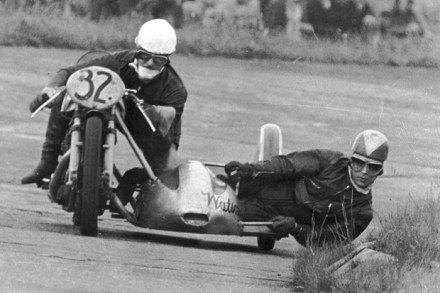
There’s courage, there’s fearlessness, and then there’s the sort of sublime audacity you need to do something like sidecar racing. Stan Dibben, 87, has it in spades. He won the world sidecar championships in 1953, still whizzes around the racetrack today and is the subject of a beautiful short documentary film by Cabell Hopkins, No Ordinary Passenger. Sidecar racing is terrifying to watch. The passenger — the non-driver — has to hurl himself from one side of the three-wheeled bike to the other as it zooms around corners; his head is often inches from the tarmac. Mistakes are disastrous. Stan Dibben got into this crazy sport after the war. ‘I was told to make my mind up,’ he recalls. ‘Did I want to be a wireman or an insulation man?

Nick Cave is still raising hell

As Sunday night’s storm clouds gathered, one of rock’s great polymath-storytellers whipped up a tempest of his own on the stage of the Hammersmith Apollo with the help of his six compadres. Sharp-suited and spivvy, Nick Cave howled and crooned his way through songs of death, sex, savagery and deviancy interspersed with love ballads of exquisite tenderness. Almost as mesmerising as the man in black was Warren Ellis, a Bad Seed of long standing, who thrashed the living daylights out of his violin like a demented Rumpelstiltskin. Periods of finely calibrated restraint were punctuated by spasms of all-hell-breaking-loose. Alone among that generation of rock stars who emerged in the early 1980s, Cave has continued to produce work of sustained variety and brilliance.

A rich, colourful romp

Bold decisions are at the core of great artistic directorship. And Tamara Rojo, the ballet star leading English National Ballet, knows that well. Le Corsaire is not the usual ballet classic one craves to see. Yet it makes a splendid addition to the already vast and multifaceted repertoire of ENB. Created in 1856, this work has stood the test of time. Thanks to endless revivals, it has become one of the most manipulated and interpolated choreographic texts. Its current popularity, however, stems from the now legendary revival that the Kirov ballet presented in the West in 1989. Glitzy and star-studded, that staging paved the way for many others, which led to more interpolations and revisitations, often in the name of the much dreaded choreographic philology.

Dear Simon Jenkins, please stop moaning about developers

When architectural preservationists meet at the tedious conferences and grim councils of despair that feed oxygen to their nihilistic and unventilated ‘heritage’ world-view, the word ‘developer’ is spat out with contempt. It is as though they are speaking of Satan and his diabolical agents, who used to appear in the horror novels of Dennis Wheatley that I so enjoyed in my youth. To hear Simon Jenkins, for example, refer to a ‘developer’ is to appreciate the impressive range over which the human voice can express contempt. To Jenkins, a ‘developer’ is a loathsome thing bent on profaning all that is sacred. ‘Developers’ despoil the countryside and debauch the city.

Jeremy Deller curates a fascinating and funny exhibition in Manchester

All That Is Solid Melts Into Air is an art show largely without art (at Manchester Art Gallery until 19 January 2014, then touring). No matter: Jeremy Deller, the curator, has found some surprising knick-knacks to illustrate how the Industrial Revolution has influenced popular culture. For instance, he plays rediscovered factory songs on a gloriously lurid jukebox. They are similar to Negro spirituals; but, while spirituals inspired R&B, our industrial folk music has descendants in heavy metal and rock. Deller charts this lineage by displaying the family trees of Noddy Holder and Bryan Ferry, reaching back to the 1790s. Continuity through time is Deller’s chief preoccupation.