From the archives

Food on the home front

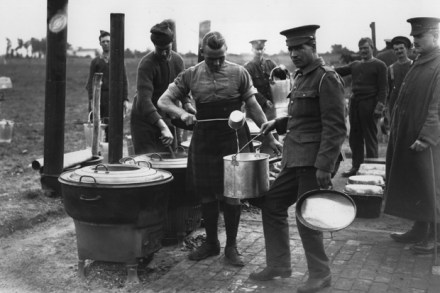
From ‘The food shortage and how to meet it’, The Spectator, 2 December 1916: A rise in prices, if properly understood and properly used, will be our salvation, not our injury. High prices help conservation, and, what is still more important, they help supply… If we artificially cut down prices here, we sterilise instead of stimulating the impulse to feed us from abroad. We are in effect saying to the world: ‘If you are such fools as to send us food, we warn you that you are not going to obtain inflated prices. You will get nothing more here than what we choose to tell you is a fair price. Our people, even if they want to do so, are not going to be allowed to pay you a penny more than we think suitable.
War and votes for women

From ‘News of the Week’, The Spectator, 25 November 1916: We admit that before the war we should have placed, and indeed did place, Female Suffrage in the catalogue of ‘no compromise’ subjects. The war, however, has modified our view by altering our belief that some fundamental difference of opinion might arise between the sexes upon an issue where action must be confined to the male — i.e., military action. Our acknowledgment of mistake here does not of course exhaust our objections to Votes for Women, but, rightly or wrongly, it does in our opinion render them non-fundamental.

Germany and the City

From ‘English versus German banking’, The Spectator, 18 November 1916: At the present moment a good many of us are in the mood to feel that we never wish to see any kind of German within our country again; but it is quite certain that this attitude of mind will not endure for ever, and it is equally certain that if we prevent German bankers from establishing themselves in London after the war they will take their business elsewhere, and to that extent London will lose its character as an international banking centre. Mr Pownall well expresses the main proposition: ‘It is the universality of London, its cosmopolitan composition, that creates its character. Deprive it of that character and its pre-eminence dies.

Conditions for surrender

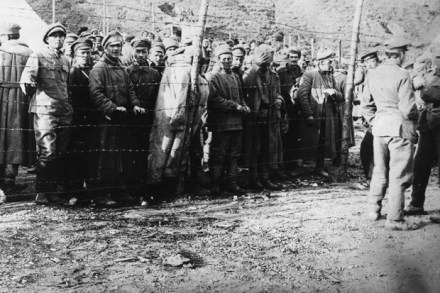
From ‘How to Shorten the War. I. Prisoners’, The Spectator, 11 November 1916: Unless we altogether mistake the mental character of the German military authorities, they will hold that there is only one effective way of dealing with our invitation to a British fireside in a prison camp, and that is by stamping with the utmost ferocity upon any symptom of readiness to surrender… If once we can set one or two plain questions rolling in the German lines, we shall have done what we want to do. ‘Is it worth while to bear this? Are we doing any good by bearing it? Does not the way we are treated give us a right not to bear it?

Love and death

From ‘Romance’, The Spectator, 4 November 1916: There is indeed a glamour and a pathos about the private soldier, especially when, as so often happens, he is really only a boy… You can’t help loving him. Most of all, when he lies still and white with a red stream trickling from where the sniper’s bullet has made a hole through his head, there comes a lump in your throat that you can’t swallow, and you turn away so that you shan’t have to wipe the tears from your eyes.

A deadly silence | 27 October 2016

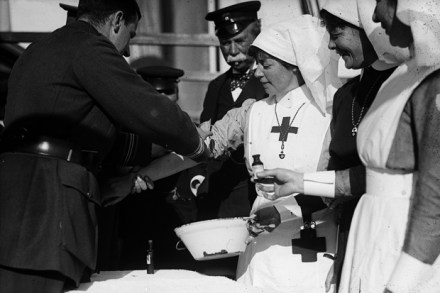
From ‘Secrecy and disease’, The Spectator, 28 October 1916: The war might have damned us, as Germany planned, but it will end in saving us. Afterwards we shall be a more highly organised nation than we once thought necessary or desirable, and we shall see all things rather differently, but we shall be much stronger. A very noticeable example of the change of heart and outlook is the attitude of people towards this question of venereal diseases. The war has brought us much too closely into contact with real and hard things for us to shrink blushing, as people too often used to do, from a question which concerns the health and safety of the whole nation. The matter, of course, was always too important for the kind of silence that mistook itself for modesty or decency.

The King’s contribution

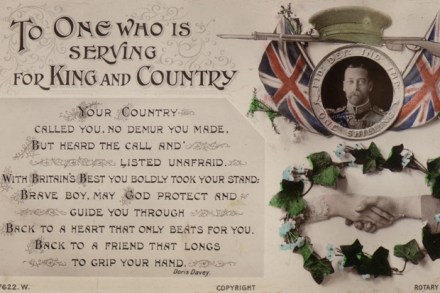
From ‘A Royal contribution’, The Spectator, 7 October 1916: His Majesty has passed through troublous times, in the constitutional controversy, in the Irish imbroglio, and in the war, when passion rose to its highest point. The temptation to go behind his Ministers, and to snatch popular favour at their expense, must have been tremendous sometimes. ‘Remember, I am not responsible for this!’ represents the attitude of many sovereigns who have called themselves constitutional. The King never by a hint, a suggestion, a word, or a gesture has taken the stage against his advisers.

Sea strategy

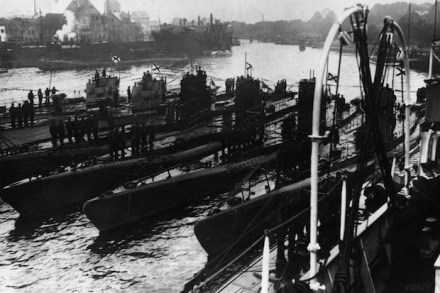
From ‘Decisive victory at sea’, The Spectator, 7 October 1916: The only excuse for changing our views of the magnificent rightness of the strategy of continually searching out the enemy, forcing him to action, and destroying him — the strategy on which Britain has been built up — would be that submarines and mines have so changed the conditions that we have to begin to write the rules of our strategy on a fresh page. No sane man, however, is either unaware of the different conditions introduced by submarines and mines or unwilling to make reasonable allowance for them. The question is not whether the method of the British Navy is to change, but whether its spirit is to change.

Conscription in Ireland

From ‘More men’, The Spectator, 7 October 1916: Are we or are we not to apply compulsory service to Ireland? The difficulties, we admit, are very great. Personally, we dislike the idea of seeing the privilege — for such it is — of defending the Empire accorded to men who have disgraced themselves as did the Sinn Feiners and the disloyal population of Ireland in the recent revolt. At the same time, it does seem a gross injustice that the Irish people should not bear their share of the common burden.

Serpent of mud

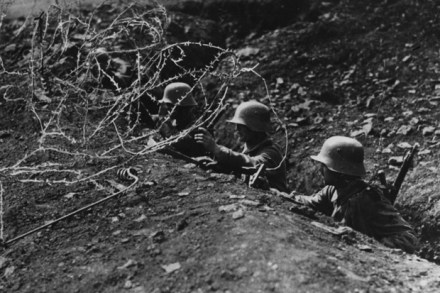
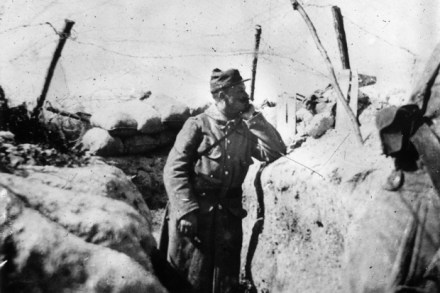
From ‘The fall of Combles and Thiepval’, The Spectator, 30 September 1916: The trench — ugly, dirty, dull, untidy serpent of mud and sandbags — will always have the advantage of the most artful fortress. In the last resort, the reason for this seeming miracle is the fact that the trench has something of mobility in it, and mobility is the vital essence of war. You can prolong a trench line to infinity, or to the sea or a neutral frontier, which is even better than infinity. A fortress has a finality about it which is fatal. The moment mobility is abandoned, as in an invested fortress, putrefaction, physical and spiritual, seems to set in.

Turning the tide

From ‘The Battle of the Somme’, The Spectator, 23 September 1916: It may prove to be the fact that the battle of last week was, indeed, the most important fought by British troops in the whole war. For it is possible that just as our men advanced on to the forward slope of the ridge the German moral slipped backwards down the slope, there and then, with the final, if secret, conviction that it could never recover itself… Our losses, of course, have been heavy, but there is not a shadow of evidence that they have been disproportionate to the ends accomplished.

In defence of Asquith

From ‘Mr. Asquith’, The Spectator, 16 September, 1916: King George has no other subject who is trusted so widely by his countrymen and who is respected so heartily by our Allies as the Prime Minister. Under his guidance we are now, after two strenuous years of war, an even more thoroughly united nation than we were at first, although we have parted one by one with what we regarded as our traditional and indispensable privileges and liberties.

Fire in the sky

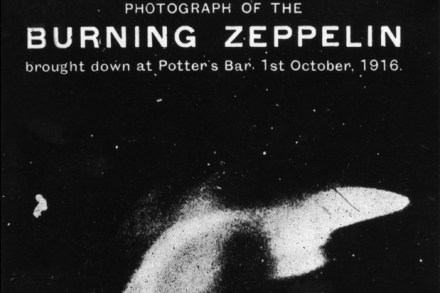
From ‘The burning of the Zeppelin’, The Spectator, 9 September 1916: Half London formed the vast proscenium for this tragedy of the air, and saw on the aerial stage the triumph of right over might — saw with their natural eyes David smite Goliath and hurl him in flaming ruin to the ground. Never before in human history had men sat in such a theatre and seen such a curtain rung down from the starry heights above them. But what made this drama of the open Heaven memorable above all record was the cheer that greeted its close. Those who had the inexpressible good fortune to hear that soul-shaking sound heard something which for its quality and its volume no ear had ever heard before, and, it may be, will never hear again.

Churchill’s privilege

From ‘Mr Churchill’s misfire’, The Spectator, 2 September 1916: There is nothing that democracy so much hates as unfair privilege, and Mr Churchill has enjoyed and has utilised an unfair privilege in getting himself in and out of the Army at his arbitrary will… The public now fully understands that his influence on our political life is almost wholly bad because it is wholly dissociated from any motive except that of personal advancement. He would, indeed, now be powerless either for good or for evil, were it not for the fact — or what appears to be the fact — that he still retains useful friends within the Cabinet who afford to him privileges which are denied to the ordinary man.

Just not cricket | 25 August 2016

From ‘The bed-rock of war’, The Spectator, 26 August 1916: As a rule in war the bowling has a great advantage over the batting, but it happens that the newest fashion in combat has given a great temporary advantage to the defence. To break a trench line which rests like that of the Germans on the sea and on a neutral country is a task demanding almost superhuman efforts, and yet it must be attempted and accomplished unless we wish the war to drag on for another three years, drag on until attrition has done its dire work, and done it, alas, on us and our allies almost as much as on our enemies.

Iron birds

From ‘News of the Week’, The Spectator, 19 August 1916: The Parliamentary Air Committee having recently inhaled much ozone at giddy heights, during their visits to a R.F.C. park, have breathed some of it forth in a brilliant idea. They propose that the present clumsy and ugly system of designating aircraft by numbers and letters should be replaced by the names of birds. The machines would be grouped in classes, and each class would have a distinctive name. The names of seabirds would be given to seaplanes and the names of land birds to Army aeroplanes.

Holding on

From ‘Restless politicians’, The Spectator, 12 August 1916: Even those journals which a few months ago were most zealous for a general election without delay now admit that there is no issue which could be presented to the country on which to take a vote… We have got to accept the continuance of the present government, with some slight modifications from time to time, because we have no means of getting a better. People who are disgusted at this admission may be again reminded that a great war is in progress, and that this fact overrides all ordinary constitutional considerations.

Entrenched wisdom

From ‘Armour of offence’, The Spectator, 5 August 1916: The soldier must never forget that it is his business to stand upon the offensive, not upon the defensive, and that for the offensive the power of rapid movement is essential. That is why, as the Germans are finding, and as the Austrians certainly found in Poland, you may make your trenches too defensible, too deep, too narrow, and generally too good. Deeply dug and laboriously protected trenches are splendid if judged only by their power to save people’s lives, so long as there is no in-fighting, but they may become veritable death-traps. In order to drive your enemy back you have got to get out of your trenches very quickly and counter-attack him, or, if need be, fall back a little for that purpose.

The new Secretary for War

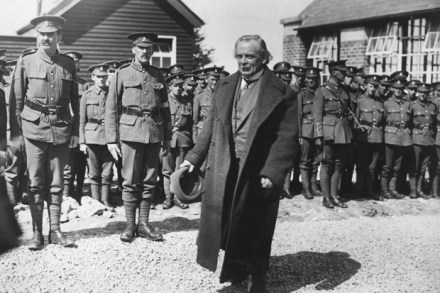
From ‘The military situation’, The Spectator, 29 July 1916: We have a new Secretary for War. Mr Lloyd George, as we all know, is a man of great personal power, with the faculty of stimulating and inspiring, and securing that what he desires shall be accomplished. With him good is not enough. He knows that more and better things can always be done, and he has a voice and a will to compel others to share his opinions. His mind is receptive to new ideas. He never stands still.

Over the top | 21 July 2016

From ‘The Battle of the Somme’, The Spectator, 22 July 1916: What we seldom hear about is what Milton called the ‘raw edge of war’, of the 10 or 15 per cent or more of stragglers who fail to go on — men who do not show anything which can be reasonably called cowardice in face of the enemy, but who seize with great alacrity various forms of excuse, legitimate or semi-legitimate, for not advancing… Now the amazing, the absolutely unique thing about the battle of the Somme is that there has been literally no ‘raw edge’ to these assaults on fortified positions. The testimony of the correspondents, of the officers, and of the men on this point is in agreement.