Features

Why are our prisons still in lockdown?

When the Covid pandemic began, one fear was that the virus would tear through prisons and cause up to 5,000 deaths. The prison service, at its best in a crisis, introduced lockdowns and control measures. These were effective and, from March 2020 to September last year, only 207 prisoners died having tested positive for Covid-19 within the previous 60 days or with the virus confirmed as a contributory factor post-mortem. Locking down was always going to be the easy bit – there is an old prison-officer saying that ‘happiness is door-shaped’ (meaning that prisoners who are locked up can’t do any harm). The hard bit is getting prisoners back into work, education or training. And the lingering effect of lockdown policies still makes it hard today.

The art of darts

I don’t watch television, which – given I’m a TV producer – is a little unusual. I suppose, just as professional chefs so often confess to living off cheese toasties, there is little joy to be had in bringing the office home. I make only one exception: the darts, which I am confident in saying is television in its purest and highest form. What makes it so compelling is that it is, fundamentally, a character-driven sport. The players choose their own walk-on songs, outfits and nicknames. And while not every player will go the full Peter ‘Snakebite’ Wright (who coordinates wacky outfits with his multi-coloured mohawk for every game), many create larger-than-life personas.

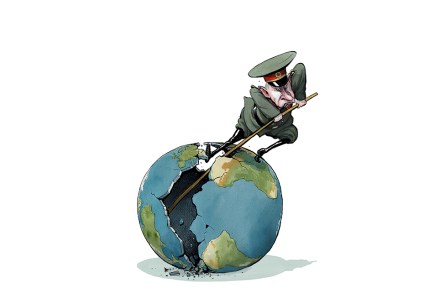
Boris Bondarev: Why more Russians aren’t defecting

Boris Bondarev’s Twitter profile sums up his past, present and future in three short phrases: ‘Russian diplomat in exile. Stop the war. The old lie: Dulce et decorum est pro patria mori’ – a quote from Wilfred Owen’s 1918 denunciation of patriotic hypocrisy. Shortly after Russia’s invasion of Ukraine, 42-year-old Bondarev quit his job as an arms control expert at Russia’s diplomatic mission to Geneva in protest. None of his colleagues in Geneva, or anywhere else, followed suit (at least not publicly). Does that make Bondarev the only Russian diplomat with a conscience? ‘It’s not about conscience,’ Bondarev tells me by Zoom from an undisclosed Swiss location where he now lives with his wife and cat. ‘It’s about courage.

The strikes have lost their power

The dead went unburied and the rubbish piled high in Leicester Square. Then a suntanned Jim Callaghan arrived back at Heathrow from a summit in Guadeloupe to tell reporters, in words fairly paraphrased in the Sun headline: ‘Crisis. What crisis?’ The Prime Minister said that he didn’t think the rest of the world, looking at Britain, would see a country going down the tube. The folklore of the Winter of Discontent in 1978-79 is ingrained in the nation’s collective memory. It was the final act of a miserable decade of three-day working weeks and power cuts. Some are suggesting that we are facing a second Winter of Discontent. Certainly, look at the strike calendar for January and there is something going on – or not going on – every day.

The faith and the fury: my father Paul Johnson

Paul Johnson – who was a columnist for The Spectator from 1981 to 2009, and who died last week – did not merely write history: he helped to make it. His first book, The Suez War, published in 1957 with an introduction by Nye Bevan, documented the evidence that eventually led to the resignation of the Prime Minister, Sir Anthony Eden. In Buckingham Palace six decades later, Prince William startled him by asking about Suez. Afterwards my father asked: ‘Who was that well-informed young man?’ A demonstration against the government over Suez was also the occasion for him to get back together with the brilliant and beautiful Marigold Hunt, whom he had once invited to the Ritz but stood up.

The joy of a modern house

We have been in our new home for four months and although getting here was hell, the living is almost heaven. I am rather surprised to be in a modern house after 40 years of living in ones built centuries ago. How would I feel without any nooks and crannies, twisting staircases, elm floors and beams, not to mention the Aga? Well, how do I now feel without the draughts, rattling windows, uneven floorboards and energy bills the size of the national debt that come with every old house, plus the responsibility of too much land? We have only moved five north Norfolk miles but into another world, nearer the marshes, sea and seals, under vast skies in a light-filled house. We left a river valley for 500ft above sea level where it is several degrees colder with noticeably clearer, saltier air.

Why is social media pushing young women to donate our eggs?

As a millennial who spends a lot of time on social media, I assumed I was desensitised to adverts. I thought I was ad-blind, until I started being bombarded with posts asking me to donate my eggs. It was a post from the London Egg Bank which first caught my eye, offering a ‘freeze and share’ scheme. In this country egg donors are only allowed to be paid £750 in compensation, but there’s nothing to stop them being given treatments in lieu of cash – and egg freezing is expensive. The average cost to collect, then freeze a woman’s eggs is around £3,350. Medication and yearly storage add at least another several hundred pounds. To have the eggs thawed and implanted into the womb costs another £2,500 on average.

Harry isn’t the first rebellious ‘spare’

A historian should feel a strong sense of déjà vu on reading about Prince Harry’s rebellion against his family. Rebellious ‘spares’ are a constant feature of English history since at least 1066. Simon Sebag Montefiore’s characteristically vivid new book The World: A Family History offers plenty of gory examples from ancient Egypt, medieval China and even, when we move away from royalty, within dynasties such as the Kennedys. While the Byzantine emperors preferred to poke out the eyes of family members who competed for power, the Ottoman sultans regularly had their brothers strangled within hours of acceding to the throne.

Trigger warning: how it feels to get shot

I got shot in the leg last week. I live in Chicago, in the Hyde Park neighbourhood, which traditionally doesn’t see a lot of shootings. Hyde Park surrounds the University of Chicago and the University Police Department is the third-largest armed force in Illinois. Hyde Park is where Barack Obama lived (about six blocks from me) before he had to take a job out of town. Cook County board president Toni Preckwinkle lives on my street. She controls about half of the patronage for the Chicago political machine, including jobs with the sheriff’s department. I’ve walked all over Hyde Park at all hours for 30 years, un-shot the entire time. But at 3.10 a.m. on Friday, I was walking home from a late-night writing session at a colleague’s apartment a block from my house.

In defence of Camilla

This week, the Duke of Sussex, self-proclaimed feminist and Lochinvar of Montecito, launched an unprovoked attack on a 75-year-old woman. In an irony that will no doubt escape him, Harry accused his stepmother, Camilla of being ‘dangerous’ and a ‘villain’. The Queen Consort, he said, in a series of television interviews, began a ‘campaign aimed at marriage and eventually the crown’, and briefed journalist friends in an attempt to ‘rehabilitate her image’. Harry has proved he does not possess a laser-like intelligence but even he might have thought twice before attacking a divorced woman for trying to marry a prince. Consider the howls if anyone accused Meghan of ‘campaigning’ to marry into the royal family.

Wasted energy: Putin’s plan to freeze Europe has failed

The Kremlin propaganda channel RT recently produced a festive video message for its overseas audiences. Somewhere in ‘Europe, Christmas 2021’ a happy family gathers in a cosy, Ikea-furnished house. A young girl cradles her present: an adorable hamster. Fast forward to Christmas 2022: the family huddles, freezing, under a blanket in a room illuminated only by the feeble glow of fairy lights powered by a tiny generator hooked up to the hamster’s exercise wheel. By Christmas 2023 the luckless Europeans, starving and shivering, celebrate with a thin soup made of… you got it. ‘Merry anti-Russian Christmas!’ trolls the final caption. ‘If your media doesn’t tell you where this is all going, RT is available via VPN.’ https://www.youtube.com/watch?

The truth about Martin Luther King

Why does the United States seem to be falling apart? The ideal that used to bring Americans together seems to have failed in some way. ‘Liberty and justice for all’ is the best summary. Sure, it was always a frail creed, and interpretations of it differed, but still. It semi-worked. The creed failed in a very paradoxical way. It was voiced too well, too purely. Its greatest articulator was Dr Martin Luther King, who is commemorated with a US national holiday celebrated on Monday. (Ronald Reagan signed Martin Luther King Day into law in 1983, in less sectarian times.) The problem, of course, was that Dr King was black. Half of white America found this hard to take: that the incarnation of the national ideal did not look like them.

The rise and fall of agony aunts

What better barometer of the nation’s psyche could there be than the questions in an agony aunt’s postbag – and the answers they receive? ‘My transgender brother is furious over my choice of baby name’, ‘My Remainer husband is refusing to get a new passport’ and ‘My leftie wife is condescending and annoying’ are just a few of the timely examples from one recent broadsheet column. These days, many responses to such dilemmas are variations on ‘Live your truth’ (in other words, do and say whatever makes you happy) – which may go some way towards explaining why agony aunts are no longer the essential reading they once were.

Six more years: how long can Biden go on?

The presidency of the United States is hard work, everybody knows that. It’s also a pretty sweet gig for should-be retirees. The 80-year-old Joe Biden and First Lady Jill just spent six days holidaying on St Croix in the Caribbean. Biden’s critics have been quick to point out that he has so far spent some 260 of his 715 days in office on vacation. That’s more than even the famously self-indulgent septuagenarian Donald Trump spent chillaxing at his estate in Florida. Who knew that leading the free world could be a part-time job? And with so much downtime, plus such power and perks, why would any proud gerontocrat quit? Bidenologists all make the same point: he spent five decades trying to be president, so why stop now?

The intellectual legacy of Pope Benedict XVI

For reasons too complex to go into, while completing a doctorate in the German College in Rome in the 1990s, I shared breakfast with the then Cardinal Ratzinger every Thursday morning for nearly three years. Those breakfasts were often initially awkward because, although the Cardinal was always gracious, he had no ‘small chat’ at all and was fairly hopeless at making casual conversation. Ratzinger was a painfully shy man who did not find socialising easy. At those breakfasts, therefore, I would engage him in theology – at which point he would come alive. I was writing a thesis on the great German theologian Karl Rahner, with whom Ratzinger had taught, and so it was easy to draw him into theological conversation about Rahnerian themes.

How worried should we be about falling sperm counts?

Here’s a jolly thought to start the year: humanity is on its way to extinction due to a drastic decline in sperm counts. Men’s reproductive health is in such a parlous state that it won’t be long until nobody can conceive a child unassisted. That, anyway, is the argument that’s become a perennial: every year or so – most recently just at the end of 2022 – a new sperm-counting study emerges and reignites the fears that we’re biologically condemned to extinction. How anxious should we be? Here’s the story so far. In 1992, a seminal study was published in the British Medical Journal that claimed to show ‘evidence for decreasing quality of semen during [the] past 50 years’.

Simon Clarke: What the PM can learn from Liz Truss

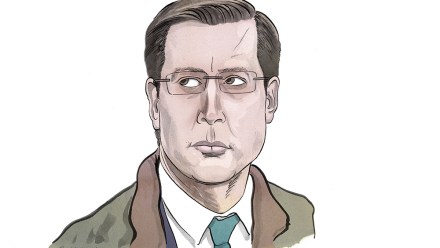
After Liz Truss’s spectacular fall from power, it was hard to find Tories who were happy to admit to having supported her. ‘Trussonomics’ became a punchline. Most of her plans were scrapped, including, this week, her childcare proposals. But among the wreckage of the Truss experiment, there is one survivor who is willing to defend its principles, loudly and publicly. And now he’s waging a lonely fight on the backbenches. ‘If the leadership dramas have taught us anything, it is that a battle for the soul of the Tory party is under way’ Simon Clarke had little profile when he was a Treasury minister under Boris Johnson, but as Truss’s levelling up secretary he was one of the most vocal advocates of her ideas.