Features

Web Exclusive: Lloyd Evans on Thomas Friedman

Thomas Friedman, the influential American commentator, addressed Intelligence Squared on his new book, ‘Hot, Flat and Crowded. Why the world needs a green revolution and how we can renew our global future.’ A star turn visited Intelligence Squared on 13th October. Thomas Friedman, Pulitzer prize winning journalist and columnist on the New York Times, came to discuss his new book ‘Hot Flat and Crowded’, an analysis of the global challenges of the 21st century. The topic seemed spectacularly tedious but Friedman caught our interest immediately with his unusual stance. He’s both deeply sceptical of America and devoutly patriotic. His language is chatty and challenging.
An evening with the Muslim Facebook crew

Sarfraz Manzoor celebrates an iftar meal with homeless people and his fellow Muslims, a web-generated ‘flashmob’ observing an Islamic tradition of generosity to the needy It is sundown in Lincoln’s Inn Fields, a large outdoor square behind London’s Holborn Underground station. I am here to meet a man called Miqdad Asaria who had invited me to attend what he had described as a ‘flashmob iftar’. During the month of Ramadan, which ended last week, an iftar is the evening meal that marks the end of the fast and it is traditional to celebrate it with family and friends. Asaria had a more ambitious proposal.

Only Abba can save the world financial markets

At the historic moment when the House of Representatives passed Hank Paulson’s bail-out bill last Friday night — thus, we must hope, despite early indications to the contrary, significantly improving the world’s chances of avoiding economic cataclysm — I was conducting some research into the Scandinavian solution. I don’t mean the policies followed by the Swedish government to steer its banking sector through a near-terminal crisis in the early 1990s, of which more in a moment. I mean I was sitting in the back row of a packed cinema watching Mamma Mia!, the Abba-singalong movie, and observing the impact of a mass inoculation of feel-good on a crowd that had been battered with bad news all week.

Strictly Come Dancing is not the BBC’s core broadcasting

Rod Liddle — a former editor of the Today programme — says that the Corporation must stop pretending to be democratic if it is to keep the licence fee. Unashamed elitism is the only chance that the Beeb has in the new media world One of the first things to go to hell when the Soviet Union collapsed was elitist early evening television. Within a remarkably short period of time the opera and the ballet and the documentaries moved down the schedules to be replaced by the sort of free and democratic programming with which we in the West are familiar: jabbering cretins, vapid celeb monkeys talking crap, mindless lumpenprole soaps, Yankee import dross, bite-sized chunks of ‘newz u can uze’ and footie. Ah, good, welcome to capitalism, you Russkies.

Maybe Polanski was right to flee America

P.G. Morgan goes in search of the truth about the great director’s flight from the US courts — and uncovers some uncomfortable truths worthy of a scene in Chinatown High above the heat and smog of Los Angeles, a small cardboard box sits on a shelf in LA’s Superior Court building awaiting its Hollywood moment. The handwriting on the box — P v Polanski #A334129 — has faded in the Californian sun. But the box’s contents — witness statements and lurid court depositions from Roman Polanski’s statutory rape case — remain as sensitive now as when they were filed away in February 1978.

Amid the financial turmoil, Peter versus George is the key battle

The Taverna Agni is one of the more expensive restaurants in Corfu, but one would scarcely expect Peter Mandelson and George Osborne to slum it. As is normal for members of London’s political elite, they found themselves in the same exotic location one August weekend. So they went to chew the kleftiko together and laugh about Gordon Brown. We know that Mr Mandelson ‘dripped pure poison’ about the Prime Minister because the fact was leaked to the press within hours — but no one ran the story. Who, after all, cared about a long-retired spin-doctor named Peter? Scroll forward six weeks and that conversation is front-page news.

WEB EXCLUSIVE: Heathrow needs a third runway – Debate report

The statistics were flying like circling jumbos at the Intelligence Squared debate on Heathrow’s proposed expansion. The News 24 anchorman Nik Gowing introduced a panel of experts led by Tom Kelly, once spin doctor to Tony Blair and now BAA’s head of communications. Heathrow’s problems boil down to capacity, he said. Already it works at 100 percent while its main rivals - Paris, Amsterdam and Frankfurt - operate at 75 percent. This makes them less susceptible to weather disruption and open to new growth. Cramped and crowded Heathrow has just lost the new Air India headquarters to Brussels. And even now, Kelly warned, Dubai is building a spanking new terminal with the futuristic title Dubai World Central.

WEB EXCLUSIVE: Georgia and Ukraine should be allowed to join Nato – Debate report

Georgia is still on our minds. August’s short nasty descent into violence triggered the first emergency debate of the season. John Kampfner, in the chair, began by observing wryly that the crisis had disproved the notion that ‘two countries that have Macdonalds don’t go to war.’ Oleh Rybachuk, a leading Ukrainian democrat, proposed the motion and expressed his country’s fears that Ukraine and Georgia would become a new eastern bloc and their borders ‘a new Checkpoint Charlie’. Expansionist Russia was busy violating Ukraine’s sovereignty by handing out citizenship to residents of Crimea. This alarmed Ukraine because ‘defending Russian citizens’ had been the Kremlin’s pretext for marching into Georgia.

Why has the word ‘grandmother’ been banned by the Guardian?

There are too few active homosexuals and career women in the Third World. This is because blacks and Asians — from Australasia to Bangalore — have a tendency to put them in a pot, cook them and eat them. Primitive African tribes also eat crippled people — those in a wheelchair, or merely suffering from a hare lip — and indeed those they consider to be ethnic minorities. I know of one handicapped spinster who committed suicide rather than be eaten by some gypsies in Bombay. Her illegitimate daughter, an air hostess, who herself had given birth to Siamese twins in Calcutta, appealed for clemency but this fell on deaf ears. She is now an illegal asylum seeker living in the province of Northern Ireland — and a grandmother to boot, with a bachelor son.

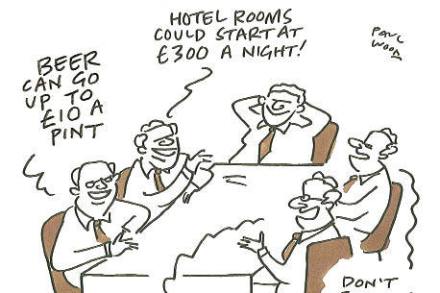
The masters of the universe have turned to drink

It’s possible to get a reservation again at Scott’s. The City boys have well and truly left the building, and can now be found drowning their sorrows elsewhere, in dark corners of the West End and Chelsea, as far away from the prying eyes of the City as possible. ‘“Reduce your risk. Sell. Get flat.” But all I could think about was the school fees and the new kitchen, and how there’s just no recovering from this.’ I was looking into the pained eyes of a former master of the universe, who had until recently stared the credit crunch in the face and laughed. He was now on his sixth (house) whisky and mumbling incoherently about getting buried by Wachovia earlier that day.

Potty-mouthed and proud

Swearing and shouting are underrated, says Giles Coren. Four-letter words can be immensely satisfying and extraordinarily effective When I was ever so small and sweet, romper-suited and frilly-booted and really quite an angel to look at, I must have had a gob on me like an angry plasterer, because the only piece of advice I can remember my mother ever giving me is: ‘If you’ve got nothing nice to say, Giles, then keep your mouth shut.’ This was most often said at table, I think, when I was passing comment on the ickiness of the boil-in-the-bag cod mornay or the pooey colour of the butterscotch Angel Delight, perhaps on the state of my baby sister’s table manners, or my father’s, or the smell of the Portuguese au pair... But it was advice I never took.

Sex, lies and apparitions

The Medjugorje story begins early in 1976 when a Franciscan monk in the former Yugoslavia, Father Tomislav Vlasic, starts an affair with a nun who becomes pregnant. Frightened he will be exposed as the child’s father, Father Vlasic persuades her to move away to Germany. She hopes he will honour his promise to leave the ministry and marry her. She writes a sequence of increasingly anxious letters when this does not happen, telling her former lover she is so miserable that she is praying she will die in childbirth. But he piously orders her to ‘be like Mary’ and accept her destiny in a foreign land — and never to tell a soul who the father really is.

Clinton Democrats are to blame for the credit crunch

‘Let us be clear: this is a crisis caused on Wall Street,’ insisted Speaker Nancy Pelosi in her consensus-strangling speech on Monday, shortly before her fellow members of the House of Representatives voted to reject the President’s $700 billion bail-out plan. Out on the campaign trail, Barack Obama ventured that the root cause of the trouble in the markets was that ‘too many people in Washington and Wall Street weren’t minding the store’. Pinning the blame for the crisis on greedy bankers and incompetent regulators may have seemed plausible enough during the turmoil of the past few days.

Face it: Marx was partly right about capitalism

Readers of Anthony Trollope will remember how thoughtless and greedy young men in the Victorian professions can be lured into ruin by accepting ‘accommodation bills’ from their shifty acquaintances. They make themselves liable for the debts of others; and only too late do they discover that they are trapped in a web of financial mechanics that forces them to pay hugely inflated sums for obligations or services they have had nothing to do with. Their own individual credit-worthiness, their own circumstances, even their own personal choices are all irrelevant: the debt has acquired a life of its own, quite independent of any real transaction they are involved in.

How Dave and George can avoid a terrible rift

The Treasury will be the engine room of David Cameron’s government. It will have to be, given the ghastly economic inheritance. But the economy will be only one of the incoming Chancellor’s headaches — his department will be in no fit state to do the leading. The Treasury — once the citadel of high-quality policy advice and the driving force behind the economic and financial reforms which revived Britain in the 1980s — now lies prostrate. It is a casualty of Gordon Brown’s personality, ten years of trench warfare between him and Tony Blair and the appointment of a new Chancellor, broken backed on arrival. This financial crisis has brutally exposed some of this.

The Tory lead is more solid than you might think

The Conservatives last won a general election in 1992. That was also the year when the opinion polls met their Waterloo. The results of 50 nationwide surveys were published during that campaign. All but six showed Labour ahead, and they all suggested that the outcome of the election would be a hung Parliament, with Labour probably the largest party. They were all wrong. The largest Tory lead reported by any poll during the campaign was only a single percentage point. In the event, the Conservatives’ lead over Labour approached eight points. To this day, no one knows why the polls came a cropper in 1992. Indeed, no one knows for sure why the polls went on to perform with only indifferent success in 1997 and 2001.

If Miliband becomes PM, I’ll join the right-wing coup to topple him

Rod Liddle is outraged by the Foreign Secretary’s alleged comparison of himself to Michael Heseltine: like comparing a Big Beast to a stumpy little Muntjac deer. Where have all the political giants gone? Apparently, David Miliband’s speech to the Labour party conference was deliberately low-key because he did not wish to have a ‘Heseltine Moment’ — that is, he did not wish to be seen as being too obviously a threat to the Prime Minister, too openly desirous of his job. What a fabulous strutting little cock this man truly is.

Zardari is even more afraid than Musharraf

The sophisticated truck bombing of the Marriott Hotel in Islamabad on 20 September, which took dozens of lives, was the latest incident in a campaign to destabilise the entire subcontinent. Most reports have blamed al-Qa’eda militants but the real blame for the crime belongs with the Talebanised sectors of the Pakistani armed forces and intelligence service (ISI), and the pusillanimity of the Pakistani president Asif Ali Zardari, widower of the assassinated Benazir Bhutto. The Marriott assault was clearly a sequel to the bombing less than three months ago, on 7 July, at the Indian embassy in Kabul, which was also devastatingly murderous. Pakistani authorities tried to deny the involvement of ISI agents, as detailed in communications intercepted by US intelligence services.

Welcome to the new austerity era, Mr Cameron

Fraser Nelson says that the Tory leader must not be tempted by a ‘safety first’ strategy at his conference in Birmingham. The global financial crisis has transformed the political context and left an opening for the Conservatives to promise true radicalism and to be proudly bold The Labour party conference already had an apocalyptic aura without the preachers from the Plymouth Brethren gathering in Manchester to rub it in. But as they stood at the security entrance, quoting blood-curdling passages from Ezekiel at passing Cabinet members, the text certainly took on a new resonance. The Labour membership knows that the end is nigh, and is just about ready to pass into the afterlife of opposition. And what better leaving present to the Conservatives than a financial armageddon?

The modern Tory hero should be Jefferson

In theory, Europeans find American elections vulgar and plutocratic. In practice, they find them utterly gripping. This is partly because the US is wealthy and powerful, but mainly because American campaigns, being more participatory than European ones, are more interesting. All organisations grow according to the DNA encoded at the time of their conception. The US was founded in a revolt against a distant and autocratic regime. In consequence, its polity developed according to what we might call Jeffersonian principles: the idea that power should be diffused and that government officials, wherever possible, should be elected. Most European constitutions, by contrast, were drawn up after the second world war.