Features

We are all victims of institutional anti-racism

I don’t suppose that anyone is about to build a community centre in commemoration of Waad al-Baghdadi, but maybe they should. There’s one for Stephen Lawrence, constructed as a token of our disgust at what Sir William Macpherson called the ‘institutional racism’ of the Metropolitan Police. Lawrence’s murder was not competently investigated by the Old Bill at least in part, Macpherson argued, for institutionally racist reasons, borrowing the phrase from the borderline psychotic black American activist Stokely Carmichael. Mr al-Baghdadi, meanwhile, was not killed by anyone, but he was smacked around a bit by a copper.

The property bubble is waiting to burst

As a general rule, it is a mistake to go through life thinking about how much one’s house is worth. In the summer of 2002, when I bought my ‘lovely end of terrace period cottage providing compact character accommodation’ in Gospel Oak, London NW5, I assumed I had managed, with unerring incompetence, to buy at the very top of the boom. It seemed to me unimaginable that anyone would be willing to spend more than the grossly inflated sum of £385,000 which I had paid for my small, damp, jerry-built house. My imagination was defective: to my stupefaction, the property boom continued for another five years, until the collapse of Northern Rock in September 2007.

The global warming guerrillas

Journalists are wont to moan that the slow death of newspapers will mean a disastrous loss of investigative reporting. The web is all very well, they say, but who will pay for the tenacious sniffing newshounds to flush out the real story? ‘Climategate’ proves the opposite to be true. It was amateur bloggers who scented the exaggerations, distortions and corruptions in the climate establishment; whereas newspaper reporters, even after the scandal broke, played poodle to their sources. It was not Private Eye, or the BBC or the News of the World, but a retired electrical engineer in Northampton, David Holland, whose freedom-of-information requests caused the Climategate scientists to break the law, according to the Information Commissioner.

Is it really racist to want an English-speaking cab driver?

Rod Liddle says that the outrage directed at a taxi firm for advertising ‘English spoken here’ serves only to strengthen white working-class resentment — and the BNP ‘Rraaaaaaaacissst!’ — that Pavlovian whine of complaint, almost always from a white person, an idle and meaningless howl of outrage where once, when uttered by a black or Asian person who had suffered discrimination, it had a point and a potency. ‘Raaacisst’ — a new definition; a word which, as soon as it is uttered, can cause debate to cease, people to be punished, argument to be subverted, the Old Bill to get involved. ‘Raaaaacccissst!

Washington Notebook

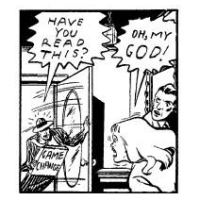
Call me blasé if you will, but of all the clapped-out forms of instant publishing, I had concluded that the ‘campaign book’ was the most dire. Call me blasé if you will, but of all the clapped-out forms of instant publishing, I had concluded that the ‘campaign book’ was the most dire. I also generally think that any use of sporting metaphors to describe politics is an infallible sign of an exhausted hack. But Game Change by John Heilemann and Mark Halperin is so invigoratingly revealing — in the best and nastiest sense of that word — that it gripped me and held me tight. Senator John McCain shouts the f-word nine times into his wife’s face in front of the staff, while raising both middle fingers.

F.W. de Klerk: a hero of our time

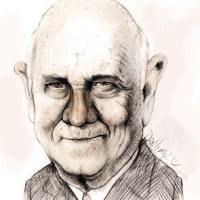
I almost punched an Englishman the other day. We were sitting in a bar, talking about the 20th anniversary of F.W. de Klerk’s Great Leap Forward of 2 February 1990 — the day he rocked the world by announcing that he was about to unban the revolutionary movements, free Nelson Mandela and turn South Africa into a land of peace and justice. I was explaining why I thought de Klerk’s move was an act of heroism almost unparalleled in the history of humankind, but the Englishman didn’t want to know. ‘De Klerk was a loser,’ he said, ‘a racist battered into submission by sanctions, township violence and global isolation, and then forced to do a decent thing that should have been done decades earlier.

There’s nothing cute about a Canuck

Next week, when the Winter Olympics come to Vancouver, the eyes of the world will be on Canada, the sprawling, frigid nation of my birth. It doesn’t happen often, so when the international spotlight swivels our way, we Canadians do our best to hog it. We don’t go in for patriotism and self-belief like our American cousins, but like the shy wallflower who ends up closing the karaoke bar with a lampshade on her head, Canadians are compelled to make fools of ourselves if we are flattered into thinking anyone might notice. So brace yourself in the coming weeks, Britain, for a gushing torrent of maple-flavoured praise for all things Canuck.

Is Cameron a Heath or a Thatcher?

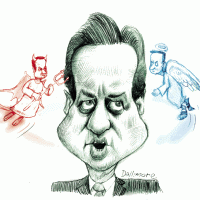
Fraser Nelson says that electoral victory is not enough. To be a great Tory prime minister, David Cameron must be bold enough to abandon Labour’s failed agenda entirely and implement his own Winning office is not the same as winning power. To get the keys to No. 10, a politician needs to be skilled in the arts of electoral combat. But to take power, a prime minister needs an agenda. Without one, he is a slave to his predecessors. The last two Tory leaders who took over from Labour promising change fared differently. Ted Heath, in 1970, was forced into a U-turn and lost power after four years. Lady Thatcher had her own agenda, and transformed the country. The question being raised in Westminster now is which of these two models Mr Cameron is likely to follow.

As Basra slid towards hell, Blair looked the other way

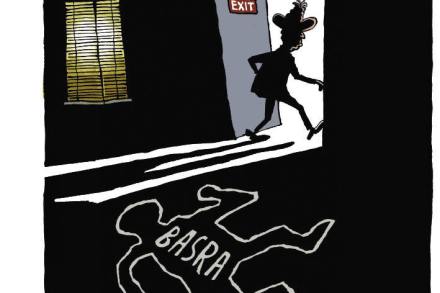
It’s a mistake to focus on the dodgy dossier, says Fraser Nelson. Blair’s real crime was to invade Iraq with no strategy, no understanding of the Islamist factions and no qualms about leaving Iraqis to the mercy of death squads There has always been a faction of the Labour party that wanted Tony Blair in the dock for the Iraq war — no matter how pointless it would be. This was the sole purpose of the Chilcot inquiry. Gordon Brown agreed to it simply to assuage his backbenchers, and the whole exercise was intended to be more a mischievous distraction than an inquisition. But almost by accident, the inquiry has exposed the real scandal of Iraq: the appalling mismanagement of the war and the defeat of the British army, which left the people of Basra to the death squads.

How can we punish Blair?

Readers may remember the Not The Nine O’Clock News parody of those Seventies current affairs programmes in which a professor and a social worker earnestly discussed teenage delinquency. Readers may remember the Not The Nine O’Clock News parody of those Seventies current affairs programmes in which a professor and a social worker earnestly discussed teenage delinquency. Expecting the usual concerned talk of deprivation, poor parenting, and high-rise flats, the interviewer was disconcerted to find both his guests averring that the only answer to youth criminals was to ‘cut off their goolies’. (It was perhaps funnier at the time — Britain then knew nothing of talk radio, or David Blunkett.

Welcome to the age of Gaga

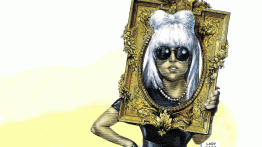
Unpredictable, spectacular, bold and contentious — Lady Gaga is the perfect pop star for the 21st century, says Luke Coppen In 1903, Rainer Maria Rilke wrote a letter to a young man who yearned to be a great artist. ‘In the deepest hour of the night,’ the German poet advised, ‘confess to yourself that you would die if you were forbidden to write. And look deep into your heart where it spreads its roots, the answer, and ask yourself: must I write?’ It’s fair to say that Rilke never imagined his words would end up tattooed on the arm of a pop star with a penchant for porcelain bikinis and flamethrower bras. Lady Gaga, who has sold eight million records in the last 18 months, claims to read Rilke’s Letters to a Young Poet every day.

Time for a Major re-think

Instead of deriding John Major we should celebrate him, says Peter Oborne. His government was stunningly radical and initiated most of Blair’s so-called reforms Gordon Brown may be in terrible trouble but he and his allies have a defence strategy. However bad things are, they say it was much worse under John Major’s weak, hopeless and sleazy administration. I believe that the time has come to mount a serious challenge to this analysis and make the case for both Major and his government. It is becoming obvious, especially with the benefit of hindsight, that John Major was a formidable leader with substantial achievements to his credit. But the narrative of John Major’s hopelessness was so strong that for many years it was impossible to make the case in his favour.

For Pakistan, America is the enemy

Only a Pakistani journalist could have linked a New Jersey school’s decision to cancel its Christmas concert because of head lice with the American conspiracy to subjugate Islam. In her ‘View From US’ column in the Dawn newspaper, Anjum Niaz, one of Pakistan’s leading journalists, quoted the letter to parents. ‘Although the likelihood of spreading lice by attending the concert is near zero, we feel that this is an appropriate precautionary measure at this time.’ In the same way, she complained, ‘peace-loving Muslims across the world are getting the flak’ as ‘the Americans are taking “appropriate precautionary measures” against the mother of all lice, al-Qa’eda’.

Should we break up the banks?

No The proposal on the American table is simple: break up the so-called super banks. To have the deposit-taking banks in one place, and the risk-takers (or proprietary traders) in another. The aim is laudable: that Main Street should not have to pay for Wall Street. This is, after all, the system which existed under Glass-Steagall, the Depression-era legislation. But that broke down, because finance became much more international, ingenious, complex and important. That global genie cannot be squeezed back into the national bottle — and if Obama tries, some genies may well bring their tax dollars here. The banking disease was not obesity but behaviour.

Confessions of a middle-class anarchist

If Gordon Brown really wants to start appealing to the middle-class vote, he could start by picking up my rubbish. The bin bags outside my flat in Kentish Town, north London, weren’t collected for four weeks over Christmas because of the snow. When the foxes started to rip them apart and left a trail of chicken carcasses and half-chewed bread across my front garden, I cracked. Patching up the most damaged bag and strapping it to my handlebars, I pedalled along the snowy roads — if my bike could negotiate the streets, so could a rubbish truck, by the way — to my local park. There, I poured the rubbish into a large, metal-mesh bin.

It’s time to tackle student Islamists

Waffling on about free speech and forming committees is no way to deal with nascent terrorists, says Michael Burleigh. Let’s hope the Tories do better What would a Conservative administration do about the radicalisation of Muslims at British universities? It is a question voters must be asking, given the swell of disturbing reports about student terrorists in the press. Last weekend, it was revealed that British students have been visiting Somalia to fight for the extremist group Al-Shabab (‘The Youth’), while the Sunday Telegraph reported that Yayha Ibrahim, an extremist preacher barred from America and Australia, was planning a speaking tour of British campuses.

WEB EXCLUSIVE: Dealing with the aftershocks

By chance, my father and I were together when we heard the news. We had both just flown to Washington DC - he from Paris, I from Istanbul - to care for my grandmother, who¹d had a heart attack. Before the words "major earthquake in Haiti" came over the car radio, we were already under the impression that we were living through a serious family emergency.  But after those words filtered through, the family emergency became far, far more serious. My brother Mischa and his wife Cristina have been living in Haiti for nearly three years. Cristina, an Italian lawyer, has been working for the Justice Section of MINUSTAH, the United Nations Stabilization Mission in Haiti. My brother is a novelist and journalist. Their first child, Leo, was born ten months ago.

David Cameron should honour his marriage vow

Labour’s Green Paper on families makes it clear that the party is opposed to promoting marriage. Ferdinand Mount says it’s crucial that the Tories don’t waver, but stick to their promise of a financial incentive What, if anything, should David Cameron promise in order to shore up family life in general and marriage in particular? Would some sort of tax incentive help to improve social outcomes and make people happier? Or is this a retro dead end, at once patronising and impractical and prohibitively expensive? Doesn’t Cameron’s self-confessed slip-up when explaining his commitment show how devilishly tricky and unrewarding the whole business is? He can at least claim to be the first party leader to have dared put the question on the agenda.