Features

WEB EXCLUSIVE: Inside the Chilcot Inquiry

Alastair Campbell emerged from that kind of shining silver limo more accustomed to transporting the likes of Jordan and Paris Hilton than former directors of communications. He got their entourage too: a vicious ‘pap’ scrum so tight that The Chilcot Inqury’s latest star witness required the assistance of four burly coppers to get to the doors of the QEII Conference Centre, temporarily affecting the exaggerated swagger of a TV detective as he did so.   Seven years after the UK first deployed troops in Iraq and more than a year, indeed, since we withdrew, Mr. Campbell is still answering questions about the preparations for war.

A message to subscribers

One of the joys of living in Britain is watching the country fall apart when some snow falls. Trucks laden with your copies of The Spectator are, alas, no exception to this ­ and we gather that many of our readers could face delays before receiving their magazines. So we have decided to put the whole magazine online this week (7 January - 14 January)  ­making it free to everyone, not just our subscribers. It's no substitute for the whole thing, I know, and can only apologise as our trucks and postmen battle through the snow.

There’s little comfort to be found on Cameron’s woolly centre ground

‘It’s a brand new year’, Mr Cameron told his Oxford audience last Saturday as he launched his election campaign.  ‘It’s a brand new year’, Mr Cameron told his Oxford audience last Saturday as he launched his election campaign. Why, so it is. He also has a ‘new politics’ on offer — new, new, new — but without a coherent philosophy, Tory or any other, to underpin it; no Disraeli, or Balfour, or Thatcher he.

Cameron’s big idea is simple: he doesn’t need one

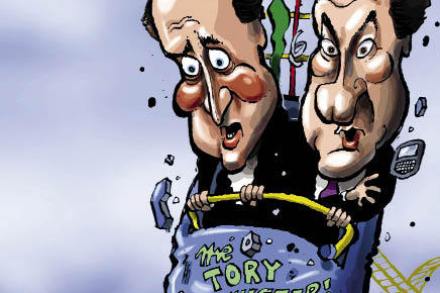
The Tories have opened the new year in a blaze of speeches and promises. But what does it all add up to? Nothing, says James Forsyth — and that’s deliberate. There will never be such a thing as Cameronism Once more, search parties are being sent out to look for David Cameron’s big idea. They will return empty-handed. For the truth is that there is no big idea. However much social responsibility, the post-bureaucratic age or progressive conservatism might be talked up as the ‘big idea’, they are not it. Rather, they are a set of classic conservative insights updated for the 21st century. Cameron is not an ideologue but rather that very English, very Tory thing: a principled pragmatist.

Cameron is our Disraeli

There is a certain type of bovine political intelligence which hates David Cameron. It cannot forgive the Tory leader his popularity, his beautiful wife, his upper-middle-class ease —  and above all his astonishing success in rebuilding the Conservative party. The core criticism works like this: David Cameron is an empty and opportunistic former PR executive, interested only in power for its own sake, utterly devoid of ideas let alone principles, morally indistinguishable from Tony Blair, and in the pocket of Rupert Murdoch. And it must be acknowledged that this portrait contains some truth. He also lacks that visceral connection with ordinary voters that marked out Margaret Thatcher.

Charlie Whelan’s war

Gordon Brown’s chief fixer is ensconced in Unite, the increasingly militant union. Iain Martin asks if the comrades can be persuaded to hold back a wave of strikes Where is Charlie Whelan these days? What’s the old rascal up to? The trade union fixer, spin-doctoring confidant and close friend of the Prime Minister was on my mind after I returned from a trip to my native Scotland for Christmas. I had booked a rail ticket to take me northwards in time for the big day — £112 first class with Virgin. My only choice, seeing as the Unite trade union had engineered a British Airways strike, rendering my £190 British Airways ticket bought months ago useless. That the industrial action was then cancelled, and that I had two tickets, was no consolation.

All Anjem Choudray wants is lots of infidel media attention

There was a car full of angry white boys cruising the high street of Wootton Bassett this week, Luke and Sam and their two friends, on the lookout for camera crews from Sky, ITV and the BBC. They wanted to make it clear, for the early evening news programmes, that if the march of Muslims through the town went ahead, they would block the road with cars, bring down a whole bunch of trouble and perhaps smash some skulls. I caught up with them as they tried to get themselves onto Sky to elucidate this important point more vigorously. They’d driven over from Swindon precisely to achieve this objective and told me that thousand upon thousand more just like them, alerted by a Facebook campaign, would be supporting them.

There’s something rotten in the state of Russia

There is a chilling sequence in Tsar, Pavel Lungin’s dark and brilliant new film about Ivan the Terrible. Ivan, played by the mercurial rock musician Pyotr Mamonov, steps out of his private chapel wild-eyed after a long session of wheedling and bargaining with his God. The Tsar walks, lost in thought, through a series of rooms. As he shuffles along grovelling boyars ceremonially dress him. One group gently places a cloth-of-gold gown over his shoulders. Another group presents an embroidered collar, then cuffs, a crown and staff. Finally the Tsar emerges into the winter sunlight, golden and terrible. The crowd of people who have been waiting for him since dawn prostrate themselves in the slush and the shit of the palace yard. Silence falls.

Bullseye Britain

It’s been a depressing few months, hasn’t it? The papers are full of stories about British decline. In such trying times it’s a comfort to turn to an activity in which Britain still rules. I speak, of course, of darts. Most of the world’s greatest games were made and built in Britain but in football and cricket and rugby and so much else the rest of the world long since over-took the original masters. That’s the problem with globalisation. Darts, however, remains a Great British Success Story. For all that darting missionaries preach the gospel of the oche overseas, this country still reigns supreme on the dartboard.

The death of ‘shabby chic’

After more than 200 years, a uniquely British taste is on the way out. Shabby chic has been vacuumed, whitewashed and dry-cleaned out of existence. Frayed shirt collars, egg yolk on the tie, soup stain on the crotch, roses rambling out of control over the crumbling terrace flagstones, walls cluttered with pictures, tables covered with teetering piles of books. The quintessentially British air of decayed gentility has been destroyed by a combination of minimalism, modernism and nihilism. For the first time in history we live in a civilisation where, the richer you are, the fewer things you have, and the newer, cleaner and more stripped-down those things must be. Shabby chic meant the opposite.

Thomas the Tank Engine is merciless and bigoted — that’s why kids love it

It is very difficult, watching a Thomas the Tank Engine dvd with your young children, to escape the suspicion that the Reverend Wilbert Awdry was anything other than a thoroughly vindictive and authoritarian old scrote, with a spiteful streak the width of the Fat Controller’s stomach. You would not leave your kids with him in person. The errant rolling stock are subjected to ghastly punishments and humiliations — including one engine being bricked up in a tunnel for months on end while the others laugh at him.

Don’t worry — drink and be merry

The government acts as if booze is the root cause of all our social problems, says Leah McLaren, but it’s not. Drinking is an important part of British culture, the pub is the hub of the community, and health warnings can even be counterproductive ‘No drug, not even alcohol, causes the fundamental ills of society. If we’re looking for the source of our troubles, we shouldn’t test people for drugs, we should test them for stupidity, ignorance, greed and love of power.’ — P.J. O’Rourke Happy new year! But don’t pass the bubbly. Haven’t you heard? We are all in danger of losing our souls to the demon liquor. According to the government, alcohol expands your liver, distends your pancreas and turns your brainstem to jelly.

Al-Qa’eda has relocated to Africa

There has been general shock at the attempted downing of Northwest Airlines flight 253 over Detroit. It isn’t just that yet another aeroplane terrorist atrocity was averted only by luck and courage after US and British intelligence were caught with their pants down once again. Nor is it just the lax airport security. No, the real amazement has been that the perpetrator, Umar Farouk Abdulmutallab, is a Nigerian who apparently got his orders from al-Qa’eda in Yemen; that the genesis of the pants bomber’s radical journey lies not in Iraq or Afghanistan, nor in Israel/Palestine, but in Africa. It was while at school in Toga that Abdulmutallab reportedly adopted the most belligerent version of Islam.

So were the Noughties nice?

Outside my local pub it says in big letters ‘£500’, and underneath: ‘This is the fine if you take your drink out into the street.’ What law imposes this fine, no one knows. It could be something to do with 24-hour drinking legislation, or even anti-terror laws. The reason people want to take their drinks into the street is that they’d like a cigarette, which they cannot have in the pub, under another law. The pub now smells not of cigarette smoke but of cooking fat, drains and sweat.

The cities of my soul

Anatole France described his literary criticism as ‘the adventures of my soul among masterpieces’. We cannot all be critics, in the sense that France was, but he surely spoke for everybody, reviewer or not, who takes reading seriously. Books do furnish a room, and the best books decorate a life. Although reading is an interior activity, as a book speaks directly to one person, one of the greatest joys in a well-lived life is reading in agreeable public places. The beach, where so many people do their annual reading, is not an agreeable place. The noise, heat and general irritation do not provide the reflection that one needs for serious reading, which is why most beach-loafers do not read seriously. In which case, why read at all?

What would you take to Bethlehem?

The Wise Men offered gold, frankincense and myrrh — but where can you get hold of myrrh these days? The Spectator asked Britain’s great and good what they would give Jesus if He were born today The Wise Men offered gold, frankincense and myrrh — but where can you get hold of myrrh these days? The Spectator asked Britain’s great and good what they would give Jesus if He were born today The Most Reverend Dr John Sentamu, Archbishop of York Firstly I would give Him myself. My life is the only valuable possession that I could give Him. We are all made in God’s image and likeness. Only a god-like gift is worthy of God. The offering of my total self forms part of my worship. The second gift I would offer Him is my lips, acknowledging Him as Lord of everything.

All in a good cause?

Today’s big charities are slick operations that spend huge sums on running costs and marketing, says Ed Howker. Worse, many of them have been annexed by the government One Christian Aid week, aged seven, I collected charity envelopes with my mum from the terraced homes that rise out of the Calder Valley. Dressed in a blue anorak, I was every bit the budding charity mugger, but there is one doorstep I particularly remember: as usual we asked the occupier if they had ‘ever considered giving any money to Christian Aid?’ ‘Sorry,’ said the middle-aged woman, ‘I don’t give to charity.’ At the time, I thought that seemed monstrous: selfishness dressed-up like a principle.

But if you’re still feeling philanthropic…

If you’re disheartened by the politicisation of big charities, here’s a selection of smaller charities recommended by Spectator staff. If you’re disheartened by the politicisation of big charities, here’s a selection of smaller charities recommended by Spectator staff. For Dementia Living with someone who has dementia is very hard. The person you knew slowly disappears and you are left with a stranger who has changed almost beyond recognition. A sense of isolation descends, along with the feeling that no one quite understands what you — the carer — are going through. Which is where the charity For Dementia comes in.

Happy Christmas from Jo’burg

Once upon a time, in the desolate Great Karoo, my father pointed out a distant line of bluegum trees marking the route Father Christmas was likely to follow when he came to deposit gifts under our Christmas tree. I was around four at the time, but even then I sensed something odd about Christmas in Africa. The cards on our mantelpiece depicted snow, but we’d never seen such a thing. Our windows were shuttered against heat, not icy blizzards. Even our Christmas tree was not a real Christmas tree, just a bough hacked off a thorn tree and draped with shreds of tinsel. But the four-year-old is a foolish creature, so I sat there for hours, peering hopefully into the sun-blackened immensity, waiting for Santa Claus to materialise.