Columns

Kamala’s blagging it

We throw around pejoratives such as ‘Idiot!’ a bit too carelessly, because then when we need to flag up genuinely subpar intelligence, the slag doesn’t land. I sometimes resort to the distinction ‘medically stupid’. As in, ‘Kamala Harris is medically stupid’. As I write this, next year’s Congressional balance of power is uncertain. What is certain: after the midterms, the same terrifyingly unfit politician will remain one cardiac arrest away from the American presidency. The press characterises the Vice President’s missteps as ‘gaffes’, but a proclivity for making embarrassing mistakes in public doesn’t capture the scale of the problem.

What Liz Truss got right

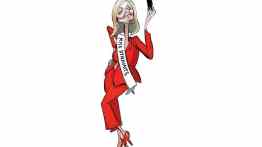
Soon after Kwasi Kwarteng’s not-so-mini-Budget, I found myself in conversation with former aides to David Cameron and Boris Johnson respectively. They were both irritated by the way Liz Truss was being praised as a ‘true Tory’ in some Conservative circles, compared with her more cautious predecessors. One of them remarked, as the other nodded, that people will soon ‘find out there’s a reason why we didn’t do those things’. Sure enough, the mini-Budget collapsed spectacularly and cost Truss her premiership. One of her mistakes had been simply to reject what had gone before, rather than to try to understand why compromises had been made. Her year-zero approach was one of the things that led to her being ejected from office so quickly.

We’ve lost interest in our dependencies

Let nobody say Liz Truss achieved nothing in her mayfly days at Downing Street. She gave away the vast British Indian Ocean territory, the islands and the sea around them, known as the Chagos Islands. To be more precise, in talks with Mauritian officials while in New York, she set in train negotiations with Mauritius over a handover next year. Exempted from any such agreement will be the island of Diego Garcia, nominally British but for all practical purposes under the control of the United States, who maintain a huge and important military base there, probably torturing people – but we wouldn’t know or, if we do, wouldn’t be so impertinent as to complain.

The weaponisation of ‘bullying’

Bullying appears to be suffering from inflation, like everything else. Certainly as an art form it seems to be in decline. As exhibit A I should like to present the ‘bullying’ recently ascribed to Gavin Williamson MP. Williamson is a hard man to defend. He has not excelled in any of the portfolios he has been given. The principal reason he sticks in the memory is that he does quite a good impression of someone doing an impression of someone sinister. The figure he most resembles is of someone who, at a young age, read the tiniest amount of Machiavelli and experienced feelings of arousal that they had not previously felt. ‘Haha, yes,’ I imagine a young Williamson saying. ‘It is indeed better to be feared than to be loved.’ He rose to be minister without portfolio.

How to balance immigration and jobs

Immigration is now at the top of the political agenda in a way that it hasn’t been since the vote to leave the European Union in 2016. Two factors have propelled it up the list, one very real (the small boats arriving across the Channel) and the other theoretical (economic modelling). The market reaction to Kwasi Kwarteng’s mini-Budget made the Office for Budget Responsibility’s next forecast all the more important. In an attempt to increase economic growth, Liz Truss wanted to formalise a more liberal immigration policy. She wanted to show the OBR that her policies would produce decent growth, but her tax cuts would not be enough to do this. So she thought more immigration would help to increase GDP figures, as it had in the Labour years.

Don’t sneer at Elon Musk

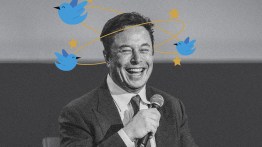
I know a man who plans to burn an effigy of Elon Musk on his bonfire on 5 November. Musk will be on a cardboard rocket and it will be hilarious, apparently,to watch him being engulfed by flames, because he’s ridiculous, he and his weird ideas about Mars. The idea that Musk is laughable is one of the few topics on which the progressive left and the old hawkish left agree. Musk isn’t a serious person, they say, and because he’s not serious, he’s dangerous. He shouldn’t be allowed to own Twitter, let alone space rockets.   There was cautious, grudging approval when Musk donated terminals for his Starlink satellites to Ukraine, followed by great alarm when he speculated about the possibility of a peace deal with Vladimir Putin.

The negligence of ‘not in my lifetime’

It is sometimes said, correctly, that conservatism is more an attitude than an ideology. And for me there have always been certain individuals who embody that attitude. The late and much-missed Tessa Keswick was one such person, and for some reason a remark of hers has recently been in my head. A few years ago we were at a friends’ house for dinner, with an eclectic group. At one point we were all debating something or other and one slightly left-wing woman at the table said: ‘Well, it’ll all be after my time, so I don’t see why I should care.’ If my eyebrows raised, Tessa’s positively shot up. After the meal the two of us debriefed. ‘That is one of the most shocking things I’ve ever heard,’ Tessa told me. I agreed.

Cutting the links with reality

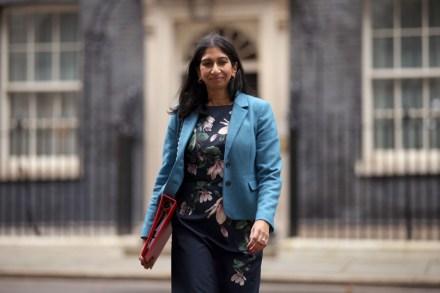
It was a difficult one for the BBC, but they got through it. The problem was this: how to do the story on the chaos at the migrant centre in the former Manston airport which might result in the Home Secretary’s resignation without acknowledging that the root of the issue was a huge increase in asylum seekers? They were avid for the story because they could smell Suella Braverman’s blood on the wind. But it is, I think, contrary to BBC producer guidelines to suggest that Britain may have a problem with illegal immigration. How, then, to stick it to Braverman without implying there’s loads of Albanians flooding the country?

The West’s uncivilised euthanasia policy

So much is happening on the surface at the moment that it can be difficult to notice certain undercurrents. Since the following story has gone almost unheeded in the Anglophone press, let me point at one especially suggestive current which could be glimpsed on the Continent this month. Cast your mind back to March 2016 and you may remember a co-ordinated set of suicide bombings in Brussels: two at the airport, one at a metro station. The three Isis-inspired terrorists managed to kill 32 people that day. But you may, understandably enough, have forgotten about it. The attacks came after the even larger ones in Paris, and people didn’t really have much to say about them.

Money is rotting

Punters and pundits alike reacted to rising mortgage rates in the wake of Truss’s mini-Budget with indignant horror. Leaving aside a market overreaction to fairly modest policy proposals, I wanted to tell aghast homeowners: ‘Well, what did you think was going to happen, people?’ In 2008, the plunging of central bank rates to nearly zero was super-weird. (EU rates eventually going negative, meaning you paid banks to keep your money, was even weirder.) Flatlined interest rates were a response to an emergency. Yet when emergency measures continue long enough, they start to seem totally normal, in this case inducing the bizarre expectation that borrowing money will be basically free, for ever. Sorry, virtually free borrowing is intrinsically dysfunctional. It (surprise!

What everyone knows but no one says about Brexit

Theresa May’s premiership is now a memory. Boris Johnson’s time in office assumes the status of a rather brief, if often embarrassing, interlude. Liz Truss has gone in short order. The threat of a comeback by Johnson has been lifted. What a rollercoaster. Each of these events, in its time, took centre-stage in our politics and each prime minister became for a while the object of contempt, suspicion and rage. I called Mrs May the death star of British politics; I called Mr Johnson a moral toad; I called Liz Truss a planet-sized mass of over-confidence and ambition teetering on a pinhead of a political brain.

Why I won’t be watching Qatar’s World Cup

The pop-up ad I get most frequently these days is David Beckham’s promotional video for the Islamic sandpit of Qatar, in which the smirking tattooed oaf enjoins us to discover such delights as buying some spices in a market and being short-changed in a local shop. Around him is the bling architecture of Doha, which looks like it was designed by his wife. The last scene is a semi-veiled hottie laughing coquettishly with the intellectually impaired former footballer, suggesting to the young men who will be visiting the medieval satrapy for the World Cup that its babes might well be inclined to put out and give you one (if you have bags of cash, designer stubble and ride a motorbike). I assume it was directed by a chap called Asif.

Why can’t I give blood?

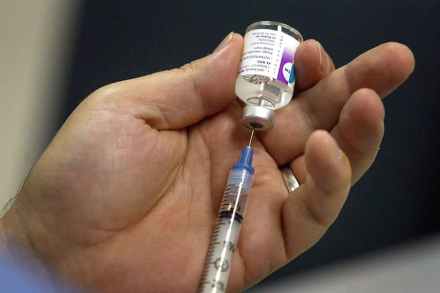
I read about the national shortage of blood last week with a feeling of gloomy inevitability. The brains of the nation are scrambled, Westminster’s insane, of course the country’s bleeding out. But at least, I thought, I can help a bit. I’ve given blood in the past and I enjoy it. There’s the feeling of warmth and purpose, and biscuits. I’d never fork out for a packet of custard creams, but like most English women and men I’m a sucker for one or two free on a saucer in a medical setting. Our blood donor scheme is actually all-round cheery. Each country has its own circulatory system, a flow out from the veins of donors, off to hospitals and into patients.

Nobody wanted Liz Truss

One of the most important ingredients in the oil used to anoint King Charles during his coronation is becoming a bit of an issue – and it may give us a signal as to what sort of monarchy lies in wait for us. Aside from cinnamon and ambergris, the oil also includes musk from the Ethiopian civet cat, obtained through what protestors suggest is a cruel process. The oversized weasel is constrained in a tight cage made of twigs and its bum is forced out of a hole at the back of a cage, whereupon skilled Ethiopian musk gatherers squeeze the animal’s perineal glands, reaping a rich harvest of noisome oil and making the civet cat wish that it had been born in, say, Denmark.

The Liz Truss survival plan

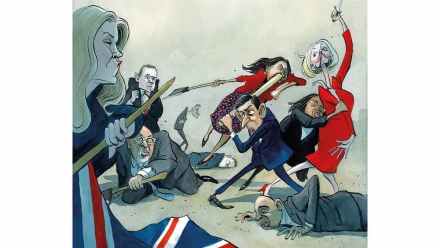
At the first stage of the Conservative leadership race, when Liz Truss was trying to win MPs’ support, her message was that she was the one who could ‘unite the right’. Now, her plan to survive in No. 10 relies on dividing the Tory left. Regicide is a messy business. ‘It’s very hard to push her out,’ says a former cabinet minister. ‘We would need to change the rules. It could be seen as an establishment stitch-up. I think she needs to do the right thing and resign.’ Everyone in the Tory party agrees that there needs to be a unity candidate when Truss goes, but there is absolutely no unity on who that should be. ‘Until we know who to replace her with, we shouldn’t move,’ says a former government member.

How to protest the protestors

These are bleak times in our land, and we must take our pleasures where we can. Personally I have been able to find a great deal of consolation over recent days in watching members of the public confronting protestors from the Just Stop Oil movement. There is some especially pleasing footage of van drivers in south London hauling protestors off the roads by the scruff of their necks. The colourful language which accompanies these acts is an additional delight, for the irate British public is not always immune to using words that polite people might deplore. All the videos bring some satisfaction. This week a strange-looking man-child with a comb-over sprayed orange paint on to the Aston Martin showroom in central London.

The SDP is the anti-futility party

Two lessons learned from the breakfast buffet at the Hilton Hotel, Deansgate, Manchester. First, the plates are no longer minuscule, but pleasingly broad. However, they consist of a smallish bit in the centre and a gently elevated wide rim – the message being: put the food only in the middle. The outer circle is simply decorative, so don’t be uncouth. The second is that you are no longer enjoined to help yourself. There’s a bloke there who does the serving for you. So if you go up and say ‘bacon, please’, he will put a piece of bacon on your plate. One piece. The same with the sausages, the fried eggs, the tomatoes. One of each. Of course, you can request more. You can say: ‘I’d like seven hash browns, please.

The joy of tuning in to the night

‘That element of tragedy which lies in the very fact of frequency,’ wrote George Eliot in Middlemarch, ‘has not yet wrought itself into the coarse emotion of mankind; and perhaps our frames could hardly bear much of it.’ Her thought extends beyond ‘compassion fatigue’ in the face of global suffering on a scale beyond our homely ken, but to life itself in its unfathomable abundance: the dramas, the joys and the sorrows and the sheer activity that surrounds us and would engulf us if we paused for long enough to think about everything. We screen almost all of it out. We have to. Our Derbyshire home is on a hillside in the middle of fields and woods.

Kwasi vs the markets

Warren Buffett famously said that ‘when the tide goes out, you see who is swimming naked’. Now that the tide of easy money has receded, and interest rates have risen, we can see that the UK is exposed. Higher rates are causing acute financial pain to an extent not anticipated for the government, homeowners and even pension funds. The cost to the taxpayer is going to be significant. The Bank of England is in an almost impossible position: it needs high interest rates to tackle inflation, but high rates threaten financial stability. Which is the lesser evil? The Bank has had to intervene in the gilt markets three times since Kwasi Kwarteng’s ‘fiscal statement’, in an attempt to lower rates and calm things down. Once bailouts start, how to stop?