Cinema

Friends reunited | 3 January 2013

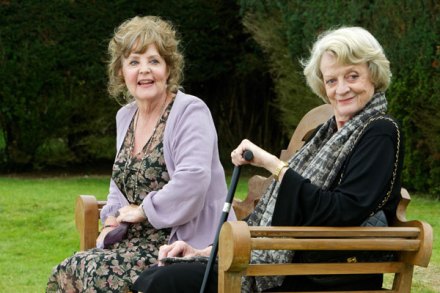
You know how television is becoming like the movies, more expansive and more expensive? Well, what if the movies were to meet television halfway, becoming smaller and more routine? The result, I’m sure, would be something like Quartet, Dustin Hoffman’s first directorial effort since 1978’s Straight Time. If you ran past this film at speed, you could almost mistake it for an episode of Downton Abbey. It’s set in a country house. Maggie Smith is among its cast members. And it’s borrowed actors from small-screen series such as Gavin and Stacey and The Vicar of Dibley. Just the ticket for a lazy Sunday night in. Except Quartet is not nearly so grand as Downton Abbey.
Trading places | 28 December 2012

The trouble with this adaptation of Salman Rushdie’s Booker prize-winning Midnight’s Children, aside from the fact it is a mess and a muddle, is that it goes on and on and on and on. And on. And on. And then, just when you think it has to be over, it goes on some more. If it were up to me, I would charge film-makers for every minute — £1, say; let’s not be greedy — over 90 minutes that I’m kept in the cinema for no good reason. In this instance, as the film comes in at two and a half hours, I think I’m owed £60 (plus VAT and expenses) and I will be invoicing Mr Rushdie directly, as we cannot let him off the hook. Rushdie has no one to blame for this but Rushdie. Rushdie wrote the script. Rushdie is the executive producer.

Going for a song | 12 December 2012

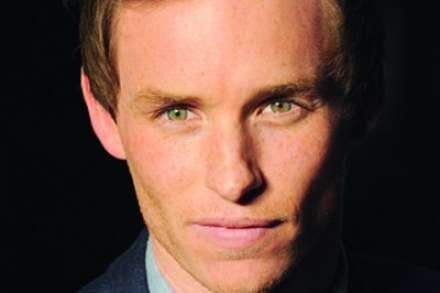
I once asked Donald Sutherland what it was like filming the famous naked love scene with Julie Christie in Don’t Look Now. He said, ‘It was just so horrible.’ I was telling this anecdote over a bacon sandwich to the freckled actor Eddie Redmayne, who, if he is hit by a bus tomorrow, will be remembered for the very rude sex scene he did in the telly adaptation of the novel Birdsong. He had to make love to the radiant French actress Clémence Poésy. What can that have been like? ‘The only thing I can say is: imagine if you had to do it. Her nipples had tape on while your bits are stuffed into a sock and there are 20 strangers watching you both. Then someone shouts “Action!” It’s horrendous!

Tiger feat

Wow! Just: wow! Life of Pi may be the most ravishingly beautiful film I have ever seen. It’s stunning. It’s gorgeous. Its visual inventiveness made me want to weep for joy. It is magical realism made magical and realistic. The palette of colours is extraordinary. You will feel you are in the sea and above the clouds and as if you are on a boat with a Bengal tiger too. Wow! Just: wow! But, weirdly, while enraptured by its look, its emotions never seemed especially pressing, and as for the spiritual journey, it didn’t exactly float my own particular boat. Is it saying a belief in God always makes life a better story than one without a God? That this is why we require faith? Is it advocating a Life of Pi-ety?

Grape expectations

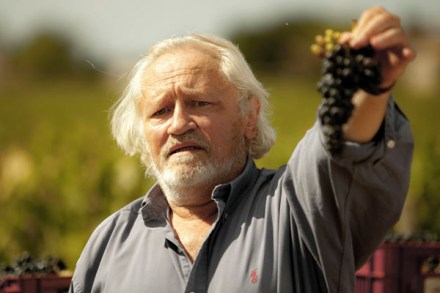
Five minutes into You Will Be My Son (or Tu seras mon fils in its original French), I expected a very different film from the one that eventually emerged. The first scene takes place in a crematorium, as a coffin and its occupant are cooked to ashes. A relative of the deceased picks at a flower, and asks whether the ashes of the man and of the wood will mix. At which the funeral attendant leans over like a great crow to say, ‘It’s all just carbon.’ The whole thing seems very poised, quite refined and a little bit clever. But then the film turns into something else entirely. Its location switches to a vineyard in Saint-Émilion, where we are properly introduced to the owner, Paul de Marseul (Niels Arestrup), and his son Martin (Lorànt Deutsch).

Caravan killers

Here’s a fun diversion for all the family: how many ‘high-concept’ film ideas can you think of in a single minute? These are the films with premises that can be summed up — and pitched to expectant, impatient Hollywood producers — in only a few words. ‘Jaws in Space’, say, or ‘Arnie versus Hitler’. Get started now, and you could soon have the studios drooling a path to your door, eager to turn your aphorisms into easily marketable products. Red carpets and golden paycheques await. I mention this because, at first glance, it seems as if Ben Wheatley’s Sightseers is the result of a similar game.

Faking it | 22 November 2012

The star of Gambit, it seems, is the Savoy. And why not? Nobody else seems to want to lay claim to this movie, a refashioning of the 1966 art con caper that starred Michael Caine. Not even Colin Firth, who spends a fair amount of time in the new film unhappily legging it, trouserless, up and down the hotel’s refurbished corridors. If you want to make an artistic copy, it had better be really good or you might as well not try, is the inadvertent message of this film. Scriptwriters the Coen brothers have taken the basic elements of the vintage Caine vehicle, which also had Shirley Maclaine, and made a crude sketch whose plot is paper-thin and whose characters are pencilled in.

Everlasting love

Michael Haneke’s Amour is about love as we near the end of life and is so painful it isn’t a film to ‘like’ or ‘enjoy’ but is one you do have to see. It’s amazing. It is, effectively, two hours and seven minutes of watching someone die, but it is riveting, and I’m still jangling from it. Haneke has taken the ordinary — getting old; dying; happens to us all; no exceptions — and has transformed it into something so literate, powerful, terrifying, intelligent and extraordinary. I’m still jangling from it, and expect to jangle until at least next Wednesday, if not Friday week. Actually, that’s overoptimistic. This is one of those films that, I suspect, is going to stay with me for life, and I’d best get used to it.

Lost in translation | 8 November 2012

Mother’s Milk is an adaptation of Edward St Aubyn’s novel of the same name and is about an English family who are about to lose their beloved holiday house in Provence. (Diddums, I’m minded to say, but only because I’ve never had a holiday house in Provence to lose, and am quite bitter about that.) Although I am generally a fan of this sort of in-action film — a family go away, there are tensions, they return home again — this is just too hopelessly faithful to the text. Huge chunks of it are spouted all over the shop.

What shall we do with the drunken sailor?

Paul Thomas Anderson’s The Master is his first film since There Will Be Blood and although it stars Joaquin Phoenix and Philip Seymour Hoffman, who give two of the most blistering performances you will see for an unspecified time period — usually, the form is to say ‘this year’, but how do I know? I’m not psychic! — it is all so enigmatic and underwritten I felt rather shut out. A ‘challenging’ film is one thing, but one that actually slams the door in your face is quite another, as well as rude. Heck, I’m mother to a teenager and can stay at home if I want to be shut out and have doors slammed in my face. It’s a pity, though.

The spy who loved M

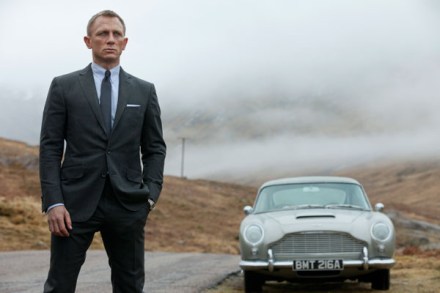
Skyfall is the latest James Bond film, as directed by Sam Mendes, which I felt I should make clear, as there is always so little pre-publicity around these releases. (You’d think the marketing people would splatter the poster on every bus and ensure every newspaper runs through every Bond Girl yet again, wouldn’t you? Pathetic.) But, now it has quietly sneaked up on us, is it any good? Yes, it is rather. It takes up the baton which Casino Royale proffered but Quantum of Solace dropped. By this, I mean although all the furniture is in place — the cars the gadgets the women the stunts the exotic locations — it further explores Bond as a fully-fledged character, and has emotional heft. Actually, something quite Freudian emerges.

Shrub of life

You know how it is: you wake up in your knock-down corrugated shack, surrounded by chickens and dogs and pigs, before staggering out into the morning sun to press the animals against your ear, listening to their heartbeats. No, sorry, I’m getting ahead of myself. You probably don’t know how it is, and neither did I before watching Benh Zeitlin’s Beasts of the Southern Wild. But this is what this film does to its viewer right from the off. It depicts a world so vivid and immediate that two dimensions naturally become three, without the need for any fancy Hollywood stereoscopics. It is, actually, our six-year-old heroine Hushpuppy (Quvenzhané Wallis) who tunes into the ba-dum, ba-dum of the animals’ hearts.

Don’t look now

I don’t know quite what I was thinking when I went to see this film as it is full of everything I personally hate. Low-life gangsters. Drugs. Violence. Liberal use of ‘pussy’ and the c-word, which I loathe so much I cannot say it myself. My son, when he was little, once overheard it somewhere and asked me what it meant and I said it was a sort of German bundt cake, but crispier, and for years I lived in terror he would be presented with a German bundt, but crispier, and exclaim, ‘Wow, great c-word!’ — but this isn’t about the film, is it? So, the film. Yes, it’s full of everything I personally hate but this does not, necessarily, make it a hateful film. It is well acted.

Young love

The perks of being a wallflower are few and far between, in my experience, and I’m not even convinced you can be a wallflower if you are as ravishing as, say, Emma Watson, who modelled for Burberry whenever her Harry Potter schedule would allow, which isn’t the way it usually works for wallflowers, but what do I know, really? In fact, this being a teenage coming-of-age drama, I will now hand over to a teenager, although not a willing one, as he is anxious to escape to ‘top field’ to do ‘nothing’ with ‘just people’. Still, I have bribed him with the promise of a tenner and a lifetime supply of Lynx (Africa) and so here he is, quizzing me: What is it about? And be quick, as I have to go top field to do nothing with just people.

What’s it all about?

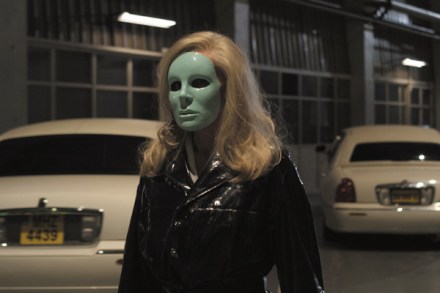
Holy Motors is so mad, deranged, lunatic, bonkers, cuckoo and away with the fairies that, if you were on a bus, and saw it boarding, you’d pray it didn’t sit next to you, although, knowing your luck, it probably would. That said, maybe you shouldn’t be quite so prissy and stand-offish. This film is a wacky ride, as well as a crazy, insane and off-the-wall one, but it is also peculiarly involving, exhilarating and unforgettable. I am still picking it out of my teeth, as if it were yesterday’s lamb chop, unlike the film I saw last week, whatever it was. (Was it good? Did I like it?) This is written and directed by the French auteur Leos Carax, who hasn’t made a full-length film for over a decade, and is obviously a bit of a one.

Divine Diana

I don’t care much for fashion — ask anyone; I’ve even lately surrendered to the fleece — and don’t care for fashion magazines at all. They have nothing to say to my life. They’ve never even featured ‘top ten fleeces of the season’, as far as I know. But this isn’t to say I don’t enjoy the odd mischievous trip behind the scenes. I loved The Devil Wears Prada, starring my friend Meryl, with whom I have dined. I loved The September Issue, the fly-on-the-wall about American Vogue and Anna Wintour, although the only thing I can now remember is being fixated with Ms Wintour’s bob which, one day, will surely join under the chin, as if she’d grown her own snood.

Star quality

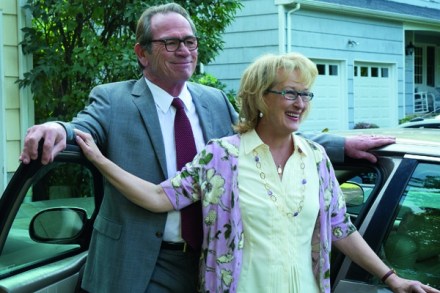
Hope Springs is a comedy drama about a long-term marriage that has effectively stalled, and is one of those films that is only as good as its stars. Luckily, in this instance, the stars are Meryl Streep and Tommy Lee Jones. Meryl, we know about. I once had dinner with Meryl, and have talked of little else since, until I realised it got on everybody’s nerves, but have gaily continued nonetheless. She is the greatest film actress of her generation, our generation, any generation. She could play my left shoe, if she put her mind to it. She may even be playing my left shoe right now. How would I know? But Mr Lee Jones? (I don’t feel matey enough to call him by his first name.) He has a face like an old-style leather football that’s been left out in the rain, year after year.

This world really is a stage

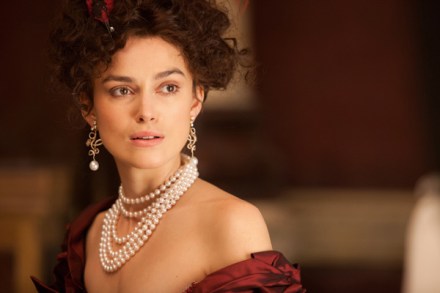
Joe Wright’s adaptation of Anna Karenina is so bold and audacious its bold audacity becomes the story, rather than the actual story itself. This is both a strength — it is always visually dazzling, inventive and surprising — and a weakness, as it is so goddamn distracting. The entire action, more or less, is set in an old decaying theatre beneath a proscenium arch with its own backstage, balconies and rat runs, and an origami-ish ability to fold in on itself, or fold out on itself to become ballroom or bedroom, and even horse-race track. According to Wright, this makes sense as high society in Tsarist Russia was all about performance, and fakery — their whole world was truly a stage — but it is also mise en scène gone totally mental.

No laughing matter | 25 August 2012

It’s a brave soul who buys a cinema ticket at this time of year, when all the studios try to bury their rubbish, and it’s a brave soul who buys a ticket to The Watch. This is a comedy starring Ben Stiller, Vince Vaughn, Jonah Hill and Richard Ayoade as four suburban men who take on an alien invasion in their neighbourhood. Actually, there are some good things about this film, which I will list here: * It does end, eventually. * ...nope, that’s it. And the bad things: * I did not laugh the once. I do not believe I even smiled, mildly. * This wants to be (I think) Invasion of the Body Snatchers via Ghostbusters and Attack the Block but succeeds in being nothing but its own dreadful, pitiful, tedious self.

Bourne again | 18 August 2012

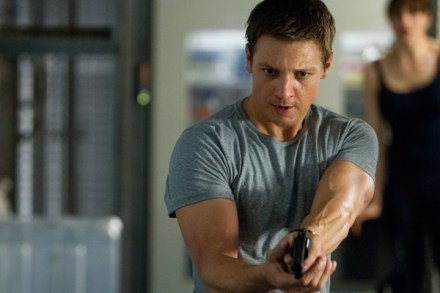
Seriously, what has Hollywood got against wolves at the moment? First there was last year’s The Grey, which saw a bearded Liam Neeson stalked across Alaska by a pack of the beasts before using his survival skills — and some broken bottles — to smash them on to the endangered species list. Now we have The Bourne Legacy, which starts with a bearded Jeremy Renner being stalked across Alaska by a pack of the beasts before using his survival skills to, etc., etc. It’s very similar, except Renner doesn’t have broken bottles at his disposal. He has military drones. It would be wrong to dwell on this lupicide, however.