Chess

When accusations fly

‘OK, there is a body with a knife there, and the police come and say nothing happened… You have to find who, why, what, but it happened, don’t pretend that it didn’t happen!’ Vladimir Kramnik deployed that analogy about the world of online chess, which he sees as riddled with cheating. Cheating happens. Once in a while, I get demolished in a casual online game in a manner that leaves no room for doubt that my opponent’s moves were silicon-assisted. Chess.com, the platform that hosts the biggest online events, has a dedicated Fair Play team to monitor cheating, and their checks have led to over a million account closures in 2023 (0.6% of the total number). Nevertheless, Kramnik clearly believes that Chess.

Triangles

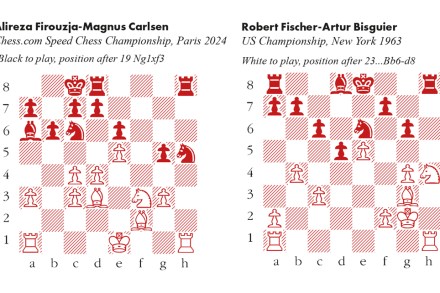
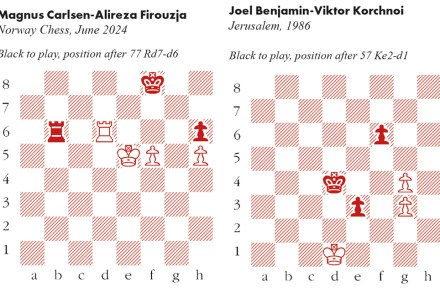
Lawyers in a courtroom, it is said, should not ask questions to which they do not already know the answer. Chess players are well advised to adopt a similar attitude to pawn endgames – steer clear unless you can anticipate the outcome with certainty. In endgames with more wood on the board, overlooking a nuance need not be catastrophic. In pawn endgames, nothing is minor, and any oversight can be decisive. Yet their apparent simplicity has the lure of a siren song. Grandmasters are usually more circumspect, so I was gobsmacked by Alireza Firouzja’s endgame howler in the recent Norway Chess tournament.

Play it again, Amin

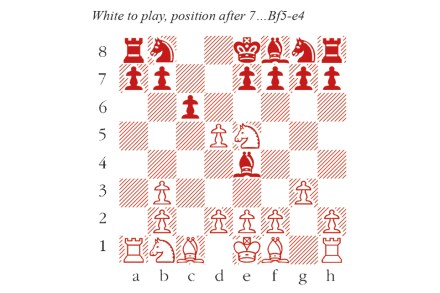
‘Back to the Future with Casablanca Chess’ was the tagline for the elite rapid tournament held in Morocco last month. The intriguing premise was that games would begin from positions taken from the opening phase of famous historical games. The four guinea pigs for this experiment – dubbed the Casablanca Chess Variant – were Magnus Carlsen, Viswanathan Anand, Hikaru Nakamura and Bassem Amin; the latter grandmaster from Egypt is rated in the world’s top 50. Other strong grandmasters selected the positions from historical world championship matches. Most allowed the players considerable creative scope, and all were balanced according to engine evaluations, so players might be happy to play with either colour. Well, one man’s meat is another man’s poison.

Sharjah Masters

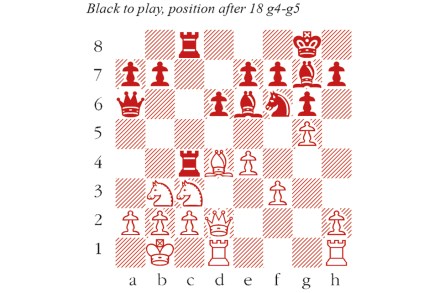
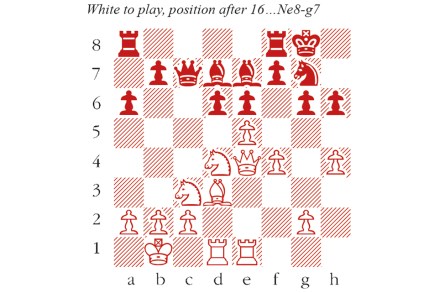
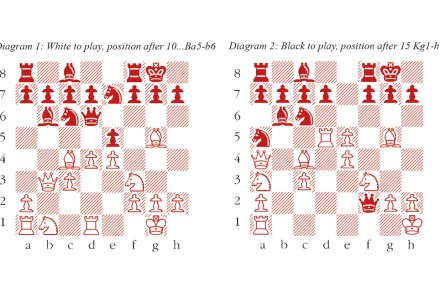
The top Emirati grandmaster Salem Saleh is an imaginative, dynamic player whose games are a treat to watch. But his win at the recent Sharjah Masters against Vladimir Fedoseev (formerly Russian, but now representing Slovenia) was surely the artistic highlight of his career. The combination which ends the game is dazzling, but both players deserve credit for energetic play in the earlier part of the middlegame. Vladimir Fedoseev-Salem SalehSharjah Masters, May 2024 1 d4 Nf6 2 c4 g6 3 h4 A modern extravagance, mainly used by players who wish to avoid the combative Grünfeld defence which would arise after 3.Nc3 d5. If Black stubbornly insists on a Grünfeld-style approach with 3… Bg7 4.Nc3 d5, then 5.h5 poses serious problems.

European Seniors

England teams brought home an Aladdin’s cave of medals from the European Senior Team Championship, which concluded in Slovenia last week. Their victory in the over-65 section was particularly convincing. The team of John Nunn (reigning world senior champion 65+), Tony Kosten, Peter Large, Chris Baker and Nigel Povah lost just two games out of 36, and picked up four individual board medals, including gold for Chris Baker. Peter Large demolished a Finnish grandmaster in the following game.

Four Nations

The Four Nations Chess League (4NCL) enjoyed a captivating finale over the early May bank holiday. As the final round commenced, three teams remained in close contention to win the title, each with nine wins out of ten matches, and each entering their final match as strong favourite. That meant the league would likely be decided on board points, so every half-point would count. The surprise contenders were the Sharks, who had fielded consistently strong squads but with only a couple of grandmasters. Beating Cheddleton by 5-3 in the final round was another good result, but not the big one they needed. Manx Liberty, who won the event last year, had the strongest lineup on paper, led by the veteran elite grandmaster Alexei Shirov.

Bundesliga

Streaks are made to be broken. For many years, the German Bundesliga, the strongest national league in the world, has been dominated by the team from Baden-Baden. Their lineups include the likes of Viswanathan Anand and Richard Rapport as well as England Olympiad players Michael Adams and Nikita Vitiugov. Before this season, they had won 16 of the last 17 league titles, with just one hiccup in 2015/16, when the team from Solingen took the title. This season proved to be a second bump on the road, when they were beaten by the team from Viernheim. This was no David and Goliath moment.

Chess on the telly

What is it like to play chess? Once in a while, I try to convey the atmosphere of a competitive chess tournament to someone who has never witnessed it. I liken it to sitting an exam, in that it lasts for hours and makes your brain hurt; at least everyone can relate to that. But that fails to explain why you would want to do it. So I also mention the thrill of a mental cage-fight, which resonates with some while horrifying others, and then I sow confusion by adding that the game is deeply beautiful. Here’s hoping that Chess Masters, an eight-episode series to be broadcast on BBC2 next year, will succeed where words often fail, and bring the game’s drama to a new audience.

The Candidates

Dommaraju Gukesh triumphed in a thrilling final round at the Candidates Tournament in Toronto. The Indian talent, who is still just 17 years old, thereby qualifies to face Ding Liren in a match for the world championship. He is by far the youngest in history to reach this milestone: Kasparov was 20 years old; Carlsen was 22. One could hardly have scripted a more dramatic 14th round, in which four players remained in contention for tournament victory. Gukesh held a half-point lead over the field, but had the black pieces against Hikaru Nakamura, who would have overtaken him with a win.

Candidates debate

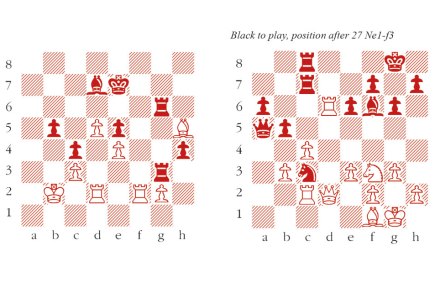
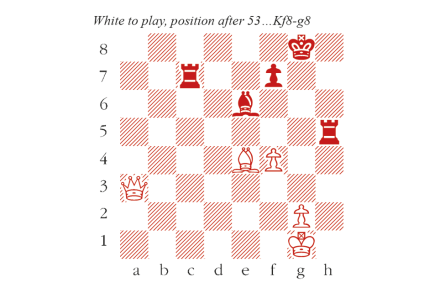
The grace of a snowflake lies in its outward simplicity, which on closer inspection reveals a sublime complexity. Chess endgames beguile me in much the same spirit. The examples below both occurred at the Fide Women’s Candidates tournament, which is currently approaching its conclusion in Toronto. Just a few moves earlier, Anna Muzychuk had an extra pawn in a rook endgame, which was being patiently guided to victory. Lei Tingjie has sacrificed her rook to reach the diagram position, pinning her hopes on the passed g-pawn to salvage a draw. Crucially, her king can shepherd the pawn while also impeding the approach of the White king. Time is of the essence. Anna Muzychuk–Lei Tingjie Fide Women’s Candidates, April 2024 53 Rd5+? This natural move throws away the win.

The event of the year

Every time I type out Candidates Tournament, I want to adorn it with an apostrophe, as with Parents’ Evening or Residents’ Association. Hear me out: Women’s Tournament sounds natural whereas Women Tournament sounds clumsy; the word is possessive rather than attributive. Be that as it may, the prevailing wind has swept the apostrophe away. Anyway, the greatest chess event of the year has begun in Toronto, and in an important sense it does belong to the players. Its legitimacy depends on the fact that qualifying spots are awarded not by invitation, but fiercely contested in elite events throughout the previous year. In the Candidates Tournament, the favourites are Ian Nepomniachtchi (who has won the previous two events), Fabiano Caruana and Hikaru Nakamura, the world no.

Menchik Memorial

Vera Menchik was 38 when she was killed by a German V1 flying bomb that landed on her home in Clapham. Born in Moscow in 1906 to a Czech father and an English mother, she was in her teens when her family settled in England. Aged 21, she won the first women’s world championship, and defended the title six times in the 1930s; she had two wins against Max Euwe a few years before he became world champion in 1935. Her sister Olga was another accomplished player; both sisters, along with their mother, were killed by the bomb. The Menchik Memorial was held last week at the Mindsports Centre in Hammersmith, to mark the 80th anniversary of Menchik’s death in 1944.

Game without end

It is just over a week since Elon Musk’s company Neuralink livestreamed an interview with Noland Arbaugh, who was paralysed from the shoulders down in a diving accident eight years ago. Following the implanting by Neuralink of a chip in his brain, he is now able to control a mouse cursor on the screen by thought alone. The 29-year-old described his joy in being able to stay up all night playing the computer game Civilization VI, for which he would previously have needed human support. (As a former Civ fanatic, I know how fast those hours go by!) Noland showed off his new ability by playing a game of online chess as he chatted. It was the perfect way to demonstrate the technology’s potential to enrich his life.

Helpmates

Chess, to state the obvious, is different from painting, or dance, or poetry. There is artistry in it, and yet the game stands apart. When we admire a sequence of moves, they only make sense viewed through the filter of an imagined adversarial contest. Sacrifices and combinations sparkle according to the obstacles that are overcome. The finest chess compositions display dazzling ideas from both sides before the denouement. And yet there is a celebrated genre of chess problem which dispenses with that premise. I’m thinking of the helpmate, in which both sides conspire to achieve mate on the board as quickly as possible. This is chess as choreography.

Dropping the golden apple

Find the best move! Once upon a time, I sincerely believed that was my overriding goal during a game of chess. Naive, but nowadays I know better. The truth is that dodging banana skins is more fruitful, so to speak, than the pursuit of golden apples. In part, this is a simple story about experience and humility. After making enough bad moves, one comes to realise that there are always more lurking around the corner. But really, it’s not about me. The past decade or so has seen a fundamental shift in the way that games of chess are perceived, for which the near-omniscient chess computer has been the driving force. The moves of the world’s best players used to be held in awe.

Two poisoned pawns

They say the best way to really know a subject is to write about it. I speculate it worked for the English grandmaster Danny Gormally, whose forthcoming book Tournament Battle Plan (Thinkers Publishing) perhaps inspired him to victory at the British Rapidplay Championships held in Peterborough earlier this month. It must be said that Gormally was also the top seed. He won the title in a blitz playoff, after his winning score of 9/11 in the main event was matched by the Irish teenager Trisha Kanyamarala, who was awarded the title of British Women’s Rapidplay champion. (The event was open to Irish citizens.) Her patient and tactically alert play allowed her to far outshine her tournament seeding.

Cambridge International Open

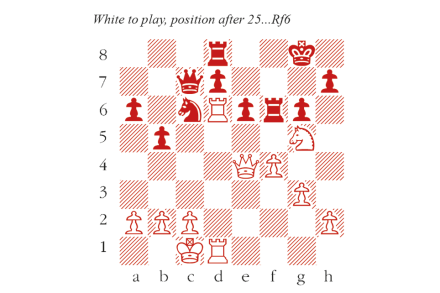
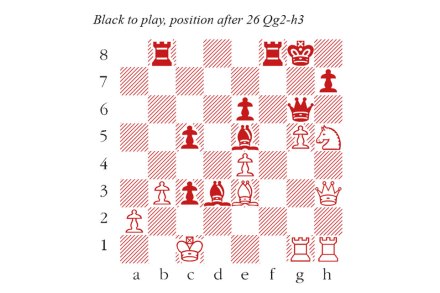
In February the Cambridge International Open returned to the University Arms Hotel. In the penultimate round, the experienced Dutch grandmaster Sergei Tiviakov was half a point clear of a strong field, and looked to be coasting towards victory against his Danish opponent. Playing White in the position below, his bishop and two passed pawns outweigh Haubro’s extra rook. Sergei Tiviakov-Martin Haubro Cambridge International Open, February 2024 (see left diagram) Tiviakov, co-author of Rock Solid Chess (New In Chess, 2023) is the epitome of a safe pair of hands at the chessboard. His position is characteristically tidy, in that every unit is protected by something else. But the most efficient path to victory involves some precise tactics: that is 40 Rxb8!

It’s a knockout

‘Chess is a sea in which a gnat may drink and an elephant may bathe.’ I’m fond of that adage, which speaks to the depth of the game in a way that numbers cannot. But how many possible games of chess are there? The mathematician Claude Shannon wrote a paper in 1949: ‘Progamming a Computer for Playing Chess’, in which he estimated that there are at least 10120 (i.e. 1 with 120 zeros) possible games of chess. He noted that with such an astronomically large number, a perfect solution by brute force was infeasible. The reasoning is straightforward. The Dutch psychologist Adriaan De Groot (a contemporary of Shannon) estimated that a typical position may have 30 legal moves, so one move for each side makes for approximately 900 possibilities. Call it 1,000 (i.e.

Young contenders

Popular wisdom has it that the smartphone has shrivelled teenagers’ attention spans. But they are getting better at chess, and there is no doubt that technology is the main driver. Chess knowledge is more widely accessible than ever before, with any number of sparring partners, courses and coaches (like me!) available online. Chess engines, such as the famous ‘Stockfish’ program, are far more useful as training tools than they were 20 years ago, when they were tactically unbeatable but strategically patchy. These days their suggestions are invariably sound, and can harnessed for post-game feedback after playing human opponents. For promising young players, with the right guidance, there is no end of opportunity.

Fearless teens

A trio of teenagers dominated the Tata Steel Challengers event, which took place in Wijk aan Zee last month alongside the elite Masters event. Their fearless chess helped them get the better of many more experienced grandmasters. India’s Leon Luke Mendonca, 17, took first place with 9.5/13, and will receive an invitation to the Masters event next year. Joint second on 9/13 were the reigning World Junior Champion Marc’Andria Maurizzi from France (16) and Daniel Dardha (18) from Belgium. These games from the latter two are simply electrifying.