Chess

Meet me in St Louis

Garry Kasparov retired from competitive chess in 2005, but has proved that at the age of 61 he remains competitive at the highest level. That is an extraordinary achievement in an time when just five of the world’s top 100 active players are older than 50. The former world champion joined a powerful field in St Louis for nine rounds of ‘Chess 9LX’ played at a rapid time control. Chess 9LX, in which the pieces on the back rank are shuffled at the start of the game, is an ideal format for Kasparov, who can count on pure chess skill, without worrying about his outdated knowledge of opening theory.

End of The World

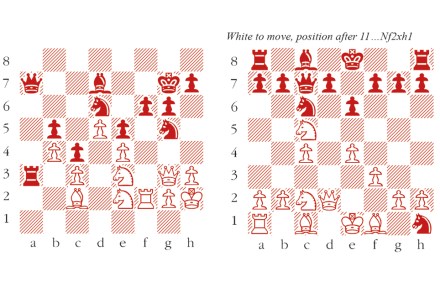
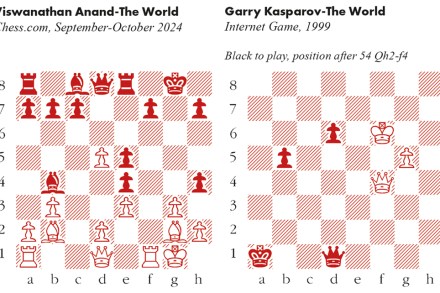
In 2016, the naming of a polar research ship was put to a public vote, and ‘Boaty McBoatface’ was the overwhelming winner. Should humanity’s fate ever be staked on a game of chess against alien invaders, I hope we don’t get a vote. If the internet has taught me anything, we would end up playing the Bongcloud Opening ‘for the lols’ and be vaporised. Even ignoring the saboteurs, the wisdom of crowds does not reliably select good chess moves. The recent game between former world champion Viswanathan Anand and ‘The World’ was a case in point.     In the first diagram above, you can see why the world voted for 14…Qd8xd5, which mops up a pawn, defends the pawn on e4, and attacks d2.

WR Masters

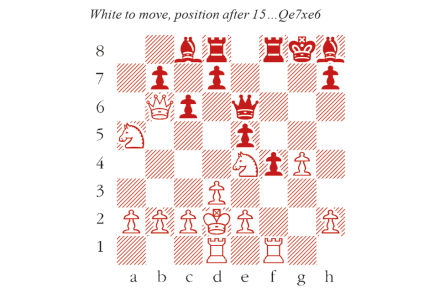
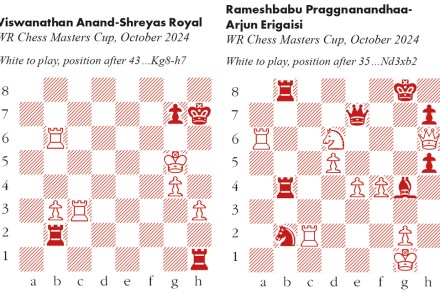
Two of England’s brightest prospects received a golden opportunity to play at the WR Chess Masters Cup, an elite knockout tournament held at the Langham Hotel in London last week. WR is Wadim Rosenstein, a keen chess player and CEO of the German WR logistics group, which last year partnered with Fide to organise the World Rapid and Blitz Team Championships in Düsseldorf.    Shreyas Royal recently broke the record to become the UK’s youngest grandmaster at the age of 15 years and seven months. In the first round of the knockout, he faced former world champion Viswanathan Anand. With two extra pawns in the diagram below, one would expect Anand to comfortably notch up the win.

Metacognition

Congratulations to Sir Demis Hassabis, who last week was awarded a Nobel prize for his work on AlphaFold, which uses artificial intelligence to predict the structure of proteins. Developed by DeepMind, AlphaFold belongs to the same family of work as AlphaZero, which revolutionised computer chess when it was released in 2017, and before that AlphaGo, which in 2015 was the first program to defeat a professional Go player. I had the honour of partnering with Hassabis for the Pro-Biz Cup at the London Chess Classic in 2021. Now CEO of Google Deepmind, at 13 he ranked second in his age group behind Judit Polgar. There is no doubt that his youthful fascination with strategy games sowed the seeds of his scientific achievement.

Rushed finish

There’s a piece of chess clickbait which occurs with tiresome regularity. The players are deep in the endgame, but have so little time remaining that the game cannot be concluded with dignity. Pieces land in between squares, or get dropped and clatter across the board. In their final seconds, players will attempt to move before their opponent has completed their own move, which is just as farcical as it sounds. One should not blame the players: against a well-matched opponent, such situations are inevitable from time to time. The arbiters sometimes get flak for not intervening, but in the heat of the moment, nobody knows if a rook landed cleanly on a8 or just outside the lines, and interrupting the game to check would do nothing to improve matters.

Imminent disaster

Mistakes in chess come in pairs. Last month, and not for the first time, that nugget of wisdom thumped me on the nose. Representing England at the Olympiad in Budapest, my game against Luca Moroni was proceeding rather pleasantly. It was clear the Italian grandmaster had underestimated my sacrifice of rook for bishop in the middlegame, and I was about to recover my material investment with interest. Alas, my return was diminished by an elementary tactical oversight, missing the move 25 Na4xb6 (see first diagram). No matter – I was still a pawn to the good. I moved my rook which was under attack, and he responded in the obvious way. One minor hiccup need not derail an otherwise agreeable game. Oblivious to any danger, my crude blunder on the very next move allowed 27 Nb3xa5.

Double gold for India

The Gaprindashvili Cup, named after the Georgian former women’s world champion Nona Gaprindashvili, is awarded at the biennial Chess Olympiad to the country with the highest total standings between the open and women’s events. In Chennai in 2022, that honour went to India, who won the bronze medals in both sections. The 45th Chess Olympiad, which concluded last weekend in Budapest, saw Indian teams surpass themselves, winning gold in both events. Their victory in the open section was all but secured with one round to spare, and featured stratospheric individual performances from Dommaraju Gukesh and Arjun Erigaisi (aged 18 and 21 respectively).

Problem solved

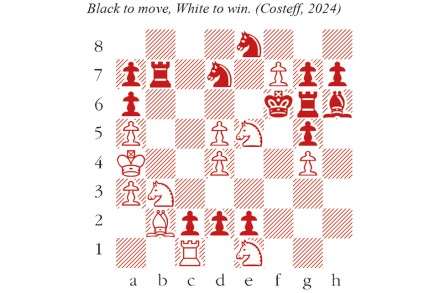
When I select puzzles to accompany this column, I stick to the plain vanilla. The stipulation must be short and sweet, and one move solutions must be accepted (though I like to include a few further words of explanation). Alas, a thousand such puzzles can never do justice to the wondrous ingenuity of chess composers. Longer mating problems and ‘studies’ (where the objective is to find a winning or drawing sequence) allow considerably more artistic scope. Then there are genres which maintain the rules of movement but subvert the players’ objectives. Those include helpmates (in which both sides choreograph their moves to engineer a checkmate) and selfmates (in which one side attempts to force the other to deliver checkmate).

Speed bumps

‘I don’t think it will be decided on the chessboard… I broke him in the Sinquefield Cup… as long as I can look him in the eyes and understand that there is absolutely nothing he can do to even enter my mind space then I believe that victory will be mine.’ Thus spake Hans Niemann in a recent interview with the YouTuber Levy Rozman (aka GothamChess), referencing the notorious game in which he beat Magnus Carlsen in St Louis two years ago. He was anticipating his clash against Carlsen in the semi-final of the Chess.com Speed Chess Championship, which took place in Paris last week. Niemann’s bombast proved premature. Carlsen won with a convincing 17.5-12.

Too much and not enough

Polishing an opening repertoire is essential for top chess players, who must have variations prepared to meet all the standard openings. Those may be selected on grounds of stylistic appeal or rarity, hoping to catch an opponent off-guard. There are standard responses in turn, and a well-prepared player will have counter-ideas locked and loaded. Vast trees of chess analysis are stored in databases on their laptops and swapped over the internet. If you have money, you can buy books or online courses in which grandmasters share their ideas. If you have time, you can turn on a powerful chess engine (such as Stockfish) and craft your own. The problem is that putting it on your computer is not the same as putting it between your ears.

Marathon

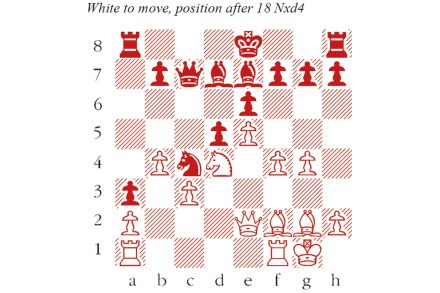
Earlier this month, at the Kingston Invitational, Peter Lalic won a game against 12-year-old Billy Fellowes in 272 moves. Published in full, it would take up most of this article and resemble a cryptographic message more than a game of chess. But it earns a place in the record books as the longest over-the-board game in history, eclipsing the game Nikolic-Arsovic, Belgrade 1989, which was agreed drawn after 269 moves. Billy Fellowes-Peter Lalic Kingston Invitational, August 2024 The first diagram, at move 18, sets the scene. With more space to manoeuvre, Black holds a clear strategical advantage.

Hans Niemann against the World

For the irrepressible Hans Niemann, August is no time to chill. The 21-year-old American grandmaster began the month by defeating his compatriot Wesley So by 13-10 in the quarter-final of the Chess.com Speed Chess Championship. He gave a vitriolic interview after the match, railing against the ‘chess establishment’ and those he perceives as trying to ruin his career. Evidently, his relations with Chess.com, Magnus Carlsen and others have hardly thawed since last year’s conclusion of their legal dispute which arose in response to unsubstantiated cheating allegations after Niemann’s win against Carlsen at the Sinquefield Cup in 2022. ‘America’s brightest talent’ (by his own description), has complained of a lack of invitations to top-tier events.

Grandmaster Royal

The British Championships, which concluded in Hull earlier this month, saw a notable achievement for 15-year-old Shreyas Royal, whose stellar performance was his third and final qualifying result to earn him the grandmaster title. He becomes the youngest British player to reach that milestone, beating David Howell’s record which had held since 2007 (and before that, my own!). Royal’s win against Howell was one of the best games of the event, although the Alexander Best Game Prize (named for C.H.O’D. Alexander, the Bletchley Park codebreaker and Spectator chess columnist) was awarded to Howell, for the precision in his endgame against Ameet Ghasi.

British Championships

The stench of burning rubber hung in the air as I trudged back to my hotel in Hull city centre last Saturday evening. A wheelie bin lay in the street, with a fire flickering out next to it. Everywhere there were tired-looking policemen, obviously relieved the yobs had dispersed. I too was spent, and a little deflated, though there was one brawl that day which I had relished. I’d faced the experienced grandmaster Stuart Conquest in the penultimate round of the British Championships, held in Hull’s City Hall. After five tense hours of play, I came agonisingly close to winning, though Stuart’s stout defensive effort ensured I also had to stay on my toes to avoid losing.

A day of chess

All eyes are on the Games in Paris, where an estimated 10,000 athletes from more than 200 nations will compete. This comes 100 years after the Paris Olympics of 1924, a milestone event when the number of competing nations jumped from 29 to 44. That same year, Fide, the international governing body of chess, (Federation Internationale des Echecs) was founded in the 9th arrondissement’s town hall by Pierre Vincent, the secretary of the French Chess Federation. An unofficial chess Olympiad took place alongside the athletic Olympics, though the first official Fide Olympiad was not until 1927. Those were sympathetic times for international cooperation – the League of Nations was founded at the Paris Peace Conference in 1920. And so, in 2024, Fide comes to mark its own centenary.

A sense of danger

I have a pet theory, based not on hard data but on insights from postmortem chitchat. My theory says that novices and experts, when facing evenly matched opponents, make roughly the same number of screw-ups in a game. The difference is that the novice’s oversights will be far more significant. The novice walks into checkmate, where the grandmaster hangs a pawn. One blunders a bishop, where the other concedes a softening of the pawn structure. Strong players rely on their well-honed sense of danger to avoid the most egregious errors. After studying hundreds of thousands of tactical motifs, one just knows when a situation looks sketchy – perhaps there are a couple of undefended pieces, and the king is open to attack.

World Seniors

If you visit the English Chess Federation’s website hoping to become a member, you will be confronted with a comprehension test. You will scroll past walls of text before appraising your membership options. Would you like to be a Supporter, Bronze, Gold, or Platinum member? Perhaps you are eligible for Junior Bronze, Free Junior Bronze, Junior Gold, Free Junior Gold, or Free Student Gold? Like the intricacies of the tax system, there must be reasons for this befuddlement of detail. The free tiers, for example, are intended as an inducement for members in their first year. But the initial impression is baffling: a simple table would go a long way to clarify the differences. As for the benefits of membership, the ECF’s monthly online magazine ChessMoves deserves greater prominence.

Classical chess

Garry Kasparov endorsed the slower time control which was used at the Superbet Chess Classic. That event, which concluded this month in Bucharest, was the latest leg of the Grand Chess Tour, the annual series of events for elite players which comprises a mix of faster and slower formats. In the words of the former world champion: ‘The preservation of classical chess… is very important for helping players to realise their full potential, to put on display what they can do.’ He compared the format to ‘modern opera’, in contrast to rapid and blitz events where the action is faster, but the play is less refined. At its best, classical chess contains ambitious, unusual ideas, such as the pawn sacrifice played by Firouzja in the game below.

Hidden links

There is a sublime satisfaction in a good detective thriller. We will, of course, have accessed the same facts as our sharp-witted sleuth. The fleck of yellow paint on the raincoat meant little to us, as did the creaking door and the page missing from the notebook. But at last the alibi is dismantled, and from the tangle of contradictions emerges an elegant, coherent thread. Genius, they say, is seeing what everyone else sees and thinking what no one else has thought. On the chessboard, we also agree on many of the facts: this rook enjoys an open file, that bishop is pinning the knight. And much tactical reasoning is straightforward: ‘The queen is guarding against the mate, so let’s try to deflect it.

English Championships

The English Championships concluded last weekend in two dramatic playoff matches. In the open event, Gawain Jones defeated last year’s winner Michael Adams by 1.5-0.5. The first game saw Adams pressing in a complex queen endgame, but he lost after an astonishing oversight which allowed mate in one move. Though Adams pushed hard for a win in the second game, patient defence from Jones secured the draw and the title. In the women’s championship, last year’s winner Katarzyna Toma faced Elmira Mirzoeva, the formerly Russian woman grandmaster who transferred her federation to England earlier this year. In the rapid playoff games, Mirzoeva took the lead with a convincing victory, but the second game saw Toma turn the tables with an unlikely counterattack in a lost position.