Chess

Back to Baku

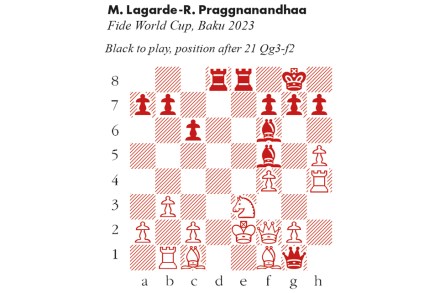
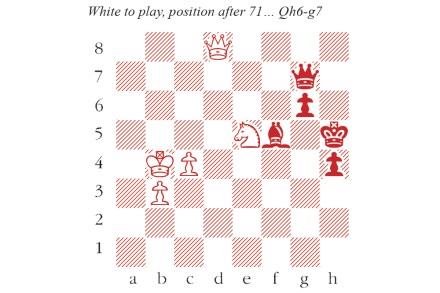
A fortnight ago, I wrote about Magnus Carlsen’s narrow escape against the German teenager Vincent Keymer at the Fide World Cup in Baku. That brush with mortality seemed to galvanise the world no. 1, who coasted to the final with convincing victories in his next three matches, against Ivanchuk, Gukesh and Abasov. His next opponent was another exceptional talent, 18-year-old Rameshbabu Praggnanandhaa from India, and Carlsen’s triumph in the tiebreak secured victory in perhaps the only major event which he had never managed to win before.    Nevertheless, Praggnanandhaa had perhaps even more reason to be satisfied with his own performance. His achievement became front-page news in India and drew praise from Narendra Modi.

Senior teams

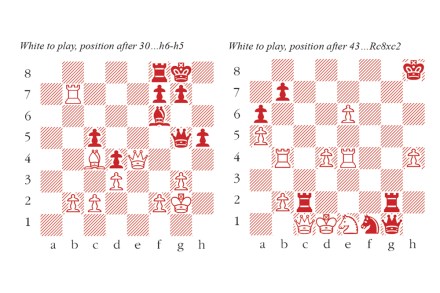
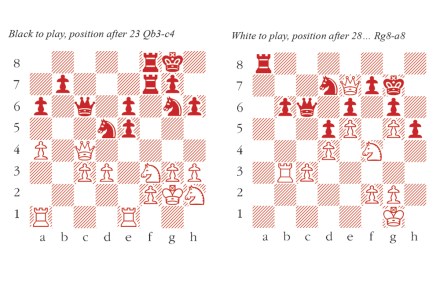
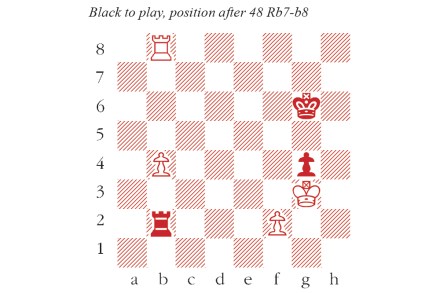
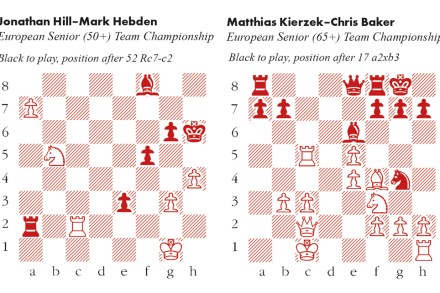
England teams brought home a raft of medals from the European Senior Teams Championship, held last month in Swidnica, Poland. England’s first team were top seeds in the over-50s event, with an all-grandmaster lineup (Mark Hebden, John Emms, Keith Arkell, Glenn Flear and Chris Ward). They faced a serious challenge from Slovakia, whom they defeated in the final round by 2.5-1.5. Mark Hebden was the standout performer, winning the individual gold medal on top board with a 7.5/8 score. His game against Jonathan Hill, from England’s third team, had a neat finish. Jonathan Hill–Mark Hebden European Senior (50+) Team Championship In the diagram position, capturing the rook on Rc2 would allow the a7 pawn to promote. Instead, Hebden sowed confusion with 52… e2.

Baku burner

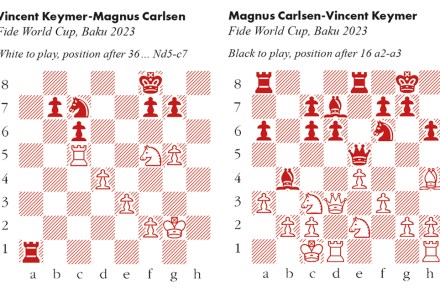
If you love chess enough to play hundreds of tournaments you will, sooner or later, play like a numbskull. You lick your wounds, go to bed, and hope the engine belches into action the next day. As a wise man once told me, the great comfort of a knockout tournament is that if you play badly, at least you get to go home. Except that doesn’t apply to Magnus Carlsen, or at least not yet. The world no. 1 is the top seed at the Fide World Cup, currently underway in Baku, Azerbaijan. But he suffered two serious glitches on consecutive days in his fourth round match against Germany’s Vincent Keymer, one of the world’s top juniors.

Funding matters

Three cheers for last week’s news leak, indicating government plans to support English chess. According to Dominic Lawson, the president of the English Chess Federation (ECF) and The Spectator’s former editor, his conversation with Rishi Sunak, setting out the significant role played by chess players in the wartime codebreaking effort at Bletchley Park, proved particularly compelling. The plans include expanding chess in schools and public parks, as well as £500,000 of funding over a couple of years for the ECF to develop the men’s and women’s international teams.  As I wrote in April, chess has been starved of funds due to not being officially classified as a sport.

British champions

Three protagonists shaped the action at the British Championships, held at De Montfort University in Leicester last month, with sharply different stories to tell. ‘Business as usual’ was a fair description of the top seed Michael Adams’s performance, who was undefeated on 7.5/9 and secured his eighth championship title by a comfortable margin. His closest pursuer for much of the event was Daniel Fernandez, whose energetic play earned him six wins in the first seven games. But his tournament unravelled in the penultimate round when he succumbed to a mating attack from a tense middlegame. In the final round, Fernandez was a heavy favourite, at least on paper. But his opening play looked impulsive, as if the previous day’s disappointment still weighed heavily.

Getting a grip

In the 12th and final game of the women’s world championship, a pivotal role was played by a modest knight retreat from China’s defending champion Ju Wenjun. Her immediate purpose was to restrain a dangerous passed pawn. But that simple measure set in motion a deeper plan, which challenger Lei Tingjie was unable to prevent. Ju used both her knights to establish an unshakeable central blockade, and Lei’s immobile pawns were destroyed a few moves later. The match was a triumph of tenacity for Ju, who was outplayed by her compatriot in exemplary style in the fifth game, and trailed at the halfway point. Thereafter, play moved from Shanghai to Chongqing, where Ju seemed to gain in confidence, equalling the score in game 8.

Blitz

Nine wins in a row. What are the chances? That’s how Magnus Carlsen began on the first day of blitz (fast) chess at the the Zagreb Grand Chess Tour. My guesstimate is that Carlsen wins no more than half of his blitz games against the standard of opposition that he faced in Croatia, where his toughest rivals included Alireza Firouzja, Fabiano Caruana and Ian Nepomniachtchi. So I think you would be more likely to see a coin land on heads nine times in a row than for Carlsen to repeat that achievement. (In slower games, where decisive games are less frequent, his chances would be lower still.

Mate in two

‘Lipton’s writing is characterised by its rigour, and though his working through of alternative hypotheses can be demanding for the reader, his positions are always stated with great clarity’. That line is taken from an obituary of Michael Lipton, published in the Financial Times, who died in April at the age of 86. Lipton was a development economist whose early work was based upon a close observation of farming techniques of the rural poor. Rather disarmingly, the CV on his website attributed his education to ‘the people of Kavathe village, Satara district, Maharashtra, India 1965-66’ right after Haberdashers’ School, Balliol College, Oxford and MIT.

Sorcery

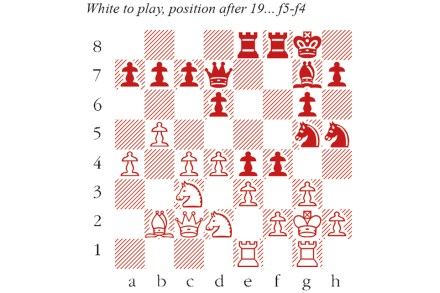
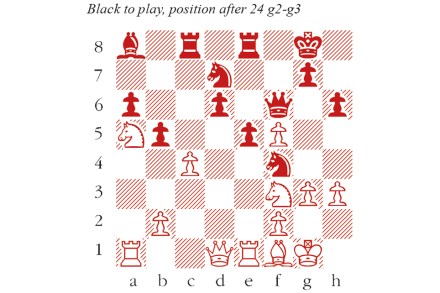
Magnus Carlsen broke into a smile while pondering his 64th move. Vishy Anand grinned back at him, both players revelling in the tension and complexity of their game from the Global Chess League, held in Dubai last month. They were down to less than a minute each, and India’s five-time world champion had just pulled a rabbit out of a hat, with a sacrificial promotion which seemed to ensure a draw by stalemate. Carlsen paused before summoning some even more powerful sorcery, which left Anand only the narrowest chance of escape. In the first diagram below, 59…b4 looks promising, but 60 Nf1+! wobbles the Black king off its ideal spot, and 60…Kd3 61 cxb4 c3+ 62 Kc1! is a dead end.

The hell of speed chess

Somewhere in hell, there is a cavernous hall filled with row upon row of people playing online speed chess. Their games bear not a trace of exuberance or wit. Instead, these wretched souls are confronted with utterly sterile positions, perhaps a lone king and rook on each side, but their flinty, remote adversaries will not agree to a draw. Instead, they shuffle the pieces back and forth – a pointless rook check here, a king sally there, and before long our infernal victims have run out of time, and lost. They curse at the injustice, and yet the next game is groundhog day. If you play enough games online, you too will run into one of these unscrupulous opponents, who stop at nothing in pursuit of the full point.

Great discoveries

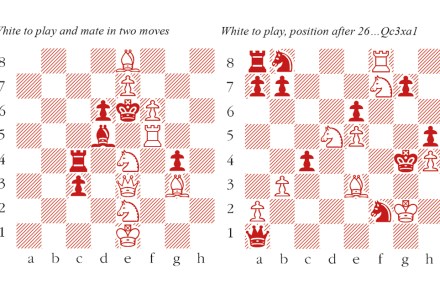
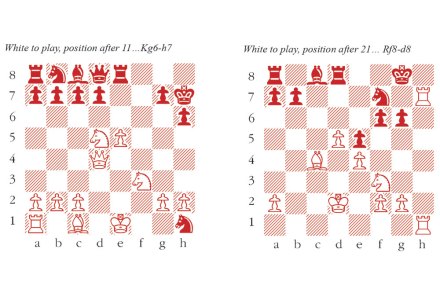
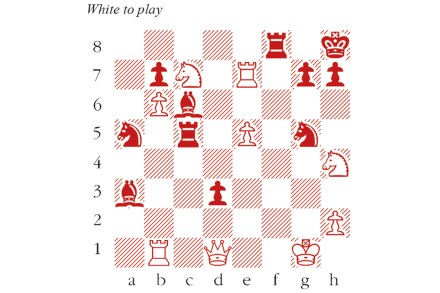
David Hodge is the 2023 British Chess Solving champion, after winning the Winton British Chess Solving Championship in Nottingham last month. Hodge is now a two-time champion, having first won the event in 2019. Above left is a position which caught my eye, taken from the Category B event, which is aimed at less experienced solvers. The problems are slightly less formidable than those in the main event, though still replete with beautiful ideas. This is White to play and mate in 4, composed by Chimedtseren (Probleemblad, 1973). If you don’t want to see the answer, skip forward a couple of paragraphs. One approach is to arrange a mating pattern with Rb3-b1-d1 and Bg2-f1, but that falls short, e.g. 1 Rb1 a4 2 Rd1 Kb5 3 Kb7 h3 4 Bf1+ c4 denies the mate.

First among equals

In recent years, the battle for the number two spot in the world rankings has resembled the gentle undulation of a lava lamp. Players rise and fall, and others take their place. I counted 11 different players who have occupied that spot over the past decade, all while Magnus Carlsen sits at the apex. The world championship match between Ian Nepomniachtchi and Ding Liren, in light of Carlsen’s abdication, had the convenient narrative of being a contest between the world numbers two and three. But neither Nepo nor Ding participated at the elite Norway Chess tournament, which concluded last week, and both were narrowly overtaken in the rating list, thanks to a return to form for two players from the US: Hikaru Nakamura and Fabiano Caruana.

Over the top

One of the quirkier books on my shelf is titled Kingwalks: Paths of Glory (Seirawan & Harper, 2021, Russell Enterprises). King safety is a fundamental imperative for chess – after all, checkmate is the aim of the game – so the exceptions where that instinct is best overridden tend to be rather appealing. Probably the most famous example is the game Short-Timman, from Tilburg 1991, in which England’s future world championship challenger marched his king far into enemy territory to assist with a mating attack. But Kingwalks identifies plenty of other possible motives for these adventures. King evacuations (vertically, or horizontally) in the face of an attack are common, but a king might also run away to prepare an aggressive pawn storm on the wing it has vacated.

English Championship

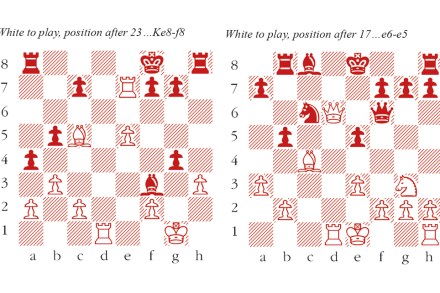
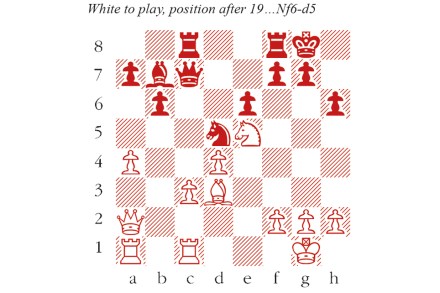
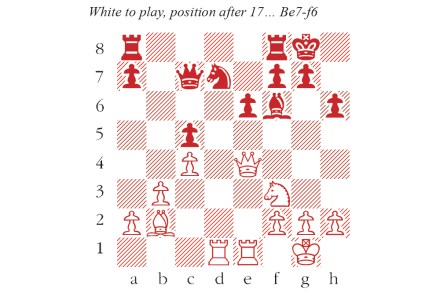
Michael Adams took first place at the Chessable English Championship in Kenilworth last weekend, winning the tournament with 6/7. In the third round, he was on the ropes in the endgame against Mark Hebden, but survived after several unexpected twists. In the diagram position, Adams has two plausible captures available but surprisingly, neither is the best move. Instead 62…Nc4! is best, thanks to the unfortunate situation of White’s knight: 63 Re2+ Kd4 64 Nxa4 Rxa3 65 Nb2 Ra2 and the pin recovers material. Mark Hebden-Michael AdamsEnglish Championship, Kenilworth, May 2023(see left diagram) 62…Rxa3 This move attempts to improve upon 62…Rxc3 63 Rxb2 Rxa3 64 Rb4!

The morning after

Aspirin, a greasy fry-up, even hair of the dog – all are popular options when nursing a hangover. The last thing you would choose to do is play a long game of chess, but that’s exactly the pickle in which Magnus Carlsen found himself during the first round of the 2012 London Chess Classic. The world number one had celebrated his 22nd birthday the night before, but dinner and bowling ‘turned into something else’ as he shared on the Norwegian podcast Sjakksnakk a few weeks ago. Carlsen shambled into a wretched position, but was granted a lifeline after one poor move from his opponent in the middlegame: ‘All of a sudden I felt like my whole hangover just got cured.’ The rejuvenated Carlsen decided it would be ‘epic’ if he managed to win the game.

Four Nations Chess League

The Four Nations Chess League (4NCL) season concluded last month in a resounding victory for Chess.com Manx Liberty. The team from the Isle of Man won all eleven matches, thanks to narrow 4.5-3.5 victories against both of their closest rivals, Chessable White Rose 1 and Cheddleton. On the final weekend, the Manx squad was boosted by the inclusion of veteran elite grandmaster Alexei Shirov, who won the only decisive game in the match against White Rose. Shirov conjured a firestorm of tactics against Jose Camacho Collados, the 2022 Welsh champion who is a lecturer in computer science at Cardiff University. Alexei Shirov (Chess.

Picking up the pieces

Seconds before resigning the decisive game of the world championship, Ian Nepomniachtchi’s hand, trembling with emotion, involuntarily toppled the captured pieces at the side of the board. It was a crushing disappointment to lose a match in which he had taken the lead on three separate occasions, and come agonisingly close to an almost unassailable lead in game 12 (of 14). Days after the match ended, ‘Nepo’ posted a splendidly ambiguous tweet: ‘Although blind chance sometimes decides the fate of a particular game, it can hardly prevent you from becoming the strongest chess player’ – followed by an emoji of a man in the lotus position. I still can’t decide what he meant. Was it a bullish assertion about the future?

Ding wins

Ding Liren from China has become the 17th world champion, defeating the Russian Ian Nepomniachtchi in Astana. The 14-game classical match saw triumph and tragedy on both sides, with six decisive games. But with honours shared at 7-7, the classical world championship was to be decided in a four-game rapid tiebreak, just as it was in 2006, 2012, 2016 and 2018. The first three were drawn, and the fourth game looked bound for the same result, which would have led to a play-off at even faster time limits. But with both players down to their last minutes, Ding took an unexpected decision to prolong the fight instead of acceding to a draw.

Reykjavik Open

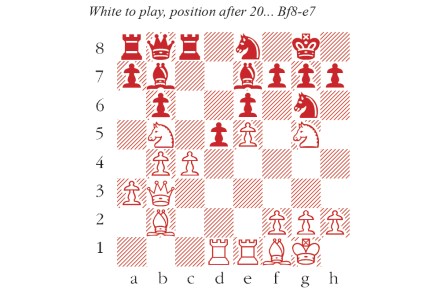
This year’s Reykjavik Open attracted a record turnout of more than 400 players. The Icelanders’ affinity for chess is well established, and the Harpa Conference Centre is a beautiful playing hall looking over the waterfront. At the top of the seedings was Ukrainian luminary Vasyl Ivanchuk, but first place went to the affable Swedish grandmaster Nils Grandelius. He took the lead in the penultimate round. Abhijeet Gupta-Nils GrandeliusReykjavik Open, April 2023 53…Kf4 is tempting, but 54 Nb7 e4 55 Nc5 Bf5 56 Nxe4! secures a draw as the bishop can never force White’s king out from the a1-corner. In what follows, the sacrifice of knight for e-pawn is carefully avoided. 53…Bd5!

Drama in Astana

As I write, six of 14 games of the world championship match between Ian Nepomniachtchi and Ding Liren have been played in Astana, Kazakhstan, with the score tied 3-3. By the time you read this, events will have moved on, so any prognosis would be futile. One ought, so to speak, to wait until the bread has risen. But the games in Astana have been so compelling that a quick peek is irresistible. Four out of six have been decisive – an extraordinary volume of bloodshed by the standards of recent world championships. Initially, Ding looked listless, as if overwhelmed by the occasion. ‘Nepo’ won game two, but by game four Ding had pulled himself together, when an elegant exchange sacrifice helped level the score. Nepomniachtchi looks stronger since his defeat against Carlsen in Dubai.